Showing 30 of 2,310 results · 1.59s
Jan 2025
The Gaming App Insights Report: 2025 Edition
Adjust
Gaming App Insights Report presents a resilient mobile gaming market that rebounded strongly in 2024, projecting global revenue of $126.1 billion for 2025 and a 49% share
Report40 pages
Jan 2024
The State of Gaming 2024: An Analysis of the Current Mobile Gaming Market Trends
Sensor Tower
global mobile gaming market underwent a significant correction in 2023, characterized by a 10% decline in worldwide downloads and a 2% drop in total revenue. This downturn
Report46 pages
Jul 2022
The Rise of Midcore Mobile Games Snapshot Report
GameRefinery
midcore mobile gaming sector is experiencing a significant shift as AAA developers successfully port major PC and console franchises to mobile devices. Between
Report25 pages
Jan 2023
The State of Mobile Gaming 2023: Mobile Gaming Market Trends and Top Titles in the U.S., Europe, and Asia
Sensor Tower
global mobile gaming landscape underwent a significant structural transition in 2022, characterized by a 14% decline in total player spending from its 2021 peak alongside a stabilization
Report68 pages
Jan 2022
Analyzing the Consumer and Market Impacts of Chinese Games Market Policies: China
Newzoo
streamlining the approval process. The market remains dominated by free‑to‑play mobile games, with LiveOps and regular content updates sustaining high retention. In 2021, half
Report29 pages
Jan 2025
Newzoo Hypercasual Mobile Game Genre Report: Eastern vs Western Markets
Newzoo
Hypercasual mobile games represent a significant and evolving segment of the global gaming industry, accounting for 36 of the top 100 downloaded mobile games in 2021. While
Report28 pages
Statistics
Udonis
series of mobile‑gaming performance snapshots, each focused on a single title and dated July 8 2026. For every game—Honor of Kings, Mobile Legends: Bang Bang, Fate/Grand
Article1 pages
Jan 2024
The First Ever Brutally Honest AMA
Brutally Honest, Matej Lancaric
primary objective of this initiative is to establish a recurring, interactive forum for mobile gaming professionals to engage in direct, expert-led discussions regarding industry growth and development
Article1 pages
Jan 2022
Two & a Half Gamers Session #1: Mobile Gaming Predictions 2022
Two & a Half Gamers
mobile gaming landscape in 2022 faces a significant shift as developers grapple with the integration of blockchain technology and the evolving mechanics of play-to-earn models. While
Article
Jan 2025
Maximize Your ROAS: Cutting-Edge Attribution Strategies in Mobile Gaming
Kochava, TikTok for Business
Mobile gaming marketers currently face a critical measurement crisis driven by tightening privacy regulations, increased media fragmentation, and the inherent inaccuracies of traditional Last-Touch Attribution. These factors
Whitepaper26 pages
Direct-to-Consumer: A $17 Billion Market for Mobile Gaming
Appcharge, GDC
mobile gaming industry is undergoing a fundamental structural shift toward direct-to-consumer (DTC) distribution models, a transition that has already established a $17 billion market. By bypassing
Report17 pages
Jan 2023
Mobile Gaming Loyalty Report 2023
Mistplay
Mobile Gaming Loyalty Report examines the drivers of player engagement, retention, and spending across the mobile landscape. By combining a longitudinal benchmark of 500 games with a survey
Report32 pages
Jul 2021
A Rising Market: Southeast Asia
Newzoo
ecosystem is heavily influenced by mobile-centric titles, specifically Mobile Legends: Bang Bang, Garena Free Fire, and PUBG Mobile. These three games accounted for roughly half
Report25 pages
Mar 2018
Gaming Spotlight 2017 Review
App Annie, International Data Corporation
global gaming industry experienced a significant shift in 2017 as mobile gaming solidified its dominance over traditional platforms. Mobile consumer spending exceeded the combined total of home consoles
Report15 pages
Jan 2025
SensorTower Report: Southeast Asia Mobile Game Market Insights 2025
Sensor Tower
SensorTower’s Southeast Asia Mobile Game Market Insights 2025 positions the region as a pivotal growth engine for mobile gaming, with 1.93 billion new installs and $625 million
Report37 pages
Jan 2022
IP-Based Mobile Games: 2022
Newzoo
mobile gaming landscape has shifted toward intellectual property (IP) as a primary strategy for navigating user-tracking challenges like Apple’s App Tracking Transparency. By 2021, nearly
Report39 pages
Jan 2024
Insight into 2024 Marketing Trends for Japanese Mobile Games
SocialPeta
Japanese mobile gaming market is characterized by a conservative but highly specialized marketing landscape, where local companies maintain a dominant revenue position. Analysis of data from 2023 reveals
Report30 pages
Mobile Games
Udonis
provided content serves as a digital repository for mobile gaming industry insights, focusing on marketing strategies, performance analytics, and player behavior trends as of 2026. The primary purpose
Article1 pages
Jun 2024
Mobile Games Annual Investment Report
DDM
mobile gaming investment landscape in 2023 was characterized by a strong concentration of capital within early-stage ventures, with a significant emphasis on blockchain integration and infrastructure. Venture
Report15 pages
Jan 2021
Mobile Game Genre Report: Role-Playing Games 2021
Pangle
Role-playing games represent the most lucrative segment of the global mobile gaming market, generating $18.5 billion in 2020 and accounting for nearly a quarter of all mobile
Report30 pages
Jan 2022
Brutally Honest #40: User Acquisition Trends
Matej Lancaric
Effective user acquisition in the mobile gaming sector requires a diversified multi-channel approach to mitigate risk and maximize reach. Analysis of 2022 market trends indicates that relying
Article
Mar 2026
Top Mobile Game Revenue and Download Trends in January 2026
SocialPeta
mobile gaming landscape in January 2026 was characterized by intense competition, driven by aggressive user acquisition strategies, cross-platform revenue shifts, and the strategic use of intellectual property
Article1 pages
Jun 2022
Two & a Half Gamers Session #21: How to Run Efficient UA on TikTok
Brutally Honest
TikTok, framed within the context of the platform's rapid expansion in the mobile gaming sector. The primary thesis centers on the necessity for mobile game developers
Article1 pages
Jul 2022
Two & a Half Gamers Session #25: Does Ubisoft Give a F! About Mobile Games?
Brutally Honest
traditional portfolio with its mobile-specific initiatives. Key areas of focus include the performance and monetization strategies of mobile subsidiaries such as Kolibri Games, Greenpanda Games
Article1 pages
Jan 2024
Marketing Insights into Global Mobile Games & Minigames in 2024
SocialPeta
show casual games experienced a 3 % YoY drop, while casino titles grew over 10 %. RPGs and puzzle games remained stable. The top twenty global mobile titles
Report21 pages
Sep 2022
Mobile Game Marketing: Insights & Trends of Popular Game Genres Q3 2022
SocialPeta
analysis examines mobile‑game marketing dynamics during the third quarter of 2022, concentrating on the performance of leading genres and the geographic distribution of traffic and revenue
Report109 pages
Dec 2022
Two & a Half Gamers Session #42
Brutally Honest
controversial or sexist advertising tactics in mobile marketing. The scope of the analysis is global, reflecting the international nature of mobile game publishing and UA operations. The methodology
Article1 pages
Jan 2025
The State of Puzzle Games: An Analysis of the Puzzle Category in Mobile Gaming
Sensor Tower, Pathmatics
mobile puzzle game market is undergoing a significant structural evolution, characterized by a shift in product models and a notable rise in hybridcasual gaming. This analysis, covering global
Report23 pages
Jul 2026
Mobile Matters: The Impact of Mobile Games for Europe
King
European mobile games sector functions as a critical pillar of the continent’s digital and creative economy, serving as a primary driver of both technological innovation and employment
Report20 pages
Jan 2018
Mobile Gaming Benchmarks: 2018
GameAnalytics
mobile gaming benchmark study analyzes performance across more than 60 000 titles that each attract at least 1,000 daily users, drawing on data from 850 million monthly
Report48 pages

The Gaming App Insights Report: 2025 Edition
Jan 202540 pages7k words
Summary
The 2025 Gaming App Insights Report presents a resilient mobile gaming market that rebounded strongly in 2024, projecting global revenue of $126.1 billion for 2025 and a 49% share of total gaming revenue, eclipsing console (28%) and PC (23%). AI‑driven personalization, dynamic monetization models, and cross‑platform play emerge as key drivers of higher retention, session length, and in‑app spending, particularly within battle royale and strategy genres. New acquisition channels—TikTok, connected TV, and influencer marketing—are reshaping player discovery, while studios that invest in AI for predictive churn mitigation and long‑term relationship building are positioned to capture the largest growth opportunities, especially as mobile gaming expands into LATAM and MENA regions.
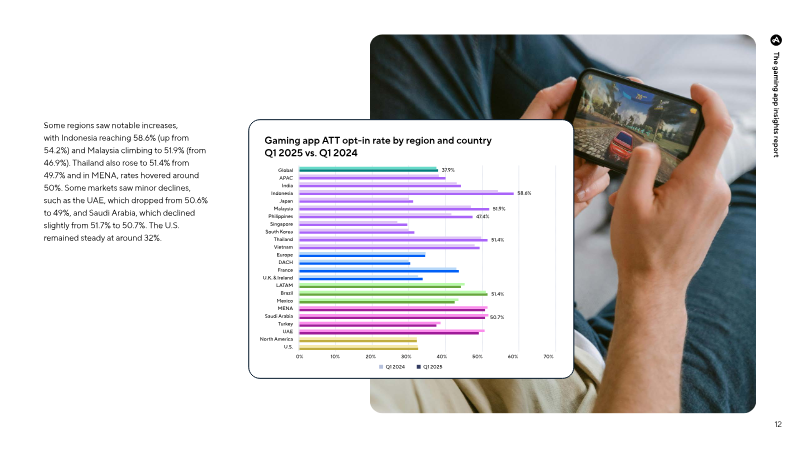
Privacy compliance shows modest improvement, with global ATT opt‑in rates rising to 37.9 % in Q1 2025; arcade titles lead the surge (42.4 → 59.3 %). Regional gains are strongest in Indonesia (58.6 %) and Malaysia (51.9 %), whereas markets such as the UAE, Japan, Saudi Arabia, and the Philippines experienced slight declines. Despite these gains, compliance remains uneven across genres and geographies.
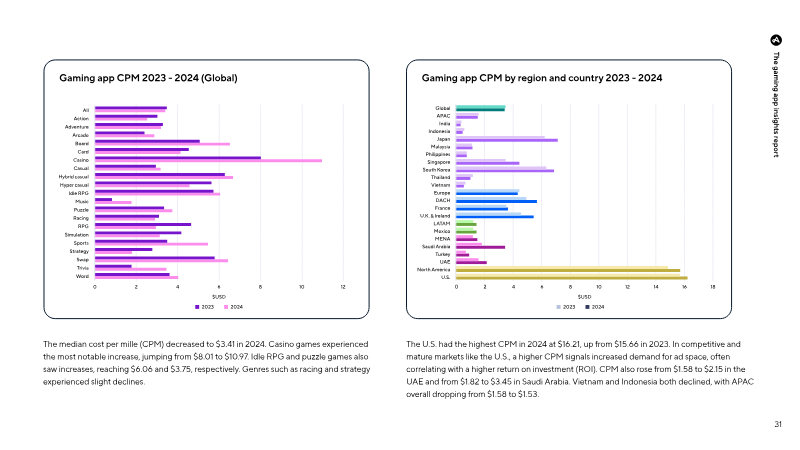
Advertising performance improved in 2024: installs per mille increased from 8.1 to 8.86, click‑through rates rose from 7 % to 9 %, and median cost per install fell slightly (0.38 → 0.36 USD). Median cost per mille dropped to $3.41, indicating more efficient ad spend. However, revenue‑per‑user metrics declined overall—ARPM fell across most categories and ARPMAU dropped from $0.31 to $0.28—though casino and strategy games bucked the trend with higher monetization.
The report concludes that mobile gaming’s next growth wave will hinge on AI‑driven, culturally tailored experimentation and hyper‑personalized user journeys. Precise targeting—through dynamic difficulty, hybrid monetization, and live events—combined with community‑building tactics drives higher lifetime value. Teams that leverage cross‑platform measurement and analytics to iterate on data‑driven decisions will be best positioned to scale and shape the future of mobile gaming.
Pages

Insights
- Mobile gaming is projected to generate $126.1 billion in 2025, capturing 49% of total global gaming revenue compared to console (28%) and PC (23%).
- Global ATT opt-in rates reached 37.9% in Q1 2025, with arcade titles showing significant growth from 42.4% to 59.3%.
- Advertising efficiency improved in 2024 as median cost per install fell from $0.38 to $0.36, while click-through rates increased from 7% to 9%.
- Despite improved ad performance, monetization metrics declined, with average revenue per monthly active user (ARPMAU) falling from $0.31 to $0.28.
- Growth in mobile gaming is shifting toward LATAM and MENA regions, with Indonesia (58.6%) and Malaysia (51.9%) leading in privacy compliance opt-in rates.
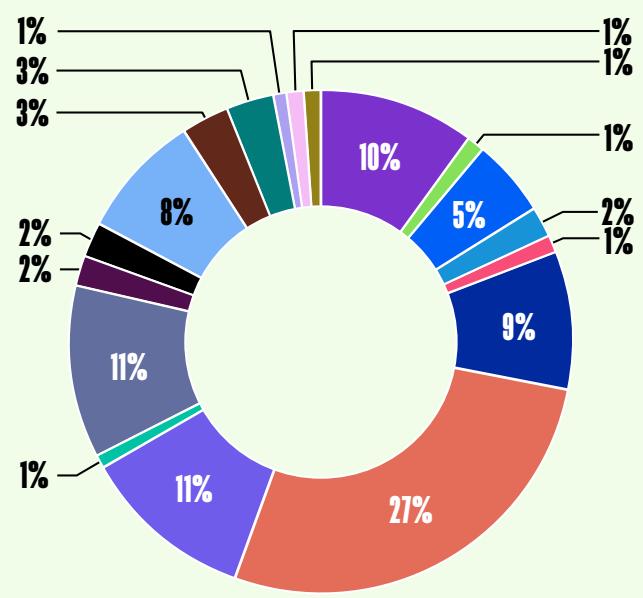
This donut chart illustrates a percentage-based distribution of categories, likely representing market share or genre popularity within the game industry. The data is segmented into various colored portions, with the largest category accounting for 27% and smaller segments ranging from 1% to 11%.