1 free read left. Create a free account for unlimited reading + AI research.
Create free accountReport King
King
1 free read left. Create a free account for unlimited reading + AI research.
Create free accountReportKing
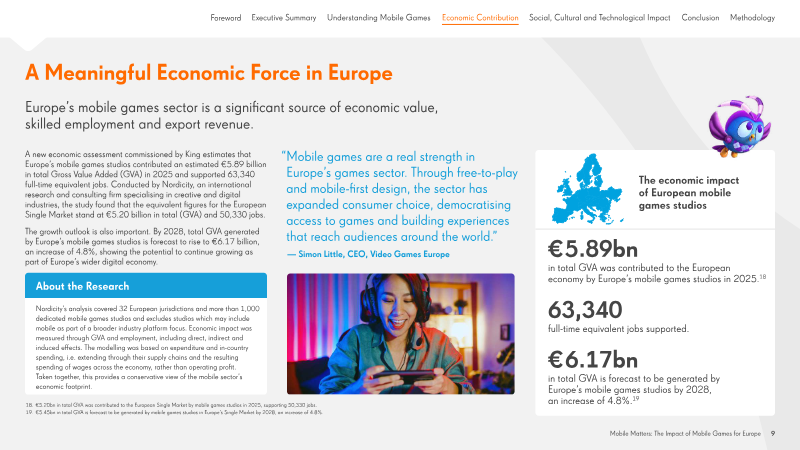
The sector supported 63,340 full-time equivalent jobs across Europe. It functions as a critical pillar of the continent’s digital and creative economy.
The European mobile games sector functions as a critical pillar of the continent’s digital and creative economy, serving as a primary driver of both technological innovation and employment. By leveraging free-to-play models that democratize access to interactive entertainment, the industry has established a robust economic footprint, contributing €5.89 billion in Gross Value Added and supporting over 63,000 jobs as of 2025. This economic influence extends beyond direct financial output, as the sector fosters essential digital skills and advances developments in artificial intelligence, positioning Europe as a competitive global hub for creative talent.
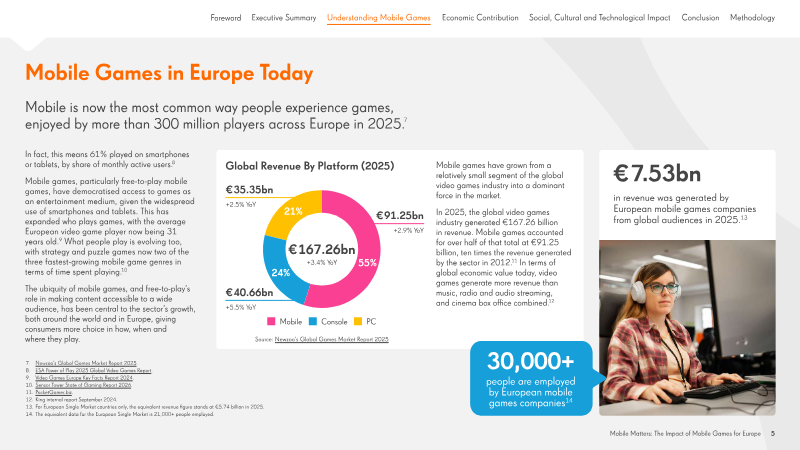
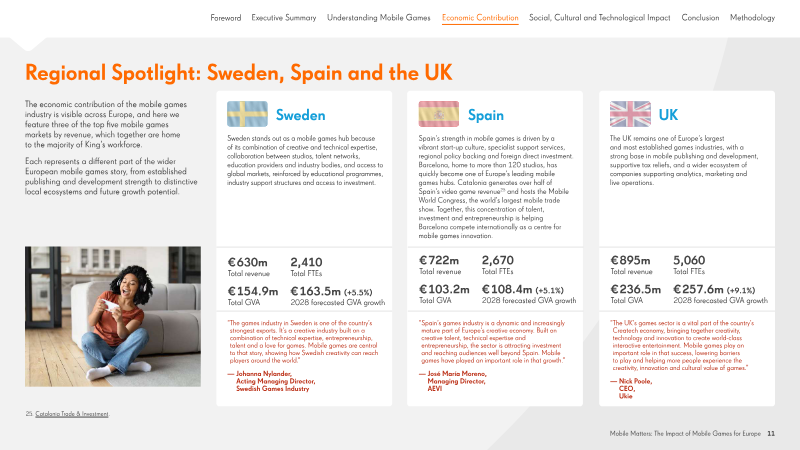
The industry’s reach spans 32 jurisdictions, with key operational centers concentrated in the United Kingdom, Sweden, and Spain. Projections indicate that revenue within the European Single Market will climb to €6.13 billion by 2028, reflecting sustained growth despite intensifying international competition and rising operational expenditures. Beyond commercial performance, the sector increasingly integrates social impact initiatives, utilizing mobile platforms to facilitate advancements in health research and environmental awareness, thereby embedding the industry into the broader societal fabric.
Analytical assessments of this sector rely on a rigorous methodology that prioritizes tangible operational spending over raw revenue figures to ensure a conservative and accurate evaluation of economic contributions. By measuring direct, indirect, and induced impacts across more than 1,170 validated companies, the data underscores the necessity of a stable regulatory environment. To maintain its current trajectory and global competitiveness, the industry requires balanced digital policies that encourage long-term investment, support infrastructure development, and nurture the specialized talent pool essential for continued innovation in an evolving digital landscape.

PocketGamer.biz · 2026

Two & a Half Gamers · 2026

PocketGamer.biz · 2026

Mobilegamer.biz · 2026

Deconstructor of Fun · 2026

Deconstructor of Fun · 2026
PocketGamer.biz · 2026

PocketGamer.biz · 2026
PocketGamer.biz · 2026

PocketGamer.biz · 2026

Mobilegamer.biz · 2026

Deconstructor of Fun · 2026