Showing 30 of 156 results · 0.29s
Jan 2021
Video Games – a Force for Good (2021)
European Games Developer Federation
Agreement to reduce energy consumption. Finally, the report identifies esports as a high-growth segment, with global revenues surpassing $1 billion
Report19 pages
Jul 2020
Esports Versus COVID-19: What Inoculated Competitive Gaming Against the Pandemic
SuperJoost
despite the lack of physical gatherings. For instance, the esports organization Astralis reported an 82% year-over-year revenue increase in 2020, reaching $8.5 million. Strategic acquisitions further
Article
Jan 2024
Italian Esports Report 2024: Market & Streaming Trends
IIDEA – Italian Interactive Digital Entertainment Association
analysis evaluates Italy’s esports ecosystem in 2024, aiming to map its audience composition, revenue structure, and strategic priorities for industry participants. Findings reveal a core fan base
Report33 pages
Leading Esports Teams by Investment Raised
Esports Charts
Cloud9 ($82.8 million), Gen.G ($59.4 million), Fnatic ($55.4 million), Bleed Esports, FaZe Clan, Team SoloMid, G2 Esports, and Dignitas. The analysis highlights that total investment raised does
Article1 pages
Europe and Esports: High Engagement and Even Higher Potential (2020)
PayPal
from 2019, with 33 million classified as “Esports Enthusiasts” and the remaining 59 million as occasional viewers. Revenue projections for the global market hit €973.9 million
Report14 pages
Jan 2020
Level Up: A Guide to Succeed in Asia’s Gaming Market
Newzoo
mobile revenue and all top-grossing titles. While China and Japan lead in total revenue, Japan maintains the highest value per user with an average revenue per download
Report62 pages
Jul 2021
A Rising Market: Southeast Asia
Newzoo
represents a rapidly accelerating segment of the global esports market, characterized by high growth rates in both viewership and revenue. Between 2019 and 2024, the region is projected
Report25 pages
Dec 2025
The Power of Play: Exploring the Growing Gaming Market
Basic Roots Consulting
genres such as hyper‑casual games and esports. RMG now accounts for approximately 82 % of India’s gaming revenue, yet monetization remains weak relative to download volumes; only
Report38 pages
Jul 2018
Forget About Fortnite: Netflix Down, Ubisoft Up, Guerrilla Out
SuperJoost
revenues of $663 million driven by Far Cry 5, while Microsoft’s gaming division saw a 39% revenue increase attributed to third-party strength. Conversely, the mobile esports
Article
Jun 2026
Mobile Legends: Bang Bang Downloads & Player Count
Udonis
dominant force in Southeast Asian mobile esports, boasting 781 million lifetime downloads and $1.58 billion in cumulative IAP revenue as of mid‑2026. Average daily players reach
Article1 pages
Jun 2026
IEM Cologne TikTok Record: PC Esports Needs Platform-Native Broadcasts
Esports Charts
strategic shift: long‑form PC esports must pivot toward platform‑native broadcasts to maximize reach, engagement, and revenue in an increasingly mobile‑centric market
Article1 pages
May 2025
Press Start on Growth: Unlocking the Full Potential of the UK Video Games Industry
Ukie
contracted 15 % after pandemic‑related cancellations, whereas esports surged 44 % YoY, driven by a rise in UK‑based tournaments. Subscription revenue rose modestly as price hikes offset
Report2 pages
Jan 2020
Gamer Mom: Cross-Stitching Meets 8-Bit Graphics
SuperJoost
irrational exuberance" in certain sectors. The esports market faces volatility due to falling share prices and platform struggles with ad revenue, casting doubt on aggressive multi-billion dollar
Article
Jan 2021
Guida agli Esports: Italia
IIDEA – Italian Interactive Digital Entertainment Association
analysis positions esports as a rapidly expanding digital sport that, in 2021, generated $947.1 million in revenue and attracted more than 215 million fans worldwide, with total direct
Report35 pages
Annual Report 2024: Savvy Games Group
Savvy Games Group
currently ranking eighth worldwide by net revenue. The organization serves as the primary vehicle for Saudi Arabia’s National Gaming and Esports Strategy, which seeks to generate
Report62 pages
Jan 2024
Live Streaming Trends Annual Report 2024
Stream Hatchet
larger share of the competitive esports market. Emerging platforms like Kick have successfully disrupted traditional market shares by offering aggressive revenue splits, leading to a more fragmented
Report54 pages
Jan 2024
East Asia Gaming Markets Target $30.8 Billion Mark by 2027
PocketGamer.biz
bolstered by the popularity of esports, with titles like League of Legends driving significant engagement. While Japan and Korea lead in revenue and player volume, Chinese Taipei exhibits
Article1 pages
Jan 2022
Southeast Asia’s Games Market
Niko Partners
total Asian games revenue, the region is projected to maintain a compound annual growth rate of 8.6% through 2025. Esports serves as a primary driver for this growth
Report4 pages
Jan 2022
Türkiye Game Market 2022 Report
Riot Games
contraction in total revenue to $625 million, the industry solidified its position as a major global hub for mobile development and esports. The primary thesis of the market
Report230 pages
Jan 2024
The AI Companions and Algorithmic Symphonies in Games: Play Less for More
Lu Weiming
defined by three primary revenue models: stats-based advantages common in strategy games, cosmetic and content-based purchases prevalent in esports and casual titles, and subscription-based perks
Article
Jan 2023
The MENA Games Market: From Sand to Stardom
Niko Partners
generated $1.8 billion in revenue and supported 67.4 million gamers. This growth is underpinned by a strong mobile-first ecosystem and a burgeoning esports sector that benefits from
Report25 pages
Jul 2018
Overwatch League Finals Report
SuperJoost
current state of the esports industry, demonstrating that high-budget, publisher-led competitive gaming can successfully cultivate a dedicated fanbase and diversify revenue streams. While the event showcased
Article
May 2020
In-Game Banner Ads 2.0: Democratization of an Art Form, or a Poor Player's Tax?
SuperJoost
within League of Legends esports broadcasts. This move by Riot Games signals the professionalization of in-game advertising, positioning it as a viable revenue stream to capture pent
Article
Jun 2026
TMGM Enters Esports Through OG Partnership
The Esports Advocate
Nets. For OG Esports, the deal follows a recent trend of securing partnerships within the finance and betting sectors, further diversifying its commercial revenue streams. TMGM, founded
Article1 pages
Jul 2026
The Esports Generation: Who They Are, and Why They Spend
Niko Partners
global esports industry has matured into a significant economic force, reaching an estimated 640 million fans and generating $3 billion in annual revenue by 2026. This ecosystem functions
Whitepaper23 pages
Jul 2026
Saudi Arabia, EA and Digital Sport's Soft Power
Video Games Industry Memo
focus on core revenue drivers like sports titles, service-based shooters, and The Sims. The acquisition aligns with Saudi Arabia’s national gaming and esports strategy, which aims
Article1 pages
Jan 2025
The Global State of Game Publishing & Marketing 2025 Industry Report
Game Publishing & Marketing Summit
services and the esports sector. Subscriptions are expected to reach 318 million active users and a $21.6 billion valuation by 2030, while the esports market is projected
Report46 pages
Nov 2022
Analyzing the Consumer and Market Impacts of Chinese Games Market Policies
Newzoo
revenue for major firms like Tencent and NetEase, these regulations threaten long-term market growth by reducing the future pipeline of engaged players and esports talent. The administrative
Report29 pages
Jan 2023
Gametech Report Q1 2023: Global & MENAP Outlook
Shorooq Partners
esports expansion. Mobile‑first development dominates, with 70 % of developers prioritising data analytics and 50 % investing in AI tools. In‑app purchases, advertising and subscriptions drive revenue, with
Report98 pages
Dec 2025
Esports 2023: Challenges and Opportunities in the UK
British Esports, Ukie
revenue streams but require regulatory clarity and infrastructure investment. Coordinated action across stakeholders is essential to unlock the UK’s full economic and cultural potential in esports
Report46 pages

Video Games – a Force for Good (2021)
European Games Developer Federation
Jan 202119 pages5k words
Summary
The 2021 Key Facts report, a joint publication by ISFE and EGDF, provides a comprehensive analysis of the European video game industry’s market performance, player demographics, and social impact. Covering the 2021 calendar year with comparative data from 2020, the report focuses on the European Union and broader European markets, including the United Kingdom. Data is derived from Ipsos, GameTrack, and Games Sales Data (GSD), utilizing surveys and retail tracking across more than 20 European nations.
The findings indicate a stable market valued at €23.3 billion, maintaining the significant revenue gains achieved during the 2020 pandemic lockdowns. While the total number of players grew by 6% to reach 52% of the European population, average weekly playtime decreased to 9 hours, returning to pre-pandemic levels. The digital ecosystem dominates the sector, accounting for 81% of total revenue, driven largely by app-based gaming and in-game extras. Demographically, the average player age is 31.3 years, and women represent nearly 48% of the total player base.
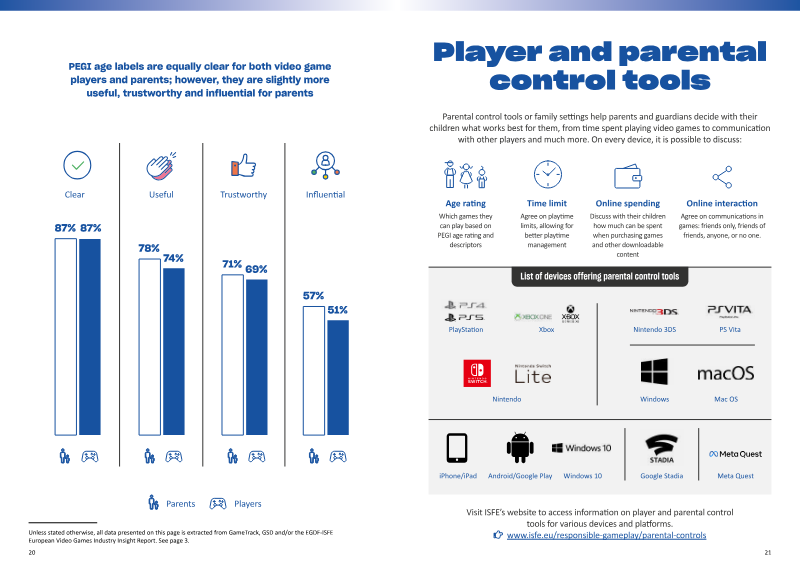
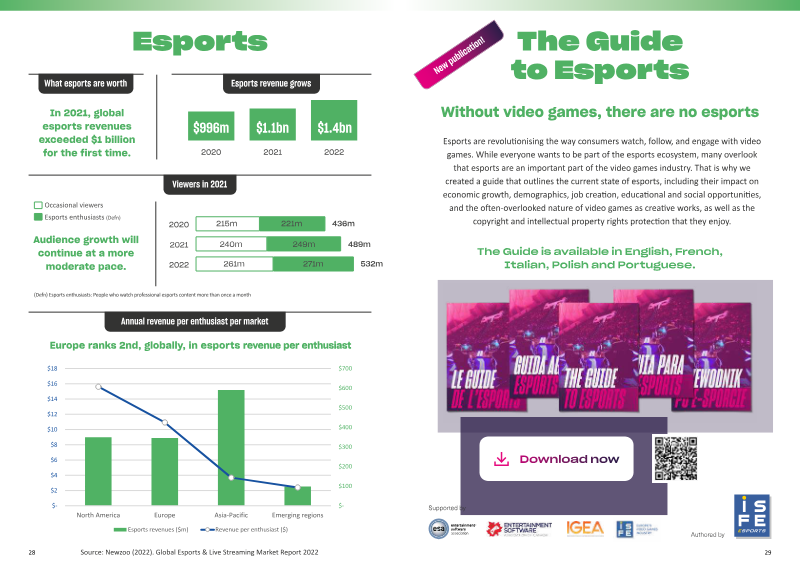
Beyond economic metrics, the report emphasizes the industry’s commitment to social responsibility and sustainability. It highlights the widespread adoption of the PEGI age rating system and the effectiveness of parental control tools, noting a significant decrease in unauthorized in-game spending by minors. The document also outlines industry-wide initiatives to improve workforce diversity, where women currently make up 22% of employees, and details environmental efforts such as the Green Game Jam and the Games Consoles Voluntary Agreement to reduce energy consumption. Finally, the report identifies esports as a high-growth segment, with global revenues surpassing $1 billion in 2021.
Pages



Insights
- The European video game market maintained a stable valuation of €23.3 billion in 2021, successfully sustaining the revenue gains achieved during the 2020 pandemic.
- Digital sales dominate the industry, accounting for 81% of total revenue, with growth primarily driven by app-based gaming and in-game purchases.
- The European player base grew by 6% in 2021 to encompass 52% of the total population, with an average player age of 31.3 years and a gender split of 48% women.
- Average weekly playtime dropped to 9 hours in 2021, signaling a return to pre-pandemic engagement levels despite the increase in total player count.
- Esports emerged as a high-growth sector, with global revenues exceeding $1 billion during the 2021 calendar year.
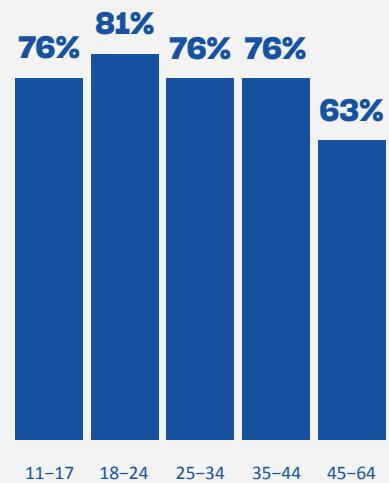
This bar chart from a game industry report illustrates the percentage of people who play video games across different age groups. It shows that gaming participation is highest among younger adults (18-24) at 81%, and gradually decreases with age, reaching 63% for those aged 45-64.