Showing 30 of 406 results · 0.65s
Consolidated Financial Results: Q1 FY2026
Sony Group Corporation
previous year. The company’s diverse portfolio showed varied performance, with the Game and Network Services segment maintaining steady sales while achieving a significant 54.1 billion yen increase
Financial20 pages
Jan 2011
Financial Highlights for the 1st Half of Fiscal Year Ending March 2011 (FY2010)
Koei Tecmo
deepening the deficits recorded during the first half of fiscal year 2009. The game software segment, the company’s largest division, was the primary driver of this decline
Financial1 pages
Nexon 2026 Capital Markets Briefing: Transformation Plan
NEXON Co.
audience by modernizing its development workflows. By utilizing AI to provide context for game design and live service support, the company aims to empower developers rather than replace
Financial3 pages
Jun 2005
NetEase.com, Inc. Form 20‑F (FY2004)
NetEase
million, driven primarily by a 192.4 % jump in online‑game income (RMB 594.3 million) and an 81.6 % rise in advertising services (RMB 156.5 million). Gross profit climbed
Financial1 pages
WEBTOON Entertainment Inc. Reports Second Quarter 2026 Financial Results
WEBTOON Entertainment
ownership and investment, exemplified by a new strategic agreement with RI Games Holdings Inc. to develop gaming content from its existing webcomic library. The company’s outlook
Financial7 pages
Jan 2024
Team17 Group PLC Annual Report and Accounts 2023
Team17
cash impairment charges, largely related to goodwill write-downs for the mobile-focused Team17 USA and underperforming development costs. In response to these challenges and rising operational risks
Financial59 pages
Sep 2013
Namco Bandai Holdings Annual Report 2013
Bandai Namco
financial results, underscoring an IP‑Axis strategy that leveraged legacy brands across toys, games and multimedia. Consolidated net sales reached ¥487.2 billion, a 7.3 % increase year‑on‑year
Financial70 pages
Jan 2015
Financial Highlights for the Fiscal Year Ending March 2015 (FY2014)
Koei Tecmo
business activities and improved operational efficiency across the company’s core segments. The game software division remains the primary driver of financial performance, contributing 24.9 billion
Financial2 pages
Annual Report 2019: Tencent Holdings Limited
Tencent
over‑year growth respectively. The group’s core digital ecosystem—encompassing WeChat, online gaming, and value‑added services—continued to expand, with monthly active users reaching 1.16 billion
Financial274 pages
Oct 2019
Financial Results for the First Half of the Fiscal Year Ending March 2020
Koei Tecmo
console title aimed at selling five million units and a top-tier mobile title capable of generating ¥1 billion in monthly revenue. With a pipeline featuring high-profile
Financial28 pages
Aug 2021
Form 10-Q: Q2 2021
AppLovin
diversified business model split between business-to-business software solutions and consumer-facing mobile applications. The IPO provided $1.75 billion in net proceeds, which the company utilized
Financial1 pages
Jan 2014
Fiscal Year Ending March 2015: 1st Half Financial Results
Koei Tecmo
hardware platforms, the expansion of the download business, and high-performing social games. The game software segment remains the primary revenue driver, contributing 9.87 billion yen in sales
Financial32 pages
Aug 2019
IGG Inc. 2019 Interim Report
IGG
During the first half of 2019, the global gaming market experienced a period of transition characterized by the natural stabilization of long-standing flagship titles. Revenue reached
Financial73 pages
Sep 2017
Bandai Namco Group Integrated Report 2017
Bandai Namco
axis” strategy in achieving record results. By leveraging core intellectual properties across games, toys, visual media, and music, the group generated ¥620.1 billion in net sales
Financial92 pages
Jan 2018
Summary of Main Questions and Answers: FY2018 Third Quarter Results Briefing
GREE
Games to diversify distribution channels and reach broader audiences. Operational efficiency is being addressed through Funplex, which focuses on the specialized management and operation of existing game titles
Financial4 pages
Jan 2014
Fiscal Year Ending March 2015 Financial Results
Koei Tecmo
billion, a success attributed to the robust performance of the Online and Mobile segment and high-profile intellectual property collaborations such as Dragon Quest Heroes. This period
Financial38 pages
Feb 2017
Summary of Financial Results for Fiscal Year Ending December 31, 2016 (Japanese GAAP) (Consolidated)
KLab
billion yen and operating activities generating 1.55 billion yen in net cash. The Game Business remains the central pillar of operations, accounting for 19.3 billion yen of total
Financial22 pages
Feb 2025
Games Investment Review: Q4 2024 Executive Summary Report
DDM, Digital Development Management
Games Investment Review provides a comprehensive analysis of financial activity within the global video game industry, focusing on the second quarter (Q2) and first half
Financial17 pages
Jun 2015
Annual Report of 11 bit studios S.A. for 2014
11 bit studios
Beyond internal game development, the company diversified its revenue streams by launching the "11 bit launchpad" publishing initiative and the "Games Republic" digital distribution platform. While these
Financial67 pages
Jul 2013
Square Enix Annual Report FY2013
Square Enix
long development cycles and low investment turnover in the console space. Conversely, social gaming and digital publications showed resilience. The Amusement division also struggled, posting an operating loss
Financial70 pages
Feb 2026
Take-Two Interactive Q3 Fiscal Year 2026 Conference Call
Take-Two Interactive
reached $1.76 billion, driven by the outperformance of core franchises across the Rockstar Games, 2K, and Zynga labels. Recurrent consumer spending, a critical metric for the company
Financial6 pages
Jan 2025
Video Game Market Update: Q1 2025
Aream & Co
quarterly briefing delivers a concise assessment of the global gaming ecosystem during the first quarter of 2025, emphasizing activity trends, revenue dynamics, and merger‑and‑acquisition
Financial37 pages
May 2024
GDE 1Q 2024 Financial Results
GDEU
This financial presentation details the unaudited operational and financial performance of a gaming company for the first quarter of 2024, providing comparative data against the same periods
Financial11 pages
Oct 2025
Consolidated Quarterly Data Appendix: FY2025 3rd Quarter
Koei Tecmo
sales accounting for 36.1% of total revenue and a significant 75.9% of total game units sold. Digital transformation remains a key trend for the firm, as evidenced
Financial8 pages
Nov 2018
Summary of Financial Results for Third Quarter of Fiscal Year Ending December 31, 2018 (Japanese GAAP)
KLab
advertising spend. Geographically focused on the Japanese market with global reach through its mobile titles, KLab revised its full-year 2018 forecasts to 31.5 billion yen in revenue
Financial12 pages
Sep 2019
Bandai Namco Group Fact Book 2019
Bandai Namco
ventures to their convergence in the 1990s, when both firms diversified into video games, publishing, and media. Landmark products such as Astro Boy, Gundam model kits
Financial27 pages
Nov 2021
Electronic Arts 10-Q: Q2 Fiscal Year 2022
Electronic Arts
growth strategy. Key acquisitions—Codemasters ($1.2 billion), Glu Mobile ($2.0 billion) and Playdemic ($1.4 billion)—expanded EA’s racing, mobile and live‑service portfolios, increasing goodwill
Financial1 pages
Feb 2020
SciPlay 10-K — FY2019 (February 2020)
SciPlay
million, driven primarily by virtual‑currency sales in its flagship mobile titles such as Jackpot Party Casino and MONOPOLY Slots. Operating expenses increased modestly, while a reduction
Financial1 pages
Jan 2022
FY2022 Annual Presentation Materials
Koei Tecmo
Hearts, Wo Long: Fallen Dynasty, Atelier Ryza 3, and Winning Post 10, alongside mobile offerings like Blue Reflection Sun and Dragon Quest Champions. A significant component
Financial38 pages
May 2019
Quarterly Report of 11 bit studios S.A. for Q1 2019
11 bit studios
million per project and targeting a release cadence of one proprietary game per year, the company aims to stabilize long-term returns. Operational scaling is evident
Financial27 pages
Consolidated Financial Results: Q1 FY2026
20 pages4k words
Summary
Sony Group Corporation’s consolidated financial results for the first quarter of fiscal year 2026, ending June 30, 2026, demonstrate strong growth across key business segments. The company reported quarterly sales of 2,837.8 billion yen, an 8% increase year-on-year, and operating income of 476.5 billion yen, representing a 40% surge. This performance was primarily driven by robust results in the Imaging and Sensing Solutions and Music segments. Net income attributable to stockholders reached 342.2 billion yen, a 32% improvement compared to the same period in the previous year.
The company’s diverse portfolio showed varied performance, with the Game and Network Services segment maintaining steady sales while achieving a significant 54.1 billion yen increase in operating income. The Imaging and Sensing Solutions segment saw a 26% rise in sales, bolstered by improved product mix and increased demand for mobile image sensors. Conversely, the Pictures segment experienced a slight decline in sales, though it maintained profitability. These results reflect the impact of foreign exchange fluctuations, which generally provided a tailwind for the company’s yen-denominated reporting.
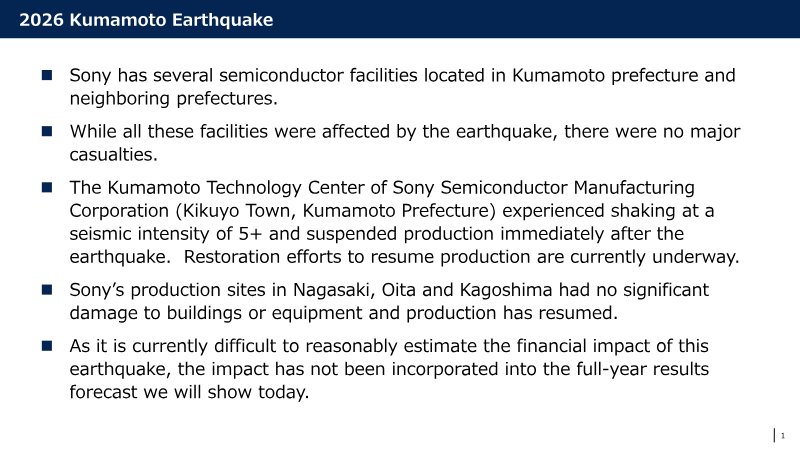
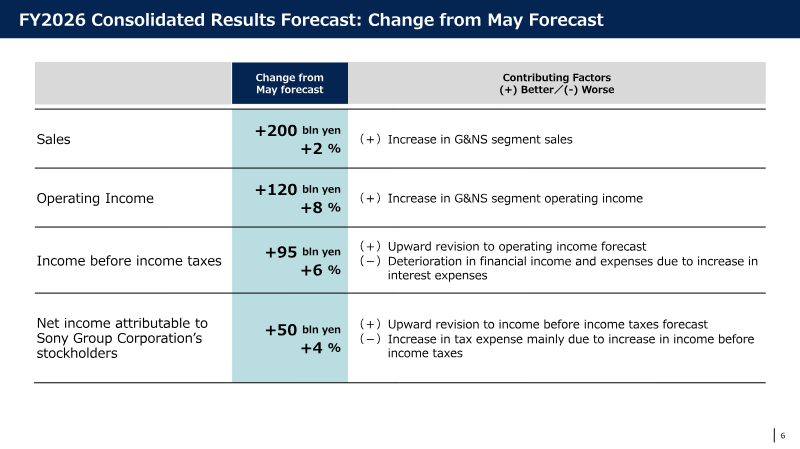
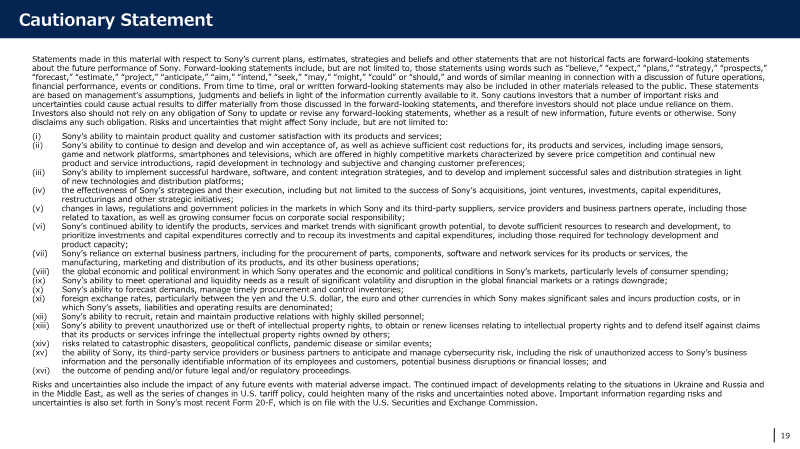
Looking ahead, Sony has upwardly revised its full-year fiscal 2026 forecast, now projecting consolidated sales of 12,500 billion yen and operating income of 1,720 billion yen. These projections account for anticipated gains in the Game and Network Services and Music segments. However, the company noted that these forecasts do not currently incorporate the potential financial impact of the July 2026 Kumamoto Earthquake. While production at the Kumamoto Technology Center was temporarily suspended due to the seismic event, other facilities in Nagasaki, Oita, and Kagoshima remained operational. Management continues to monitor the situation, emphasizing that the full extent of the earthquake's impact on operations and supply chains remains difficult to estimate at this time.
Pages
Insights
- Sony reported Q1 FY2026 consolidated sales of 2,837.8 billion yen (up 8% YoY) and operating income of 476.5 billion yen (up 40% YoY).
- Net income for the quarter reached 342.2 billion yen, marking a 32% improvement compared to the same period last year.
- The Game and Network Services segment achieved a significant 54.1 billion yen increase in operating income despite maintaining steady sales.
- The Imaging and Sensing Solutions segment drove growth with a 26% rise in sales, fueled by increased demand for mobile image sensors and a favorable product mix.
- Sony upwardly revised its full-year FY2026 forecast to 12,500 billion yen in sales and 1,720 billion yen in operating income.
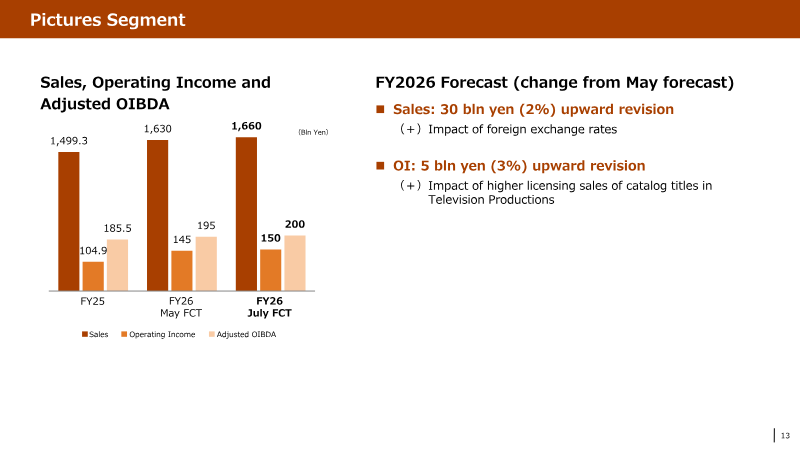
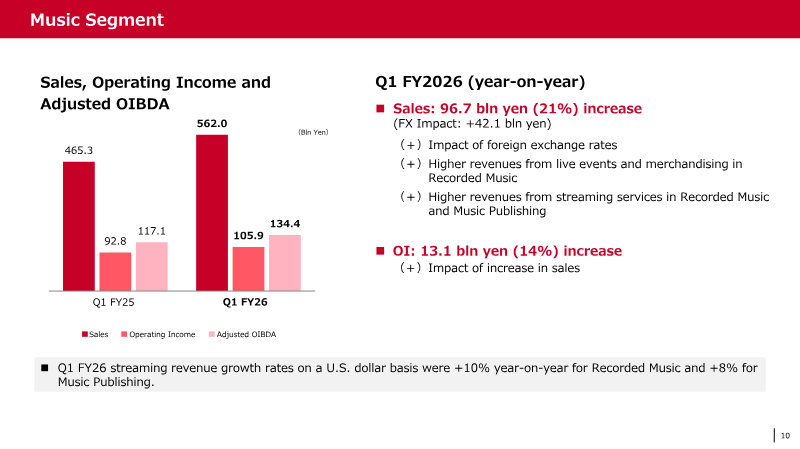
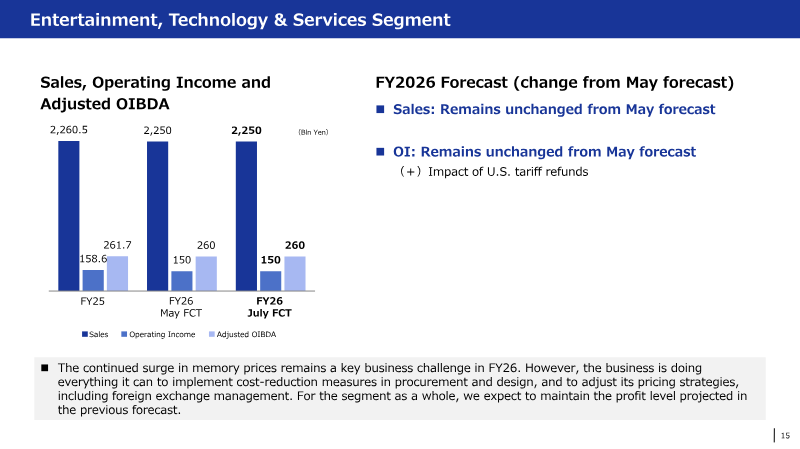
Sales, Operating Income and Adjusted OIBDA