Updated Mar 21, 2026 by Square Enix
Financial · July 1, 2013
Published by Square Enix
Square Enix experienced a period of severe financial volatility during the fiscal year ended March 31, 2013, reporting its first operating loss since the 2003 merger. Despite a 15.7% increase in net sales to ¥147,981 million, the company recorded a substantial net loss of ¥13,714 million. This downturn was primarily driven by a structural crisis in the high-definition (HD) games category, where major Western titles such as Tomb Raider and Hitman: Absolution failed to meet sales targets amid intense competition and high retail promotion costs. Furthermore, the company incurred ¥11,210 million in extraordinary losses related to the disposal and revaluation of game content as part of a major organizational restructuring. The financial results highlight a widening gap between traditional and emerging business models. While the Digital Entertainment segment remained the primary revenue driver, particularly in the Japanese market, it was hampered by long development cycles and low investment turnover in the console space. Conversely, social gaming and digital publications showed resilience. The Amusement division also struggled, posting an operating loss due to weak arcade machine sales. To mitigate these challenges, management initiated a strategic pivot toward a "unified system" emphasizing digital distribution, free-to-play models, and tablet development. This shift includes leveraging global IPs across multi-device environments and expanding the use of "meta-narratives" to engage customers. Geographically, Japan remains the company's strongest market, though significant resources are being directed toward overseas expansion and the establishment of new studios, such as in Montreal, to bridge the gap between HD production and mobile platforms. Despite the net loss and a 98.4% drop in net cash from operating activities, the company maintained a stable liquidity position with ¥98,822 million in cash and cash equivalents. Moving forward, the strategy focuses on network-compliant entertainment and region-specific content portfolios to adapt to a rapidly evolving global gaming landscape.

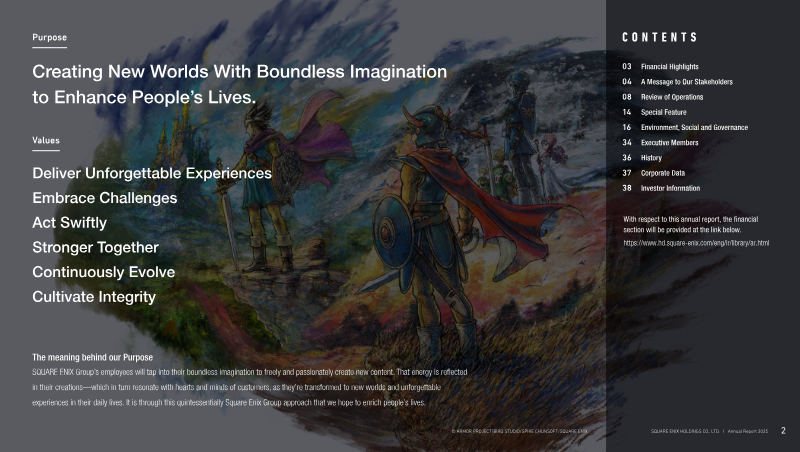
C o r p o r a t e P h i l o s o p h y This philosophy represents our company's mission and the beliefs for which we stand. To spread happiness across the globe by providing unforgettable experiences This philosophy represents our company’s mission and the beliefs for which we stand. The Square Enix Group provides high-quality content, services, and products to help those customers create their own wonderful, Each of our customers has his or her own definition of happiness. The Square Enix Group provides high-quality content, services, and products to help those customers create their own wonderful, unforgettable experiences, thereby allowing them to discover a happiness all their own. Management Guidelines M a n a g e m e n t G u i d e l i n e s These guidelines reflect the foundation of principles upon which our corporate philosophy stands, and serve as a standard of value These guidelines reflect the foundation of principles upon which our corporate philosophy stands, and serve as a standard of value for the Group and its members. We shall strive to achieve our corporate goals while closely considering the following: 1. Professionalism 1. Professionalism We shall exhibit a high degree of professionalism, ensuring optimum results in the workplace. We shall display initiative, make continued efforts to further develop our expertise, and remain sincere and steadfast in the pursuit of our goals, while ultimately aspiring to forge a corporate culture disciplined by the pride we hold in our work.
alism, ensuring optimum results in the workplace. We shall display initiative, make continued efforts to further develop our expertise, and remain sincere and steadfast in the pursuit of our goals, while ultimately aspiring to forge a corporate culture disciplined by the pride we hold in our work. 2. Creativity and Innovation 2. Creativity and Innovation To attain and maintain new standards of value, there are questions we must ask ourselves: Is this creative? Is this innovative? Mediocre dedication can only result in mediocre achievements. Simply being content with the status quo can only lead to a collapse into oblivion. To prevent this from occurring and to avoid complacency, we must continue asking ourselves the aforementioned questions. 3. Harmony Everything in the world interacts to form a massive system. Nothing can stand alone. Everything functions with an inevitable accord to reason. It is vital to gain a proper understanding of the constantly changing tides, and to take advantage of these variations instead of struggling against them. We shall continue to work towards harmony and serve as an integral part of this ever-fluctuating system.
s with an inevitable accord to reason. It is vital to gain a proper understanding of the constantly changing tides, and to take advantage of these variations instead of struggling against them. We shall continue to work towards harmony and serve as an integral part of this ever-fluctuating system. In order to achieve ideal performance levels, we as individuals, shall aim for a mutual respect amongst our coworkers, remain conscious of the duties assigned us, and place an emphasis on teamwork. As a corporate organization, we shall work diligently to maintain an optimal balance culminating in the ultimate satisfaction of all our stakeholders, including customers, shareholders, counterparties, and employees. As a business entity, we shall contemplate what functions we are to perform within the realm of industry, while acting in a manner that ensures the mutual harmony and benefit of all parties within it. Finally, as a member of society, we shall comply with laws and regulations while fulfilling our civic obligations, including community involvement and environmental conservation. involvement and environmental conservation.
anner that ensures the mutual harmony and benefit of all parties within it. Finally, as a member of society, we shall comply with laws and regulations while fulfilling our civic obligations, including community involvement and environmental conservation. involvement and environmental conservation. CONTENTS Disclaimer Regarding Forward-Looking Statements Statements in this annual report with respect to the current plans, estimates, strategy, 01 Financial Highlights and beliefs of SQUARE ENIX HOLDINGS CO., LTD., and consolidated subsidiaries [collectively ”SQUARE ENIX HOLDINGS”] include both historical facts and forward- 02 To Our Shareholders looking statements concerning the future performance of SQUARE ENIX HOLDINGS. Such information is based on management’s assumptions and beliefs in light 08 Directors and Auditors of the information currently available and, therefore, involve risks and uncertainties. 02 To Our Shareholders Actual results may differ materially from those anticipated in these statements due to 09 Message from New Directors the influence of a number of important factors. 08 Directors and Auditors Such factors include but are not limited to: [1] general economic conditions in 10 Review of Operations Japan and foreign countries, in particular levels of consumer spending; [2] fluctuations in exchange rates, in particular the exchange rate of the Japanese yen in relation to 14 Creator’s Voice the U.S.
ctors include but are not limited to: [1] general economic conditions in 10 Review of Operations Japan and foreign countries, in particular levels of consumer spending; [2] fluctuations in exchange rates, in particular the exchange rate of the Japanese yen in relation to 14 Creator’s Voice the U.S. dollar, the euro and others, which SQUARE ENIX HOLDINGS uses extensively in its overseas business; [3] the continuous introduction of new products and rapid 20 Corporate Governance technical innovation in the digital entertainment industry as well as SQUARE ENIX HOLDINGS’s ability to continue developing products and services accepted by 26 Financial Section consumers in the intensely competitive market, which is heavily influenced by subjective and quickly changing consumer preferences. 66 Corporate Data technical innovation in the digital entertainment industry as well as SQUARE ENIX 67 Investor Information HOLDINGS's ability to continue developing products and services accepted by 66 Corporate Data and quickly changing consumer preferences
SQUARE ENIX HOLDINGS CO., LTD. and Consolidated Subsidiaries F i n a n c i a l H i g h l i g h t s SQUARE ENIX HOLDINGS CO.‚ LTD. and Consolidated Subsidiaries Years ended March 31 Thousands of Millions of Yen U.S. Dollars 2009 2010 2011 2012 Millions 2013 Thousands of of Yen U.S. Dollars For the Year 2009 2010 2011 2012 2013 2013 For the Year ¥ 135,693 192,257 ¥ 125,271 127,896 147,981 $1,573,437 Net sales ¥ 135,693 ¥ 192,257 ¥ 125,271 ¥ 127,896 ¥ 147,981 $1,573,437 Operating income (loss) 12,277 28,235 7,325 10,713 (6,081) (64,667) Recurring income (loss) 11,261 27,822 5,390 10,297 (4,378) (46,552) Net income (loss) 6,333 9,509 (12,043) 6,060 (13,714) (145,825) At Year-end ¥ 213,194 270,529 ¥ 206,336 ¥ 213,981 202,509 $2,153,207 Total assets Total assets ¥ 213,194 148,724 ¥ 270,529 154,258 ¥ 206,336 135,143 ¥ 213,981 137,297 ¥ 202,509 121,636 $2,153,207 Total net assets 1,293,321 Total net assets 148,724 154,258 135,143 137,297 121,636 1,293,321 Yen Yen U.S. Dollars Per Share of Common Stock Per Share of Common Stock Net income (loss) ¥ 55.11 ¥ 82.65 ¥ (104.66) ¥ 52.66 ¥ (119.19) $ (1.27) Total net assets 1,280.92 1,326.82 1,160.66 1,177.87 1,043.62 11.00
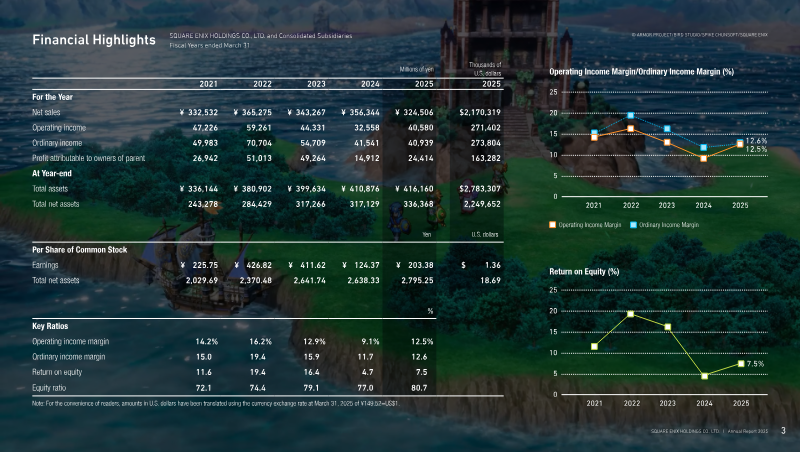
Square Enix’s 2023 fiscal year, ending March 31, 2023, marks a period of significant structural transformation and strategic pivot under the leadership of new President Takashi Kiryu. The primary thesis of this period centers on optimizing the corporate portfolio by divesting Western studios and reallocating resources toward internal development and emerging technologies. This shift is punctuated by the ¥9.5 billion gain from the sale of Crystal Dynamics and Eidos Interactive to the Embracer Group, a move designed to streamline operations and fund expansion into blockchain, AI, and cloud computing. Financial performance for the 2023 fiscal year showed a contraction compared to the previous year’s record highs. Net sales fell 6.0% to ¥343.3 billion, while operating income dropped 25.2% to ¥44.3 billion. This decline was largely attributed to the Digital Entertainment segment, which suffered from a lack of major expansion packs for *Final Fantasy XIV* and underperforming new titles in the HD and mobile sub-segments. Conversely, the Amusement segment provided a resilient offset, seeing a 22.9% increase in sales as the Japanese market recovered from pandemic-related restrictions. Despite the dip in annual earnings, the company maintains a robust financial position with an equity ratio of 79.1% and cash reserves totaling ¥190.9 billion. The geographic scope remains centered on Japan, which accounts for ¥225.7 billion of total sales, though the company continues to manage a global footprint with cumulative sales for the *Final Fantasy* and *Dragon Quest* franchises reaching 185 million and 88 million units, respectively. Looking ahead, the strategy emphasizes building a stable recurring income base from MMOs to support high-cost HD development. Forecasts for fiscal year 2024 project a recovery, with net sales expected to reach ¥360 billion, driven by a refined title portfolio and continued institutional focus on human capital and sustainable governance.
Square Enix achieved a significant financial recovery during the fiscal year ended March 31, 2014, returning to profitability with a net income of ¥6.5 billion following substantial losses the previous year. Net sales rose to ¥155 billion, driven primarily by the Digital Entertainment segment, which generated over ¥94 billion in revenue. This turnaround was fueled by the successful relaunch of Final Fantasy XIV: A Realm Reborn, strong performance from high-definition remasters, and the rapid growth of mobile titles such as Dragon Quest Monsters Super Light. While the Amusement and Merchandising segments also saw improved profitability, the Publication segment experienced a decline due to a reduction in new comic releases. The strategic focus shifted toward a digital-first business model, emphasizing variable pricing, cloud gaming, and shorter development cycles to mitigate the risks associated with traditional console disc distribution. Management prioritized regional specialization, particularly in the JRPG genre, while aggressively expanding into high-growth mobile markets in China, India, and South America. Despite a ¥1.7 billion extraordinary loss from a review of work-in-progress content and significant inventory write-downs, the company maintained a strong liquidity position with cash and deposits totaling ¥115.4 billion. This financial stability supported a consolidated dividend payout ratio target of approximately 30%. Corporate governance remained a central priority, characterized by a board structure featuring external oversight and a robust audit system. The company also navigated various financial adjustments, including the adoption of new accounting standards for retirement benefits and the management of ¥35 billion in convertible bonds. With Japan accounting for over 71% of total revenue, the company continues to leverage its domestic strength while utilizing its global subsidiary network, including Taito and Eidos, to pursue international growth and high-quality production without incurring disproportionate expenses.
The fiscal year ending March 31, 2012, marked a period of significant financial recovery and strategic pivot for the global entertainment group. Following a substantial loss in the previous year, the organization returned to profitability with a net income of ¥6,060 million on net sales of ¥127,896 million. This recovery was driven primarily by the Digital Entertainment segment, which benefited from the stabilization of major massive multiplayer online (MMO) titles and the successful launch of high-definition console games. While the Japanese market remains the dominant revenue source, accounting for over 80% of geographical sales, the group maintains a broad international footprint through subsidiaries like Crystal Dynamics and Eidos. The strategic focus has shifted toward a "supporting rock" model, utilizing the high lifetime profitability of established MMOs to provide a stable financial foundation. Simultaneously, the group is aggressively pursuing growth in the social and mobile networking sectors, transitioning toward free-to-play models and digital distribution to counter the decline of traditional console markets. To support this evolution, management is restructuring into smaller, agile development teams and investing in proprietary technology like the Luminous Studio engine to maintain high-end differentiation. This transition is further supported by a robust liquidity position, with ¥110.1 billion in cash and equivalents and a strong net asset ratio of 63.3%. Despite growth in digital sectors, the Amusement and Publication segments faced headwinds due to softening market conditions and the conclusion of major intellectual properties. To mitigate these risks and navigate rapid technological shifts, the group has strengthened its corporate governance and internal control systems. Financial transparency was further enhanced through accounting adjustments related to head office relocations and revised tax rates. Looking forward, the group anticipates significant growth, forecasting a substantial increase in sales for the 2013 fiscal year as it continues to diversify platforms and expand its global reach.
Square Enix achieved record financial performance for the fiscal year ended March 31, 2010, characterized by a 41.7% increase in net sales to ¥192.3 billion and a 130% surge in operating income to ¥28.2 billion. This growth was primarily driven by a successful globalization strategy and the integration of Eidos Ltd., which expanded the company’s consolidated subsidiaries from 16 to 46. High-performing international titles, including Final Fantasy XIII, Batman: Arkham Asylum, and Just Cause 2, were instrumental in raising overseas revenue from 16.5% to 26.6% of total sales. The period marked a significant strategic pivot toward a "network-centric" business model. Management prioritized transitioning into a community platform operator, focusing on digital networks, smartphone gaming, and user-generated data over traditional physical media. To support this evolution, the company underwent a major structural reorganization into a holding company format, which included a net headcount reduction of 457 employees and the integration of amusement and software units through mergers involving Taito Corporation and Square Enix Co., Ltd. Financial results were impacted by ¥17.9 billion in extraordinary losses, largely due to the ¥12.2 billion accelerated amortization of goodwill and restructuring costs related to Taito. Despite these charges, net income rose to ¥9.5 billion. The company maintained a strong liquidity position with ¥109.7 billion in cash and equivalents, supported by the issuance of ¥35 billion in convertible bonds to manage debt redemptions. Moving forward, the strategy emphasizes expansion into the Chinese market and a commitment to stable shareholder returns, maintaining a 42.3% consolidated payout ratio while targeting future net sales of ¥160 billion.