Showing 30 of 2,310 results · 1.88s
Jan 2023
Gaming Spotlight 2023
IDC
Mobile gaming continues to dominate the industry’s growth trajectory, yet recent regulatory tightening and rising acquisition costs are poised to curb spend by roughly
Report33 pages
May 2026
Mobile Game Market Review: April 2026
GameRefinery
April 2026 mobile game market review highlights a blend of innovative retention mechanics, event design, and monetization shifts across casual and midcore titles. Casual games such as Monopoly
Article1 pages
Jan 2023
Mobile Games: State of the Market & Playtime Q3 2023
Apptica, Gamelight
Mobile games: state of the market & playtime Joint report of Apptica & Gamelight The purpose of this study is to analyse the state of gaming category
Report36 pages
Sep 2022
Global Mobile Games in August 2022
SocialPeta
August 2022 global mobile‑game landscape was dominated by a mix of long‑standing titles and new viral hits. Revenue leaders included Fate/Grand Order, which surged 150 % month
Article1 pages
May 2025
Global Top Mobile Games: April 2025
SocialPeta
April 2025 the global mobile gaming landscape was dominated by a mix of established franchises and fresh titles. The second anniversary of miHoYo’s “Honkai: Star Rail” drove
Article1 pages
Mar 2023
Global Mobile Games in February 2023
SocialPeta
February 2023 global mobile games snapshot highlights significant shifts in advertising spend, revenue generation, and download volumes across key markets. In February, the Japanese franchise Dragon Ball
Article1 pages
Dec 2024
CESA Game Industry Report 2024
CESA – Computer Entertainment Supplier's Association
effect post‑2022, continued expansion of mobile gaming, and rising PC‑gaming share (thanks to Steam). Platform share (2024) – Mobile: dominant share (≈ 60 % of global revenue). Console
Report3 pages
Sep 2026
The H5 Gaming Audience in 2026
Google, Newzoo
also participate in traditional mobile, console, or PC gaming. While H5 games generally command less weekly time than dedicated mobile apps, they are valued for their accessibility, lack
Article1 pages
Dec 2023
Alien Invasion Case Study: How to Scale a Game with a Small UA Team
Brutally Honest
user acquisition strategy of Alien Invasion: RPG Idle Space, a hybrid-casual mobile game developed by Multicast Games and later acquired by CrazyLabs. The game successfully bridges hypercasual
Article
Mar 2024
The Gaming App Insights Report: Unlocking Growth Opportunities for Mobile Marketers
Adjust
mobile gaming industry is entering a period of stabilization and renewed growth following recent volatility, characterized by a 7% year-over-year increase in global installs during late
Report43 pages
Jan 2021
Mobile Game Genre Report: Comparing & Contrasting Eastern and Western Markets
Newzoo
Role-playing games emerged as the dominant force in the mobile gaming industry in 2020, generating $18.5 billion in revenue and capturing over 21% of the global market
Report30 pages
Mar 2022
Two & a Half Gamers Session #10: How to Save Millions with Marketability Tests
Brutally Honest
podcast session provides a strategic framework for mobile game developers to mitigate financial risk through rigorous marketability testing prior to full-scale development. The core thesis posits that
Article1 pages
Aug 2025
Playable Ads Trends in Mobile Games & Apps: July 2025
Brutally Honest
user attention intensifies, playable advertisements have emerged as a critical creative pillar for mobile games and applications. The primary objective is to identify and analyze the most effective
Article1 pages
May 2026
Mobile Live Ops in 2025
AppMagic
Mobile game downloads expanded by 4.1 % year‑over‑year in 2025, yet revenue growth lagged at only 0.7 %. Midcore titles accounted for roughly two‑thirds of earnings, while
Article1 pages
Jan 2019
Mobile Benchmarks Report GameAnalytics
GameAnalytics
mobile gaming landscape in the first half of 2019 reflects a significant structural shift as developers increasingly pivot from in-app purchases toward ad-based monetization models. Analysis
Report34 pages
Oct 2025
Playable Ads Trends in Mobile Games & Apps: September 2025
Brutally Honest
emphasizing that simplicity and thematic familiarity are the most effective tools for modern mobile game marketing
Article1 pages
Jul 2026
Playable Ads Trends in Mobile Games & Apps: June 2026
Brutally Honest
identify and analyze successful creative patterns that drive engagement across diverse mobile game genres. Key trends observed in June 2026 highlight a move toward diverse psychological hooks
Article1 pages
May 2021
Epic vs Apple: The $85 Billion Mobile Gaming Battle
SuperJoost
Epic Games and Apple serves as a pivotal moment for the $85 billion mobile gaming market, carrying significant implications for antitrust regulation and the control platform holders exert
Article
Jul 2022
Two & a Half Gamers Session #23: How to Do a Proper Game Performance Audit
Brutally Honest
This session provides a framework for conducting comprehensive performance audits in mobile gaming, focusing on the intersection of user acquisition (UA), ad monetization, and game design. The primary
Article1 pages
Apr 2026
State of Gaming 2026
Sensor Tower
State of Gaming analysis demonstrates a shifting landscape in which mobile gaming remains the largest driver of downloads—approximately 50 billion in 2025—but its growth rate
Report69 pages
Game Analytics 100: The Retention Curve
East Side Games
analysis demonstrates that player retention in mobile games can be accurately modeled with a power‑law curve, expressed either
Report23 pages
Aug 2026
CYGMA: The Cyprus Video Game Industry 2025
GameDev Reports
Cyprus Video Game Industry report, published by the Cyprus Game Makers Association (CYGMA), provides a comprehensive analysis of the nation’s gaming sector, highlighting its significant global influence
Article1 pages
Oct 2020
Raport bieżący nr 42/2020
PlayWay
October 20, 2020, marks a strategic expansion for PlayWay S.A. within the mobile gaming sector. Headquartered in Warsaw, the new entity was formed through a partnership between PlayWay
Legal1 pages
Jan 2022
2022 Global White Paper on Mobile Advertising & Marketing
SocialPeta
global mobile gaming landscape underwent a significant transition toward quality and strategic refinement, characterized by a 2% decline in total advertisers and a 27.83% reduction in ad creatives
Whitepaper106 pages
Aug 2025
How Royal Kingdom Reached $145M in Less Than a Year
Udonis
Dream Games, has established itself as a major commercial force in the mobile gaming sector, generating $145 million in revenue and securing 55 million downloads within its first
Article1 pages
May 2026
Mobile Market: Q1 2026
Sensor Tower, PWN Games
overall growth (+14 % vs +6.9 %), yet game revenue on iOS fell YoY while Google Play games edged up slightly. Total mobile downloads dipped 0.8 % to 37.5 billion, with
Article1 pages
Jan 2022
The State of Mobile Game and App Markets
AdQuantum
analysis demonstrates that mobile app and game advertising in the first half of 2022 experienced a notable contraction, with a 6.24 % year‑over‑year decline in app advertisers
Report43 pages
Digital Marketing Agency
Udonis
specialized digital marketing agency focused on the mobile sector, providing comprehensive growth solutions for mobile games and applications. The agency’s primary thesis centers on the necessity
Article1 pages
Jul 2026
King Dodges Xbox Cuts, Destiny Rising, and Mobile Market News: June 2026
Mobilegamer.biz
mobile games industry experienced a period of significant structural and operational shifts in June 2026, characterized by platform policy changes, studio restructuring, and ongoing debates regarding developer support
Article1 pages
Jan 2024
Brutally Honest #120: UA in the Post IDFA World
Matej Lancaric
differentiation in crowded markets. The scope of these observations covers major global mobile gaming entities, including Supercell, Playrix, and Dream Games, with a particular emphasis on the competitive
Article

Gaming Spotlight 2023
Jan 202333 pages7k words
Summary
Mobile gaming continues to dominate the industry’s growth trajectory, yet recent regulatory tightening and rising acquisition costs are poised to curb spend by roughly 2 % in 2023. The analysis underscores that creative optimization, diversified monetization models—including ads, subscriptions, and battle‑passes—and data‑driven partner insights are essential to counter ad fatigue and maintain daily active users, stickiness, and revenue in an increasingly fragmented market. Contextual market data is highlighted as a critical tool for staying ahead of evolving consumer preferences and macroeconomic headwinds.
First‑half 2023 data reveal that free‑to‑play titles remain the most influential drivers of downloads and in‑app purchase (IAP) revenue. “Monopoly GO” led mobile downloads with over 45 million installs and $232 million in IAP, attracting a slightly higher female audience and players aged 25‑34. “Honkai: Star Rail” achieved 62 million downloads and $457 million in spend, largely fueled by a high‑price bundle that accounted for 61 % of May revenue; it appeals more to male players but enjoys strong traction among Gen‑Z gamers. “Royal Match” secured the second spot in global spend with $1.7 billion, driven by a 20 % female skew and significant engagement from players aged 45 and older. These findings illustrate a demographic shift: match‑3 games are increasingly monetized by female and older players, while high‑ticket RPGs continue to attract Gen‑Z consumers.
Survey results indicate a sharp decline in U.S. mobile gamers’ positive sentiment toward in‑game video ads—from 50 % “like” in Q3 2020 to 30 % by Q3 2022—while rewarded‑video ads maintain a more favorable reception at around 40 %. The drop aligns with the rollout of Apple’s ATT framework, yet ad fatigue and oversaturation are identified as primary drivers rather than regulatory causation. The recommendation is to diversify ad formats, prioritizing rewarded videos and playable ads, and to tailor these experiences to specific demographic segments to mitigate fatigue and sustain growth.
Pages


Insights
- Mobile gaming spending is projected to decline by approximately 2% in 2023 due to rising acquisition costs and increased regulatory pressure.
- High-performing titles demonstrate distinct demographic trends: 'Royal Match' generated $1.7 billion in revenue with a strong base of players aged 45+, while 'Honkai: Star Rail' captured $457 million by targeting Gen-Z with high-price bundles.
- Consumer sentiment toward standard in-game video ads has dropped significantly, falling from 50% positive in Q3 2020 to 30% by Q3 2022, largely due to ad fatigue and market oversaturation.
- Rewarded video ads remain more effective than standard video ads, maintaining a 40% favorability rating among U.S. mobile gamers.
- 'Monopoly GO' emerged as a top performer in early 2023, securing 45 million installs and $232 million in IAP revenue, particularly among the 25-34 age demographic.
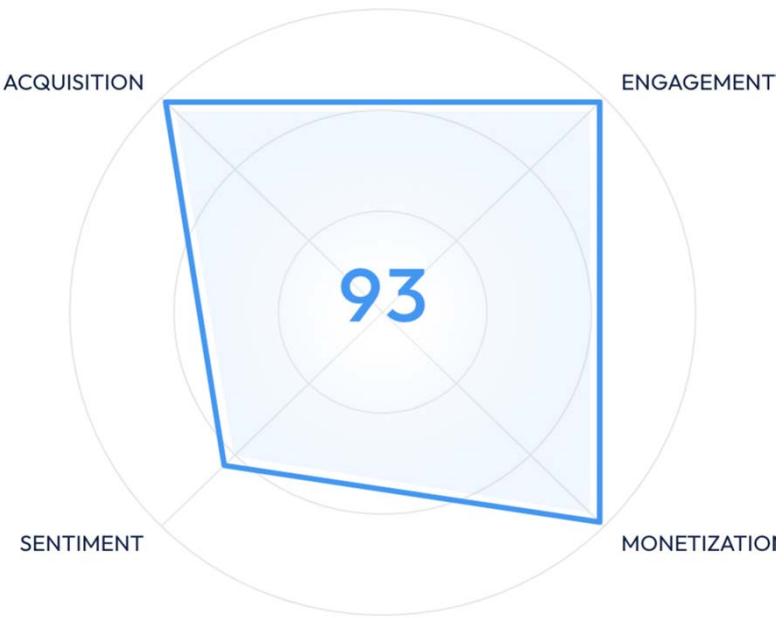
This radar chart displays a high-level performance score of 93, visualizing a game's relative strengths across four key business metrics: Acquisition, Engagement, Monetization, and Sentiment. The shape indicates that the game is performing exceptionally well in acquisition, engagement, and monetization, while sentiment is slightly lower by comparison.