
Report40 pages
Store Intelligence Data Digest: Q2 2023
Global mobile app performance in the second quarter of 2023 reflects a stabilizing market, with total downloads reaching 34.3 billion despite a marginal 1.5% year-over-year decline. While TikTok maintained its long-standing position as the most downloaded app globally, the quarter was defined by the rapid expansion of the shopping platform Temu, which achieved 74 million downloads and secured a top-ten global ranking. In the gaming sector, established titles like Subway Surfers and Ludo King continued to lead worldwide, though new entries such as MONOPOLY GO! and Honkai: Star Rail demonstrated significant momentum by dominating Western markets and leveraging existing brand equity.
Geographic trends highlight a shift in growth centers, as traditional markets like the United States, China, and the United Kingdom experienced download contractions. In contrast, India solidified its status as the world’s largest mobile market, accounting for 24% of global Google Play downloads. Emerging markets also showed resilience, with the App Store seeing double-digit growth in Brazil and Indonesia. While Meta and Google remain the preeminent global publishers, Meta faced regional headwinds in Asia due to regulatory shifts in India that impacted Instagram and Facebook adoption.
Sector-specific analysis reveals a transition toward gamification and retention-focused strategies. Education apps, led by Duolingo, successfully utilized streak features to drive high user engagement, whereas the food delivery and streaming sectors faced saturation. Food delivery downloads fell below pre-pandemic levels, and streaming services pivoted toward aggressive monetization and advertising strategies to combat slowing acquisition. Although Netflix maintains a superior 79% retention rate, its low new-user acquisition rate of 3% underscores the broader challenge of maintaining growth in a mature digital landscape.
- Global mobile app downloads reached 34.3 billion in Q2 2023, reflecting a stabilizing market despite a 1.5% year-over-year decline.
- India has become the world’s largest mobile market, accounting for 24% of all global Google Play downloads, while traditional markets like the U.S., China, and the U.K. experienced contractions.
- Temu emerged as a major disruptor with 74 million downloads, while new gaming titles MONOPOLY GO! and Honkai: Star Rail gained significant momentum in Western markets.
- Netflix faces a mature market challenge with a high 79% retention rate but a low 3% new-user acquisition rate, forcing the streaming sector to pivot toward aggressive monetization.
- Food delivery downloads have fallen below pre-pandemic levels, signaling market saturation in the sector.
+1
Sensor TowerJul 2023
Report13 pages
Newzoo DLC Content Report 2023
This analysis examines the impact of downloadable content (DLC) on player engagement and revenue across the PC and console markets. Covering the period from April 2020 to April 2023, the study evaluates over 1,600 DLC releases across 37 major global markets. The findings demonstrate that DLC serves as a critical tool for extending game longevity and driving monetization, particularly within the live-service model. In 2022, DLC sales accounted for 13% of total PC revenue and 7% of console revenue in the United States, highlighting a stronger reliance on add-on content among PC audiences.
The research indicates that DLC launches provide a significant boost to player activity, with an average increase of 11% in Monthly Active Users (MAU) during the launch month. Medium-sized games, defined as those with 250,000 to 2 million MAU, saw the most substantial benefit, averaging a 22% growth rate. From a genre perspective, strategy games experienced the highest engagement spikes at 30.5%, followed by role-playing games at 21.1%. However, the data also reveals a trend of declining engagement in the months following a release, suggesting that players often churn or move to other titles once they have consumed the new content.
Case studies of The Sims 4 and Dead Cells illustrate diverse strategic approaches to content delivery. Electronic Arts successfully utilized a "free-to-play" funnel by releasing a free update immediately before a paid expansion, resulting in the most successful launch week in the franchise's recent history. Conversely, Dead Cells demonstrated the power of crossovers, with its Return to Castlevania DLC driving a 225% increase in MAU. Despite these spikes, the analysis notes that retention remains a challenge, as a significant majority of players do not return for subsequent updates, emphasizing the constant need for fresh content to maintain a stable player base.
- DLC launches drive an average 11% increase in Monthly Active Users (MAU), with medium-sized games (250,000 to 2 million MAU) experiencing the highest growth at 22%.
- Strategy games see the largest engagement spikes from DLC at 30.5%, followed by role-playing games at 21.1%.
- In 2022, DLC sales accounted for 13% of total PC revenue and 7% of console revenue in the United States, indicating a higher reliance on add-on content on PC.
- Retention remains a persistent challenge, as most players do not return for subsequent updates and engagement typically declines in the months following a release.
- Strategic content delivery, such as Electronic Arts' free-to-play funnel for The Sims 4 or the 225% MAU spike driven by the Dead Cells 'Return to Castlevania' crossover, can significantly boost performance.
+1
NewzooMay 2023
Report13 pages
How DLC boosts engagement for PC and console games
Downloadable content (DLC) serves as a critical driver for player engagement and long-term monetization in the PC and console gaming sectors. Analyzing over 1,600 content releases between April 2020 and April 2023 across 37 major markets, data indicates that DLC launches provide an average monthly active user (MAU) boost of 11%. This impact is most pronounced for medium-sized games with 250,000 to 2 million MAU, which experienced a 22% growth during launch months. While these releases successfully spike interest, engagement typically declines in the months following the initial release, highlighting the necessity of a consistent content pipeline to maintain player interest.
Monetization trends in the United States further underscore the importance of post-launch content. In 2022, DLC accounted for 13% of PC revenue and 7% of console revenue, contributing to a landscape where in-game spending represents nearly half of total industry earnings. Strategy games emerged as the top-performing genre for DLC-driven growth, seeing a 30.5% average increase in MAU, followed by role-playing and adventure titles. These findings suggest that genres requiring deep mechanical updates or narrative expansions benefit most from the DLC model.
Case studies of The Sims 4 and Dead Cells illustrate diverse strategic approaches to content delivery. Electronic Arts successfully utilized a "free-to-play" transition combined with a free base-game update to prime the audience for the "Growing Together" expansion, resulting in its most successful launch week since 2015. Conversely, Dead Cells demonstrated the power of high-profile collaborations, such as the Castlevania DLC, which drove a 225% MAU increase. However, the data also reveals a retention challenge, as a significant majority of players who engage with new DLC do not remain active in subsequent non-update months. This emphasizes that while DLC is a potent tool for re-acquisition and revenue, sustaining a permanent player base remains a complex hurdle for live-service titles.
- DLC releases drive an average 11% increase in monthly active users (MAU), with medium-sized games (250,000 to 2 million MAU) seeing the highest impact at 22% growth.
- Strategy games benefit most from the DLC model, recording a 30.5% average increase in MAU, followed by role-playing and adventure titles.
- DLC is a significant revenue driver, accounting for 13% of PC revenue and 7% of console revenue in the U.S. during 2022.
- High-profile collaborations can trigger massive short-term spikes, evidenced by the Dead Cells 'Castlevania' DLC which drove a 225% increase in MAU.
- Strategic content delivery, such as Electronic Arts' combination of a free-to-play transition and base-game updates for The Sims 4, can achieve record-breaking expansion launches.
+1
NewzooMay 2023
Report10 pages
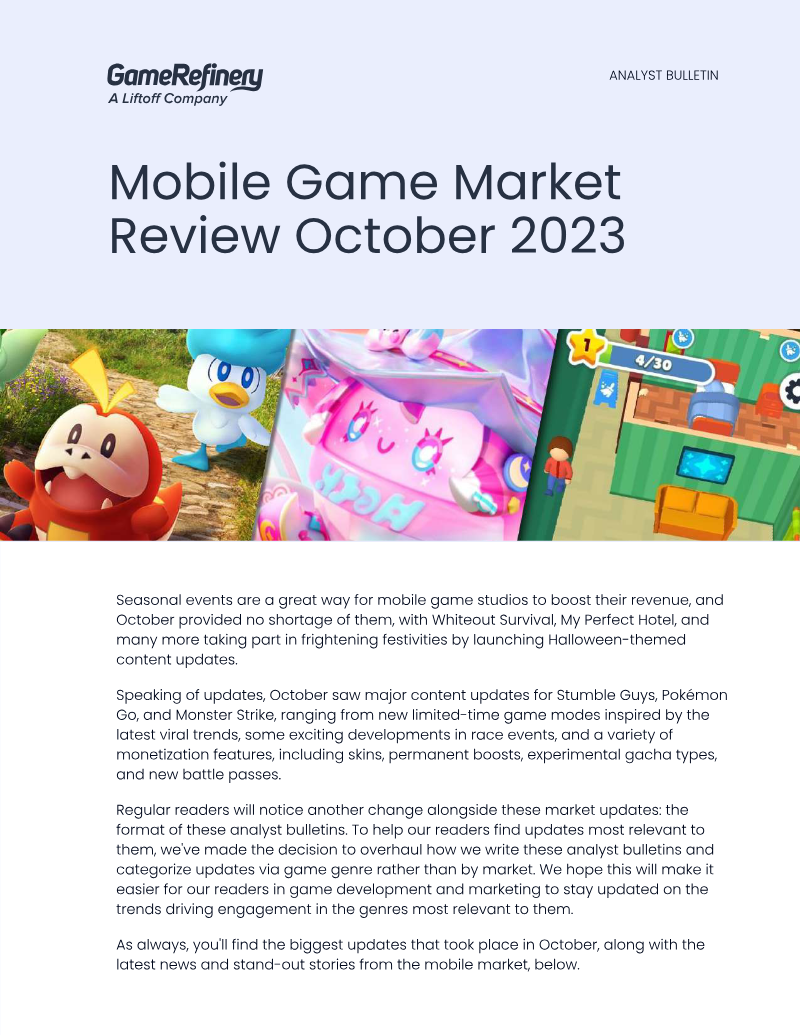
Mobile Game Market Review October 2023
The mobile gaming market in October 2023 was characterized by a heavy reliance on seasonal Halloween content and innovative social features to drive monetization and engagement. Analysis of the period reveals that major titles across the casual and midcore segments utilized limited-time events, crossover collaborations, and experimental gacha mechanics to bolster revenue. Geographically, the review focuses on major global markets, specifically the United States, Japan, and China, highlighting how regional preferences dictate event structures, such as the prevalence of social multi-gachas and location-based business discounts in the Japanese market.
In the casual segment, developers increasingly integrated social and competitive mechanics to maintain player interest. Notable examples include Pokémon Go’s introduction of a four-player party system and Eggy Party’s "Pedestrian Street" mode, which emphasizes social hangouts over core gameplay. Data indicates that titles like My Perfect Hotel successfully improved revenue trends by balancing download fluctuations with permanent boost systems and specialized battle passes. Furthermore, the market saw the rise of "challenging" platforming content in the party royale genre, drawing inspiration from viral PC trends to test player perseverance.
The midcore sector demonstrated the power of long-term live operations and high-profile collaborations. Monster Strike’s 10th-anniversary celebrations in Japan utilized celebrity partnerships and anime crossovers to maintain its top-tier status. Simultaneously, new entries such as Dungeon Hunter 6 and Reverse: 1999 achieved significant chart positions shortly after launch, with the latter reaching the top 100 in both the US and Japan. The findings suggest a market shift toward hybrid gameplay—such as combining merge mechanics with match-3 puzzles—and the successful localization of high-performing Chinese extraction shooters for Western audiences. Overall, the data underscores that consistent content overhauls and the strategic timing of feature updates remain the primary drivers for scaling performance in a competitive mobile landscape.
- Live operations and seasonal content, particularly Halloween-themed events and crossover collaborations, were the primary drivers for revenue and engagement across casual and midcore mobile titles in October 2023.
- Casual games are increasingly integrating social and competitive features to sustain retention, exemplified by Pokémon Go’s four-player party system and Eggy Party’s social-focused 'Pedestrian Street' mode.
- The midcore sector continues to rely on long-term live service strategies, evidenced by Monster Strike maintaining top-tier status in Japan through its 10th-anniversary celebrity and anime collaborations.
- New market entrants like Reverse: 1999 demonstrated strong global appeal by reaching the top 100 charts in both the US and Japan shortly after its launch.
- Monetization strategies in the casual segment are shifting toward permanent boost systems and specialized battle passes, as seen in the revenue stabilization of My Perfect Hotel.
+1
GameRefineryApr 2023

Report23 pages
The State of Puzzle Games: 2023
The puzzle game sector is undergoing a significant structural evolution, characterized by a shift in product models and monetization strategies. This analysis, covering global mobile market data from January 2018 through mid-2023, examines the performance of various sub-genres, including Swap, Blast, Merge, and Pair. The primary objective is to evaluate how developers are leveraging meta-features and hybrid monetization to sustain growth in a maturing market.
Key findings indicate that while traditional casual puzzle games continue to dominate total revenue, the hybridcasual model has emerged as a primary growth driver. Between early 2022 and early 2023, hybridcasual revenue surged by approximately 430%, signaling a departure from purely hypercasual, ad-supported frameworks. This transition is particularly evident in the Pair sub-genre, where hybridcasual revenue grew from 14.8% to 58.7% of the total within a single year. Conversely, many established sub-genres, such as Real-Time, Chain, and Bubble Shooter, experienced double-digit declines in both downloads and revenue during the same period.
Methodologically, the findings rely on consumer spending and download estimates from the Apple App Store and Google Play Store, excluding third-party Android marketplaces. The data highlights that successful titles increasingly integrate complex meta-features—such as narrative storytelling, decoration, and social clans—alongside diversified monetization tools like season passes and loot boxes. While casual games maintain the largest market share, the data suggests that future industry success depends on the ability to blend accessible gameplay with the deeper retention mechanics and hybrid revenue streams characteristic of the hybridcasual model.
- The hybridcasual model has become the primary industry growth driver, with revenue surging approximately 430% between early 2022 and early 2023.
- The Pair sub-genre experienced a significant shift toward hybridcasual monetization, which grew from 14.8% to 58.7% of its total revenue in just one year.
- Established sub-genres including Real-Time, Chain, and Bubble Shooter faced double-digit declines in both download volume and revenue throughout the 2022–2023 period.
- Successful puzzle titles are increasingly adopting complex meta-features such as narrative storytelling, decoration, and social clans to improve player retention.
- Monetization strategies are moving away from purely ad-supported frameworks toward diversified models that incorporate season passes and loot boxes.
+2
Sensor TowerJan 2023
Report32 pages
Hybridcasual Games Playbook (2023)
Hybridcasual gaming represents a strategic evolution in the mobile industry, bridging the gap between the accessibility of hypercasual titles and the sophisticated progression systems of casual games. The primary thesis of this analysis is that by blending simple, intuitive mechanics with deeper metagame layers—such as narrative progression, resource management, and social features—developers can significantly increase user retention, session length, and lifetime value (LTV). This shift addresses the declining interest in traditional hypercasual games, which saw a 15% decrease in downloads between 2021 and 2022, while hybridcasual titles experienced continued growth, reaching 5 billion downloads in 2022.
Key performance data highlights the superiority of the hybridcasual model in maintaining player interest. Top-tier hybridcasual games demonstrate average session lengths of 372 seconds, exceeding hypercasual benchmarks by 160 seconds. Furthermore, retention rates are substantially higher, with hybridcasual titles achieving 54% Day 1 retention and 9% Day 60 retention, compared to significantly lower figures for hypercasual counterparts. Revenue models have also matured; while advertisements remain a core component, they are increasingly optional and rewarded, allowing in-app purchases (IAPs) to account for a growing share of total revenue. Successful implementation of IAP strategies, such as secondary currencies and exclusive content packs, has been shown to increase IAP revenue by as much as 35% in specific case studies.
The industry scope covers global mobile gaming, with a focus on subgenres including arcade idle, tower defense, and simulation. Methodologically, the findings rely on comparative performance metrics from 2022, internal product strategy analysis, and specific case studies of titles like Zombie Defense and Aquarium Land. The analysis concludes that long-term success in this segment requires a rigorous, data-driven approach to post-launch optimization, including A/B testing of game economies, audience segmentation, and the continuous integration of new content to sustain player engagement.
- Hybridcasual games reached 5 billion downloads in 2022, contrasting with a 15% decline in traditional hypercasual downloads between 2021 and 2022.
- Hybridcasual titles achieve a 54% Day 1 retention rate and a 9% Day 60 retention rate, significantly outperforming traditional hypercasual benchmarks.
- Average session lengths for top-tier hybridcasual games reach 372 seconds, which is 160 seconds longer than hypercasual industry benchmarks.
- Integrating in-app purchase strategies like secondary currencies and exclusive content packs can increase IAP revenue by up to 35%.
- The hybridcasual model shifts revenue dependency away from mandatory advertisements toward optional, rewarded ad formats and increased in-app purchases.
+4
Sensor TowerJan 2023

Report11 pages
From Hyper to Hybrid in 2023
The report examines mobile advertising and in‑app purchase (IAP) trends across Android and iOS platforms from January 2022 through June 2023, focusing on the shift toward hybrid marketing strategies. Key findings show a 23 % rise in Android IAPs and a 24 % increase on Apple, indicating robust revenue growth for both ecosystems. Geographic analysis reveals that India, Brazil, the United States, Indonesia, and Mexico remain the top five Android install markets in both 2022 and H1 2023, while iOS installs shift from China and Japan in 2022 to Canada and Germany in H1 2023, underscoring changing regional appetites.
Ad network performance also evolved: Google Ads ascended to the top Android spot in H1 2023, overtaking AppLovin, while Meta entered the top five on both platforms. On iOS, AppLovin moved from second to first place, and Google Ads entered the top five for the first time. These shifts suggest advertisers are reallocating spend toward networks with stronger cross‑platform reach and data capabilities.
The methodology relies on anonymized Tenjin data collected between 1 January 2022 and 30 June 2023, with rankings limited to networks and countries exceeding 25 million installs. Tenjin positions itself beyond attribution, offering a data‑science platform, SKAdNetwork reporting, LTV analytics, automation APIs, and cost aggregation to support hyper‑growth for small and medium publishers. The report thus provides actionable insights into platform performance, regional dynamics, and network effectiveness for mobile marketers navigating the hybrid advertising landscape.
- In-app purchase revenue grew significantly between January 2022 and June 2023, with a 23% increase on Android and a 24% increase on iOS.
- Google Ads became the top-performing network for Android installs in H1 2023, while AppLovin rose to the number one position for iOS installs.
- Meta has successfully entered the top five ad networks on both Android and iOS platforms as of H1 2023.
- The top five Android install markets remained consistent from 2022 through H1 2023, led by India, Brazil, the United States, Indonesia, and Mexico.
- iOS install market focus shifted geographically between 2022 and H1 2023, moving away from China and Japan toward Canada and Germany.
+1
TenjinJan 2023

Report27 pages
From Hyper to Hybrid in 2023 (2023)
The report examines the evolving landscape of mobile gaming in 2023, focusing on the decline of pure hyper‑casual profitability and the rise of hybrid models that blend ad revenue with in‑app purchases. It attributes the downturn to factors such as iOS App Tracking Transparency, post‑COVID user behavior shifts, and stricter publisher gatekeeping that now demands “absolute hit” metrics. Consequently, developers increasingly self‑publish and diversify monetization strategies, incorporating IAPs and meta gameplay elements.
Key findings highlight that India leads in ad impressions and IAP volume, while the United States dominates eCPM earnings across both Android and iOS platforms. Apple Search Ads remains the top iOS ad network, securing three of the highest positions, whereas Applovin dominates Android advertising. In monetization channels, ironSource and Meta networks top the rankings for revenue generation on both operating systems. The data set spans global markets, covering major regions such as North America and Asia, and includes both Android and iOS ecosystems.
The methodology relies on Tenjin’s comprehensive data warehouse, aggregating millions of installs and ad impressions to produce rankings and predictive insights. The analysis integrates LTV prediction models, attribution visualization, and advanced metrics to provide actionable guidance for publishers transitioning from hyper‑casual to hybrid monetization strategies.
- The mobile gaming market is shifting away from pure hyper-casual models toward hybrid strategies that combine ad revenue with in-app purchases (IAP) to counter declining profitability.
- Profitability in the hyper-casual sector has been negatively impacted by iOS App Tracking Transparency, post-COVID user behavior shifts, and higher publisher thresholds for hit metrics.
- The United States leads global eCPM earnings across both Android and iOS, while India holds the top position for total ad impressions and IAP volume.
- Apple Search Ads is the dominant ad network on iOS, occupying three of the top-ranked positions, whereas Applovin leads the Android advertising landscape.
- IronSource and Meta are the top-performing networks for revenue generation across both Android and iOS operating systems.
+3
TenjinJan 2023

Report68 pages
SensorTower The State of Mobile Gaming 2023
The 2023 SensorTower analysis demonstrates a pronounced shift in mobile gaming dynamics, with hyper‑casual titles experiencing a 24 % year‑over‑year decline in Q4 2022, while hybrid‑casual games grow 13 % and exclusive‑access titles surge 54 %. Revenue patterns echo this trend: action and tabletop genres record modest gains, whereas shooter, RPG, and casino segments suffer double‑digit drops. Geographic revenue distribution shows RPG dominance in Asia (39 %) but a more balanced genre mix across North America and Europe, each contributing at least 12 % of total earnings.
Hybrid‑casual games differentiate themselves through the adoption of meta‑features. Thirty percent of leading hybrid‑casual titles embed at least one such feature, compared with only five percent of hyper‑casuals. Character collection is the most prevalent meta‑feature, present in 18 % of hybrid‑casuals and boosting average playtime by 122 %. Downloads for hybrid‑casual games rose 17 % in Europe and a striking 124 % in Asia during 2022, while the global market grew 4 % YoY.
Live‑Ops events prove highly lucrative for flagship titles. Marvel Snap’s themed events generated between $670 k and $746 k on launch day, illustrating the monetization power of well‑timed in‑app events. SensorTower’s event‑tracking tool offers publishers granular revenue attribution, facilitating competitive benchmarking and schedule optimization.
Regional performance highlights divergent trends. Europe’s top five markets—Germany, the U.K., France, Russia, and Italy—saw a collective 6 % revenue decline to $700 million in Q4 2022, with Russia’s market plummeting 72 % YoY after the Ukraine conflict. Despite an 8 % overall download drop, Russia remained Europe’s largest volume market with 673 million downloads (24 % of the region). In contrast, Asia’s quarterly gross fell 15 % to $9.5 billion, largely due to a 20 % Google Play decline, while downloads stayed flat above 5.5 billion per quarter; India led the region by a wide margin.
- The mobile gaming market is shifting away from hyper-casual titles, which saw a 24% year-over-year decline in Q4 2022, toward hybrid-casual games that grew 13% and exclusive-access titles that surged 54%.
- Hybrid-casual games are successfully utilizing meta-features to drive engagement, with 30% of top titles embedding these features and character collection specifically boosting average playtime by 122%.
- Regional revenue performance is diverging, with Asia’s quarterly gross falling 15% to $9.5 billion and Europe’s top five markets experiencing a collective 6% revenue decline to $700 million in Q4 2022.
- Live-Ops events remain a primary monetization driver, evidenced by Marvel Snap’s themed events generating between $670,000 and $746,000 on their respective launch days.
- While global market downloads grew 4% year-over-year, hybrid-casual games significantly outperformed this average with download growth of 17% in Europe and 124% in Asia during 2022.
Sensor TowerJan 2023

Report33 pages
Gaming Spotlight 2023
Mobile gaming continues to dominate the industry’s growth trajectory, yet recent regulatory tightening and rising acquisition costs are poised to curb spend by roughly 2 % in 2023. The analysis underscores that creative optimization, diversified monetization models—including ads, subscriptions, and battle‑passes—and data‑driven partner insights are essential to counter ad fatigue and maintain daily active users, stickiness, and revenue in an increasingly fragmented market. Contextual market data is highlighted as a critical tool for staying ahead of evolving consumer preferences and macroeconomic headwinds.
First‑half 2023 data reveal that free‑to‑play titles remain the most influential drivers of downloads and in‑app purchase (IAP) revenue. “Monopoly GO” led mobile downloads with over 45 million installs and $232 million in IAP, attracting a slightly higher female audience and players aged 25‑34. “Honkai: Star Rail” achieved 62 million downloads and $457 million in spend, largely fueled by a high‑price bundle that accounted for 61 % of May revenue; it appeals more to male players but enjoys strong traction among Gen‑Z gamers. “Royal Match” secured the second spot in global spend with $1.7 billion, driven by a 20 % female skew and significant engagement from players aged 45 and older. These findings illustrate a demographic shift: match‑3 games are increasingly monetized by female and older players, while high‑ticket RPGs continue to attract Gen‑Z consumers.
Survey results indicate a sharp decline in U.S. mobile gamers’ positive sentiment toward in‑game video ads—from 50 % “like” in Q3 2020 to 30 % by Q3 2022—while rewarded‑video ads maintain a more favorable reception at around 40 %. The drop aligns with the rollout of Apple’s ATT framework, yet ad fatigue and oversaturation are identified as primary drivers rather than regulatory causation. The recommendation is to diversify ad formats, prioritizing rewarded videos and playable ads, and to tailor these experiences to specific demographic segments to mitigate fatigue and sustain growth.
- Mobile gaming spending is projected to decline by approximately 2% in 2023 due to rising acquisition costs and increased regulatory pressure.
- High-performing titles demonstrate distinct demographic trends: 'Royal Match' generated $1.7 billion in revenue with a strong base of players aged 45+, while 'Honkai: Star Rail' captured $457 million by targeting Gen-Z with high-price bundles.
- Consumer sentiment toward standard in-game video ads has dropped significantly, falling from 50% positive in Q3 2020 to 30% by Q3 2022, largely due to ad fatigue and market oversaturation.
- Rewarded video ads remain more effective than standard video ads, maintaining a 40% favorability rating among U.S. mobile gamers.
- 'Monopoly GO' emerged as a top performer in early 2023, securing 45 million installs and $232 million in IAP revenue, particularly among the 25-34 age demographic.
+2
IDCJan 2023
Report36 pages
2023 Casual Gaming Apps Report
The casual gaming landscape in 2023 is defined by a strategic pivot from rapid user acquisition toward long-term profitability and sophisticated engagement models. While iOS acquisition costs significantly exceed those of Android at $2.23 compared to $0.63, both platforms achieve a comparable Day-7 return on ad spend of approximately 7.7%. North America remains the most expensive yet lucrative market, yielding an 8.1% return on ad spend despite a high $3.59 cost per install. Simulation games have emerged as a particularly efficient entry point for developers, maintaining the lowest acquisition costs at $0.59.
Casual titles serve as the primary engine for the broader mobile ecosystem, driving 74% of installs across all gaming categories and nearly 75% of mid-core installs. Hyper-casual and puzzle games remain the dominant traffic sources, but the industry is increasingly embracing hybridization. This trend involves layering complex meta-elements, such as narrative progression and competitive social features, over simple core mechanics. By blending ad-based and in-app purchase monetization models, developers are successfully targeting crossover audiences and extending the lifecycle of traditionally short-lived genres.
Engagement strategies now heavily rely on competitive mechanics and gameplay diversification. Approximately 90% of leading level-based titles utilize solo leaderboards, while over half incorporate team-based races, debunking the myth that casual players avoid competitive environments. Furthermore, nearly a quarter of top-grossing casual games integrate minigames, such as hidden object or board game mechanics, to refresh the user experience and lower acquisition barriers. These features collectively deepen player retention and monetization, signaling a shift toward more robust, feature-rich casual experiences that prioritize player depth over simple volume.
- Casual gaming now accounts for 74% of all mobile game installs and drives nearly 75% of mid-core game installations.
- Developers are shifting from volume-based user acquisition to hybrid models that blend ad-based revenue with in-app purchases to extend player lifecycles.
- North America remains the most expensive market with a $3.59 cost per install, yet it maintains a high 8.1% return on ad spend.
- While iOS acquisition costs ($2.23) are significantly higher than Android ($0.63), both platforms deliver a comparable Day-7 return on ad spend of approximately 7.7%.
- Simulation games currently offer the most efficient entry point for developers, maintaining the lowest acquisition costs at $0.59 per install.
+3
LiftoffJan 2023

Report33 pages
Gaming Spotlight 2023 Review
The global gaming market in 2023 was defined by a complex interplay between mobile contraction and steady growth in the PC and console sectors. While mobile remains the industry’s largest segment, consumer spending fell 2% to $108 billion, a decline attributed to macroeconomic instability and privacy-related shifts such as Apple’s App Tracking Transparency framework. Conversely, the PC and home console markets expanded by 4% and 3% respectively, bolstered by the rising popularity of subscription services. Handheld gaming also experienced a demographic fragmentation, with the Nintendo Switch Lite attracting a younger, female-leaning audience while the Steam Deck appealed to older, male gamers. Emerging technologies like cloud-streamed gaming are gaining significant traction, projected to reach $3.8 billion in revenue with mobile devices facilitating over a quarter of global streaming hours.
Success in the first half of 2023 was concentrated among high-performing titles that leveraged Gen Z engagement and sophisticated in-app purchase models. Monopoly GO and Honkai: Star Rail emerged as standout performers, generating hundreds of millions in revenue within their first months of release. Established franchises like Royal Match and FIFA Soccer also reached significant lifetime milestones, surpassing $1.7 billion and $1 billion respectively. These successes occurred despite a challenging user acquisition landscape where gamer sentiment toward traditional advertising formats has turned increasingly negative. While rewarded video and playable ads remain the most tolerated formats, overall ad fatigue is rising due to market oversaturation.
To navigate this evolving environment, the industry must adapt to shifting privacy standards and the impending implementation of Google’s Privacy Sandbox. Although data suggests that privacy frameworks have not directly damaged iOS ad sentiment, the general decline in ad acceptance necessitates a move toward more diverse formats and contextual market data. Strategic focus is shifting toward combating rising acquisition costs through high-value player engagement and the optimization of cross-platform experiences. As the market stabilizes, the integration of cloud services and the continued dominance of mobile-first economies in emerging regions will likely dictate the next phase of global industry growth.
- The global mobile gaming market contracted by 2% to $108 billion in 2023, driven by macroeconomic instability and privacy-related shifts like Apple’s App Tracking Transparency.
- PC and home console markets grew by 4% and 3% respectively, largely supported by the increasing adoption of subscription-based models.
- Cloud-streamed gaming is a growing revenue stream projected to reach $3.8 billion, with mobile devices accounting for over 25% of total streaming hours.
- High-performing titles like Monopoly GO and Honkai: Star Rail achieved rapid, massive revenue success by targeting Gen Z and utilizing sophisticated in-app purchase models.
- Rising ad fatigue and negative sentiment toward traditional advertising are forcing developers to move away from standard formats toward rewarded video, playable ads, and contextual market data.
+2
data.aiJan 2023
Report32 pages
2023 Liftoff Company Midcore Gaming Apps Report
The midcore mobile gaming market in 2023 is defined by a strategic pivot toward deeper gameplay mechanics and diversified monetization streams, now commanding 35% of total iOS gaming revenue in the United States. While North America remains the most lucrative region with a 4.5% Day-7 return on ad spend, significant performance disparities exist between platforms. Android offers a more cost-effective environment for user acquisition compared to iOS, though the shooter genre remains the most expensive and rewarding category, commanding a $7.47 cost per install alongside a leading 6% Day-7 return on ad spend.
Market longevity favors midcore titles over casual alternatives, as evidenced by midcore games being twice as likely to maintain a top-200 grossing position over a twelve-month period. The strategy genre, particularly 4X and "Build & Battle" subgenres, continues to dominate revenue charts. To sustain this momentum, developers are increasingly adopting sophisticated engagement models such as extraction shooter mechanics, multi-layered Battle Passes with dedicated storefronts, and seasonal progression resets designed to prevent late-game stagnation.
Operational strategies have shifted toward aggressive LiveOps and the circumvention of traditional platform fees. Top-performing titles typically manage fifteen simultaneous unique events and fifteen limited-time gachas to drive consistent monetization. Furthermore, publishers are leveraging legal shifts to direct players toward external web stores, offering better value while avoiding app store commissions. Competitive social structures remain the backbone of retention, with 88% of leading midcore games utilizing permanent PvP seasons and over half incorporating guild-based competitions to foster long-term player commitment.
- Midcore mobile games now account for 35% of total iOS gaming revenue in the United States, demonstrating significantly higher market longevity than casual titles.
- Shooter games represent the most high-stakes category, commanding a $7.47 cost per install while delivering a leading 6% Day-7 return on ad spend.
- Top-performing midcore titles maintain engagement through aggressive LiveOps, typically running fifteen simultaneous unique events and fifteen limited-time gachas at any given time.
- Retention strategies are heavily reliant on competitive social structures, with 88% of leading titles utilizing permanent PvP seasons and over 50% incorporating guild-based competitions.
- North America remains the most lucrative region for midcore apps, yielding a 4.5% Day-7 return on ad spend despite performance disparities between Android and iOS user acquisition costs.
+2
LiftoffJan 2023
Report27 pages
Hyper to Hybrid: Mobile Gaming Market Trends 2023
The mobile gaming landscape is undergoing a fundamental shift as developers transition from hyper-casual to hybrid-casual business models. This evolution is driven by a significant downward trend in ad revenue profitability, influenced by Apple’s App Tracking Transparency framework, shifting post-pandemic user behaviors, and increased selectivity from major publishers. To maintain sustainability, developers are increasingly adopting self-publishing strategies and integrating sophisticated meta-gameplay components alongside in-app purchases to diversify revenue streams beyond traditional advertising.
Data from the 2022 calendar year reveals a cooling market for ad-centric models, characterized by declining ad impressions and effective cost per mille (eCPM) across both Android and iOS platforms. Conversely, the volume of in-app purchases grew on both operating systems, signaling a successful pivot toward hybrid monetization. Geographically, India emerged as the leader for Android installs, while the United States maintained its position as the primary market for both ad revenue and in-app purchase value across all devices.
The competitive landscape for ad networks and monetization channels shows distinct platform preferences. Apple Search Ads dominates iOS rankings for installs, retention, and lifetime value, while AppLovin and ironSource lead the Android market. AppLovin currently stands as the top monetization channel by total ad revenue on both platforms. These findings are based on anonymized data from the full 2022 period, utilizing a weighted average methodology for performance metrics and focusing on networks and regions that exceeded a threshold of 25 million installs. The analysis underscores a broader industry movement toward deeper player engagement and more complex economic structures in mobile gaming.
- Mobile developers are shifting from hyper-casual to hybrid-casual models to counter declining ad revenue profitability caused by Apple’s App Tracking Transparency and post-pandemic behavioral shifts.
- In-app purchase volume grew across both Android and iOS in 2022, signaling a successful industry-wide pivot toward diversified revenue streams beyond traditional advertising.
- Ad-centric monetization models faced a cooling market in 2022, characterized by a downward trend in both ad impressions and effective cost per mille (eCPM) on all platforms.
- Apple Search Ads is the top-performing channel for iOS installs, retention, and lifetime value, while AppLovin and ironSource lead the Android market.
- AppLovin currently serves as the leading monetization channel by total ad revenue across both Android and iOS platforms.
+3
TenjinJan 2023
Report15 pages
In-Game Spending: Parents' Supervision of In-Game Spending 2023
The research investigates how parents supervise and manage their children’s in‑game purchases, tracking trends across five European markets—United Kingdom, France, Germany, Spain and Italy—over four survey waves (2018, 2019, 2020 and 2023). Each wave surveyed adult parents or guardians of children who play video games, with sample sizes ranging from 962 in 2018 to 2,808 in 2023, providing a broad cross‑section of the region’s gaming households.
Findings show that three‑quarters of parents consistently report that their children do not spend on in‑game extras, a proportion that has remained stable since 2020. Among the minority who do spend, the average monthly outlay rose from €33 in 2020 to €39 in 2023, reflecting a €6 increase that aligns with inflation. Most spending (64 %) falls within the €1‑20 range, with the most popular items being gameplay‑impacting content (34 %) and decorative or cosmetic items (just under one third). Loot boxes and other unknown‑reward items remain relatively unpopular.
Parental oversight is high: nine‑in‑ten parents of spending children have some form of agreement, half of which are explicit—either seeking permission (38 %) or setting limits (23 %). Preferred monitoring tools include credit‑card bill checks, parental‑control settings, and two‑factor authentication, though 44 % of parents who avoid controls deem them unnecessary and 32 % find them difficult to activate. Awareness of in‑game currency and loot boxes among all players (ages 11‑64) is also limited, with only 9 % having purchased in‑game currency and 4 % having bought loot boxes. The study’s methodology relies on standardized questionnaires administered to representative adult panels in each country, ensuring comparability within each survey year while noting that cross‑year comparisons are constrained by methodological changes.
- Three-quarters of children do not engage in in-game spending, a figure that has remained stable since 2020.
- Average monthly in-game spending among children who do spend increased from €33 in 2020 to €39 in 2023, a rise consistent with inflation.
- The majority of in-game spending (64%) is concentrated in the €1–20 monthly range, with gameplay-impacting content (34%) and cosmetic items (33%) being the most popular purchases.
- Parental oversight is high, with 90% of parents of spending children maintaining some form of agreement, including explicit permission requirements (38%) or spending limits (23%).
- While 44% of parents who do not use parental controls consider them unnecessary, 32% report that they find these tools difficult to activate.
+1
Video Games EuropeJan 2023

Report15 pages
Misleading (Non-Core) Gameplay Ads Research 2023
The prevalence and perception of non-core gameplay advertisements, often categorized as misleading, represent a significant shift in mobile gaming marketing strategies. Based on a 2023 survey of 5,212 respondents across the United States, Japan, Europe, and Brazil, findings indicate that a vast majority of gamers have encountered these ads. Recognition is highest in the United States at 91%, while other regions range between 71% and 77%. Despite the controversial nature of these promotions, approximately 75% of players in Western markets and 70% in Japan and Brazil admit that the mechanics showcased in these ads are often more fascinating than the actual core gameplay of the advertised titles.
The research challenges the assumption that misleading ads lead to immediate user churn. Between 35% and 46% of gamers reported they would continue playing a game despite the discrepancy, choosing to evaluate the product on its own merits rather than the accuracy of the advertisement. Players generally understand that developers use these tactics to inflate download numbers and revenue or to revitalize interest in older titles. The most appealing elements of these ads are the specific gameplay mechanics and puzzles, while user interface and new features hold the least draw. Notable titles associated with this phenomenon include Hero Wars, various "Scapes" games, and Evony.
Demographic data reveals that the modern gaming audience is maturing, with nearly 10% of U.S. gamers over the age of 60 and less than 2.5% of the global sample under 18. Regional preferences vary significantly; casual titles dominate the U.S. market, while RPGs and complex math-based mechanics are preferred in Japan. In Europe and Brazil, competitive RPG and MMORPG genres lead in popularity. While engagement is high in the West, with many playing over 18 hours weekly, nearly half of Japanese respondents play for less than four hours per week. Ultimately, the industry is seeing a blurring of lines as developers integrate these advertised mini-games into their products to transition from "misleading" to "non-core" content.
- Approximately 75% of Western players and 70% of Japanese and Brazilian players find the mechanics shown in misleading ads more engaging than the actual core gameplay of the advertised titles.
- Between 35% and 46% of gamers continue playing a title despite recognizing that the advertisement does not accurately represent the core gameplay experience.
- Ad recognition is widespread, with 91% of U.S. respondents and 71% to 77% of respondents in other surveyed regions reporting exposure to non-core gameplay advertisements.
- Developers are increasingly integrating these advertised mini-games into their actual products to convert misleading marketing into legitimate non-core content.
- Players identify specific gameplay mechanics and puzzles as the most appealing elements of these ads, while user interface and new features are the least effective drivers of interest.
+1
NextersJan 2023

Report13 pages
5 Mobile App Forecasts: 2023
Global mobile market projections for 2023 indicate a complex landscape defined by shifting consumer priorities and economic pressures. While total mobile advertising spend is expected to reach $362 billion, growth is projected to slow due to macroeconomic headwinds. Short-form video apps are anticipated to be the primary drivers of this ad spend, helping to offset a decline in performance marketing budgets. Conversely, mobile gaming is facing a downturn, with consumer spending forecasted to drop to $107 billion in 2023. This decline is attributed to a combination of the global economic squeeze and tightening privacy regulations, such as IDFA and Google’s upcoming changes, which complicate the targeting of high-spending users.
Despite the contraction in gaming spend, specific high-performing titles continue to reach massive financial milestones. Fourteen new apps and games are projected to surpass $2 billion in lifetime consumer spend during 2023, with eleven of those being games. Notably, the video streaming sector remains robust, with platforms like HBO Max and iQIYI expected to join the $3 billion lifetime spend club, reflecting a sustained consumer shift toward mobile-first entertainment.
The broader mobile economy is also seeing a migration of retail dollars toward experiential sectors. As discretionary income tightens, consumers are prioritizing travel, live events, sports, and wellness over physical goods. This shift is supported by a long-term trend of increasing mobile engagement; total time spent in apps is forecasted to surpass 6 trillion hours by 2028. This growth is fueled by 5G rollout and the deepening personalization of apps, with emerging markets in Latin America, Southeast Asia, and the Middle East driving significant engagement. These findings are based on proprietary market estimates and historical data analysis of global app store performance and consumer behavior.
- Mobile gaming consumer spending is projected to decline to $107 billion in 2023 due to macroeconomic pressures and stricter privacy regulations like IDFA.
- Global mobile advertising spend is expected to reach $362 billion in 2023, with short-form video apps serving as the primary growth driver to offset reduced performance marketing budgets.
- Eleven of the fourteen new apps projected to surpass $2 billion in lifetime consumer spend during 2023 are games, demonstrating that top-tier titles remain resilient despite the broader market downturn.
- The video streaming sector is showing sustained growth, with platforms like HBO Max and iQIYI expected to reach the $3 billion lifetime consumer spend milestone.
- Consumer spending is shifting away from physical goods toward experiential sectors like travel, live events, sports, and wellness as discretionary income tightens.
+1
data.aiJan 2023
Report41 pages
Mobile Growth & Monetization Report 2023
The mobile gaming landscape in 2023 reflects a strategic pivot toward operational efficiency as developers navigate softening in-app purchase (IAP) and advertising revenues. Success currently hinges on capturing player interest within the first 14 days, a critical window where 77% of all conversions occur. To capitalize on this timeframe, monetization strategies emphasize low-friction price points between $1.01 and $5.00, with high-performing assets such as virtual currencies, limited-time bundles, and sales generating over 56% of total IAP revenue.
Beyond direct purchases, the integration of rewarded video ads and offerwalls has become essential for sustaining non-paying user bases. Strategic ad placement between levels or within game lobbies yields the highest engagement, particularly when incentivized by currency or gacha mechanics. Offerwalls, in particular, represent a significant growth lever, contributing 33% of total ad revenue for games utilizing multi-faceted monetization. These tools also serve as powerful retention drivers; players engaging with offerwalls demonstrate a 14% retention rate at Day 90, vastly outperforming the 3% rate seen among non-converters.
From a global marketing perspective, hypercasual advertising remains the most effective conversion engine across the majority of gaming genres. Advertisers are increasingly looking toward high-value Tier-2 markets, noting exceptional click-through rates for sports titles in Japan and trivia games in South Korea. Furthermore, the adoption of Custom Store Pages is emerging as a vital tactic for improving return on investment, particularly within the puzzle, casino, and lifestyle segments. These findings underscore a broader industry trend toward data-driven personalization and diversified revenue streams to maintain long-term player lifetime value.
- 77% of all player conversions occur within the first 14 days, making this initial window the most critical period for monetization.
- Low-friction price points between $1.01 and $5.00 are the primary drivers of in-app purchase revenue, with virtual currencies and limited-time bundles accounting for over 56% of total IAP income.
- Offerwalls are a major retention driver, as players who engage with them exhibit a 14% retention rate at Day 90 compared to only 3% for non-converters.
- Offerwalls contribute 33% of total ad revenue for games that employ a multi-faceted monetization strategy.
- Rewarded video ads and offerwalls are essential for sustaining non-paying users, with the highest engagement occurring when ads are placed between levels or within game lobbies.
+2
UnityJan 2023
Report25 pages
The State of Mobile Gaming in India: A Look at India's Casual, Hyper-Casual, and Real Money Gaming App Industry Trends
This analysis examines the rapid expansion and evolving user behavior within the Indian mobile gaming market, focusing on the casual, hyper-casual, and real-money gaming (RMG) segments. The primary thesis asserts that while the COVID-19 pandemic and increased smartphone penetration triggered a massive "gold rush" in installs and engagement, the industry now faces a critical inflection point. As organic growth stabilized in 2022, the focus for developers has shifted from simple acquisition to sophisticated, insights-led retention and monetization strategies to sustain long-term profitability.
Key findings value the Indian gaming industry at $2.6 billion, with projections to reach $8.6 billion by 2027. Data indicates that India has surpassed the United States in terms of user base, exceeding 300 million gamers. During the 2021 pandemic waves, casual games saw a 90% uplift in installs, while RMG apps experienced significant revenue fluctuations, including a 35% increase in April 2021. However, the data reveals a downward trend in "stickiness" and installs moving into 2022, highlighting a retention crisis where 68% of users engage with an app fewer than ten times.
The scope of the research covers the Indian market from 2021 through the first quarter of 2022, utilizing data from over 100 gaming brands. The methodology relies on a combination of market analysis from MoEngage, AppTweak, and AppsFlyer, incorporating normalized trends in installs, In-App Advertising (IAA), and In-App Purchases (IAP).
The conclusions emphasize that technical optimization and personalized engagement are mandatory for survival. Effective strategies identified include App Store Optimization (ASO) to improve discoverability, RFM (Recency, Frequency, Monetary) segmentation to target "champion" players, and the use of predictive AI to prevent churn. The findings suggest that brands utilizing multi-channel engagement platforms can achieve push notification conversion rates as high as 91%, which is essential for navigating India's highly competitive and maturing digital landscape.
- The Indian gaming industry is projected to grow from $2.6 billion in 2022 to $8.6 billion by 2027, supported by a user base exceeding 300 million gamers.
- The industry is facing a significant retention crisis, with 68% of users engaging with a gaming app fewer than ten times.
- Following a pandemic-era surge where casual game installs rose 90% and RMG revenue grew 35% in April 2021, organic growth stabilized and declined throughout 2022.
- Brands utilizing multi-channel engagement platforms can achieve push notification conversion rates as high as 91%.
- To combat churn and sustain profitability, developers must shift from acquisition-focused models to strategies like RFM (Recency, Frequency, Monetary) segmentation and predictive AI.
+2
MoEngageJan 2023
Report27 pages
From Hyper to Hybrid: Hypercasual Gaming Trends 2023
The mobile gaming landscape is undergoing a significant structural shift as developers transition from hyper-casual models toward hybrid-casual strategies. This evolution is driven by a marked decline in ad revenue profitability, influenced by the implementation of App Tracking Transparency on iOS, shifting post-pandemic user behaviors, and increased selectivity from major publishers. To maintain sustainability, developers are increasingly integrating in-app purchases and meta-gameplay components into their titles while opting for self-publishing models to retain greater control over their assets.
Data from 2022 reveals a downward trend in ad impressions and eCPMs across both Android and iOS platforms. Conversely, the volume of in-app purchases grew on both operating systems, signaling a successful pivot toward diversified monetization. Geographically, the United States remains the dominant market, ranking first for both ad revenue and in-app purchases across platforms. India emerged as the leading territory for total installs on Android, highlighting the importance of emerging markets for scale, even as monetization remains concentrated in Tier 1 regions.
The competitive landscape for ad networks and monetization channels shows distinct leaders. Apple Search Ads dominates the iOS ecosystem, securing the top position in multiple categories including retention and lifetime value. On Android, AppLovin and ironSource lead the market. AppLovin specifically stands out as the top monetization channel by total ad revenue on both operating systems. For eCPM performance, Meta Audience Network and ironSource lead on Android and iOS respectively.
These findings are based on anonymized data collected throughout the 2022 calendar year, utilizing a weighted average methodology. The analysis focuses on high-scale performance, only including countries and ad networks that exceeded a threshold of 25 million installs. This comprehensive view underscores a broader industry movement where the traditional reliance on pure advertising is being replaced by a more balanced, hybrid approach to game design and revenue generation.
- The mobile gaming industry is shifting from hyper-casual to hybrid-casual models, driven by declining ad revenue profitability and the impact of iOS App Tracking Transparency.
- Developers are increasingly adopting in-app purchases and meta-gameplay components to replace the traditional reliance on pure advertising revenue.
- Data from 2022 shows a consistent downward trend in ad impressions and eCPMs across both Android and iOS platforms, while in-app purchase volume grew.
- The United States remains the primary market for both ad revenue and in-app purchases, while India leads in total Android installs, emphasizing the split between scale in emerging markets and monetization in Tier 1 regions.
- AppLovin is the leading monetization channel by total ad revenue across both iOS and Android platforms.
+1
TenjinJan 2023