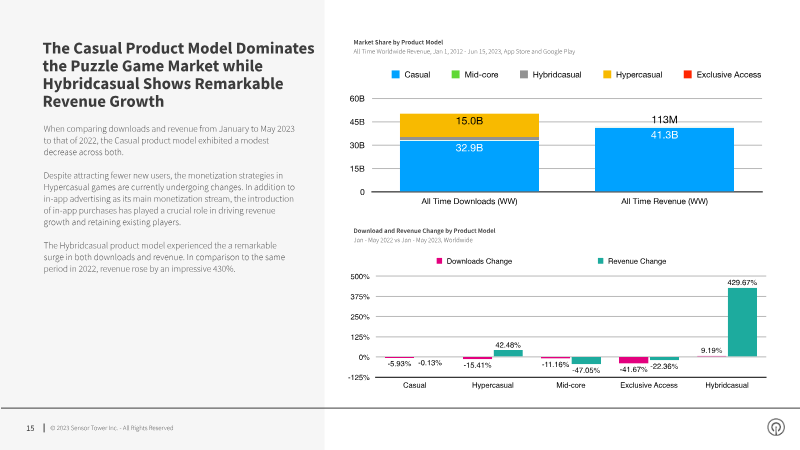
The hybridcasual model has become the primary industry growth driver, with revenue surging approximately 430% between early 2022 and early 2023.
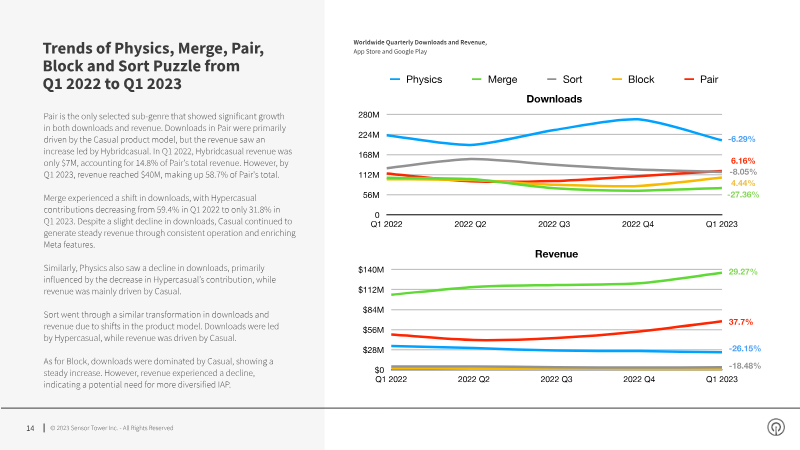
See it on page 15The Pair sub-genre experienced a significant shift toward hybridcasual monetization, which grew from 14.8% to 58.7% of its total revenue in just one year.
See it on page 14Established sub-genres including Real-Time, Chain, and Bubble Shooter faced double-digit declines in both download volume and revenue throughout the 2022–2023 period.
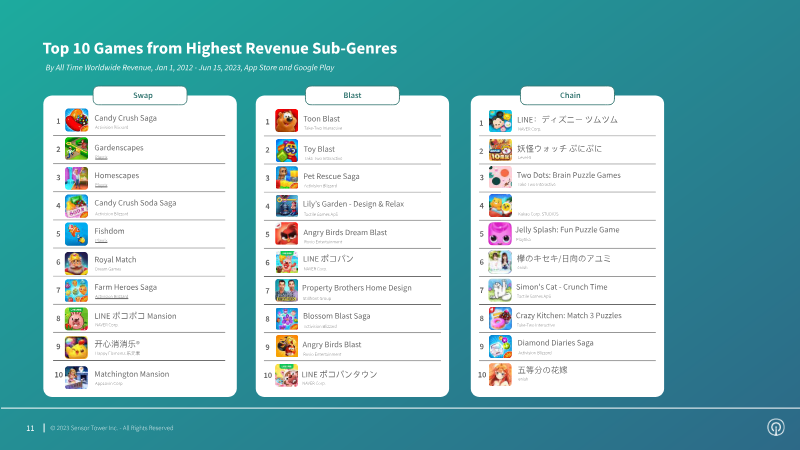
See it on page 11Successful puzzle titles are increasingly adopting complex meta-features such as narrative storytelling, decoration, and social clans to improve player retention.
See it on page 12Monetization strategies are moving away from purely ad-supported frameworks toward diversified models that incorporate season passes and loot boxes.
See it on page 3While traditional casual puzzle games still hold the largest overall market share, future growth is increasingly dependent on blending accessible gameplay with deeper hybrid revenue streams.
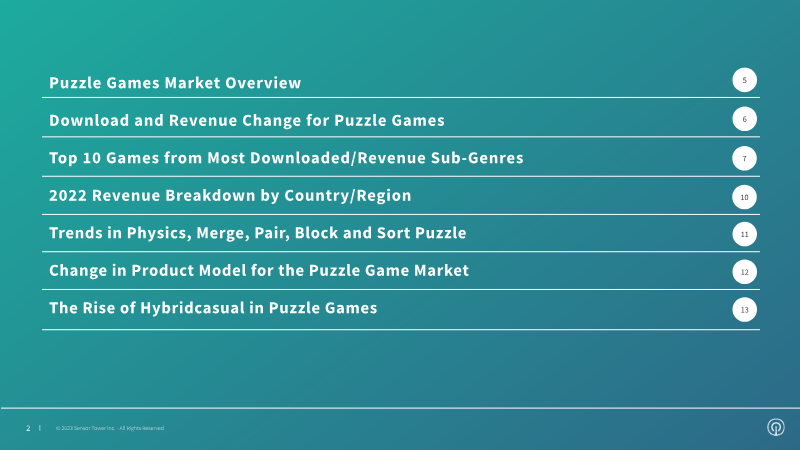
See it on page 2The puzzle game sector is undergoing a significant structural evolution, characterized by a shift in product models and monetization strategies. This analysis, covering global mobile market data from January 2018 through mid-2023, examines the performance of various sub-genres, including Swap, Blast, Merge, and Pair. The primary objective is to evaluate how developers are leveraging meta-features and hybrid monetization to sustain growth in a maturing market.
Key findings indicate that while traditional casual puzzle games continue to dominate total revenue, the hybridcasual model has emerged as a primary growth driver. Between early 2022 and early 2023, hybridcasual revenue surged by approximately 430%, signaling a departure from purely hypercasual, ad-supported frameworks. This transition is particularly evident in the Pair sub-genre, where hybridcasual revenue grew from 14.8% to 58.7% of the total within a single year. Conversely, many established sub-genres, such as Real-Time, Chain, and Bubble Shooter, experienced double-digit declines in both downloads and revenue during the same period.
Methodologically, the findings rely on consumer spending and download estimates from the Apple App Store and Google Play Store, excluding third-party Android marketplaces. The data highlights that successful titles increasingly integrate complex meta-features—such as narrative storytelling, decoration, and social clans—alongside diversified monetization tools like season passes and loot boxes. While casual games maintain the largest market share, the data suggests that future industry success depends on the ability to blend accessible gameplay with the deeper retention mechanics and hybrid revenue streams characteristic of the hybridcasual model.
This analysis examines the performance of the mobile puzzle game category during the first quarter of 2023, utilizing data from the Apptica platform across 35 countries. The study focuses on the Apple App Store and Google Play, evaluating market trends, subgenre popularity, and advertising activity to provide a comprehensive overview of the sector’s economic and engagement landscape. The puzzle category remains a significant driver of mobile gaming, accounting for approximately 20% of all gaming downloads on iOS and 11% on Android. While Android dominates in total download volume—capturing 80% of the market share compared to 20% on iOS—the revenue distribution favors iOS, which generates 56% of total puzzle game earnings. Candy Crush Saga emerged as the leading title for combined revenue, while Royal Match demonstrated exceptional performance on iOS. Match 3 games represent the dominant subgenre, accounting for roughly one-third of all downloads and between 56% and 86% of revenue across the analyzed markets. Other subgenres, such as Trivia, Merge, and Word games, show varying levels of regional success; for instance, Merge puzzles are particularly profitable in Japan, while Bubble Shooters maintain a strong download presence in India and Pakistan. Advertising remains a critical component of the category’s strategy, with puzzle games representing over 50% of ad traffic on iOS and more than 33% on Android. Despite this high volume of traffic, the number of unique creatives is slightly higher on Android (32%) than on iOS (30.2%). The United States leads in both total downloads and revenue, followed by major markets including India, Brazil, Japan, and Germany, confirming the global reach and sustained commercial viability of the puzzle genre.