
Report48 pages
Baromètre Annuel du Jeu Vidéo en France 2017
SYNDICAT NATIONAL DU JEUVIDEO DIGIWORLD X Une vidéo Pictanovo! a production, types d'aide : dedieau jeu ide paprojet, dgdi poes ades ! a egion Hauts-de 20.00€ rprojet. A4 frane lanait te f onds regional COUV Comit de lecture 16/02/18 2E DE May fone.con 1 503/18 Comnite de lecture21/09/18 B A R O M È T R E A N N U E L D U J E U V I D É O E N F R A N C E 08<sup>LE </...
- The global video game market is projected to grow from €60 billion in 2017 to nearly €80 billion by the end of 2021, with mobile gaming being the largest segment at €22.5 billion in 2017.
- The 'premium' economic model (paid-at-purchase with no additional content) has become dominant in 2017, adopted by 63.9% of studios, surpassing the free-to-play model which saw a significant 26.8-point decline.
- French video game companies are predominantly small, with an average of 29.5 full-time equivalent (FTE) employees in 2017, an increase of 3.2 FTE since 2016, though half of companies have 6 FTE or fewer.
- CDI (permanent contracts) remain the majority (60%) in the sector in 2017, increasing by 3.8 points from 2016, while the use of fixed-term contracts (CDD) also rose by 1.2 points.
- Developer studios are increasingly self-publishing, with 63% engaged in direct commercialization, though reliance on traditional publishers for expertise and resources remains necessary.
+1
Syndicat National du Jeu VidéoFeb 2018
Report48 pages
Mobile Gaming Benchmarks: 2018
The 2018 mobile gaming benchmark study analyzes performance across more than 60 000 titles that each attract at least 1,000 daily users, drawing on data from 850 million monthly active players over a full calendar year (July 2017‑June 2018). The methodology employs a dual presentation: an overall yearly view and genre‑specific breakdowns, with green, yellow, and red bands indicating top 15 %, median, and underperforming levels.
Retention metrics reveal that day‑28 retention peaks during the “cold and boring quarter” before Christmas, with top performers achieving 6.5‑7 % retention versus a median of only 1.5 %. Card, Casino, and Word games lead the field, each exceeding 6 % retention; Board and Trivia also perform well. Average session length follows a similar seasonal pattern, reaching roughly 15 minutes for top titles in winter compared to a median of 6.5 minutes, especially within Casino and Card genres where holiday engagement is strongest.
Monetization data show role‑playing games dominate ARPDAU, with leading titles earning 6–7 times the median and bottom performers generating none. Strategy games also outperform most other genres, achieving about twice the ARPDAU and conversion rates of their peers. Daily conversion rates for top‑15 % titles hover around 1.2 %, while the median sits near 0.4 % and bottom performers near 0.1 %.
The case study of Voodoo illustrates how a data‑driven acquisition and monetization pipeline can scale an indie studio into a top publisher. By scraping Play Store data, analyzing D1/D7 retention through GameAnalytics, and rapidly iterating on high‑potential titles, Voodoo launched multiple hits such as Paper.io (20 M+ downloads) and Helix Jump (310 M+). Rigorous KPI tracking and real‑time analytics enabled the studio to publish simultaneously while minimizing risk, demonstrating a scalable model for high‑performing mobile game portfolios.
- Top-tier mobile games achieve day-28 retention rates of 6.5–7% during the winter months, significantly outperforming the industry median of 1.5%.
- Role-playing games lead the market in ARPDAU, with top titles generating 6–7 times the revenue of the median performer.
- Strategy games consistently outperform the broader market, achieving double the ARPDAU and conversion rates of average mobile titles.
- Top-performing titles in the 85th percentile maintain a daily conversion rate of approximately 1.2%, while median titles struggle at 0.4% and bottom performers at 0.1%.
- Card, Casino, and Word games are the strongest performers for long-term retention, each maintaining rates exceeding 6%.
GameAnalyticsJan 2018

Report48 pages
Spelutvecklarindex 2018
Framsida (collage) & fristående illustrationer: Anna Nilsson Text & analys: Johanna Nylander Dataspelsbranschen är en samarbetsorganisation för ANGI och Spelplan-ASGD. ANGI representerar förlag samt distributörer och Spelplan-ASGD representerar utvecklare Dataspelsbranschen | Swedish Games Industry Klara norra kyrkogata 31, Box 22307 SE-104 22 Stockholm Kontakt: [email protected] NYCKELTAL Förändring 2012-2017 Oms.
- The Swedish game industry's revenue reached 14,695 MSEK in 2017, continuing a strong growth trend from 3,715 MSEK in 2012.
- Employment in the Swedish game industry increased by 24% (1,047 full-time positions) in 2017, nearly doubling the 558 new positions from 2016, but companies still face recruitment challenges and a shortage of skilled developers.
- The number of women in the Swedish game industry has quintupled in six years, with women now making up 20% of all employees, and more women are taking leadership roles, such as Ebba Ljungerud becoming CEO of Paradox in August 2018.
- Swedish game companies are active in mergers and acquisitions, with notable examples in 2017 including THQ Nordic acquiring Black Forest Games and Pieces Interactive, and Starbreeze acquiring Dhruva Interactive and Enterspace AB.
- The industry benefits from diversified revenue streams like 'games as a service' (GaaS), microtransactions, and subscription models, leading to more stable income and higher valuations for publicly traded game companies.
+1
DataspelsbranschenJan 2018
Report46 pages
Koulutusta Suomessa
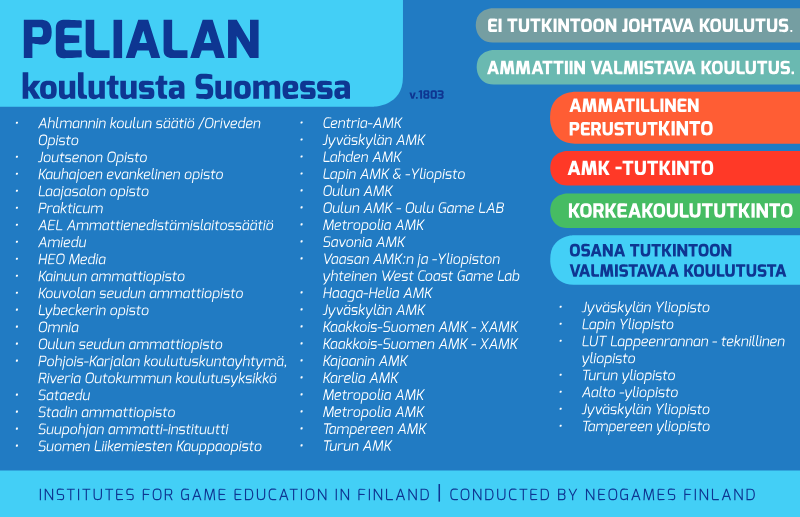
• Ahlmannin koulun säätiö /Oriveden • Opisto • • Joutsenon Opisto • • Kauhajoen evankelinen opisto • • Laajasalon opisto • • Prakticum • • AEL Ammattienedistämislaitossäätiö • • Amiedu • • HEO Media • • Kouvolan seudun ammattiopisto • • Lybeckerin opisto ...
- Finland offers a wide range of game industry education, from vocational training to university degrees, including programs focused on game programming, design, art, and business.
- Vocational education (AMMATILLINEN PERUSTUTKINTO) includes programs like Datonomi, Media-alan perustutkinto (Animation and Game Industry), and Peliohjelmoija, with durations typically ranging from 2 to 3 years.
- Universities of Applied Sciences (AMK) offer Bachelor's degrees (AMK-TUTKINTO) in fields such as Information Processing (Tietojenkäsittely) and Culture and Arts (Game Design), generally lasting 3.5 to 4 years.
- Several institutions offer non-degree game-related training, such as 'Kohti Pelialaa' at Joutsenon Opisto (9 months, 31 ECTS), 'Spelproduktion' at Prakticum (1 year, 60 ECTS), and 'Pelisuunnittelu' at HEO Media (9 months, 60 ECTS).
- Specialized programs exist, like Oulu Game LAB (Oulun AMK), West Coast Game Lab (Vaasan AMK & Yliopisto), and Metropolia AMK's 3D-animation and visualization with a focus on game graphics.
+1
Neogames FinlandJan 2018
Whitepaper84 pages
Libro Blanco del Desarrollo Español de los Videojuegos
LIBRO CENTRO UNIVERSITARIO Fando Eurapeo de DE TECNOLOGIA Y ARTE DIGITAL Ung manere de hacer Eurapa Asociación Española de Empresas Productoras y Desarrolladoras de Videojuegos y Software de Entretenimiento 1 . INTRODUCCIÓN 05 2. CADENA DE VALOR DE LA INDUSTRIA DEL VIDEOJUEGO 07 2.1. Cadena de valor tradicional de la industria de videojuegos 08 2.2.
- The global gaming market had 1.231 billion active players by the end of 2013, representing over half of the world's internet-connected population and 17.5% of the total global population.
- The gamification business is projected for exponential growth, with Markets And Markets estimating a potential business of $5.5 trillion USD by 2018, growing at a 67.1% annual rate between 2013 and 2018.
- The Spanish video game sector increased employment by 29% in 2013, with 65% of contracts being permanent, making it a significant job creator for highly qualified young professionals.
- In 2012, the Russian video game industry generated $1.3 billion, a 30% increase from 2011, and its market is expected to double in the next three years to reach $1.5 billion.
- The UK offers R&D tax deductions for video game companies, with SMEs receiving a 225% enhanced deduction on their R&D investment.
+2
DEV – Asociacion Espanola de Empresas Productoras y Desarrolladoras de VideojuegosJan 2018

Whitepaper59 pages
Guide RGPD pour les Développeurs de Jeux Vidéo
Le Règlement général pour la protection des données (RGPD) constitue le texte de référence en matière de protection des données personnelles au sein de l’Union Européenne. Les principaux objectifs du RGPD sont d'accroître à la fois la protection des personnes concernées par un traitement de leurs données à caractère personnel et la responsabilisation des acteurs de ce traitement.
- The GDPR significantly increases potential penalties for non-compliance, with fines up to 20 Million Euros or 4% of annual global turnover, a substantial increase from the previous 3 Million Euros maximum under the 1978 French law.
- Data Protection Officers (DPOs) are not held responsible for GDPR non-compliance; the data controller or processor bears this responsibility. DPOs cannot be penalized for performing their duties due to their independence, though they can be dismissed for reasons unrelated to their DPO role.
- Consent under GDPR must be a free, specific, informed, and unambiguous indication of the data subject's wishes, given by a statement or clear affirmative action, and the data controller must be able to prove valid consent.
- Processing 'sensitive data' (special categories of personal data) is generally prohibited unless specific exceptions apply, such as explicit consent from the data subject for defined purposes.
- Data controllers must facilitate the exercise of data subjects' rights (access, rectification, erasure, etc.), responding within one month (or two for complex cases) and providing reasons if a request is denied, with these services generally being free unless requests are unfounded or repetitive.
reTeenmeepeJan 2018

Report17 pages
Baromètre Annuel du Jeu Vidéo en France Edition 2018
The 2018 Annual Barometer of the Video Game Industry in France provides a comprehensive analysis of the French gaming sector’s economic health, employment trends, and production landscape. Produced through a collaboration between the Syndicat National du Jeu Vidéo (SNJV) and IDATE DigiWorld, the study aims to capture the industry's current activity levels and future outlook. The methodology involved an online survey conducted between June and August 2018, targeting both SNJV members and non-member companies, including development studios, publishers, and service providers.
Key findings reveal a dynamic and predominantly independent industry, with 93% of studios identifying as independent. The sector is characterized by a strong entrepreneurial spirit, as 56% of development studios are less than five years old. Production remains robust, with 1,200 games in development during 2018, two-thirds of which represent new intellectual properties. Studios show a clear preference for PC development, followed by mobile and console platforms. Financially, the industry relies heavily on self-financing, though there is a growing reliance on public support mechanisms, with 62% of studios utilizing regional, national, or European aid.
Employment in the sector is marked by high qualification levels and steady growth. In 2018, the industry supported an average of 9.5 full-time equivalent employees per studio, with 86% of these roles held under permanent contracts. Projections indicate the creation of 650 to 850 new jobs annually, reflecting a positive outlook. Industry leaders express significant confidence in both their individual companies and the broader French gaming ecosystem, with 76% of respondents viewing France as an attractive territory for video game production. The report concludes that the industry is increasingly export-oriented, with 40% of studio revenue generated internationally.
- The French video game industry is overwhelmingly independent, with 93% of studios operating independently and 56% of development studios being less than five years old.
- In 2018, the sector had 1,200 games in active development, with two-thirds of these projects representing new intellectual properties.
- Public funding is a critical pillar of the industry, with 62% of studios utilizing regional, national, or European financial support mechanisms.
- The sector demonstrates strong export performance, with 40% of total studio revenue generated from international markets.
- Employment is stable and growing, with 86% of the average 9.5 full-time equivalent employees per studio held under permanent contracts.
Syndicat National du Jeu VidéoJan 2018
Report27 pages
Jahresbericht der Deutschen Games-Branche 2018
01 Gamer in Deutschland 6 02 Markt für Computer- und 12 .2 Umsätze mit virtuellen Gütern und Zusatzinhalten sowie Abonnements .3 Umsätze mit Gebühren für Online-Netzwerke 03 Games-Branche in Deutschland 22 .1 Beschäftigtenzahlen und Unternehmen .4 Die 10 Forderungen der Games-Branche 04 eSports 36 05 gamescom 40 06 Deutscher Computerspielpreis 42 07 Unterhaltungssof...
- The German games market generated 2.2 billion Euros in 2017, growing 10% from 2016. This growth was driven by a 21% increase in revenue from virtual goods and additional content (reaching 1.01 billion Euros) and a 57% increase in revenue from online network fees (reaching 179 million Euros).
- Smartphone gaming has surpassed PC as the most popular gaming platform in Germany, with 18.2 million smartphone gamers compared to 17.3 million PC gamers in 2017. Console gaming also saw significant engagement with 16 million players.
- The German games industry is largely mid-sized, with 90% of companies generating up to 5 million Euros in annual revenue. It also boasts a high export quota, with 46% of its revenue earned outside Germany, significantly higher than the music (9%) and film/TV (4%) industries.
- The market share of German game developments continues to decline, reaching 5.4% in 2017 (down from 6.9% in 2014). This is particularly evident in mobile gaming, where the share of German-developed apps dropped from 4.2% to 3.7% due to increased competition and high marketing costs.
- The gamescom event attracted over 355,000 visitors in 2017, maintaining its position as the world's largest event for games. The number of exhibitors also grew by 6% to 703.
+1
game – Verband der deutschen Games-Branche e. V.Jan 2018
Report51 pages
The Games Monitor 2018
We are honored to present The Games Monitor 2018 edition with the latest facts, figures, trends and developments in the Dutch games industry. The Games Monitor was first published in 2012 and was followed by new research in 2015. Both reports generated a lot of interest into the Dutch games industry’s facts and figures, which is why we are pleased to be able to provide you with an update for 2018.
- The Dutch games industry saw a net job growth of over 60% concentrated in Utrecht, Eindhoven, and Amsterdam between 2015 and 2018.
- The total number of entertainment game companies increased by over 50 since 2015, continuing a previous trend, while the number of applied game developers stabilized at 114 companies.
- Applied games have a strong foothold in the Dutch industry, with healthcare and education remaining the largest market segments for applied game companies, and 62% of studios working on five or more projects in 2018.
- Dutch game companies are most positive about growth for mobile games, consoles/PC, and Augmented Reality (AR), but less so for Virtual Reality (VR) due to expensive hardware and lack of user-friendliness.
- Key challenges for both applied and entertainment game studios include finding enough players/sales, acquiring sufficient funds, and securing suitable personnel, with a noted lack of investors in the Netherlands.
+2
Dutch Games AssociationJan 2018
Report6 pages
Games Monitor: The Netherlands 2018
The Games Monitor 2018 provides a comprehensive analysis of the Dutch video games industry, tracking its evolution and maturation between 2015 and 2018. The industry is defined by companies whose core activities involve the development, production, publication, or distribution of electronic games, categorized into entertainment and applied (serious) games. The research methodology combined desk research with a survey of 165 companies, supplemented by industry roundtable discussions to validate findings.
The Dutch games sector experienced accelerated growth during the 2015–2018 period, characterized by an average annual job increase of 10 percent. By the end of 2018, the industry comprised 575 companies and 3,850 jobs, generating an estimated annual turnover of €225–300 million. While the average company size remains small at approximately seven employees, there is a clear trend toward scaling up, evidenced by a significant increase in mid-sized firms employing between 11 and 100 people. Geographically, the industry is concentrated in major urban centers, with Amsterdam, Utrecht, and Eindhoven accounting for over 60 percent of net job growth.
Market dynamics show a strong expansion in entertainment game development, which grew by 33 percent, while the applied games sector—primarily serving healthcare, education, and government—has stabilized. Business models in the entertainment sector rely heavily on premium monetization and in-app advertising, whereas applied studios frequently utilize work-for-hire models. The educational landscape remains robust, with 44 game-related study programs producing over 900 graduates annually. Overall, the industry is transitioning toward a more mature, competitive state, marked by increased productivity, strategic acquisitions, and international expansion.
- The Dutch games industry reached 575 companies and 3,850 jobs by the end of 2018, generating an estimated annual turnover of €225–300 million.
- The sector experienced accelerated growth between 2015 and 2018, maintaining an average annual job increase of 10 percent.
- Entertainment game development expanded by 33 percent, while the applied games sector, serving healthcare, education, and government, stabilized.
- Industry growth is highly centralized, with Amsterdam, Utrecht, and Eindhoven accounting for over 60 percent of net job gains.
- While the average firm size remains small at seven employees, there is a clear trend toward scaling, with a notable increase in mid-sized companies employing 11 to 100 people.
+1
Dutch Games AssociationJan 2018
Report35 pages
The Data Behind 10 Years of the iOS App Store – 2018
The iOS App Store underwent a profound transformation between 2010 and 2018, evolving from a nascent marketplace into a mature global economy characterized by massive revenue growth and a shift in monetization strategies. During this period, the platform facilitated over 170 billion downloads and generated $130 billion in consumer spend. While download volume grew at a steady compound annual growth rate of 15%, revenue surged at 52%, signaling a highly lucrative ecosystem where nearly 10,000 individual apps reached at least $1 million in annual consumer spend by 2017.
The gaming sector emerged as the primary economic engine of the platform, accounting for 75% of total consumer spend despite representing only 31% of total downloads. This financial dominance was mirrored by a fundamental shift in business models, as the industry moved away from paid downloads—which fell to less than 1% of the market—toward free-to-play mechanics and in-app subscriptions. Clash of Clans and Netflix established themselves as the all-time leaders in consumer spend for games and non-games respectively, while Facebook maintained the highest volume of total downloads.
Geographically, the center of the app economy shifted toward the Asia-Pacific region, which now accounts for nearly 60% of global iOS revenue. China, in particular, experienced a meteoric rise, overtaking the United States in 2016 to become the world’s largest market for both downloads and spending. This regional growth was largely propelled by domestic tech giants such as Tencent, Baidu, and NetEase. As the marketplace continues to mature, data-driven insights from providers like App Annie remain essential for businesses navigating this complex, multi-billion dollar landscape.
- The gaming sector is the primary economic driver of the iOS App Store, accounting for 75% of total consumer spend despite representing only 31% of total downloads.
- Between 2010 and 2018, the platform generated $130 billion in consumer spend, with revenue growing at a 52% compound annual growth rate compared to a 15% growth rate for downloads.
- The Asia-Pacific region now accounts for nearly 60% of global iOS revenue, with China overtaking the United States in 2016 to become the largest market for both downloads and spending.
- Monetization has shifted decisively away from paid downloads, which now represent less than 1% of the market, in favor of free-to-play mechanics and in-app subscriptions.
- By 2017, the ecosystem matured to the point where nearly 10,000 individual apps were generating at least $1 million in annual consumer spend.
+1
data.aiJan 2018
Report31 pages
A Global Analysis of Mobile Gaming Benchmarks: 2018 Edition
The mobile gaming landscape between July 2017 and June 2018 was characterized by a widening performance gap between elite titles and the market median. Analysis of over 60,000 games and 850 million monthly active players reveals that top-tier titles in the 15th percentile maintain Day 1 retention rates exceeding 35%, whereas Day 28 retention across the board rarely surpasses 6%. This retention decay underscores the difficulty of long-term player engagement, leading industry leaders like Voodoo to implement strict 50% Day 1 retention thresholds to identify potential hits early in the development cycle.
Monetization metrics further illustrate this disparity, with top-performing games generating three to four times more revenue per paying user than average titles. The Role Playing, Strategy, and Casino genres dominate financial benchmarks, with elite performers achieving an average revenue per paying user of up to $40. Furthermore, the average revenue per daily active user for top-tier games is six times higher than the median, a success largely attributed to sophisticated A/B testing of price points and the implementation of reactive in-game offers.
As mobile games are projected to account for 76% of global app revenue, the ability to convert and retain players remains the primary differentiator for commercial success. While average games struggle with low conversion rates, top-performing titles achieve conversion metrics triple those of the median. These findings suggest that data-driven development and aggressive optimization of monetization funnels are essential requirements for competing in a market where the majority of value is concentrated among a small percentage of high-performing titles.
- Top-tier mobile games generate six times more revenue per daily active user than the market median, highlighting a massive performance gap between elite titles and the rest of the industry.
- Elite titles in the 15th percentile achieve Day 1 retention rates exceeding 35%, while industry-wide Day 28 retention struggles to surpass 6%.
- Leading publishers like Voodoo utilize a strict 50% Day 1 retention threshold as a primary filter to identify potential commercial hits early in development.
- Role Playing, Strategy, and Casino genres lead the market, with top performers achieving an average revenue per paying user of up to $40, which is three to four times higher than average titles.
- Top-performing games achieve conversion rates triple those of the market median, underscoring the necessity of aggressive monetization funnel optimization.
+1
GameAnalyticsJan 2018

Report34 pages
The Data Behind 10 Years of Google Play (2018)
This analysis examines the growth and performance of the Google Play Store over a nearly seven-year period, spanning from January 2012 to August 2018. Utilizing data from the App Annie platform, the findings track the evolution of the Android ecosystem from its early stages to a mature marketplace featuring over 2.8 million available apps. During this timeframe, the platform recorded nearly 330 billion total downloads and generated over $85 billion in consumer spend, with more than 5,000 individual apps surpassing the $1 million revenue milestone.
Geographic trends reveal a significant divide between volume and value. India leads the world in total downloads at 36.9 billion, followed closely by the United States and Brazil. However, Japan emerges as the most lucrative market, contributing $25.1 billion in consumer spend, significantly outpacing the United States and South Korea. The data highlights a shift in monetization strategies, particularly the 2017 transition toward in-app subscriptions. This change, supported by a reduction in Google’s transaction fees for long-term subscribers, resulted in a 55% growth in spend for non-gaming apps between 2016 and 2017.
The competitive landscape is dominated by major social media and gaming entities. Facebook-owned properties occupy the top four spots for all-time downloads, while LINE and Tinder lead in non-gaming consumer spend. In the gaming sector, Subway Surfers is the most downloaded title, but GungHo Online’s Puzzle & Dragons and Mixi’s Monster Strike lead in total revenue. Looking forward, the analysis projects continued aggressive growth, estimating that annual consumer spend on Google Play will reach $42 billion by 2022, a 90% increase from 2017 levels.
- Between 2012 and 2018, the Google Play Store generated over $85 billion in consumer spend across 330 billion total downloads, with more than 5,000 apps surpassing the $1 million revenue milestone.
- Annual consumer spend on Google Play is projected to reach $42 billion by 2022, representing a 90% increase from 2017 levels.
- While India leads in total download volume with 36.9 billion, Japan is the most lucrative market, contributing $25.1 billion in total consumer spend.
- A 2017 shift toward in-app subscriptions, supported by reduced transaction fees for long-term subscribers, drove a 55% growth in non-gaming app spend.
- Facebook-owned properties hold the top four spots for all-time downloads, while LINE and Tinder lead non-gaming consumer spend.
+3
data.aiJan 2018

Report42 pages
Libro Blanco de los Esports en España
Spain’s esports ecosystem is emerging as a distinct economic sector, yet it remains in an early‑stage development phase. The analysis underscores a rapid professionalisation of competitive gaming, with Spanish teams now incorporated as limited companies, employing full technical staff and often operating shared “gaming houses” that mirror structures seen in more mature markets. This organisational shift signals a move toward sustainable business models and deeper investment potential.
Audience metrics illustrate the sector’s expanding reach. In the first half of 2017, the Liga de Videojuegos Profesional (LVP) generated 9.7 million unique viewers on Twitch, representing a 57 percent year‑on‑year increase, while its YouTube video‑on‑demand content grew 16 percent in 2016. These figures sit within a broader Spanish‑speaking gaming community of approximately 37.5 million individuals, indicating a substantial base for future growth. The overall video‑game market in Spain produced €1.163 billion in 2016, confirming the financial relevance of gaming as a whole and providing a foundation for esports expansion.
Collectively, the data portray a vibrant yet nascent market where professional structures are taking shape, audience engagement is accelerating, and the surrounding gaming economy offers a solid fiscal backdrop. Continued investment in team infrastructure, content distribution, and talent development is likely to convert this early momentum into a more mature and economically significant esports industry in Spain.
- The Liga de Videojuegos Profesional (LVP) reached 9.7 million unique Twitch viewers in the first half of 2017, marking a 57 percent year-on-year increase.
- Spain's broader video game market generated €1.163 billion in 2016, providing a stable financial foundation for the emerging esports sector.
- Spanish esports teams are transitioning into professional limited companies that employ full technical staff and utilize structured gaming houses.
- The Spanish-speaking gaming community comprises approximately 37.5 million individuals, representing a significant addressable market for future expansion.
- YouTube video-on-demand content for the LVP grew by 16 percent during 2016.
AEVIJan 2018
Report121 pages
Videojuegos en España: Impacto Económico y Escenarios Fiscales
Spain’s video‑game industry is presented as a dynamic component of the national ICT services sector, whose economic relevance extends far beyond direct production. Using 2016 input‑output tables updated with INE data, the analysis quantifies the sector’s contribution to GDP, employment and value‑added, and evaluates how fiscal incentives and inter‑industry linkages shape its growth trajectory.
In 2016 the industry generated €1.177 billion in direct output, representing roughly 0.11 % of national GDP, and created 8 790 high‑skill jobs. When indirect and induced effects are incorporated, total activity rises to €3.577 billion, value‑added reaches €1.452 billion and employment expands to 22 828 positions, implying that each euro invested yields three euros of economic activity and that a game‑industry job supports 2.6 additional jobs elsewhere. The sector supplies 14.3 % of publishing output, 9.6 % of audiovisual production and 3.8 % of related services, yet its forward absorption and diffusion coefficients are low, indicating limited downstream impact compared with professional services.
Productivity analysis shows a 6.4 % annual decline in value‑added per employee within the broader editing segment, while revenue per worker remains modest at €144 k. Between 2014 and 2024, software publishing and cable‑free telecommunications emerge as the fastest‑growing Spanish activities, with annual expansions of 4.7 % and 4.2 % respectively, underscoring the sector’s alignment with broader digital trends.
Four fiscal‑policy scenarios are compared, and the tax‑credit option (E2) delivers the strongest stimulus, adding €627 million of production, €254 million of value‑added and 4 000 full‑time jobs, albeit at the cost of a modest deterioration in public‑finance balance. Methodologically, the study follows Frascati and Oslo standards, aggregates data at the two‑digit CNAE level, and employs a Leontief inverse to trace demand‑driven effects, ensuring international comparability of R&D, innovation and ICT metrics.
- The Spanish video game industry generates a total economic impact of €3.577 billion, with every €1 invested yielding €3 in total economic activity.
- The sector supports 22,828 total jobs when accounting for indirect and induced effects, with each direct industry position sustaining 2.6 additional jobs elsewhere.
- Implementing a tax-credit fiscal policy (Scenario E2) is projected to provide the strongest stimulus, adding €627 million in production and 4,000 full-time jobs to the economy.
- In 2016, the industry directly contributed €1.177 billion to GDP (0.11% of the national total) and employed 8,790 high-skill workers.
- Software publishing has emerged as a high-growth activity in Spain, expanding at an annual rate of 4.7% between 2014 and 2024.
+2
AEVIJan 2018

Report70 pages
Annual Report 2017
Games Workshop achieved record-breaking financial performance during the 2016/17 fiscal year, characterized by a 34% increase in revenue to £158.1 million and a doubling of operating profit to £38.3 million. This growth was balanced across all primary channels—trade, retail, and mail order—and supported by a robust gross margin of 72.4%. North America emerged as the largest geographic market, contributing £57.0 million to the total revenue. The company’s vertically integrated model, centered on its Nottingham manufacturing hub, produced 30 million miniatures and launched over 400 new products, while royalty income from licensed video games like Total War: Warhammer provided high-margin supplementary growth.
Strategic priorities focused on long-term stability and cash generation, resulting in a 72% return on capital and a 76% increase in dividends per share. Despite this success, the period involved significant administrative and leadership transitions. Long-standing Chairman Tom Kirby announced his retirement, and the board addressed a technical breach of the Companies Act 2006 regarding an "unlawful dividend" payment of £1.9 million. This was rectified through shareholder resolutions to release directors from liability and treat the payment as a loan offset by future dividends.
Operational investments included a major ERP system upgrade and a continued commitment to the UK Living Wage and universal profit-sharing, which saw a £4.9 million discretionary payment to the workforce. Environmental and governance disclosures highlight a reduction in carbon emissions and an 85% waste recycling rate. While the company maintains a conservative "survivalist" fiscal strategy, its strong liquidity position—ending the year with £17.9 million in cash and no debt—underpins its viability as a going concern through the 2020 horizon.
- Games Workshop achieved record financial performance in the 2016/17 fiscal year, with revenue increasing 34% to £158.1 million and operating profit doubling to £38.3 million.
- The company maintained a 72.4% gross margin and a 72% return on capital, supported by a debt-free balance sheet and £17.9 million in cash reserves.
- North America became the company's largest geographic market, contributing £57.0 million in revenue, while royalty income from licensed titles like Total War: Warhammer provided high-margin growth.
- The Nottingham manufacturing hub produced 30 million miniatures and launched over 400 new products, underpinned by a vertically integrated business model.
- Shareholders saw a 76% increase in dividends per share, despite the company addressing a technical breach of the Companies Act 2006 regarding an unlawful £1.9 million dividend payment.
Games Workshop GroupAug 2017

Report104 pages
State of the Polish Video Game Industry 2017
This report was made possible thanks to funding provided by the Ministry of Culture and National Heritage, the Ministry of Development, Creative Europe Desk Poland and the Agency The research part of the project was coordinated by the Kraków Technology Park. The partners of the report include the Polish Games Association, Indie Games Poland Foundation, Grupa Onet S.A. and Gry-Online S.A.
- The Polish video game industry is growing, with 13 companies listed on the Warsaw Stock Exchange (WSE) having a combined worth of nearly PLN 9.5 billion and generating PLN 270 million in earnings last year. These WSE-listed developers contributed over PLN 67 million in taxes to the Polish treasury in 2016.
- Poland is a significant test market for game soft launches, particularly for mobile games, due to its comparable market significance to the US, UK, or Germany, and lower user acquisition costs compared to Western or Asian markets. While the percentage of paying players and amounts spent are lower than in Western Europe or North America, the gap is narrowing.
- The PlayStation brand, especially the PS4, dominates the console market in Poland, significantly outselling Xbox One. This trend is partly attributed to the high system requirements of cross-platform titles like The Witcher 3: Wild Hunt, which encouraged many PC players to switch to consoles for a smaller hardware investment.
- The age distribution of Polish gamers shifted in 2016, with a significant decrease in the 15-24 age group (from 43% in 2015 to 31% in 2016), largely due to their migration from social network and PC gaming to mobile games (a 5% increase in mobile gaming for this age group).
- Asian companies are increasingly acquiring Western game developers and publishers, a trend observed over the past 1.5 years, with examples including Youzu buying Bigpoint, Netmarble acquiring Kabam, and Tencent purchasing Supercell. This indicates a growing interest from Asian giants and media conglomerates in the global video game market.
+2
Kraków Technology ParkJan 2017
Report14 pages
State of the Game Industry 2017
The 2017 State of the Game Industry report provides a comprehensive snapshot of the global development landscape leading into the 31st Game Developers Conference. Based on a survey of over 4,500 professional game developers, the data primarily reflects the perspectives of "journeyman" creators in North America (67%) and Europe (22%), with the largest segment of respondents (37%) possessing three to six years of industry experience.
The findings highlight a significant shift in the immersive technology sector, where the HTC Vive emerged as the leading platform for VR/AR development, surpassing the Oculus Rift in both current usage and future interest. While 61% of developers are not yet involved in VR, those who are have increasingly moved toward the Vive, which 40% of respondents expect to support for their next projects. Despite concerns regarding hardware costs and motion sickness—which affects 83% of developers to some degree—75% of the industry views VR and AR as a sustainable long-term business, with a plurality predicting that augmented reality will be the dominant immersive tech within twenty years.
In the broader platform market, PC (53%) and mobile (38%) remain the primary targets for development. Notably, Android (54%) surpassed iOS (51%) in developer interest for the first time in the survey's history. Regarding consoles, developers expressed cautious optimism for the Nintendo Switch, with 50% predicting it will outsell the Wii U. However, the industry remains divided on mid-cycle hardware refreshes like the PS4 Pro and Project Scorpio; while only 5% view them negatively, 41% remain undecided about their impact on the traditional "fixed-spec" benefits of console development.
Financially, the industry continues to lean toward independence, with 55% of projects funded by internal company resources and 54% of developers operating without a traditional publisher. Confidence in crowdfunding saw a slight decline, with 46% of respondents expressing no interest in the model. Conversely, confidence in eSports reached an all-time high, with 90% of developers affirming its long-term sustainability as it moves toward mainstream social acceptance.
- The HTC Vive has overtaken the Oculus Rift as the primary platform for VR/AR development, with 40% of developers planning to support it for their next project.
- Despite 61% of developers not currently working in VR, 75% of the industry views immersive technology as a sustainable long-term business, with AR expected to dominate within 20 years.
- For the first time in the survey's history, developer interest in Android (54%) has surpassed iOS (51%) as a primary mobile target.
- The industry is shifting toward self-sufficiency, with 55% of projects funded internally and 54% of developers operating without a traditional publisher.
- Confidence in eSports has reached an all-time high, with 90% of developers affirming its long-term sustainability as a mainstream fixture.
+1
Game Developers ConferenceJan 2017

Report47 pages
Corporate Responsibility Report 2017
Modern Times Group (MTG) presented a comprehensive overview of its corporate responsibility performance for 2017, positioning itself as a global digital‑entertainment leader with approximately 3,700 employees and net sales of €16‑17 billion SEK. The report emphasizes MTG’s commitment to “media for good,” detailing initiatives that safeguard children through parental controls, audio‑description (covering 15 % of output) and subtitles (89 % of output), and noting a decline in broadcast‑compliance complaints to 49, with none upheld by Ofcom. Recognition of its children’s programming was underscored by a Kristallen award.
Diversity and inclusion formed a central pillar of the strategy, with the workforce representing 59 nationalities and achieving near‑gender parity in Sweden and Finland (48 % women). The company set a 50/50 gender‑balance target for 2020, yet disclosed a persistent gender‑pay gap—women earned 66‑67 % of men’s basic salary, and female representation fell to 20 % at senior‑executive levels. Employee engagement remained high, reflected in an 84 % satisfaction rate and an 88 % sense of pride, while turnover stood at 16.5 %, driven primarily by male departures.
Environmental performance revealed a 49.7 % increase in total greenhouse‑gas emissions versus 2016, largely attributable to the inclusion of MTGx operations and air travel, which accounted for roughly 70 % of emissions. Excluding air travel, emissions declined 12 % year‑on‑year, and overall energy consumption dropped from 71,782 GJ in 2015 to 51,459 GJ in 2017. The group’s external gaming arm, alongside its esports and digital‑entertainment divisions, contributed to a diversified portfolio spanning Europe and North America.
Independent assurance by Ethos International confirmed compliance with GRI Core “in‑accordance” standards, identifying minor calculation errors and recommending enhancements in materiality analysis, equality and diversity focus, supplier code enforcement, and HR system integration. Stakeholder surveys and user testing were highlighted as effective mechanisms for aligning responsibility initiatives with customer expectations.
- MTG reported a 49.7% increase in total greenhouse-gas emissions in 2017 compared to 2016, with air travel accounting for approximately 70% of the company's total emissions.
- While MTG achieved near-gender parity in Sweden and Finland at 48%, female representation at the senior-executive level remained low at 20%, and women earned only 66–67% of the basic salary of their male counterparts.
- The company set a formal target to achieve a 50/50 gender balance across its workforce by 2020.
- MTG demonstrated strong broadcast compliance in 2017, recording 49 complaints with zero upheld by Ofcom, while 89% of output included subtitles and 15% included audio-description.
- Total energy consumption across the group decreased significantly from 71,782 GJ in 2015 to 51,459 GJ in 2017.
+1
Modern Times GroupJan 2017

Report30 pages
TIGA Genre Report 2016
Breakdown of platform releases Examples from different genres TIGA represents developers, digital publishers, service companies and education providers and is the trade association for the video games industry. Our core purpose is to strengthen the games development and digital publishing sector. We achieve this by campaigning for the industry in the corridors of power, championing the industry in the media and helping our members commercially.
- Action/Adventure is the most common game genre, with over 45 releases, followed by Arcade and Puzzle/Trivia, each with over 30 releases.
- Mobile platforms (iOS, Android, Windows Phone) show a higher number of releases in Casual, Puzzle/Trivia, and Action/Adventure genres compared to other genres.
- Desktop platforms (PC, Mac, Linux) have a significantly higher number of releases in Action/Adventure and RPG genres, with over 70 and 60 releases respectively.
- The UK has a strong history of developing Action/Adventure games, with many notable titles originating from the country, though other countries also excel in this genre.
- UK developers have a good track record in sports games, producing titles like 'Match Day' and 'Daley Thomson’s Decathlon', and are exploring new casual sports experiences.
TIGAJan 2016