Report34 pages
Creative Industries Statistics: United Kingdom (August 2020)
Creative Industries Statistics United Kingdom August 2020 Released: Official Statistics on Film, High-End 13 August 2020 Television, Animation, Video Games, Next release: Children’s Television, Theatre, Orchestra, Summer 2021 and Museums & Galleries Exhibition Frequency of release: Tax Reliefs https://www.gov.uk/government/org Section 1: Key points and summary 4 1.1 Summary ...
- Since its introduction in 2007, Film Tax Relief (FTR) has supported 3,470 films, accounting for £18.4 billion in UK expenditure. In 2019-20 alone, 300 films claimed FTR with £2.5 billion in UK expenditure.
- High-End Television (HETV) Tax Relief, introduced in 2013, has supported 635 programmes with £5.9 billion in UK expenditure. In 2019-20, 110 programmes claimed HETV tax relief, totaling £1.5 billion in UK expenditure.
- Video Games Tax Relief (VGTR) paid out an estimated £161 million for 2018-19, with 310 claims made by 270 companies. Since its introduction in 2014, the relief aims to promote sustainable production of culturally relevant video games in the UK.
- Theatre Tax Relief (TTR) paid out £71 million in 2019-20 across 1,115 claims, representing 3,580 productions. Since its 2014 introduction, TTR has disbursed £280 million for 12,065 productions.
- Children's Television Tax Relief (CTR) supported 25 British children's TV programmes in 2019-20 with £30 million in UK expenditure. Since 2015, 280 programmes have claimed CTR, totaling £299 million in UK expenditure and £59 million in payments.
HM RevenueAug 2020

Report82 pages
Annual Report 2020
Games Workshop achieved record-breaking financial results for the 2019/20 fiscal year, demonstrating significant resilience despite the operational disruptions caused by the COVID-19 pandemic. Annual revenue rose 5.1% to £269.7 million, while profit before tax reached £89.4 million. This performance marks the fourth consecutive year of record growth, driven primarily by a robust trade segment—which now accounts for 52% of total revenue—and a substantial increase in royalty income from licensing agreements in the video game and media sectors.
The company’s strategic focus remained on the global expansion of its Warhammer intellectual property and the modernization of its industrial infrastructure. Significant capital investments totaling £18 million were directed toward production and logistics expansions in Nottingham and North America, alongside the implementation of a new ERP system. While physical retail sales declined by 11% due to pandemic-related store closures, digital engagement and online sales saw marked growth. The company also successfully navigated the transition to IFRS 16 accounting standards, which brought £32.1 million in lease liabilities onto the balance sheet.
Geographically, North America remains the company's largest market, contributing £104.8 million to total revenue. Despite the economic uncertainties of the pandemic and Brexit, the Group maintained a strong liquidity position, ending the period with £52.9 million in cash and no utilized borrowing facilities. This financial stability allowed the board to maintain its commitment to shareholders through dividends of 145 pence per share and to support its workforce by providing full pay during shutdowns and distributing profit-share bonuses to all staff. The report concludes with a focus on long-term sustainability, ethical sourcing, and continued IP exploitation to ensure future viability.
- Games Workshop achieved record-breaking financial results for the 2019/20 fiscal year, with revenue rising 5.1% to £269.7 million and profit before tax reaching £89.4 million.
- The trade segment now accounts for 52% of total revenue, supported by a significant increase in royalty income from video game and media licensing.
- North America remains the company's largest market, contributing £104.8 million to total revenue despite pandemic-related operational disruptions.
- The company invested £18 million in capital projects, including production and logistics expansions in Nottingham and North America and the implementation of a new ERP system.
- Physical retail sales declined by 11% due to pandemic-related closures, though this was offset by growth in digital engagement and online sales.
+1
Games Workshop GroupAug 2020

Presentation40 pages
3Q FY2020 Presentation Material
CyberAgent’s performance during the third quarter of fiscal year 2020 remained resilient despite the economic disruptions caused by the COVID-19 pandemic. Consolidated sales reached 112.8 billion yen, a marginal year-over-year decrease of 0.7%, while operating profit stood at 8.2 billion yen. By the end of this period, the company had already achieved between 89% and 102% of its full-year operating profit forecasts. This stability was largely driven by the Internet Advertisement segment, which successfully offset declining demand in certain sectors by pivoting toward advertisers benefiting from stay-at-home trends, and the Game business, which generated 36.7 billion yen in quarterly revenue following major title anniversaries.
The media segment, centered on the streaming platform ABEMA, demonstrated significant growth with a 19.2% year-over-year increase in sales to 13.3 billion yen. This expansion was supported by a record 56 million downloads and a surge in the WINTICKET gambling transaction business, which doubled its volume to 7.2 billion yen. Strategic priorities for this segment include reaching one million ABEMA Premium subscribers by late 2020 and leveraging new virtual production technologies, such as Pay-Per-View systems, to enhance monetization.
Looking forward, the corporate strategy focuses on establishing ABEMA as a long-term financial pillar while maintaining market share in the advertising sector through AI-driven efficiency. In the gaming division, the emphasis remains on the dual approach of developing new intellectual properties and extending the lifecycle of existing titles through robust operational management. These efforts are underpinned by a broader commitment to ESG initiatives and information security, ensuring sustainable value creation across the company’s diverse digital portfolio.
- CyberAgent reported 112.8 billion yen in consolidated sales for 3Q FY2020, achieving 89% to 102% of its full-year operating profit forecast despite a marginal 0.7% year-over-year revenue decline.
- The Game business generated 36.7 billion yen in quarterly revenue, bolstered by major title anniversaries and a strategy focused on both new IP development and lifecycle extension for existing games.
- The media segment, anchored by the ABEMA streaming platform, grew sales by 19.2% year-over-year to 13.3 billion yen, supported by 56 million total downloads.
- WINTICKET gambling transactions doubled in volume to 7.2 billion yen, contributing significantly to the media segment's growth.
- The Internet Advertisement segment maintained stability by pivoting toward advertisers benefiting from stay-at-home trends to offset sector-specific demand declines.
+1
CyberAgentJul 2020
Report12 pages
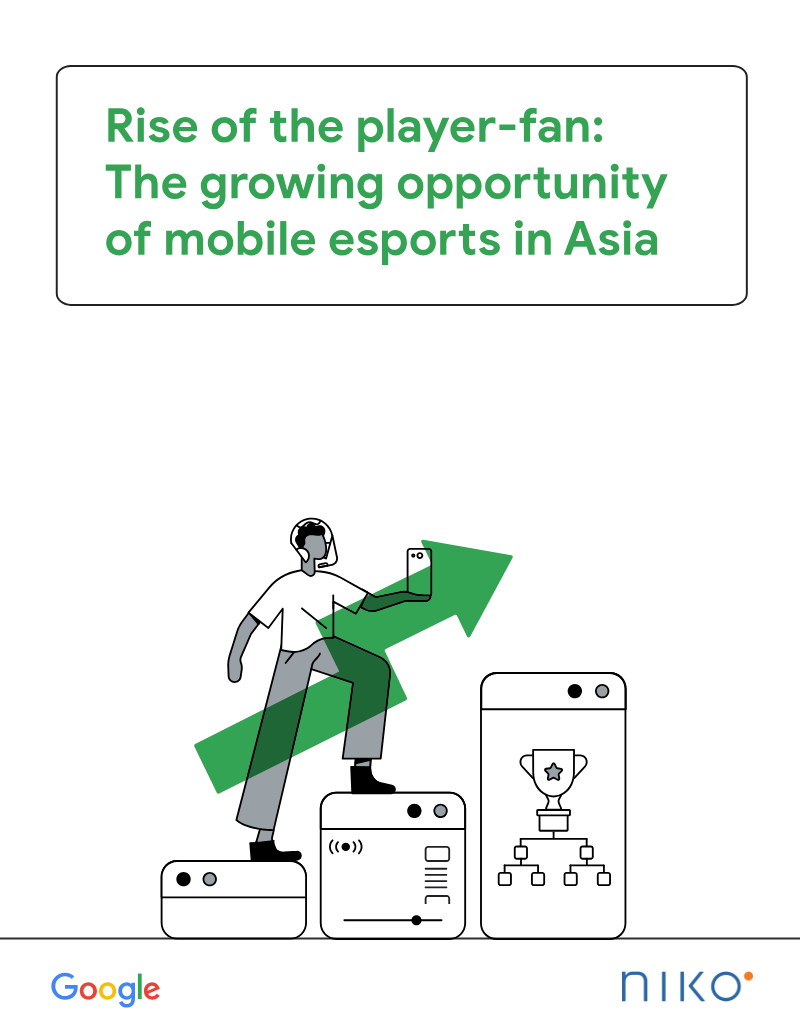
Rise of the Player-Fan: The Growing Opportunity of Mobile Esports in Asia
Mobile esports has emerged as a primary driver of player engagement and revenue across Asia, signaling a shift from traditional PC and console dominance to a mobile-first competitive landscape. The central thesis posits that Asia is the global epicenter of this evolution, fueled by a massive population of 1.5 billion gamers and a robust infrastructure of internet cafes, local streaming platforms, and increasing 5G penetration. By lowering hardware barriers to entry, mobile technology has transformed casual players into "player-fans" who both compete in and spectate high-stakes tournaments.
Key data points highlight the scale of this growth, with global esports prize pools increasing 40% between 2017 and 2019 to exceed $228 million. In 2019 alone, mobile esports generated $19.5 billion in global revenue, with Asia accounting for 68% of that total. China remains the largest single market, boasting 350 million esports fans, while Southeast Asia saw a 244% increase in tournament prize values between 2018 and 2019. The COVID-19 pandemic further accelerated these trends, with gamers in Asia spending up to 75% more time playing and viewership in China doubling during lockdowns.
The scope of this analysis covers major Asian markets including China, South Korea, Japan, India, and Southeast Asia, focusing on the period between 2017 and 2020. It examines industry segments ranging from hardware manufacturing and 5G infrastructure to specific game genres like MOBAs and Battle Royales. Methodology relies on primary data from Niko Partners, including consumer panels of over four million users, executive interviews, and market modeling to provide a comprehensive outlook on the region's competitive gaming trajectory.
- Asia dominates the global mobile esports landscape, accounting for 68% of the $19.5 billion in total global mobile esports revenue generated in 2019.
- China is the world's largest esports market with 350 million fans, while Southeast Asia experienced a 244% surge in tournament prize values between 2018 and 2019.
- Global esports prize pools grew by 40% between 2017 and 2019, reaching a total valuation exceeding $228 million.
- Mobile technology has lowered hardware barriers to entry for 1.5 billion Asian gamers, effectively converting casual players into active competitive participants and spectators.
- The COVID-19 pandemic acted as a significant growth catalyst in Asia, leading to a 75% increase in time spent gaming and a doubling of esports viewership in China.
+1
Niko PartnersJul 2020

Presentation1 pages
Play Like a Girl: Key Ways to Engage Asia's Growing Female Gaming Audience
The female gaming demographic in Asia represents a primary catalyst for regional market growth, expanding at a significantly faster rate than the male audience. In 2019, Asia accounted for 48% of global gaming revenue, totaling $69 billion. Within this landscape, female players grew to comprise 38% of the 1.33 billion total gamers in the region, up from 32% in 2017. This shift is particularly pronounced in China, where 45% of the gaming population is female, followed by South Korea, Japan, and Southeast Asia at 40% each.
Mobile technology serves as the dominant platform for this demographic, with 95% of Asia’s female gamers playing on mobile devices compared to much smaller shares for PC and consoles. While female players typically engage in shorter sessions than males—with 60% playing up to seven hours per week—their spending power is substantial. Female gamers contributed 35% of mobile gaming revenue in 2019, a figure projected to reach 39% in 2020. Contrary to casual stereotypes, these players show a strong preference for complex genres including MMORPGs, MOBAs, and shooters, particularly those featuring deep strategy, diverse character options, and immersive storylines.
The rise of female-specific esports leagues and professional teams further signals a maturing market with expanding sponsorship opportunities. This upward trajectory was accelerated by the COVID-19 pandemic; data from 2020 indicates that over 96% of female gamers in China increased their playtime during lockdowns, with a majority also increasing their in-game spending. To effectively engage this audience, developers and marketers must prioritize mobile-first strategies and integrate sophisticated gameplay elements that reflect the diverse interests of the modern female gamer.
- Female gamers in Asia grew to 38% of the 1.33 billion total regional gaming population by 2019, up from 32% in 2017.
- Mobile is the primary platform for this demographic, with 95% of female gamers in Asia playing on mobile devices.
- Female gamers contributed 35% of mobile gaming revenue in 2019, with projections estimating an increase to 39% in 2020.
- Contrary to casual gaming stereotypes, female players in Asia show a strong preference for complex genres including MMORPGs, MOBAs, and shooters.
- China leads the region with 45% of its gaming population being female, while South Korea, Japan, and Southeast Asia each report 40%.
+1
Niko PartnersJun 2020

Presentation43 pages
2Q FY2020 Presentation Material: January to March 2020
CyberAgent achieved record-high financial performance during the second quarter of fiscal year 2020, with consolidated sales reaching 129.1 billion yen and operating profit surging 45.3% year-over-year to 12.4 billion yen. This growth was primarily anchored by the Game Business, which generated 44.8 billion yen in revenue. Success in this segment was driven by high-profile anniversary events for established titles like Granblue Fantasy and the strong market debut of KonoSuba: Fantastic Days. By the end of the first half, the company had already secured between 63% and 72% of its full-year profit targets, though projections for the remainder of the year remain cautious due to anticipated declines in advertising demand stemming from the COVID-19 pandemic.
The media segment, centered on the ABEMA streaming platform, demonstrated significant momentum as stay-at-home orders accelerated user adoption. ABEMA reached 52 million downloads and grew its premium subscriber base to 676,000, with a clear trajectory toward one million subscribers by the end of the calendar year. While the segment still operates at a loss, these losses narrowed to 4.2 billion yen as sales rose nearly 19%. Monetization efforts are diversifying beyond traditional advertising into subscriptions and related services, such as the WinTicket betting platform, which saw transaction volumes double quarter-on-quarter to 3.5 billion yen.
Strategic priorities for the future focus on balancing short-term gains with long-term operational stability. In the gaming sector, the emphasis remains on high-quality development and extending the lifecycle of existing intellectual properties. Simultaneously, the media division is pivoting toward a multi-faceted revenue model to ensure the sustainability of its expanding digital ecosystem. Despite the broader economic uncertainty introduced by global health trends, the current fiscal trajectory suggests a robust foundation built on digital entertainment and diversified media services.
- CyberAgent achieved record-high Q2 FY2020 consolidated sales of 129.1 billion yen and a 45.3% year-over-year increase in operating profit to 12.4 billion yen.
- The Game Business drove performance with 44.8 billion yen in revenue, bolstered by anniversary events for Granblue Fantasy and the successful launch of KonoSuba: Fantastic Days.
- By the end of the first half of FY2020, CyberAgent had already achieved 63% to 72% of its full-year profit targets.
- The ABEMA streaming platform reached 52 million downloads and 676,000 premium subscribers, with management targeting one million subscribers by the end of the calendar year.
- The media segment narrowed its operating loss to 4.2 billion yen as sales grew nearly 19%, supported by a doubling of WinTicket betting transaction volumes to 3.5 billion yen.
+1
CyberAgentApr 2020

Presentation26 pages
1Q FY2020 Presentation Material: October to December 2019
Financial performance for the first quarter of fiscal year 2020, covering October to December 2019, reflects a period of strategic investment and steady growth across core digital segments. Net sales reached 115.6 billion yen, representing approximately 25% of the full-year forecast of 465 billion yen. Operating income and ordinary income both stood at 7.7 billion yen, tracking toward an annual target range of 28 billion to 32 billion yen. Profit attributable to owners of the parent was 1.4 billion yen, fulfilling roughly 15% to 18% of the projected 8 billion to 10 billion yen annual goal.
The gaming segment maintained momentum through the performance of established titles and new releases. Key contributors included the third anniversary of Princess Connect! Re:Dive and the ongoing success of Granblue Fantasy and BanG Dream! Girls Band Party. New market entries such as Kick-Flight and the global expansion of Monster Strike further diversified the portfolio. In the media sector, the Abema platform demonstrated significant scaling, reaching 48 million downloads by the end of the quarter. Weekly active users showed consistent upward trends, supported by diverse programming including news, sports, and original reality content like Weekend Homestay.
Strategic focus remains on the medium- and long-term monetization of the media business. The revenue model is evolving to balance advertising and subscription income with expanding peripheral businesses, such as the WinTicket betting service. This diversification aims to accelerate the path to profitability for the streaming segment. Geographically centered in Shibuya, Japan, the organizational strategy emphasizes integrated reporting and a unified corporate culture to drive innovation across advertising, gaming, and digital media services.
- The company generated 115.6 billion yen in net sales for 1Q FY2020, meeting approximately 25% of its 465 billion yen full-year revenue target.
- Operating and ordinary income both reached 7.7 billion yen, tracking toward the annual target range of 28 billion to 32 billion yen.
- Profit attributable to owners of the parent was 1.4 billion yen, representing 15% to 18% of the projected 8 billion to 10 billion yen annual goal.
- The Abema media platform reached 48 million total downloads by the end of December 2019, supported by growth in weekly active users across news, sports, and original reality programming.
- Gaming segment momentum was driven by established titles including Granblue Fantasy, BanG Dream! Girls Band Party, and the third anniversary of Princess Connect! Re:Dive.
+1
CyberAgentJan 2020
Report33 pages
State of the Game Industry 2020
The global game development landscape in 2020 is characterized by a transition toward next-generation hardware and a diversifying array of digital storefronts. While PC and mobile remain the primary platforms for the majority of the nearly 4,000 surveyed professionals, significant momentum is building for the PlayStation 5 and Xbox Series X, with over a third of developers working on cross-generational titles. In the immersive reality sector, the Oculus Quest has emerged as the leading platform for both interest and active development, signaling a shift away from tethered VR solutions. Despite this technological evolution, the industry remains heavily self-funded and continues to struggle with demographic representation, as three-quarters of the workforce identifies as male and nearly half of all studios lack formal diversity or accessibility initiatives.
Labor practices and monetization models are currently undergoing intense scrutiny. Although a majority of developers support unionization, there is widespread skepticism regarding its near-term implementation. Workweeks exceeding 40 hours remain common, often driven by self-imposed pressure rather than external mandates. Economically, the industry is moving toward "pay to download" and subscription models, yet deep dissatisfaction exists regarding traditional revenue splits. Only a small fraction of developers believe the standard 30% platform cut is justified, with most advocating for a more equitable 10-15% share.
Confidence in emerging digital ecosystems varies significantly based on perceived infrastructure and business viability. The Epic Games Store maintains the highest level of long-term optimism among developers, whereas Google Stadia faces substantial doubt regarding its technical requirements and pricing. Apple Arcade occupies a speculative middle ground, reflecting a broader uncertainty about the long-term profitability of subscription-based gaming. As the workforce remains relatively young—with over 60% of professionals possessing less than a decade of experience—the industry’s future trajectory depends on balancing these rapid technological shifts with sustainable labor practices and more equitable distribution models.
- The industry is experiencing a significant shift in revenue expectations, as most developers reject the standard 30% platform fee in favor of a 10-15% revenue split.
- Workforce demographics remain stagnant, with 75% of professionals identifying as male and nearly 50% of studios lacking formal diversity or accessibility initiatives.
- Labor concerns persist as workweeks exceeding 40 hours remain common, and while a majority of developers support unionization, there is widespread skepticism regarding its near-term feasibility.
- The Oculus Quest has become the dominant platform for immersive reality development, signaling a clear industry pivot away from tethered VR solutions.
- Developer sentiment toward digital storefronts is polarized: the Epic Games Store leads in long-term optimism, while Google Stadia faces significant doubt regarding its business viability.
+4
Game Developers ConferenceJan 2020
Report7 pages
AI's Ever-Growing Presence in Gaming: $1.8B in VC Investments
Venture capital investment in AI-focused gaming startups has experienced significant growth, totaling $1.8 billion between 2020 and 2024. This influx of capital reflects a strategic shift in investor interest toward verticalized AI tooling designed to enhance scalability and production efficiency within the gaming sector. By 2024, AI-focused startups accounted for approximately 65% of total deal activity in gaming infrastructure, signaling a move away from broader platform bets toward specialized technological solutions.
The investment landscape is categorized into three primary segments: in-game content generation, development infrastructure, and other AI-focused applications. Content generation, which includes tools for creating assets, worlds, and narrative elements, leads the market with $1.2 billion in deal value across 119 deals. Development infrastructure, encompassing productivity tools, testing automation, and backend analytics, secured $0.4 billion across 72 deals. The remaining $0.2 billion was directed toward marketing, influencer tools, and player analytics.
Methodologically, the analysis focuses on startups that received venture financing between 2020 and 2024, specifically excluding studios that utilize AI solely for internal production. The data reveals a robust compound annual growth rate of approximately 35% in deal value from 2022 to 2024. While early-stage rounds dominate the market, the average check size has tripled over the five-year period, rising from $2.6 million in 2020 to $7.3 million by 2024. Andreessen Horowitz, Bitkraft, and Y Combinator emerge as the most active investors, with Andreessen Horowitz leading in both the number of deals and total invested capital.
- Venture capital investment in AI-focused gaming startups reached $1.8 billion between 2020 and 2024, with deal value growing at a 35% compound annual rate from 2022 to 2024.
- AI-focused startups now account for approximately 65% of all gaming infrastructure deal activity, reflecting a strategic pivot toward specialized verticalized tooling over general platform investments.
- In-game content generation tools lead the market with $1.2 billion in funding across 119 deals, followed by $0.4 billion for development infrastructure and $0.2 billion for marketing and analytics.
- Average investment check sizes have tripled over the five-year period, increasing from $2.6 million in 2020 to $7.3 million by 2024.
- Andreessen Horowitz, Bitkraft, and Y Combinator are the most active investors in the space, with Andreessen Horowitz leading in both total deal count and capital deployed.
+2
GDevJan 2020

Report21 pages
Asia Spotlight Report: The Impact of COVID-19 on China’s Video Game Market in Q1 2020
The video game market in China experienced a significant surge in engagement and revenue during the first quarter of 2020, driven by widespread stay-at-home mandates during the COVID-19 pandemic. Total industry revenue for the quarter is estimated to have been approximately 30% higher than in the same period of 2019. This growth was characterized by increased mobile, PC, and console usage, as gamers sought entertainment and social connection during prolonged quarantine periods.
Key findings from an April 2020 survey of 1,057 Chinese gamers highlight the depth of this shift: 97.2% of respondents reported spending more time on mobile games, while 94.6% increased their time on PC titles. Spending also rose, with 81.6% of mobile gamers and 76.3% of PC gamers reporting higher expenditures during the lockdown. While major titles from publishers like Tencent and NetEase dominated the market, the period also saw a notable decline in the internet cafe sector, which was forced to close entirely. Survey data suggests a lasting impact on consumer behavior, as 57% of former internet cafe users indicated they do not intend to return to those venues once reopened.
The pandemic also forced a rapid evolution in industry operations, particularly within the esports and development sectors. Esports tournaments successfully migrated to online formats, supported by municipal government initiatives to reduce regulatory barriers. Conversely, game development and outsourcing studios faced productivity challenges, leading to project delays for some global titles. While the surge in home-based gaming provided a substantial revenue boost, the industry faced headwinds regarding hardware manufacturing, component scarcity, and a decline in advertising revenue for smaller, ad-supported titles. Overall, the period solidified gaming as a primary social and entertainment outlet for Chinese consumers, with many users reporting a newfound acceptance of gaming within their households.
- China’s video game market revenue in Q1 2020 was approximately 30% higher than in Q1 2019, driven by increased engagement during the COVID-19 quarantine period.
- Mobile gaming saw significant growth, with iOS weekly game downloads during the Lunar New Year 153% higher than in December 2019 and 81.6% of surveyed gamers reporting increased spending.
- PC gaming engagement surged, with 94.6% of surveyed players spending more time on PC titles and Steam reaching a global record of 18.8 million concurrent users on February 2, 2020.
- The closure of all 133,000 internet cafes in China eliminated a primary gaming venue for 115 million users, with 57% of surveyed cafe-goers stating they do not intend to return once restrictions are lifted.
- Esports tournaments successfully migrated to online formats to mitigate the impact of event cancellations, with 61.7% of surveyed gamers reporting increased viewership during the outbreak.
+2
Niko PartnersJan 2020

Report22 pages
2020 Year in Review: Digital Games and Interactive Media
The global digital games and interactive media industry experienced significant growth in 2020, with total revenue rising 12% year-over-year to $126.6 billion. This expansion was primarily driven by the COVID-19 pandemic, which forced consumers to remain at home and seek alternative forms of entertainment. As traditional leisure activities like professional sports and cinema were suspended, video games became a primary outlet for social interaction and entertainment, with 55% of U.S. residents reporting increased gaming activity as a direct result of the lockdowns.
Market performance was characterized by the dominance of free-to-play titles, which accounted for 78% of total digital revenue, largely fueled by mobile gaming in Asian markets. However, the premium games segment saw the most rapid growth, increasing by 28% as blockbuster releases like Animal Crossing: New Horizons and Call of Duty: Modern Warfare captured consumer spending. Gaming video content also emerged as a major pillar of the industry, reaching 1.2 billion viewers and generating $9.3 billion in revenue. Additionally, the virtual reality sector saw a 25% increase in game earnings, bolstered by the release of high-profile titles and the adoption of standalone headsets like the Oculus Quest 2.
The analysis relies on digital point-of-sale data from publishers, developers, and payment service providers, tracking the monthly spending of 195 million paying digital gamers worldwide. Findings indicate that while the initial surge in spending was tied to pandemic-related lockdowns, the long-term behavioral shifts in gaming habits are expected to persist. Looking ahead, the industry is projected to maintain its momentum, with ongoing trends including the consolidation of major publishers, the rise of subscription-based models, and the continued integration of mainstream brands and public figures into interactive digital spaces.
- The global digital games and interactive media industry grew 12% year-over-year in 2020, reaching $126.6 billion in total revenue.
- Free-to-play titles dominated the market, accounting for 78% of total digital revenue, primarily driven by mobile gaming in Asian markets.
- Premium game sales experienced the fastest growth at 28%, bolstered by high-profile releases such as Animal Crossing: New Horizons and Call of Duty: Modern Warfare.
- Gaming video content became a major industry pillar, attracting 1.2 billion viewers and generating $9.3 billion in revenue.
- The virtual reality sector saw a 25% increase in earnings, supported by the launch of major titles and the adoption of standalone hardware like the Oculus Quest 2.
+4
SuperDataJan 2020
Report11 pages
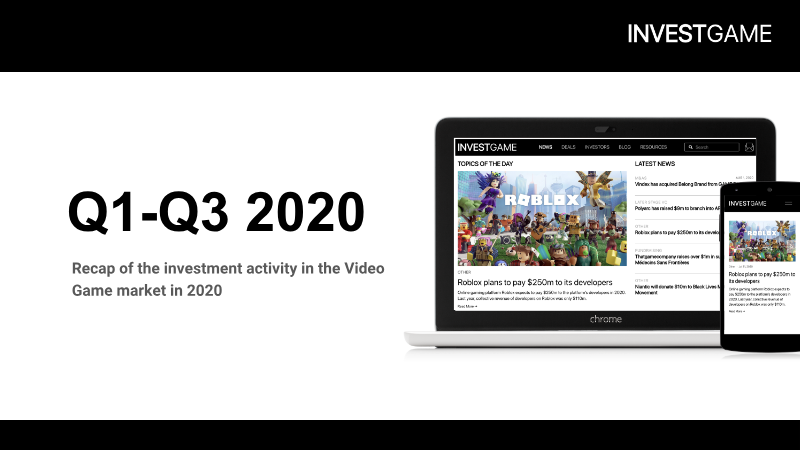
Investment Activity Report Q1–Q3 2020
The report documents investment activity in the global gaming industry from January to September 2020, covering mobile, PC & console, multiplatform, VR/AR, cloud‑native and esports segments. Total deal value reached $27.5 billion across 1,000 transactions, with gaming deals accounting for the largest share ($15.3 billion in 211 contracts). Platform & tech deals contributed $4 billion, esports $685 million and other categories $504 million. Public offerings dominated the capital‑raising landscape, generating $9.2 billion from 51 IPOs and PIPEs, while M&A activity totaled $6.6 billion across 132 deals and private venture investments added $4.7 billion from 254 rounds.
Early‑stage VC activity fell sharply after the COVID‑19 outbreak in May, dropping to 5–7 deals per month, but later‑stage and corporate funding remained relatively stable at 1–2 deals monthly until July. The period saw $2.7 billion raised by developers and publishers, with 69 pre‑seed/seed/Series A rounds and 9 Series B+ deals. U.S. firms dominated later‑stage funding (over 90% of value), whereas only 30% of early‑stage capital went to U.S. startups. Three high‑profile transactions—Scopely ($200 m), Roblox ($150 m), and Epic Games ($1.78 b)—accounted for 78% of total capital inflows.
M&A activity remained resilient, with major deals such as Zynga’s acquisition of Peak Games ($2 billion) and Microsoft’s purchase of ZeniMax ($7.5 billion). Tencent, Zynga, and Microsoft were the top strategic acquirers, collectively exceeding $11 billion in announced deals. Public market activity stalled early in the year but rebounded in June with IPOs from Archosaur Games ($280 m) and Kakao Games ($330 m). The report highlights a shift toward mobile acquisitions, sustained corporate investment despite pandemic disruptions, and a growing trend of large‑scale consolidations in the gaming sector.
- The global gaming industry saw $27.5 billion in total deal value across 1,000 transactions during the first nine months of 2020, with gaming-specific deals accounting for $15.3 billion.
- M&A activity was defined by large-scale consolidation, led by Microsoft’s $7.5 billion acquisition of ZeniMax and Zynga’s $2 billion purchase of Peak Games, with Tencent, Zynga, and Microsoft collectively exceeding $11 billion in deal value.
- Public offerings were the primary driver of capital, generating $9.2 billion from 51 IPOs and PIPEs, while private venture investments contributed $4.7 billion across 254 rounds.
- Three high-profile transactions—Epic Games ($1.78 billion), Scopely ($200 million), and Roblox ($150 million)—accounted for 78% of total venture capital inflows.
- Early-stage venture capital activity experienced a sharp decline following the May 2020 COVID-19 outbreak, dropping to 5–7 deals per month, while later-stage and corporate funding remained more resilient.
+2
InvestGameJan 2020
Report29 pages
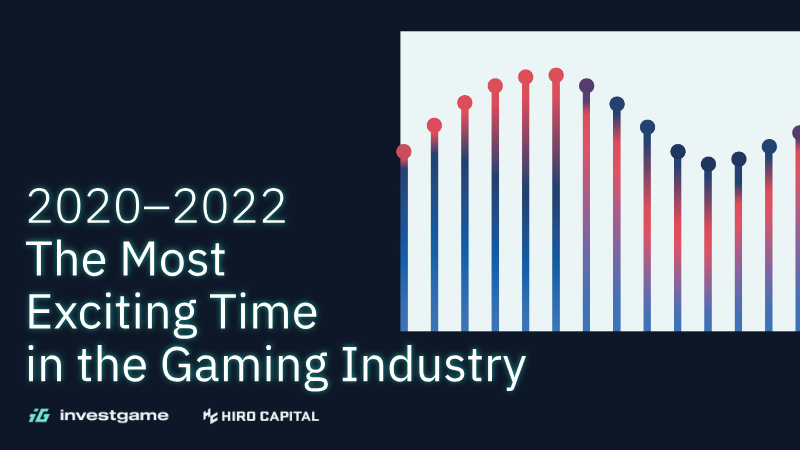
The Most Exciting Time in the Gaming Industry: 2020–2022
The analysis demonstrates that the gaming sector experienced a pronounced surge in deal activity between 2020 and 2022, with private equity investments peaking at $12 billion in 2021 before receding to $10.1 billion the following year. Mergers and acquisitions reached a high of $41 billion in 2021, cooling to $27.3 billion in 2022, while public offerings peaked at $24.5 billion and collapsed to $4.6 billion amid a macro‑economic slowdown projected to continue into 2023. Despite this contraction, strategic investors such as Microsoft, Sony, and Netflix maintained studio acquisitions, and early‑stage venture capital remained resilient with substantial dry powder poised for future rounds.
Late‑stage transactions contracted sharply in early 2023, with only sixteen deals versus thirty‑one in 2022 and a four‑and‑a‑half‑fold decline in disclosed value from $4.2 billion to $0.9 billion. The top fifteen M&A deals over the period accounted for roughly eighty percent of announced value, dominated by public takeovers—including Microsoft’s purchases of Activision Blizzard and ZeniMax—and characterized by high EV/EBITDA multiples, reaching up to 55×. Venture capital activity stayed robust, led by Makers Fund and BITKRAFT Ventures in both deal count and value. Corporate investments slowed in 2022 but are expected to rebound as regulatory scrutiny eases and large cash reserves, such as Epic’s $2 billion, become available.
The report is framed within a global context, covering all major gaming markets from 2020 through 2022, with particular emphasis on the United States, Europe, and Asia. It focuses on public, private, and venture capital transactions across the industry’s core segments—game development studios, publishing platforms, and emerging technology providers. The findings underscore a transition from high‑volume, high‑valuation deals toward a more cautious investment climate, while highlighting the enduring appeal of strategic acquisitions and venture funding as engines for future growth.
- The gaming industry experienced a massive investment peak in 2021, with M&A reaching $41 billion, private equity hitting $12 billion, and public offerings peaking at $24.5 billion.
- Market activity cooled significantly by 2022, with public offerings collapsing to $4.6 billion and late-stage transaction values dropping four-and-a-half-fold to $0.9 billion in early 2023.
- Strategic acquisitions remain a primary driver of industry value, with the top 15 M&A deals—led by Microsoft’s purchases of Activision Blizzard and ZeniMax—accounting for approximately 80% of total announced deal value.
- High-valuation trends characterized the peak period, with M&A deals achieving EV/EBITDA multiples as high as 55×.
- Early-stage venture capital remains resilient, with firms like Makers Fund and BITKRAFT Ventures continuing to lead in both deal count and total value despite broader market contractions.
InvestGameJan 2020

Report33 pages
The Past, Present and Future of Games
The analysis outlines the evolution of gaming from its early stages to contemporary and projected future states, emphasizing demographic shifts, monetization models, and technological convergence. It identifies a multi‑segment consumer base—ranging from “Ultimate Gamers” to “Time Fillers”—and quantifies engagement levels, noting that 45 % of U.S. gamers aged 10‑30 integrate social features into gameplay, while mobile gaming accounts for a growing share of revenue. The report highlights the rise of “games as a service,” cloud gaming, and esports ecosystems, citing 2020 revenue growth of 29 % in PC games and a 19.6 % increase in mobile downloads, with projected 2023 gamer spend up 21 %. Key platforms such as Fortnite, League of Legends, and Genshin Impact dominate viewership, with streaming hours on Twitch and YouTube rising fivefold between 2018 and 2019. The document also maps global value chains, noting Disney’s acquisition of BamTech for sports streaming rights and AT&T’s expansion into esports content. Methodologically, the study draws on Newzoo Consumer Insights surveys, platform analytics, and industry revenue data from 2002‑2027, covering North America, Europe, Asia-Pacific, and emerging markets. The findings underscore a convergence of gaming with social networking, mobile commerce, and 5G‑enabled cloud services, positioning the industry for continued diversification and higher lifetime value per consumer.
- The gaming industry is experiencing significant growth, evidenced by a 29% increase in PC game revenue and a 19.6% rise in mobile downloads in 2020, with total consumer spend projected to grow by 21% in 2023.
- Gaming is increasingly defined by social integration, with 45% of U.S. gamers aged 10–30 utilizing social features during gameplay.
- Streaming viewership has surged, as evidenced by a fivefold increase in hours watched on Twitch and YouTube between 2018 and 2019, led by dominant titles like Fortnite, League of Legends, and Genshin Impact.
- The industry is shifting toward a 'games as a service' model, supported by the convergence of cloud gaming, 5G technology, and mobile commerce to increase consumer lifetime value.
- Major media and telecommunications corporations are actively consolidating their position in the gaming ecosystem, exemplified by Disney’s acquisition of BamTech and AT&T’s expansion into esports content.
+1
NewzooJan 2020

Report14 pages
Europe and Esports: High Engagement and Even Higher Potential
The study demonstrates that European esports audiences are expanding rapidly, with a projected 92 million viewers by the end of 2020 and a year‑over‑year growth of 7.4 %. Enthusiasts—those watching professional content more than once a month—total 33 million, while occasional viewers comprise the remaining 59 million. Revenue forecasts show a global market of nearly €974 million in 2020, rising to €1.6 billion by 2023, with Europe mirroring this trajectory.
Survey data from 10,175 respondents aged 18‑45 across ten Western and Northern European countries reveal that esports engagement is not confined to the youngest cohort; only 33 % of 18‑20 year olds are regular enthusiasts, whereas the 21‑25 age group leads in engagement. Geographic variation is pronounced: Finland shows a 52 % enthusiast rate among 18‑20 year olds, compared to 21 % in the UK. COVID‑19 lockdowns increased viewership in markets with stricter restrictions, and 62 % of respondents in Spain and the UK expect continued higher viewership post‑lockdown.
Gender analysis indicates that 32 % of the audience are women, primarily occasional viewers. Nonetheless, female participation in competitive play is rising, with 60 % of respondents acknowledging growth in women’s involvement. Women spend money on esports products at a comparable rate to men (46 % vs 38 %) and favor physical merchandise, whereas men lean toward digital items such as skins and premium passes.
The research underscores strong cross‑sport interest, with 64 % of viewers also supporting a favorite sports team, and highlights the strategic opportunity for brands to engage this growing, diverse, and monetarily active audience.
- The European esports market is projected to reach 92 million viewers by the end of 2020, with a 7.4% year-over-year growth rate.
- Global esports revenue is forecasted to climb from €974 million in 2020 to €1.6 billion by 2023, with Europe following a similar growth trajectory.
- Esports engagement is not limited to the youngest demographic, as the 21–25 age group currently leads in enthusiast participation compared to the 18–20 cohort.
- Geographic engagement varies significantly, with Finland reporting a 52% enthusiast rate among 18–20 year olds compared to only 21% in the UK.
- Women comprise 32% of the esports audience and demonstrate high purchasing power, with 46% spending on esports products compared to 38% of men.
+1
PayPalJan 2020

Report28 pages
InvestGame Deals Report 2020 – Game M&A
The 2020 Game M&A landscape reached a record $33.6 billion in transaction value across 664 deals, with public offerings contributing 45% of the volume and $15.1 billion in 2020 alone, while M&A activity totaled $12.6 billion (potentially $22.2 billion when including recent mega‑deals). The United States dominated the market, accounting for 36% of deal value and hosting four of the top‑10 transactions. Tencent, Embracer, Stillfront, and Zynga were the leading acquirers, together representing 60% of total value. Swedish firms, particularly Embracer and Stillfront, led a domestic acquisition boom that captured 31% of all announced gaming M&A deals.
Investment trends reflected the low‑interest‑rate environment and robust public‑market valuations. Venture capital and corporate funding surged to $5.9 billion, with 363 private deals (55% of transactions) and a pronounced late‑stage focus on multiplatform, mobile, and PC/console titles. Early‑stage VC funding reached $333 million across 82 deals, while late‑stage rounds were concentrated in a handful of large transactions. IPO activity rose to 18 deals ($2.8 billion), led by Asian firms such as Kakao Games and Archosaur, and public PIPE funding exceeded $95 million in the Esports & Other segment.
The Esports & Other sector saw 37 M&A deals totaling $500 million, with control‑type acquisitions dominating (35 of 37). Majority stake takeovers were common, and the segment attracted significant public PIPE funding. Two hardware firms—NACON and Corsair Gaming—raised $350 million through IPOs, while Skillz leveraged a SPAC to achieve a $9 billion market cap. These findings underscore a 2020 environment of heightened M&A activity, concentrated investment in key geographic hubs, and a strategic shift toward multiplatform and esports opportunities.
- The 2020 gaming market hit a record $33.6 billion in total transaction value across 664 deals, driven by $15.1 billion in public offerings and $12.6 billion in M&A activity.
- Tencent, Embracer, Stillfront, and Zynga emerged as the dominant market forces, collectively accounting for 60% of the total M&A value.
- The United States led the global market by capturing 36% of total deal value and hosting four of the year's top-10 largest transactions.
- Swedish firms, specifically Embracer and Stillfront, drove a domestic acquisition boom that accounted for 31% of all announced gaming M&A deals.
- Venture capital and corporate funding reached $5.9 billion across 363 private deals, with a clear strategic focus on late-stage investments in multiplatform, mobile, and PC/console titles.
+1
InvestGameJan 2020

Whitepaper73 pages
Model Scheme and Manual for Game Incubation Programming and Financing: Baltic Games Industry
VENTSPILS HIGH TECHNOLOGY PARK ERHVERVSAKADEMI DANIA TECHNOLOGY PARK This model scheme illustrates “how to run” an incubation programme for game development companies, drafted in form of a manual for business support providers and intermediaries working with Dania University of Applied Sciences Kaunas Science and Technology Park Ventspils High Technology Park für internationale Zusammenarbeit mbH Title page: © iStock.com-bedya, 1.
- Most game incubators in Europe, especially those for game creators, are primarily funded by public sources, with private initiatives being a minority.
- Establishing a sustainable game incubator often takes over 5 years to break even, with only 40.8% of business incubators aiming to break even as part of their business plan.
- Game incubation programs can be structured in various ways, including long-term incubation (1 year+ for medium-maturity startups) and short-term acceleration (3-4 months for high-maturity startups, often involving equity exchange for funding).
- Effective communication strategies for recruiting incubator participants include leveraging social media platforms like Facebook, Twitter, Instagram, and LinkedIn, and partnering with industry job portals like Skillshot.pl.
- The Ventspils High Technology Park GameDev Incubator, operating since 2018, offers free support tools like co-working spaces, coaching, workshops, and grants, focusing on PC, mobile, VR/AR platforms, and collaborates with Ventspils Digital Centre and University of Applied Sciences.
+2
Ventspils High Technology ParkJan 2020

Whitepaper87 pages
Guideline for Set-Up and Maintenance of a Mentoring System for Game Business Incubation
The guideline provides hands-on support regarding the whole process of set-up and maintenance of a mentor system (search for mentors, get in contact, motivate them to get engaged, integrate them in the programme, monitor their work and give feedback, promote their engagement, keep them on board, support further Metropolia University of Applied Sciences Swedish Games Industry (Association of Swedish Game Developers) – Dataspelsbranschen Ventspils High Technology Park für internationale Zusammenar...
- The game industry is highly competitive and unique, with revenues exceeding three times that of the movie industry, requiring specialized incubation support distinct from generic tech incubators.
- Effective game incubation systems need to tailor their offerings based on the local startup ecosystem, considering factors like founders' experience (e.g., fresh graduates vs. industry veterans) and community focus (e.g., hobby developers needing business skills).
- Mentoring in game incubation involves a continuous, supportive relationship with experienced industry professionals, ideally based on a flexible long-term development plan, and requires mentors with strong communication, listening, and industry understanding.
- Incubators like VHTP GameDev Incubator operate both on-site and remotely, leveraging external experts and national support networks (e.g., Latvian Game Developers Association) to provide services like free co-working spaces, legal/accounting advice, and conference opportunities.
- Feedback collection through surveys, interviews, and discussions is crucial for iterating and restructuring incubator offerings, as demonstrated by Farm League's shift to the Living Game Intelligence Network (LGIN).
+1
BGI ProjectJan 2020
Whitepaper49 pages
Manual on International Cooperation for BSR-Wide Game Business Development
The manual summarises all the findings, lessons learnt and conclusions from the work on internationalisation, ideas for cooperation and recommendations to the different actors in game business. für internationale Zusammenarbeit mbH Hamburg Institute of International Economics für internationale Zusammenarbeit mbH Title page: © iStock.com-bedya, EXECUTIVE SUMMARY .4 1.
- The global game market is rapidly growing, with China leading in consumer spending, followed by the US and Japan. European countries, with smaller home markets, must focus on global markets, necessitating internationalization in game incubation.
- International cooperation is crucial for game incubators to stay updated on trends, tools, and opportunities, requiring resources like travel to events and partners, supported by sustainable business models or public funding.
- The Game Camps project (2017-2020), funded by Interreg Central Baltic, fostered cross-border startups by bringing together over 250 game enthusiasts from Finland, Sweden, Estonia, and Latvia, resulting in four new startups and support for over 15 existing ones.
- Establishing a common brand like 'Baltic Sea Games' for the BSR game industry involves questions about who creates and promotes it, their motivations, and target groups. The brand has a logo and social media presence, but its WordPress website is currently an initial landing page.
- Collaborative ecosystem activities, such as strengthening the incubation ecosystem, sharing expertise on specialized topics, and creating international environments for startups, are identified as key areas where transnational efforts can significantly boost quality and impact.
+1
BGZ Berliner Gesellschaft für internationale Zusammenarbeit mbHJan 2020

Report16 pages
Spillrapporten 2019/2020
Norsk spillbransje En global bransje Utfordringer og i dag i vekst muligheter «For å få oversikt over potensialet og utviklingen i dataspillbransjen er det viktig med et godt kunnskapsgrunnlag om spillbransjen og markedet, herunder tall og statistikk som er sammenliknbare med andre næringer og andre Sitatet over er hentet fra regjeringens ferske dataspill Vår ambisjon er at denne statistikken skal oppdateres og strategi, «Spillerom», for perioden 2...
- The Norwegian gaming industry's gross turnover from games was 550 million NOK in 2018, with 388 million NOK directly by companies and 162 million NOK through other distribution channels.
- Export revenue from Norwegian games is significant, estimated at 377 million NOK in 2018, substantially higher than the 87.3 million NOK from Norwegian film exports in 2015.
- Funcom is the largest company in the Norwegian gaming industry, a pattern seen in Finland (Supercell accounted for 88% of turnover in 2015) and Sweden, where dominant players drive overall industry growth.
- Access to private capital is a major barrier for growth in the Norwegian gaming industry, as many small companies with low equity struggle to secure funding for long development cycles.
- The Norwegian Film Institute (NFI) provided 23.7 million NOK in grants to data games in 2018, with 13.7 million NOK (58%) going to professional companies, indicating a focus on smaller-scale game development rather than growth-phase companies.
+1
Norsk Spill- og MultimedieforeningJan 2020