
Report19 pages
Results: What's Next - Focus on Cash Flow
The analysis outlines a strategic pivot toward cash‑flow optimization for the company, driven by recent shifts in the VR market and a need to secure additional financing. Revenue growth in 2024 reached PLN 190.4 million, largely supported by the launches of Project Maverick and Project Echo, as well as the January 2024 release of Bulletstorm VR. However, profitability suffered due to write‑offs of the Red and Bifrost projects and a decline in 2Q revenues linked to Gemini negotiations, resulting in an EBITDA of PLN 12.9 million and a net loss of PLN 175.3 million.
Operationally, the organization is trimming non‑essential spend and restructuring office space and team composition to reduce overhead. The workforce, which expanded from 612 employees in 2020 to 756 by the end of 2024, is being realigned with a focus on critical projects. The company has ceased further investment in VR development following the 2024 platform subsidy withdrawal, redirecting resources toward AAA and compact‑AAA titles.
Future initiatives include two new work‑from‑home projects with Sony Interactive Entertainment, the self‑publishing of Project Bison (the final VR title from PCF Group) slated for Q4 2025, and an early‑access release of Lost Rift in 2025. Krafton’s waiver of ROFO/ROFR rights for Bifrost and Victoria frees the company to seek external publishers. Scenario analysis is underway to identify additional funding sources, ensuring liquidity while maintaining a lean operational model across global studios in Warsaw, Montreal, Newcastle, Dublin, Katowice, and Rzeszów.
- The company reported 2024 revenue of PLN 190.4 million, but incurred a net loss of PLN 175.3 million and an EBITDA of PLN 12.9 million due to project write-offs and revenue declines.
- Management is pivoting away from VR development following the withdrawal of platform subsidies, shifting focus toward AAA and compact-AAA titles.
- The organization is implementing a cost-reduction strategy that includes restructuring office space and realigning the workforce, which had grown to 756 employees by the end of 2024.
- Krafton has waived its ROFO/ROFR rights for the Bifrost and Victoria projects, allowing the company to pursue external publishing partners for these titles.
- Future production includes two new projects with Sony Interactive Entertainment, the self-publishing of the final VR title Project Bison in Q4 2025, and an early-access release of Lost Rift in 2025.
+3
PCF Group
Report18 pages
Wyniki Finansowe 2023: PCF Group S.A.
The presentation outlines PCF Group S.A.’s financial performance for 2023, focusing on its core gaming and publishing operations. The group’s revenue reached PLN 180.3 million, with self‑publishing projects contributing PLN 171.5 million and external publishing adding PLN 8.8 million. EBITDA for the year was PLN 49.7 million, a decline from PLN 70.5 million in 2022 due to higher operating costs and lower margins on key titles such as “Bulletstorm VR” and the cancelled “Dagger” project. Net income fell to PLN −75.6 million, largely driven by a one‑off write‑down of the Dagger IP and increased staff expenses.
Balance sheet highlights show total assets rising to PLN 513.5 million, driven by a PLN 68.0 million increase in intangible assets and a PLN 112.7 million rise in development costs. Equity stood at PLN 277.6 million, while cash and equivalents were PLN 159.4 million at year‑end. The company’s workforce grew from 612 to 756 employees, reflecting expansion in development and publishing teams across Warsaw, Montreal, New Castle, Dublin, Katowice, and Rzeszów.
Geographically, PCF operates in Europe and North America, with major studios in Warsaw and Montreal. The group’s strategy for 2024 includes closing underperforming projects, renegotiating VR contracts, and tightening cost controls on travel and event expenses. Funding options will be explored to support the planned portfolio of AAA titles, including “Bison” and “Green Hell VR,” while maintaining a focus on self‑publishing growth.
- PCF Group S.A. reported a net loss of PLN 75.6 million in 2023, primarily due to a one-off write-down of the 'Dagger' project and rising staff expenses.
- Annual revenue reached PLN 180.3 million, with self-publishing projects accounting for the vast majority at PLN 171.5 million.
- EBITDA declined to PLN 49.7 million from PLN 70.5 million in 2022, impacted by higher operating costs and lower margins on titles like 'Bulletstorm VR'.
- The company increased its workforce from 612 to 756 employees across its international studios in Europe and North America.
- Total assets rose to PLN 513.5 million, supported by a PLN 112.7 million increase in development costs and PLN 68.0 million in intangible assets.
PCF Group
Report15 pages
Wyniki Finansowe 3M24
The presentation outlines PCF Group S.A.’s financial performance for the first quarter of 2024, focusing on its gaming and VR portfolio. Revenues rose to PLN 180.3 million in Q1 2024, up from PLN 171.5 million in the same period a year earlier, driven by the launch of “Bulletstorm VR” and ongoing development of the AAA title “Maverick.” Net income for the quarter was a loss of PLN 0.9 million, reflecting higher operating costs associated with new project development and capitalisation of work‑for‑hire initiatives. EBITDA improved to PLN 11.0 million, a 3‑fold increase over Q1 2023, largely due to cost optimisation and the inclusion of amortisation from recent IP acquisitions. The group’s balance sheet shows total assets of PLN 277.6 million at 31 March 2024, up from PLN 159.4 million a year earlier, with equity rising to PLN 427.3 million. Cash and equivalents stood at PLN 112.7 million, indicating a solid liquidity position.
Geographically, the company operates studios in Warsaw, Montreal, Newcastle, Dublin, and Katowice, with a workforce of 756 employees in 2024 versus 763 in 2023. The portfolio includes two self‑published AAA titles and three VR projects, with “People Can Fly” and “Bison” slated for release in 2024–2026. The presentation also highlights ongoing work‑for‑hire projects such as “Green Hell VR” and “Bulletstorm VR,” which are expected to contribute additional revenue streams in the coming quarters. Overall, PCF Group S.A. demonstrates growth in revenue and EBITDA while managing increased costs associated with expanding its IP and development capabilities.
- PCF Group S.A. reported Q1 2024 revenue of PLN 180.3 million, an increase from PLN 171.5 million in Q1 2023, driven by the launch of 'Bulletstorm VR' and development of the 'Maverick' title.
- EBITDA tripled year-over-year to PLN 11.0 million, attributed to cost optimization and the inclusion of amortisation from recent IP acquisitions.
- The company recorded a net loss of PLN 0.9 million for Q1 2024, resulting from elevated operating costs tied to new project development and work-for-hire initiatives.
- Liquidity remains strong with PLN 112.7 million in cash and equivalents, while total assets grew significantly to PLN 277.6 million compared to PLN 159.4 million in the prior year.
- The development pipeline includes two self-published AAA titles and three VR projects, with 'People Can Fly' and 'Bison' scheduled for release between 2024 and 2026.
+2
PCF Group
Report17 pages
Wyniki Finansowe 1H25: Warszawa
The presentation outlines PCF Group S.A.’s financial performance for the first half of 2025, focusing on revenue trends, profit calculations, and portfolio developments across its global operations. Revenues have shown a gradual decline from 2021 to 2024, with cumulative figures falling from PLN 190.4 m in 2021 to PLN 171.5 m by the end of 2024, and quarterly revenue in Q1‑2025 recorded at PLN 58.5 m. EBITDA has been negatively impacted by lower sales on the Gemini project and a delayed Bulletstorm VR launch, resulting in an adjusted EBITDA loss of PLN 11.3 m for 2024 and a projected loss of PLN 33.3 m in 2025 after accounting for new projects such as Echo and Delta, as well as write‑downs related to the PCF Chicago subsidiary.
The group’s workforce is distributed across two continents, with 534 employees in Warsaw and additional teams in Montreal, Newcastle, Dublin, Katowice, and Rzeszów. Back‑office development is handled by Incuvo Studio Europe and North America, while publishing responsibilities are shared with the QA Gameon division.
Portfolio highlights include the upcoming co‑op release of Green Hell on Meta Quest platforms and a VR shoot‑to‑survive title slated for Q4 2025. The presentation emphasizes that these releases are the last VR titles to be published by PCF Group, signalling a strategic shift. Overall, the data suggest a contraction in revenue and profitability driven by project delays and market adjustments, with future performance hinging on the successful launch of new VR titles and cost management initiatives.
- PCF Group faces significant financial pressure with an adjusted EBITDA loss of PLN 11.3 million in 2024 and a projected loss of PLN 33.3 million for 2025.
- Annual revenue has trended downward from PLN 190.4 million in 2021 to PLN 171.5 million in 2024, with Q1 2025 revenue recorded at PLN 58.5 million.
- Profitability has been negatively impacted by lower sales for the Gemini project, the delayed launch of Bulletstorm VR, and asset write-downs related to the PCF Chicago subsidiary.
- The company is undergoing a strategic pivot, with the upcoming Green Hell Meta Quest release and a Q4 2025 VR title serving as the final VR projects to be published by the group.
- Future financial performance is contingent on the successful execution of new projects, specifically those codenamed Echo and Delta, alongside ongoing cost management initiatives.
+2
PCF Group
Report17 pages
Wyniki Finansowe 3M25
The presentation outlines the financial performance and strategic outlook of PCF Group S.A. for the period up to 31 March 2025, with a focus on its gaming and VR portfolio. Core data show cumulative revenues of PLN 190.4 million, with quarterly figures ranging from PLN 150.1 million in Q2 2023 to PLN 162.2 million in Q4 2024, reflecting a modest upward trend despite occasional dips linked to project launches and market conditions. Net income for the year 2024 is projected at PLN 63.0 million, with an EBITDA of PLN 11.0 million in Q1 2024 and a corrected EBITDA of PLN 10.0 million in Q2 2025, indicating operational profitability but sensitivity to project-specific expenses such as the Bifrost initiative and the Echo project. The group’s portfolio includes flagship titles like “Bulletstorm VR” (released January 2024) and “Green Bison Quest” slated for Q4 2024 on Meta, alongside ongoing VR developments with partners Creepy Jar and People Can Fly. Personnel distribution shows a stable workforce of 756 employees across Warsaw, Montreal, New Castle, Dublin, Katowice, and Rzeszów, with a balanced split between development, back‑office, studio, publishing, QA, and game operations. Geographic coverage spans Europe and North America, with a strategic emphasis on expanding VR offerings in the US market. Methodologically, figures are rounded and derived from internal financial statements; no external survey data is cited. The document serves primarily as an informational update rather than a formal investment recommendation, emphasizing that projections are contingent on management’s assumptions and market variables.
- PCF Group S.A. reported cumulative revenues of PLN 190.4 million as of March 31, 2025, with quarterly figures showing a modest upward trend from PLN 150.1 million in Q2 2023 to PLN 162.2 million in Q4 2024.
- The company projects a net income of PLN 63.0 million for the 2024 fiscal year.
- Operational profitability remains sensitive to project-specific expenditures, evidenced by an EBITDA of PLN 11.0 million in Q1 2024 and a corrected EBITDA of PLN 10.0 million in Q2 2025.
- The current development pipeline includes the 'Bifrost' and 'Echo' projects, alongside the 'Green Bison Quest' title scheduled for a Q4 2024 release on Meta.
- The firm maintains a stable workforce of 756 employees distributed across six international locations, including hubs in Warsaw, Montreal, New Castle, Dublin, Katowice, and Rzeszów.
PCF Group
Report19 pages
Wyniki Finansowe: Q3 2025
The presentation outlines PCF Group S.A.’s financial performance and strategic outlook for the third quarter of 2025, covering operations in Poland, Europe, North America and the UK. Revenue for the quarter reached PLN 190.4 million, a slight decline from the previous year’s PLN 180.3 million, driven by lower sales of the AAA title “Lost Rift” and a modest increase in self‑publishing income. Net profit fell to PLN –95.7 million, reflecting significant one‑off costs and amortisation of goodwill and IP assets, particularly from the “Lost Rift” CGU. EBITDA after adjustments was PLN –1.7 million, a deterioration from the prior year’s positive figure, largely due to write‑downs of development assets and licensing expenses.
The group’s balance sheet shows a reduction in total assets from PLN 1,144 million to PLN 1,050 million, with a corresponding decline in equity and an increase in short‑term liabilities. Cash flow remains a priority, with management emphasizing the need to focus on WFH projects that can self‑finance and reduce dependency on external funding.
Strategically, PCF is pursuing new AAA collaborations (e.g., Krafton), expanding its VR portfolio with titles such as “Green Hell” and “Pirates VR,” and securing publishing agreements for the “People Can Fly” IP on Meta Quest platforms. The company plans to streamline costs, maintain client relationships, and accelerate new project pipelines while monitoring cash generation closely.
- PCF Group S.A. reported a net loss of PLN 95.7 million for Q3 2025, driven by significant one-off costs and the amortisation of goodwill and IP assets related to the 'Lost Rift' title.
- Adjusted EBITDA declined to PLN –1.7 million, primarily due to write-downs of development assets and increased licensing expenses.
- Quarterly revenue reached PLN 190.4 million, showing a slight increase from the previous year's PLN 180.3 million, despite lower sales performance from the AAA title 'Lost Rift'.
- The company's total assets decreased from PLN 1,144 million to PLN 1,050 million, accompanied by a reduction in equity and an increase in short-term liabilities.
- Management is shifting focus toward self-financing projects and cost streamlining to reduce dependency on external funding.
+2
PCF Group
Report16 pages
Omówienie Wyników Finansowych Q3 2021
The presentation outlines PCF Group S.A.’s financial performance for the third quarter of 2021, emphasizing a significant revenue surge and robust profitability. Total group revenues reached PLN 131.8 million, up 66.2 % year‑over‑year, driven primarily by game sales and outsourcing services. EBITDA rose to PLN 54.9 million, a 99.6 % increase, while net profit climbed to PLN 46.4 million, up 112.6 %. Workforce expanded by 62.7 %, reaching 260 employees, reflecting accelerated development activity across multiple studios in Poland, the United States, and Canada. The group’s balance sheet strengthened markedly: equity grew to PLN 241.6 million (+215.7 %), total assets rose to PLN 292.8 million (+206 % of liabilities), and cash reserves surged to PLN 149.8 million (+262.6 %).
Operational highlights include the launch of Outriders New Horizon, which generated a 1,000‑player spike and an 80 % positive review rate on Steam, reinforcing the company’s reputation for high‑quality releases. The portfolio strategy now targets annual self‑published titles, with new IPs such as Gemini Dagger slated for 2024. Outsourcing revenue increased by 69.7 % to PLN 150 million, while outsourcing costs rose modestly to PLN 35.2 million, maintaining a healthy margin.
Geographically, the group operates studios in Warsaw, London, Montreal, Chicago, and New York, with a global workforce of 500 developers, QA, and support staff. The financial data cover Q3 2021, with comparative figures for Q3 2020 and a year‑end 2020 baseline. Methodologically, figures derive from audited financial statements under IFRS, with adjusted EBITDA reflecting non‑recurring items. The presentation serves as an informational update rather than a sales or investment recommendation, noting that forward‑looking statements are based on management expectations and subject to risk.
- PCF Group S.A. reported strong Q3 2021 growth, with total revenue reaching PLN 131.8 million, a 66.2% year-over-year increase.
- Profitability metrics surged significantly, with EBITDA rising 99.6% to PLN 54.9 million and net profit climbing 112.6% to PLN 46.4 million.
- The company’s financial position strengthened substantially, with cash reserves growing 262.6% to PLN 149.8 million and total equity reaching PLN 241.6 million.
- Outsourcing services were a primary revenue driver, growing 69.7% to PLN 150 million while maintaining healthy margins against costs of PLN 35.2 million.
- The workforce expanded by 62.7% to 260 employees, supporting a global operational footprint across studios in Poland, the United States, Canada, and the UK.
PCF Group

Report86 pages
Management Board Report on the Activities of PCF Group Capital Group and PCF Group S.A.: 2020
SPRAWOZDANIE ZARZADU Z DZIALALNOSCI GRUPY KAPITALOWEJ PCF GROUP SPÓLKA AKCYJNA ORAZ SPOLKI PCF GROUP SPOEKA AKCYJNA (dane w tys. zł, chyba że zaznaczono inaczej) Niniejsze Sprawozdanie z działalności Grupy Kapitałowej PCF Group S.A. i spółki PCF Group S.A. w 2020 r. zostało sporządzone na podstawie § 70 ust. 1 pkt 4, 6, 7 oraz § 71 ust. 1 pkt 4, 6, 7 Rozporządzenia Ministra Finansów z dnia 29.03.2018 r.
- PCF Group's total sales revenue in 2020 reached 103.8 million PLN, a 24% increase from 2019. The "games production for hire" segment accounted for 96% of this revenue (100.0 million PLN), while "copyrights to produced games" (royalties) made up 4% (3.8 million PLN).
- The Triple-A shooter RPG game "Outriders," a key product in the "games production for hire" segment, launched on April 1, 2021, and received a Metascore of 76/100 based on 21 critic reviews for PC. On its launch weekend, it peaked at over 125,000 concurrent players on Steam.
- PCF Group is developing "Project Dagger," a game planned for release by the end of 2024, with a publisher budget of 40-60 million EUR for its production. People Can Fly U.S., LLC acquired the intellectual property rights for Project Dagger on July 20, 2020, for a one-time payment of 500,000 USD.
- The Group faces a significant risk due to high revenue concentration from collaborations with a limited number of publishers, including Square Enix Limited (for Outriders, Project Gemini, Outriders expansion, and Project Dagger) and Take-Two Interactive Software, Inc.
- PCF Group's long-term goals (beyond 24 months) include expanding multiplayer game competencies, acquiring new production teams or studios, or taking over game development entities to create new IPs, with an intent to strengthen the Group with new teams within 18-24 months.
+1
PCF Group

Report80 pages
Annual Standalone Financial Statements: 2020
ZAKONCZONY 31 GRUDNIA 2020 ROKU JEDNOSTKOWE SPRAWOZDANIE Z SYTUACJI FINANSOWEJ ................................................................. 3 JEDNOSTKOWE SPRAWOZDANIE Z WYNIKU ............................................................................................. 5 JEDNOSTKOWE SPRAWOZDANIE Z WYNIKU I POZOSTAŁYCH CAŁKOWITYCH DOCHODÓW ............. JEDNOSTKOWE ZESTAWIENIE ZMIAN W KAPITALE WŁASNYM ..............................................................
- PCF Group's net profit from continuing operations significantly increased from 2,385 thousand PLN in 2019 to 29,096 thousand PLN in 2020.
- The basic and diluted earnings per share (EPS) also saw a substantial rise, from 0.09 PLN in 2019 to 1.06 PLN in 2020.
- The company's assets from contracts grew considerably, from 5,787 thousand PLN at the end of 2019 to 21,577 thousand PLN at the end of 2020.
- PCF Group received financial support from government anti-COVID-19 shields in Poland, recognizing a 50% remission of the subsidy, amounting to 1,750 thousand PLN, in its 2020 results.
- The company amortizes development work for produced games over a 5-year period, with amortization expenses for intangible assets totaling 2,130 thousand PLN in 2020, up from 1,730 thousand PLN in 2019.
PCF Group

Report82 pages
Annual Consolidated Financial Statement: 2020
ZAKONCZONY 31 GRUDNIA 2020 ROKU SKONSOLIDOWANE SPRAWOZDANIE Z SYTUACJI FINANSOWEJ .......................................................... 3 SKONSOLIDOWANE SPRAWOZDANIE Z WYNIKU ...................................................................................... SKONSOLIDOWANE SPRAWOZDANIE Z WYNIKU I POZOSTAŁYCH CAŁKOWITYCH DOCHODÓW ...... 6 SKONSOLIDOWANE ZESTAWIENIE ZMIAN W KAPITALE WŁASNYM .......................................................
- The company's net cash flow from operating activities significantly increased from 1,898 thousand PLN in 2019 to 15,762 thousand PLN in 2020.
- Profit before tax saw a substantial rise from 4,852 thousand PLN in 2019 to 26,658 thousand PLN in 2020.
- Net profit from continuing operations increased from 4,828 thousand PLN in 2019 to 24,579 thousand PLN in 2020, leading to an increase in basic and diluted earnings per share from 0.18 PLN to 0.89 PLN.
- The company implemented remote work capabilities and other preventative measures in 2020 due to the COVID-19 pandemic and received financial support from government anti-pandemic programs in Poland and the United States.
- The company utilizes the IP Box tax relief for corporate income tax calculations in 2019 and 2020, as confirmed by a tax interpretation on April 30, 2020.
PCF Group
Report2 pages
Assessment of Annual Financial Statements: 2020
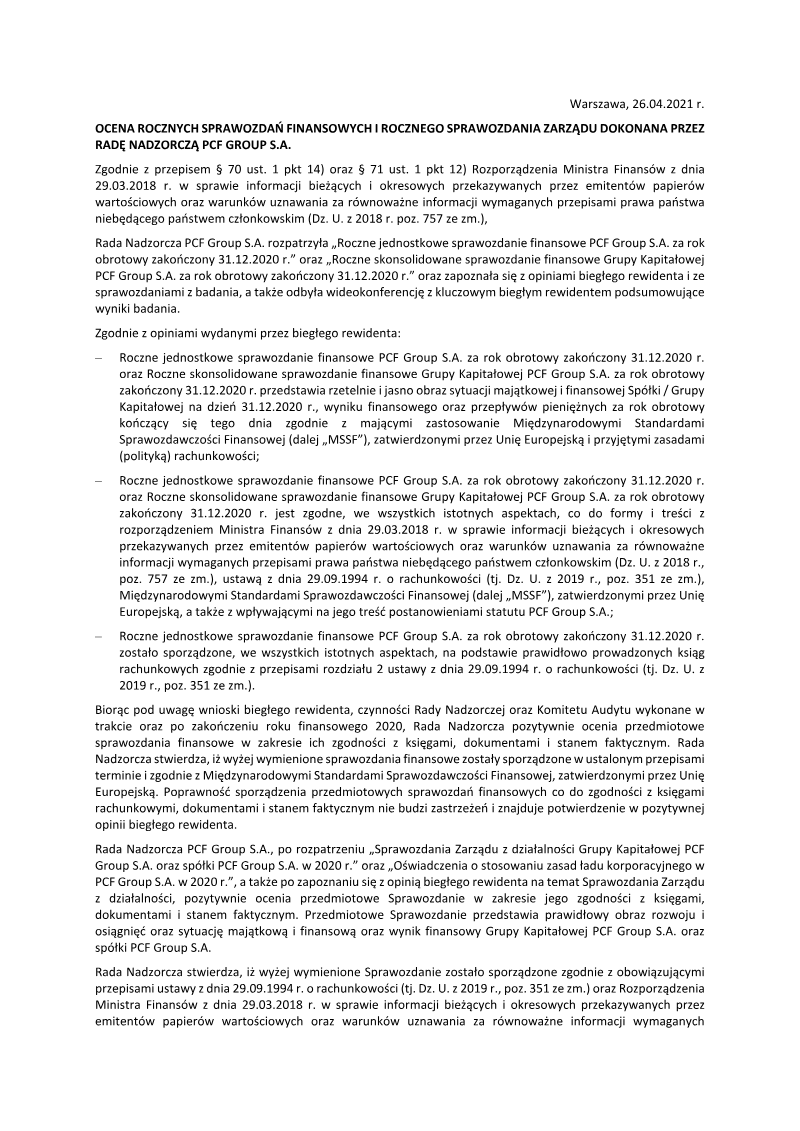
The assessment confirms that PCF Group S.A.’s 2020 annual financial statements, both individual and consolidated, comply with International Financial Reporting Standards (IFRS) approved by the European Union and meet Polish accounting legislation. The audit opinion declares the statements present a clear, reliable picture of the company’s financial position, results and cash flows as of 31 December 2020. The supervisory board reviewed the audited reports, management’s activity report and corporate governance statement, all of which were found consistent with accounting records and factual circumstances. No material misstatements or deviations from regulatory requirements were identified.
The review covered the entire Polish market, focusing on PCF Group’s operations for the 2020 fiscal year. Methodologically, the board relied on the independent auditor’s report and a video conference with the lead auditor summarizing audit findings. The board’s positive evaluation affirms that the financial statements were prepared within statutory deadlines, based on properly maintained books and aligned with both national law and IFRS. The corporate governance declaration also satisfied all mandated components, indicating adherence to governance standards.
Overall, the supervisory board’s findings endorse the integrity and compliance of PCF Group S.A.’s 2020 financial disclosures, affirming their suitability for investors and regulatory stakeholders.
- PCF Group S.A.’s 2020 individual and consolidated financial statements were found to be in full compliance with EU-approved International Financial Reporting Standards (IFRS) and Polish accounting legislation.
- The independent audit confirmed that the company’s financial records accurately reflect its financial position, results, and cash flows as of 31 December 2020.
- The supervisory board identified no material misstatements or deviations from regulatory requirements during their review of the 2020 fiscal year.
- Management’s activity report and the corporate governance statement were verified as consistent with both the company's accounting records and factual circumstances.
- The company successfully met all statutory deadlines for the preparation and submission of its 2020 financial disclosures.
PCF Group
Report6 pages
Independent Auditor's Report on the Consolidated Financial Statements: 2020
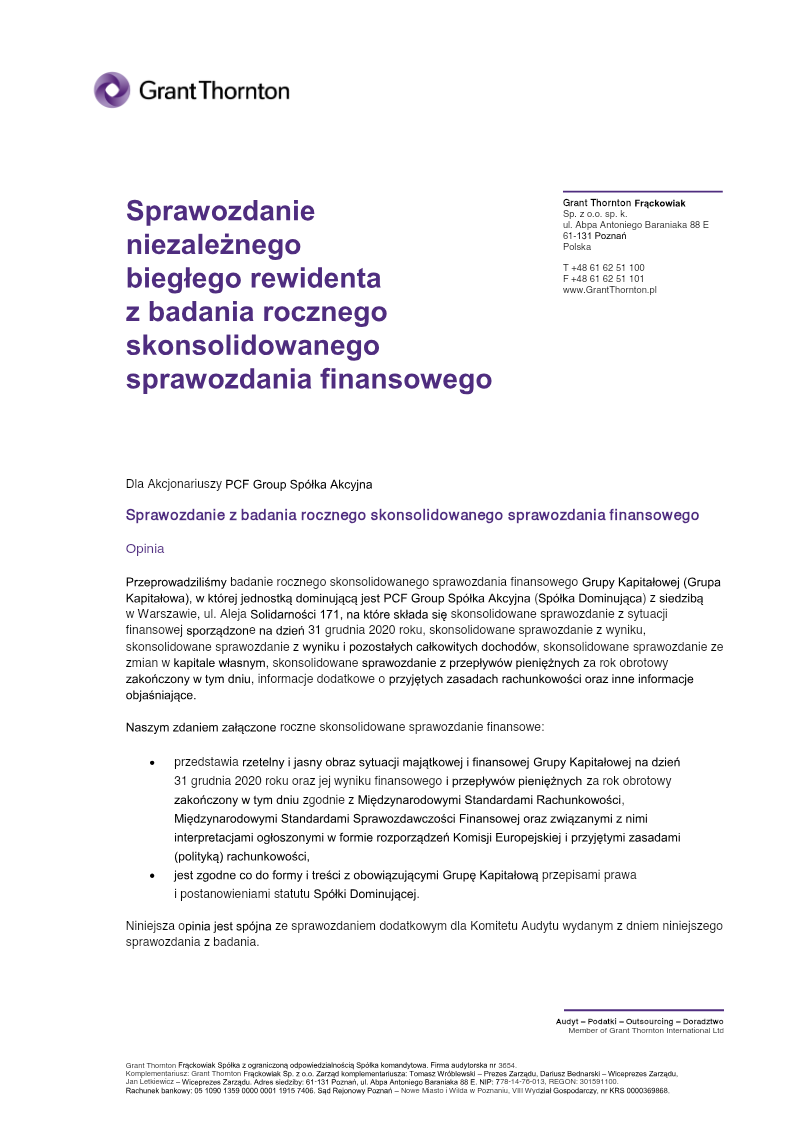
The audit opinion confirms that the 2020 consolidated financial statements of PCF Group Spółka Akcyjna and its subsidiaries present a true and fair view of the group’s financial position, performance, and cash flows in accordance with International Financial Reporting Standards (IFRS) and related EU regulations. The audit was conducted under Polish statutory requirements, International Standard on Auditing (ISA) 200 and related national standards, with the auditor maintaining independence in line with IESBA ethics. The audit scope covered all financial statements, including the statement of changes in equity, cash‑flow statement, and additional disclosures, but did not extend to future profitability or management effectiveness. Key audit areas included revenue recognition under IFRS 15, valuation of customer‑contract assets, and assessment of significant estimates such as variable consideration, warranties, and performance obligations. The auditor obtained sufficient appropriate evidence to support the opinion and identified no material misstatements or significant uncertainties affecting the group’s ability to continue as a going concern. The report also addresses other statutory disclosures, including the annual activity report and corporate governance statement, affirming compliance with Polish accounting law and regulatory requirements. The audit engagement was continuous for two fiscal years (2019–2020), with the 2020 statements being the first after the group’s shares were listed on the Warsaw Stock Exchange. The auditor’s responsibilities, management’s duties, and audit procedures are detailed, underscoring the rigorous nature of the examination and the auditor’s professional skepticism throughout the engagement.
- The 2020 consolidated financial statements for PCF Group S.A. received an unqualified audit opinion, confirming they present a true and fair view of the group's financial position in accordance with IFRS and EU regulations.
- The audit identified no material misstatements or significant uncertainties regarding the group’s ability to continue as a going concern.
- Key audit focus areas included revenue recognition under IFRS 15, the valuation of customer-contract assets, and the assessment of significant estimates such as warranties and performance obligations.
- The 2020 fiscal year represents the first financial reporting period for PCF Group S.A. following its listing on the Warsaw Stock Exchange.
- The audit was conducted in compliance with Polish statutory requirements and International Standards on Auditing (ISA), covering a continuous two-year engagement period from 2019 to 2020.
PCF Group
Report6 pages
Independent Auditor's Report: Annual Financial Statement 2020
The audit opinion confirms that PCF Group’s 2020 financial statements present a true and fair view of the company’s assets, liabilities, equity, income, expenses, and cash flows as of 31 December 2020. The statements comply with International Financial Reporting Standards, IFRS, and related EU regulations, and are based on properly maintained accounting records. The auditor’s responsibility was carried out under Polish auditing law, the International Standards on Auditing (ISA), and the EU Regulation 537/2014. Independence was maintained in accordance with IESBA ethics, and the audit team performed sufficient procedures to obtain reasonable assurance that no material misstatement exists due to error or fraud.
Key audit focus areas included the valuation of contract‑based receivables and obligations, where complex, frequently modified agreements required significant judgment. The auditor evaluated the company’s revenue recognition policies under IFRS 15, assessed estimates of variable consideration such as bonuses and warranties, and reviewed the allocation of transaction prices to identified performance obligations. These matters were disclosed in Notes 3 and 18 of the financial statements.
The audit also covered other information, including the annual report and corporate governance statement. The auditor expressed an unqualified opinion on these disclosures, finding them prepared in accordance with applicable laws and consistent with the financial statements. No material misstatements were identified, and no prohibited non‑audit services were rendered during the engagement.
- PCF Group received an unqualified audit opinion for its 2020 financial statements, confirming they present a true and fair view in compliance with IFRS and EU regulations.
- The audit confirmed that PCF Group’s financial records are accurate and free from material misstatements resulting from error or fraud as of 31 December 2020.
- Auditors focused specifically on the valuation of contract-based receivables and obligations, which involved complex, frequently modified agreements requiring significant management judgment.
- Revenue recognition policies were evaluated under IFRS 15, with specific scrutiny applied to the allocation of transaction prices and estimates for variable considerations like bonuses and warranties.
- The company’s annual report and corporate governance statement were found to be consistent with the financial statements and prepared in accordance with applicable legal requirements.
PCF Group
Report40 pages
Consolidated Interim Financial Report: Q1 2021
GRUPA KAPITAŁOWA PCF GROUP SPÓŁKA AKCYJNA – WYBRANE DANE od 01.01 od 01.01 od 01.01 od 01.01 do 31.03.2021 r. do 31.03.2020 r. do 31.03.2021 r. do 31.03.2020 r.
- Net profit for Q1 2021 was 7,818 thousand PLN, a decrease from 8,683 thousand PLN in Q1 2020. Basic and diluted earnings per share also decreased from 0.32 PLN in Q1 2020 to 0.27 PLN in Q1 2021.
- Sales revenue increased to 30,871 thousand PLN in Q1 2021 from 25,930 thousand PLN in Q1 2020, but gross profit from sales decreased from 11,809 thousand PLN to 10,603 thousand PLN in the same period.
- The company's share capital increased to 591,250.24 PLN by March 31, 2021, from 550,000 PLN at the end of 2020, due to the issuance of 2,062,512 Series B shares.
- The company signed a preliminary agreement with Square Enix Limited on July 31, 2020, for the issuance of subscription warrants (Series A) tied to revenue milestones of 45,000 thousand PLN from agreements with Square Enix Limited, valid until September 30, 2024.
- As of March 31, 2021, Sebastian Wojciechowski holds 50.31% of the company's share capital and voting rights, a decrease from 54.08% at December 31, 2020.
+1
PCF Group
Report82 pages
Raport półroczny za I półrocze 2021
WARSZAWA, 29 WRZ ŚNIA 2021 ROKU Spółka Akcyjna ZA I PÓŁROCZE PCF Raport półroczny za I GRUPA KAPITAŁOWA PCF GROUP SPÓŁKA AKCYJNA 2 0 półrocze 2021 r. (dane w tys. zł, chyba że zaznaczone inaczej) GROUP ~~2 1~~ Grupa Kapitałowa PCF Group Spółka Akcyjna PLN EUR od 01.01 od 01.01 od 01.01 od 01.01 do 30.06.2021 r. do 30.06.2020 r.
- Net profit for the first half of 2021 was 21,720 (in thousands of PLN), compared to 17,272 for the same period in 2020, showing an increase.
- On April 27, 2021, the company acquired 100% of shares in Game On Creative, Inc. (Montreal, Canada), leading to an increase in goodwill of 31,511 (in thousands of PLN) and an increase in investments in subsidiaries of 25,368 (in thousands of PLN).
- A new subsidiary, People Can Fly Chicago, LLC, was established on April 6, 2021, under Delaware law, USA.
- The company recommended a dividend payout of 0.19 PLN per share for the 2020 financial year, totaling 5,616,877.28 PLN, which was approved on June 22, 2021, with a payment date of July 8, 2021.
- Financial revenues for the first half of 2021 were 548 (in thousands of PLN), a decrease from 1,019 (in thousands of PLN) in the first half of 2020, primarily due to lower interest income from cash and equivalents.
PCF Group
Report66 pages
Półroczne sprawozdanie zarządu z działalności Grupy Kapitałowej: H1 2021
WARSZAWA, 29 WRZ ŚNIA 2021 ROKU sp ółka akcyjna ~~2 1~~ Za okres 1.01.2021 – 30.06.2021 r. 29 WRZE ŚNIA PCF Półroczne sprawozdanie z działalności Grupy Kapitałowej PCF Group Spółka Akcyjna 2 0 oraz spółki PCF Group Spółka Akcyjna za okres 1.01.2021 – 30.06.2021 r. GROUP (dane w tys. zł, chyba że zaznaczono inaczej) ~~2 1~~ Niniejsze Półroczne sprawozdanie Zarządu z działalności Grupy Kapitałowej PCF Group S.A.
- PCF Group S.A. acquired 100% of Game On Creative Inc. for PLN 29,369,385.59 on April 27, 2021, and indirectly acquired the Phosphor Games, LLC development team (now People Can Fly Chicago, LLC) on April 23, 2021, which began operations on May 1, 2021.
- The company increased its share capital by PLN 7,754.28 to PLN 599,004.52 through the issuance of 387,714 Series D ordinary bearer shares at an issue price of PLN 75.75 per share, with the subscription agreement signed on May 31, 2021.
- PCF Group S.A. began developing a new self-published game using new intellectual property in May 2021, following the strengthening of its development team and acquisition of production and publishing competencies in April 2021.
- The game 'Outriders', released on April 1, 2021, did not generate royalty payments for PCF Group S.A. from Square Enix Limited for the period of April 1 to June 30, 2021, indicating that net sales did not cover the publisher's costs, and the game did not achieve a Metacritic score high enough for increased royalty percentages.
- Tangible fixed assets increased by PLN 5.8 million to PLN 9.1 million by June 30, 2021, and right-of-use assets increased by PLN 13.9 million to PLN 25.5 million, primarily due to the acquisition of Game On Creative Inc. and the recognition of a new office lease in Montreal.
+1
PCF Group
Report14 pages
Prezentacja wyników finansowych: 9 miesięcy 2022
The presentation outlines PCF Group S.A.’s financial performance for the first nine months of 2022, emphasizing revenue growth, profitability metrics, and balance‑sheet strength. Total group revenues reached PLN 131.8 million, up from PLN 130.9 million in the same period of 2021, while EBITDA climbed to PLN 40.3 million from PLN 26.1 million in 2021, reflecting a significant improvement in operating efficiency. Adjusted EBITDA, accounting for non‑recurring items such as warranty provisions and restructuring costs, stood at PLN 41.3 million, underscoring robust underlying earnings.
Net income for the nine‑month period was PLN 42.1 million, a notable increase from PLN 30.8 million in 2021, driven by higher gross margins and disciplined cost management. The group’s balance sheet remained solid, with total assets of PLN 60.3 million and equity of PLN 54.6 million, while working‑capital items such as receivables and payables were well balanced. Cash reserves of PLN 137.1 million provided liquidity for ongoing development and expansion initiatives.
Geographically, PCF Group operates across multiple regions, with a workforce of 614 employees as of September 30, 2022, spread across North America and Europe. The company’s portfolio includes seven titles in development or publishing stages, with several high‑profile IPs such as “Gemini Dagger” and “Bifrost Victoria” slated for release in 2024. The presentation also highlights strategic partnerships, including a collaboration with Take‑Two Interactive Software and ongoing development outsourcing that generated PLN 44.1 million in revenue during the period.
Overall, the data indicate a healthy growth trajectory for PCF Group S.A., driven by expanding IP pipelines, efficient cost structures, and a strong balance sheet that supports continued investment in game development and market expansion.
- PCF Group S.A. reported a net income of PLN 42.1 million for the first nine months of 2022, a significant increase from PLN 30.8 million in the same period of 2021.
- EBITDA grew to PLN 40.3 million from PLN 26.1 million in 2021, reflecting improved operating efficiency and disciplined cost management.
- The company maintains a strong liquidity position with PLN 137.1 million in cash reserves to support ongoing development and expansion initiatives.
- Development outsourcing remains a key revenue driver, contributing PLN 44.1 million to the total group revenue of PLN 131.8 million.
- The company is actively developing seven titles, including high-profile IPs 'Gemini Dagger' and 'Bifrost Victoria' scheduled for release in 2024.
+2
PCF Group
Report2 pages
Raport z przeglądu skróconego śródrocznego sprawozdania finansowego: H1 2021
The report presents the conclusion of an independent review conducted by Grant Thornton Frąckowiak on PCF Group S.A.’s condensed half‑year financial statements for the period from 1 January to 30 June 2021. The review covered the condensed statement of financial position, the condensed statements of profit or loss and other comprehensive income, changes in equity, cash‑flow statement, and selected explanatory notes. The statements were prepared in accordance with International Accounting Standard 34 on interim financial reporting, as adopted by European Union regulations.
The engagement was performed under the Polish National Standard for Review of Interim Financial Information (Standard 2410), equivalent to International Standard on Review Engagements. The review involved inquiry procedures directed at the company’s finance and accounting personnel, analytical procedures, and other review activities. The scope is narrower than a full audit; therefore, the reviewers do not express an audit opinion but provide a review conclusion.
The key finding is that nothing was identified that would lead the reviewers to believe the condensed interim financial statements were not prepared in all material respects in accordance with IAS 34. The conclusion is supported by the procedures performed and the information obtained during the review.
The report covers PCF Group S.A., a Warsaw‑based joint‑stock company, and pertains to the first half of 2021. No specific financial figures or ratios are disclosed in the summary, as the focus is on the review methodology and overall compliance with IAS 34.
- Grant Thornton Frąckowiak issued a clean review conclusion for PCF Group S.A.’s condensed half-year financial statements for the period ending 30 June 2021.
- The review confirmed that the financial statements were prepared in all material respects in accordance with International Accounting Standard 34 (IAS 34) for interim financial reporting.
- The engagement was conducted under the Polish National Standard for Review of Interim Financial Information 2410, which is equivalent to the International Standard on Review Engagements.
- The scope of the review was limited to inquiry and analytical procedures, meaning no formal audit opinion was expressed by the reviewers.
- The review covered the full suite of financial documents, including the statement of financial position, profit or loss, comprehensive income, changes in equity, and cash-flow statements for H1 2021.
PCF Group
Report2 pages
Report on the Review of the Condensed Interim Consolidated Financial Statement: 2021
The report presents the conclusion of a review conducted by Grant Thornton Frąckowiak on the condensed interim consolidated financial statements of PCF Group Spółka Akcyjna for the period ending 30 June 2021. The review covers the group’s condensed consolidated statements of financial position, income, other comprehensive income, changes in equity and cash‑flow information for the first half of 2021. The statements were prepared in accordance with International Financial Reporting Standard 34 on interim financial reporting, as required by European Commission regulations.
The review was performed under Polish National Standard 2410, equivalent to the International Standard on Review Engagements. The engagement involved inquiry procedures directed at financial and accounting personnel, analytical review procedures, and other review activities. The scope is limited compared to a full audit; therefore, the reviewers cannot express an assurance opinion that all material matters have been identified and disclosed.
The conclusion states that nothing was found to indicate that the condensed interim consolidated financial statements were not prepared in all material respects in accordance with IFRS 34. The report is signed by Jan Letkiewicz, a licensed auditor, and dated 29 September 2021.
- Grant Thornton Frąckowiak concluded that PCF Group S.A.’s condensed interim consolidated financial statements for the period ending 30 June 2021 were prepared in accordance with IFRS 34.
- The review covered the group’s financial position, income, comprehensive income, changes in equity, and cash-flow information for the first half of 2021.
- The engagement was conducted under Polish National Standard 2410, which is equivalent to the International Standard on Review Engagements.
- The review process consisted of analytical procedures and inquiries of financial and accounting personnel rather than a full audit.
- Because the review scope was limited, the auditors did not provide an assurance opinion regarding the identification of all material matters.
PCF Group
Report51 pages
Śródroczne skonsolidowane sprawozdanie: Q3 2021
WARSZAWA, 29 LISTOPADA 2021 ROKU Ś RÓDROCZNE SKONSOLIDOWANE SPRAWOZDANIE ZA OKRES 3 I 9 MIESIĘ CY ZAKOŃCZONY 30 WRZEŚ NIA 2021 ROKU 29 LISTOPADA 2021 PCF GRUPA KAPITAŁOWA PCF GROUP SPÓŁKA AKCYJNA 2 0 Śródroczne skonsolidowane sprawozdanie za okres 9 miesięcy zakończony 30.09.2021 r. GROUP (dane w tys.
- PCF Group S.A.'s total assets significantly increased from 95,697 thousand PLN at the end of 2020 to 292,787 thousand PLN by September 30, 2021, driven by a substantial rise in equity from 76,519 thousand PLN to 241,589 thousand PLN.
- The company's net profit for the 9 months ending September 30, 2021, was 46,410 thousand PLN, a significant increase from 21,828 thousand PLN for the same period in 2020. Basic and diluted earnings per share also rose from 0.79 PLN to 1.57 PLN.
- Total revenue from sales grew from 79,319 thousand PLN for the 9 months ending September 30, 2020, to 131,797 thousand PLN for the same period in 2021, with most revenue (130,215 thousand PLN) coming from game production services.
- PCF Group expanded its capital group structure in 2021 by establishing People Can Fly Chicago, LLC (April 6) and acquiring Game On Creative, Inc. (April 27), further strengthening its international presence.
- The company issued new shares (Series B and D) in 2021, raising net proceeds of 100,286,845.80 PLN from Series B shares, contributing to the increase in equity.
+1
PCF Group