
Report49 pages
Target, Connect, Engage: Driving Profitable App Growth
Achieving sustainable mobile app growth in a privacy-centric digital landscape requires a sophisticated integration of precise measurement tools and advanced advertising optimization. The primary objective of modern mobile marketing is to shift focus from simple installation metrics toward high-value user engagement and long-term profitability. By leveraging Mobile Measurement Partners (MMPs) in tandem with platform-specific optimization features, brands can navigate complex cross-channel user journeys, mitigate ad fraud, and significantly improve their return on ad spend.
Data-driven strategies, specifically those utilizing App Event Optimization and Value-Based Optimization, serve as the foundation for scaling performance. These methodologies allow advertisers to move beyond broad acquisition tactics, instead employing granular audience segmentation and real-time tracking to identify and retain high-value users. Case studies involving major global brands such as Burger King, Rappi, and Carrefour demonstrate that this technical synergy consistently yields substantial improvements in conversion rates and overall revenue. For instance, integrated campaigns have successfully driven multi-fold increases in return on investment, proving that technical precision directly correlates with commercial success.
The scope of these strategies encompasses global mobile markets, focusing on the intersection of social media advertising and third-party attribution. Success in this environment relies on a structured, agile approach that prioritizes diversified creative testing and consistent budget management. By combining the analytical depth of an MMP with the reach and targeting capabilities of platforms like TikTok, developers can effectively lower customer acquisition costs while maximizing user lifetime value. Ultimately, the integration of these technologies is essential for any organization seeking to maintain a competitive edge in the evolving mobile ecosystem.
- Mobile marketing strategy must shift from simple installation metrics to prioritizing high-value user engagement and long-term profitability to ensure sustainable growth.
- Integrating Mobile Measurement Partners (MMPs) with platform-specific optimization tools is essential for navigating cross-channel journeys, mitigating ad fraud, and improving return on ad spend.
- App Event Optimization and Value-Based Optimization are the primary methodologies for scaling performance through granular audience segmentation and real-time tracking.
- Global brands including Burger King, Rappi, and Carrefour have achieved substantial improvements in conversion rates and multi-fold increases in ROI by utilizing integrated, data-driven campaigns.
- Lowering customer acquisition costs while maximizing user lifetime value requires a combination of analytical depth from MMPs and the reach of social media platforms like TikTok.
+2
KingJan 2025

Report32 pages
Hybrid Casual Games Playbook
Hybridcasual games blend the instant‑on‑tap simplicity of hyper‑casual titles with deeper progression systems that encourage sustained engagement. The playbook outlines the genre’s rise, noting a 3 % download growth in 2022 to 5 billion downloads—up from 4.9 billion in 2021—while hyper‑casual downloads fell 15 %. Revenue has nearly doubled over two years, with ads contributing about 50 % of total earnings and in‑app purchases accounting for the remainder. Session lengths average 372 seconds, a 160‑second increase over hyper‑casual games, and retention rates at day 30 reach 54 % versus 42 % for hyper‑casual titles, with day 60 retention at 9 % versus 1 %.
The document surveys sub‑genres such as Arcade Idle, Tower Defense, and Interactive Story, citing successful titles like Aquarium Land, City Defense!, and Fight for America. It highlights how hybrid mechanics—drawing towers, RPG‑style upgrades, or automated idle workers—boost lifetime value by 17–35 % in some cases. Methodology relies on aggregate download and revenue data from 2020‑2022, coupled with in‑house analytics tracking session length, retention, and monetization funnels.
Best‑practice guidance centers on marketability, economy tuning, A/B testing, and post‑launch optimization. Case studies of Zombie Defense illustrate how adding narrative layers, social features, and tiered in‑app purchase options can lift LTV to $2+ on day 7. The playbook concludes that sustained success in Hybridcasual hinges on balancing accessibility with meta‑depth, maximizing IAP revenue, and continuously refining content based on player segmentation.
- Hybrid-casual games are outperforming hyper-casual titles, with 5 billion downloads in 2022 (a 3% increase) compared to a 15% decline in hyper-casual downloads.
- Hybrid-casual games achieve significantly higher retention, with day-30 retention at 54% (vs. 42% for hyper-casual) and day-60 retention at 9% (vs. 1%).
- Revenue is split evenly between ads and in-app purchases, with session lengths averaging 372 seconds, which is 160 seconds longer than hyper-casual benchmarks.
- Integrating hybrid mechanics like RPG-style upgrades and automated idle systems can increase player lifetime value by 17–35%.
- Successful titles such as Zombie Defense demonstrate that adding narrative layers and tiered in-app purchase options can drive day-7 lifetime value to over $2.
+1
Sensor TowerJan 2025

Report37 pages
The Industry Quest for Growth
Global games spending reached a record $199.4 bn in 2024, rising 3.5 % year‑over‑year and projected to stabilize near $200 bn in 2025 with modest growth thereafter. The sector remains smaller than the broader video‑related entertainment market but is nine times larger than recorded music, underscoring its expanding economic footprint. Key growth levers include a $7‑8 bn upside from Nintendo’s Switch 2, which is expected to sell 103 million units by 2030, and an additional $1‑2 bn from enhanced in‑game monetisation. Emerging markets—particularly the Middle East, Africa, and Southeast Asia—offer significant upside driven by youthful, mobile‑savvy populations.
The launch delay of GTA VI is anticipated to shave $2.7 bn from 2025 console spend, creating a sales window for other publishers and Nintendo to capture holiday‑season revenue. Untapped consumer cohorts, such as 16‑24 year‑old females and players aged 55+, represent further opportunities for market expansion.
Publishers are responding to slower growth by shifting toward higher‑margin, low‑cost strategies. Remasters and remakes—examples include Resident Evil 4 and the Final Fantasy VII remake—are becoming primary revenue engines. Simultaneously, platform diversification across PC, console, and direct‑to‑consumer web stores, coupled with hybrid monetisation models that blend advertising, in‑app purchases, and subscriptions, are being tested to optimise returns. Expanding intellectual property into music, merchandising, and cloud‑gaming subscriptions further unlocks value from dormant franchises.
- Global games spending reached a record $199.4 billion in 2024, a 3.5% year-over-year increase, with projections stabilizing near $200 billion in 2025.
- The upcoming Nintendo Switch 2 is projected to generate $7–8 billion in upside and reach 103 million units sold by 2030.
- The delay of GTA VI is expected to reduce 2025 console spending by $2.7 billion, creating a strategic window for other publishers to capture holiday market share.
- Publishers are mitigating slower growth by prioritizing high-margin, low-cost strategies such as remasters and remakes, alongside diversifying platforms and hybrid monetization models.
- Emerging markets in the Middle East, Africa, and Southeast Asia, combined with untapped demographic cohorts like 16–24-year-old females and players aged 55+, represent the primary opportunities for future expansion.
+1
NintendoJan 2025

Report67 pages
Global Games Market Report 2025
The Global Games Market Report 2025 projects a steady expansion of the worldwide player base to 3.6 billion, with payers rising to 1.6 billion and total revenue reaching $188.8 billion, a 3.4 % increase year‑over‑year. Mobile dominates growth and revenue, contributing $103 billion (55 % of the market) and expanding 4.5 % YoY, while PC and console follow at 3.1 % and 2.5 %. The report notes that average spend per payer is expected to decline slightly through 2028 as the market matures, underscoring the importance of retention, innovative monetization and post‑launch content to sustain growth in an increasingly saturated ecosystem.
Geographically, the Asia‑Pacific region leads with a 4.2 % YoY increase, and North America remains strong for console sales (5.4 %). Key growth drivers include the launch of Nintendo Switch 2, continued success of live‑service titles on PC, and a shift toward direct‑to‑consumer monetization in mobile. Discoverability challenges and content fragmentation are identified as notable hurdles across all platforms.
Single‑player AAA titles released in the February–May window outperform those launched August–November by an average of 34 %, largely due to crowded holiday windows and cannibalization. Early Access titles that transition to full release within 4–9 months generate the highest new‑player lift, while staggered cross‑platform releases capture only about 13 % of the total player base. Player attrition drops sharply in weeks 2–5 and stabilizes after week 12, indicating that longer main‑story content (20–40 hours) and simulation elements help retain players over the long term.
The commercial life of single‑player titles is increasingly driven by post‑launch content, strategic discounting and community engagement rather than initial premium spend. DLC revenue shares evolve over a game’s lifecycle, with genres aligning to specific monetization models and subscriptions gaining influence on long‑term engagement. Post‑launch content is identified as the key determinant of discoverability, retention and profitability across a game’s back catalogue.
Methodologically, the report employs a top‑down, data‑driven model that blends proprietary engagement metrics (Game Performance Monitor, Steam data), public economic indicators and partner insights to forecast platform‑specific player, payer and revenue figures through 2028. The approach excludes taxes, hardware and gambling from revenue calculations and provides detailed platform‑by‑platform forecasts (PC, console, mobile, cloud, VR) alongside analytical tools for market segmentation, genre trends and post‑launch monetization strategies.
- The global games market is projected to reach $188.8 billion in 2025, a 3.4% year-over-year increase, with mobile platforms accounting for 55% of total revenue at $103 billion.
- Mobile gaming remains the primary growth engine with a 4.5% year-over-year expansion, while PC and console segments grow at 3.1% and 2.5% respectively.
- Single-player AAA titles launched between February and May outperform those released in the August–November holiday window by an average of 34% due to reduced market cannibalization.
- Player retention is optimized by 20–40 hour main-story content and simulation elements, with attrition rates stabilizing significantly after the 12-week mark.
- Early Access titles achieve the highest new-player lift when transitioning to a full release within a 4–9 month window.
NewzooJan 2025
Report41 pages
Mobile Growth and Monetization Report 2023
The report establishes that mobile game monetization is most effective when focused on early‑stage conversion and strategic ad placement. Analysis of 31 billion in‑app purchase events shows that 77 % of players who convert do so within the first two weeks, with currencies and limited‑time sales accounting for 22–23 % and 15–20 % of revenue respectively. Pricing the first purchase between $1 and $5 maximizes conversion efficiency, while targeting tier‑2 markets and deploying offerwalls can further enhance retention.
Rewarded‑ad data, derived from 31 billion monthly impressions and 158 million installs, identifies high‑engagement placements between levels, in the IAP store, and lobby screens. Extra‑reward, currency, and gacha offers drive the greatest engagement. Offerwalls contribute roughly 33 % of total ad revenue, delivering about $4.68 per converted user; multi‑reward offers generate 60–82 % of conversions and can yield up to $68 per completion. These insights suggest that placing high‑visibility rewarded ads and integrating offerwalls can simultaneously boost retention and monetization.
Complementary tactics such as custom store pages further improve player engagement. Offerwall conversions can increase day‑7 to day‑120 retention by up to fivefold, especially for high‑engagement segments. Custom store pages allow developers to align in‑game messaging with ad creatives, reducing resource costs and enhancing conversion rates. Targeting genre‑specific markets—sports in Japan or trivia in South Korea—can lift click‑through rates above tier‑2 averages, underscoring the importance of data‑driven audience and creative optimization.
Overall, the findings emphasize a focused strategy: early conversion pricing, strategic rewarded‑ad placement, offerwall integration, and tailored store experiences. These combined tactics deliver measurable gains in retention, revenue, and campaign efficiency across iOS and Google Play platforms worldwide.
- 77% of players who make in-app purchases convert within the first two weeks, with the highest conversion efficiency achieved by pricing initial offers between $1 and $5.
- Offerwalls contribute approximately 33% of total ad revenue and can increase day-7 to day-120 player retention by up to fivefold.
- Multi-reward offerwall campaigns generate 60–82% of conversions and can yield up to $68 per completion, while delivering an average of $4.68 per converted user.
- In-app currencies account for 22–23% of revenue, while limited-time sales contribute 15–20%.
- High-engagement rewarded ad placements are most effective when positioned between game levels, within the IAP store, or on lobby screens.
+2
UnityJan 2025

Report40 pages
The Gaming App Insights Report: 2025 Edition
The 2025 Gaming App Insights Report presents a resilient mobile gaming market that rebounded strongly in 2024, projecting global revenue of $126.1 billion for 2025 and a 49% share of total gaming revenue, eclipsing console (28%) and PC (23%). AI‑driven personalization, dynamic monetization models, and cross‑platform play emerge as key drivers of higher retention, session length, and in‑app spending, particularly within battle royale and strategy genres. New acquisition channels—TikTok, connected TV, and influencer marketing—are reshaping player discovery, while studios that invest in AI for predictive churn mitigation and long‑term relationship building are positioned to capture the largest growth opportunities, especially as mobile gaming expands into LATAM and MENA regions.
Privacy compliance shows modest improvement, with global ATT opt‑in rates rising to 37.9 % in Q1 2025; arcade titles lead the surge (42.4 → 59.3 %). Regional gains are strongest in Indonesia (58.6 %) and Malaysia (51.9 %), whereas markets such as the UAE, Japan, Saudi Arabia, and the Philippines experienced slight declines. Despite these gains, compliance remains uneven across genres and geographies.
Advertising performance improved in 2024: installs per mille increased from 8.1 to 8.86, click‑through rates rose from 7 % to 9 %, and median cost per install fell slightly (0.38 → 0.36 USD). Median cost per mille dropped to $3.41, indicating more efficient ad spend. However, revenue‑per‑user metrics declined overall—ARPM fell across most categories and ARPMAU dropped from $0.31 to $0.28—though casino and strategy games bucked the trend with higher monetization.
The report concludes that mobile gaming’s next growth wave will hinge on AI‑driven, culturally tailored experimentation and hyper‑personalized user journeys. Precise targeting—through dynamic difficulty, hybrid monetization, and live events—combined with community‑building tactics drives higher lifetime value. Teams that leverage cross‑platform measurement and analytics to iterate on data‑driven decisions will be best positioned to scale and shape the future of mobile gaming.
- Mobile gaming is projected to generate $126.1 billion in 2025, capturing 49% of total global gaming revenue compared to console (28%) and PC (23%).
- Global ATT opt-in rates reached 37.9% in Q1 2025, with arcade titles showing significant growth from 42.4% to 59.3%.
- Advertising efficiency improved in 2024 as median cost per install fell from $0.38 to $0.36, while click-through rates increased from 7% to 9%.
- Despite improved ad performance, monetization metrics declined, with average revenue per monthly active user (ARPMAU) falling from $0.31 to $0.28.
- Growth in mobile gaming is shifting toward LATAM and MENA regions, with Indonesia (58.6%) and Malaysia (51.9%) leading in privacy compliance opt-in rates.
+2
AdjustJan 2025
Report19 pages
Hyper-Casual 9 Games Benchmark Report: Q3 2022
The report presents a quantitative assessment of hyper‑casual mobile games for the third quarter of 2022, focusing on acquisition costs, retention performance, and geographic distribution. It identifies a narrowing cost‑per‑install (CPI) gap between Android and iOS, now at 10 cents compared with an average of 15 cents over the previous four years, suggesting intensified competition on Android. Retention benchmarks reveal a consistent advantage for iOS across all performance tiers: top‑tier games achieve 51 % day‑1 and 22 % day‑7 retention versus 42 % and 16 % on Android; top‑25 games show 33 %/9 % versus 26 %/5 %; median titles record 25 %/6 % against 19 %/3 %. These figures illustrate a pronounced disparity between platforms, with iOS retaining users more effectively at every level.
Geographically, the analysis lists leading markets by player volume and revenue potential. The United States, Japan, South Korea, Brazil, the United Kingdom, Canada, Germany, India, France, and Indonesia appear repeatedly as key regions, with Japan and South Korea consistently ranking among the top three. The data imply that hyper‑casual titles should prioritize these territories for user acquisition and monetization strategies.
Methodologically, the study aggregates data from over 100 k games tracked by GameAnalytics, a leading analytics provider that serves one‑third of global mobile players. The benchmark draws on CPI figures, retention rates, and regional player counts to deliver actionable insights for developers and publishers seeking to optimize performance in the hyper‑casual segment during Q3 2022.
- iOS maintains a significant retention advantage over Android across all performance tiers, with top-tier iOS games achieving 51% day-1 and 22% day-7 retention compared to 42% and 16% on Android.
- The cost-per-install (CPI) gap between Android and iOS has narrowed to 10 cents, down from a four-year average of 15 cents, indicating intensified competition on the Android platform.
- Median hyper-casual titles show a clear performance disparity between platforms, with iOS recording 25% day-1 and 6% day-7 retention versus 19% and 3% on Android.
- Japan and South Korea consistently rank among the top three global markets for both player volume and revenue potential in the hyper-casual segment.
- Key regions for user acquisition and monetization strategies include the United States, Japan, South Korea, Brazil, the United Kingdom, Canada, Germany, India, France, and Indonesia.
TenjinJan 2025

Report49 pages
Target. Connect. Engage: Driving Profitable App Growth with Revenue-Boosting Strategies
The primary purpose of the analysis is to demonstrate how a strategic partnership between a mobile measurement partner (MMP) and TikTok’s advertising ecosystem can unlock profitable growth for app marketers. By integrating real‑time attribution, privacy‑preserving measurement, and value‑based optimization, brands can accurately credit campaigns, reduce fraud, and maximize return on ad spend (ROAS) across the entire customer journey.
Key findings show that cross‑platform visibility is essential for identifying high‑value users and optimizing acquisition budgets, especially amid tightening privacy regulations on iOS and Android. AppsFlyer’s comprehensive measurement suite, combined with TikTok’s SKAdNetwork tools and self‑reporting network, delivers precise audience targeting and cost‑effective user acquisition. Case studies from Burger King, Casas Bahia, and Carrefour illustrate tangible results: a 7× ROI for coupon activations, a 44 % lift in conversion rates with a 55 % ROI gain, and a 29 % increase in in‑app revenue with triple the return compared to other channels.
The document outlines best practices for app install and retargeting campaigns, recommending the use of App Event Optimization (AEO) and Value‑Based Optimization (VBO) to focus spend on high‑value actions. Automated Smart Performance Campaigns and real‑time ROAS measurement via AppsFlyer integrations further enhance efficiency and lifetime value.
Geographically, the insights apply globally across major mobile markets, with a focus on the U.S., Europe, and emerging regions where TikTok’s user base is rapidly expanding. The time frame covers current privacy‑driven advertising environments and anticipates ongoing downturns, positioning the partnership as a resilient growth strategy for 2024‑2026.
- Integrating AppsFlyer’s measurement suite with TikTok’s advertising ecosystem enables brands to maximize ROAS through real-time attribution and privacy-compliant user acquisition.
- Case studies demonstrate significant performance gains, including a 7x ROI for Burger King, a 44% conversion lift for Casas Bahia, and a 29% increase in in-app revenue for Carrefour.
- App marketers should prioritize App Event Optimization (AEO) and Value-Based Optimization (VBO) to focus advertising spend on high-value user actions.
- Automated Smart Performance Campaigns and real-time ROAS measurement are recommended strategies to maintain growth and efficiency through 2026 despite tightening privacy regulations.
- Cross-platform visibility is essential for identifying high-value users and optimizing acquisition budgets across both iOS and Android environments.
+2
AppsFlyerJan 2025

Report29 pages
Sensor Tower India: Mobile Game Market Insights 2025
India is positioned as the world’s largest mobile‑gaming market, with 8.45 billion downloads recorded in FY 2024‑25 yet only $400 million in in‑app purchase (IAP) revenue, underscoring a pronounced monetization gap despite high engagement. Downloads have stabilized post‑pandemic while IAP spending has accelerated, largely driven by Google Play’s dominance and an expanding share of higher‑spending iOS users. Demographic analysis shows that 77 % of players are aged 18‑34, 86 % are male, and lifestyle titles uniquely attract a larger female audience.
Genre‑level insights reveal that casual, family‑oriented categories—Simulation (driving/flight), Arcade (platformer/runner), and Tabletop board games—generate the bulk of download volume. In contrast, monetization is concentrated in competitive, engagement‑heavy segments such as Shooter (Battle Royale), Casino, and Strategy (4X). Publishers are advised to pair mass‑appeal casual titles with monetization strategies that target the growing cohort of high‑value, competitive gamers.
India‑based publishers maintain robust domestic download volumes through culturally resonant titles like Ludo King and Dream11, yet monetization remains modest. To offset this challenge, publishers are expanding overseas revenue streams, with the US, Saudi Arabia, and the UK emerging as key markets. The dual strategy of leveraging local appeal for mass reach while pursuing international growth is presented as a pathway to enhance overall profitability in India’s mobile‑gaming ecosystem.
- India is the world's largest mobile-gaming market by volume, recording 8.45 billion downloads in FY 2024-25 but generating only $400 million in in-app purchase (IAP) revenue.
- Monetization is heavily concentrated in competitive, engagement-heavy genres including Shooter, Casino, and Strategy (4X), while high-volume downloads are driven by casual Simulation, Arcade, and Tabletop titles.
- The player base is predominantly male (86%) and aged 18-34 (77%), though lifestyle titles represent a unique segment for attracting female gamers.
- While domestic publishers maintain high download volumes through culturally resonant titles like Ludo King and Dream11, they are increasingly targeting the US, Saudi Arabia, and the UK to offset modest domestic monetization.
- IAP spending is showing signs of acceleration, supported by Google Play’s market dominance and an increasing share of higher-spending iOS users.
+1
Sensor TowerJan 2025

Report49 pages
Mobile App Trends 2025: Japan Edition
Japan remains the world’s third-largest mobile app market, characterized by a resilient consumer spend of $16.5 billion in 2024 and a 7% year-over-year increase in total installs. While the gaming sector remains a foundational pillar, the market is undergoing a significant diversification into finance, entertainment, and digital comics. User trust is also on an upward trajectory, evidenced by App Tracking Transparency opt-in rates rising to 21.4%, with the gaming vertical leading at 31%. This shift suggests a maturing ecosystem where users are increasingly comfortable with data sharing in exchange for personalized experiences.
The gaming sector demonstrated notable stability in the first half of 2025, with a 3% increase in installs that outperformed global trends. Card games experienced a 127% surge in sessions, while role-playing games maintained the highest engagement levels with average session lengths of 40 minutes. Simultaneously, the finance sector emerged as a high-growth vertical, with installs rising 50% driven by payment and banking apps. Although average revenue per monthly active user has seen declines in some sectors, engagement metrics remain strong, particularly in entertainment where short-form drama apps have achieved a high revenue-per-download of $4.13.
A defining trend across the Japanese landscape is the strategic shift toward paid user acquisition. This is most visible in the comic app market, which reached a record paid-to-organic ratio of 1.03. Despite a decline in new installs for comics, the vertical remains a global revenue powerhouse due to deep user loyalty and session lengths averaging over 17 minutes. Across finance, entertainment, and comics, the market is transitioning from a phase of rapid expansion to one focused on maximizing the lifetime value of a culturally invested and highly engaged user base.
- Japan’s mobile market generated $16.5 billion in consumer spend in 2024, supported by a 7% year-over-year increase in total installs.
- The finance sector is a primary growth driver, with a 50% surge in installs fueled by the adoption of payment and banking applications.
- Gaming remains a stable pillar, with card games seeing a 127% increase in sessions and role-playing games maintaining 40-minute average session lengths.
- User trust is maturing, as evidenced by App Tracking Transparency opt-in rates rising to 21.4% overall, with the gaming vertical reaching 31%.
- The comic app market has shifted to a paid-to-organic acquisition ratio of 1.03, prioritizing high lifetime value and user loyalty over raw install volume.
+1
AdjustJan 2025

Report28 pages
Mobile Game Genre Report: Comparing and Contrasting Eastern and Western Markets
This analysis explores the hypercasual mobile gaming landscape, comparing market dynamics between Western regions, such as the United States and United Kingdom, and Eastern markets, specifically Japan and South Korea. Utilizing 2021 download data and consumer insights from Newzoo and Pangle, the findings reveal that hypercasual games accounted for 36 of the top 100 most-downloaded mobile games globally. While the genre dominates Western charts—representing nearly half of the top 100 downloads in the U.S. and U.K.—it maintains a smaller footprint in Japan and South Korea, where it comprises approximately 20% of top downloads.
The sector is characterized by rapid evolution and high competition, with only eight of the top 36 hypercasual titles from 2020 remaining in the 2021 rankings. A significant shift in subgenre popularity occurred during this period, as runner and racing mechanics overtook simulation and ASMR themes. Demographically, hypercasual players across all four key markets skew male and are younger than the general mobile gaming population, with an average age below 30. These players often engage with midcore and hardcore genres, such as RPGs and strategy games, making them a valuable audience for cross-genre user acquisition.
To combat historically low retention rates—often falling below 10% by day seven—developers are increasingly adopting "hybrid-casual" strategies. This involves integrating lite meta features, progressive difficulty, and live operations to deepen engagement. Monetization remains heavily reliant on in-game advertising, with interstitial videos being the most prevalent format. However, the rise of hybrid models has introduced new revenue streams, including "remove ad" IAPs and battle passes. Success in Eastern markets specifically requires deep localization, including busier user interfaces and culturally specific live events, to effectively scale and improve lifetime value.
- Hypercasual games represent 36% of the top 100 global mobile downloads, though they command nearly 50% of top charts in the U.S. and U.K. compared to only 20% in Japan and South Korea.
- The hypercasual sector suffers from high volatility, with only eight of the top 36 titles from 2020 maintaining their positions in the 2021 rankings.
- Developers are shifting toward 'hybrid-casual' models—incorporating lite meta features and live operations—to address retention rates that typically drop below 10% by day seven.
- Runner and racing mechanics have overtaken simulation and ASMR themes as the dominant subgenres in the hypercasual market.
- Hypercasual players skew male and under 30 years old, frequently engaging with midcore and hardcore titles like RPGs and strategy games.
+3
PangleJan 2025
Report80 pages
State of Mobile 2025: TikTok Edition
The mobile industry reached a significant milestone in 2024, generating a record $150 billion in in-app purchase revenue, representing a 12.5% year-over-year increase. While global downloads experienced a marginal 1% decline to 136 billion, user engagement reached an all-time high of 4.2 trillion total hours. This growth was primarily fueled by non-gaming sectors, specifically Entertainment, Productivity, and Photo & Video, alongside a recovering mobile gaming market where eleven titles surpassed $1 billion in annual revenue. Geographically, North America and Europe remain the strongest monetization hubs, though nearly 80% of total consumer spend now occurs outside an app’s home country, signaling a highly globalized marketplace.
Artificial Intelligence has emerged as the primary catalyst for industry transformation, with AI chatbots recording a 200% revenue surge and generative AI apps reaching $1.3 billion in annual spend. This technology is being integrated across diverse verticals, from productivity tools to dating apps like Tinder and Grindr, which are utilizing AI to streamline user experiences and facilitate real-world connections. The Productivity and Utility sector specifically benefited from this trend, seeing a 35% revenue increase to $15 billion. Furthermore, niche categories such as short-form drama apps and fitness reward platforms are gaining significant traction, with the latter benefiting from a shift toward social "run clubs" and outdoor exercise.
The 2024 landscape also highlights a shift in monetization strategies and user behavior. In the dating sector, revenue grew by 14% despite a decrease in time spent, suggesting that users are prioritizing efficient, high-value interactions over passive scrolling. Meanwhile, the Health and Fitness category continues to see strong seasonal surges and global expansion in markets like Germany and Australia. Across all sectors, the industry is moving toward community-focused retention and sophisticated subscription models, leveraging AI to maintain high per-user monetization even as traditional download growth stabilizes in mature markets.
- The mobile industry generated a record $150 billion in in-app purchase revenue in 2024, marking a 12.5% year-over-year increase despite a 1% decline in global downloads.
- Artificial Intelligence is the primary industry catalyst, evidenced by a 200% revenue surge for AI chatbots and $1.3 billion in annual spend on generative AI applications.
- The Productivity and Utility sector grew 35% to reach $15 billion in revenue, driven largely by the integration of AI tools.
- The mobile gaming market is recovering, with eleven individual titles surpassing $1 billion in annual revenue during 2024.
- The marketplace is increasingly globalized, with nearly 80% of total consumer spend now occurring outside of an app’s home country.
+1
Sensor TowerJan 2025
Report36 pages
Intelligence Top Mobile Games Challenges: A User Acquisition, Ad & Product Monetization Report
The mobile gaming landscape heading into 2025 is defined by the critical difficulty of performing within an increasingly crowded market space. Approximately 41% of user acquisition managers identify market saturation and rising costs per installment as their primary obstacles, driven largely by intense competition from non-gaming entities. This environment has forced a strategic pivot away from traditional acquisition tactics toward sustainable growth rooted in long-term retention and creative iteration. Consequently, the industry is transitioning from a focus on sheer volume to a model centered on maximizing lifetime user value through sophisticated engagement strategies.
Ad monetization and product management sectors face parallel pressures, specifically regarding effective user segmentation and the declining value of electronic cost per mille (eCPM). While segmentation is the most widespread concern for monetization teams, senior executives are particularly focused on innovating new revenue streams to compensate for diminishing ad returns. In the realm of product management, LiveOps development and the accurate assessment of return on investment have emerged as the dominant priorities. Nearly 30% of product managers rank LiveOps as their most significant challenge, outweighing traditional concerns such as game economy balancing or initial prototype testing.
To navigate these hurdles, the industry is moving toward data-driven personalization and revenue diversification. Success in the maturing mobile market now requires leveraging artificial intelligence for audience segmentation and expanding monetization models to include subscriptions and alternative storefronts. By moving beyond simple acquisition hacks and focusing on robust LiveOps and incremental growth through retention, developers aim to stabilize revenue in a volatile privacy-centric environment. This shift underscores a broader industry evolution where deep audience understanding and operational agility are the primary drivers of commercial viability.
- Market saturation and rising costs per installment are the primary obstacles for 41% of user acquisition managers, driven by intense competition from non-gaming entities.
- Product managers are prioritizing LiveOps as their most significant challenge, with nearly 30% ranking it above traditional concerns like game economy balancing or prototyping.
- The industry is shifting away from high-volume acquisition toward sustainable growth models that prioritize long-term user retention and lifetime value maximization.
- Monetization teams are struggling with declining eCPM values and are under pressure from executives to innovate new revenue streams beyond traditional advertising.
- Effective user segmentation is the most widespread concern for monetization teams, necessitating the use of artificial intelligence to achieve deeper audience personalization.
+2
AppLovinJan 2025

Report12 pages
Top 10 Hybridcasual Games in Q1 2025: The Great Puzzle Takeover
The analysis highlights a rapid maturation of the hybrid‑casual segment in the mobile gaming market, showing that the top ten titles generated $87 million in net in‑app‑purchase (IAP) revenue in the first quarter of 2025—a 67 percent year‑over‑year increase from the same period in 2024. Puzzle games dominate the revenue mix, contributing 48 percent, while arcade titles account for 45 percent; together they represent more than 90 percent of total earnings. Within puzzles, block‑puzzle titles lead with 71 percent of puzzle revenue, followed by screw‑puzzle (20 percent) and sort‑puzzle (9 percent), the latter posting a 5.6‑times YoY growth. The report covers a global scope of 60 countries, focusing on the period from Q1 2023 through Q1 2025 and concentrating on the hybrid‑casual niche that blends hyper‑casual mechanics with deeper casual‑style monetisation and live‑ops.
Methodologically, the study isolates hybrid‑casual games by filtering the hyper‑casual tag for top‑grossing apps, then examines revenue, download, and release data for each title. Key case studies include Color Block Jam, which achieved $25 million in Q1 2025 after a modest Q4 2024 start, All in Hole, whose eat‑and‑grow model drove a nine‑fold YoY revenue surge and now accounts for 84 percent of its sub‑genre’s earnings, Mob Control, which posted 27 percent revenue growth and introduced “skip tickets” to balance ad and IAP streams, and Screwdom, whose shift to 3D puzzle design generated $3.6 million and set a new benchmark for screw‑puzzle games.
The findings suggest that successful hybrid‑casual titles combine a highly clickable core loop with layered progression, strategic live‑ops, and nuanced monetisation—often leveraging high‑budget user‑acquisition campaigns and viral social media exposure. This convergence of design and marketing is reshaping sub‑genres, lowering acquisition costs, and establishing hybrid‑casual as a dominant, profit‑rich trend in the mobile gaming ecosystem.
- The top ten hybrid-casual games generated $87 million in net IAP revenue in Q1 2025, marking a 67 percent year-over-year increase.
- Puzzle and arcade titles dominate the hybrid-casual market, collectively accounting for over 90 percent of total earnings with a 48 percent and 45 percent revenue share, respectively.
- Block-puzzle games lead the puzzle category with 71 percent of revenue, while sort-puzzle titles experienced the fastest growth, increasing 5.6 times year-over-year.
- Individual title performance highlights include Color Block Jam reaching $25 million in Q1 2025 and All in Hole achieving a nine-fold year-over-year revenue surge through its eat-and-grow model.
- Successful hybrid-casual titles are increasingly integrating deeper monetization strategies, such as Mob Control’s implementation of 'skip tickets' to balance ad and IAP revenue streams.
+2
AppMagicJan 2025

Report87 pages
Understanding Audiences and Designing Better Mobile Games
The analysis establishes that genre is the primary driver of mobile‑game discovery, influencing 49 % of players across nine major markets and outweighing recommendations and advertising. Within this framework, strategy titles deliver the highest lifetime value and revenue per install, a result of dense monetisation layers such as consumable boosts, speed‑ups, loot‑box bundles and limited‑time offers. Player motivations and churn factors differ markedly by genre and region: Japanese action‑RPG/MMORPG users play chiefly for stress relief (47 %) and item collection (37 %), while boredom, repetitiveness and aggressive monetisation trigger attrition, mirroring the experience of over a third of Korean RPG players who abandon games due to pushy in‑app purchases.
Puzzle gamers are predominantly female (≈ 70 %) and older (≈ 60 % aged 35 +), favor short solo sessions, and seek stress relief and time‑killing. A pronounced mismatch exists between their expectations—learning, accomplishment and unique experiences—and current offerings, with only 17‑32 % feeling satisfied, leading to churn driven by boredom, slow progress and intrusive ads. Successful titles mitigate this through frequent live events, special‑event currencies and diverse level‑goal designs, while modest social engagement (20‑30 %) still influences retention. Notably, more than 80 % of U.S. puzzle players and roughly 68 % of Japanese players would return after a 30‑day hiatus if informed of new content, and 30‑36 % cite such updates as a decisive factor. Hyper‑casual audiences in the United States, United Kingdom and South Korea also demonstrate high receptivity to developer communication, exceeding 80 %.
A comprehensive catalogue of core gameplay and monetisation mechanics—battle‑passes, consumable boosts, crafting, limited‑time bundles, VIP tiers, loot‑boxes
- Genre is the primary driver of mobile-game discovery for 49% of players across nine major markets, outweighing both advertising and recommendations.
- Strategy games generate the highest lifetime value and revenue per install due to dense monetization layers including loot-box bundles, consumable boosts, and limited-time offers.
- Puzzle games, which attract a demographic that is approximately 70% female and 60% aged 35+, suffer from high churn because only 17–32% of players feel satisfied with current offerings.
- Aggressive monetization is a primary driver of attrition, causing over one-third of Korean RPG players to abandon games due to pushy in-app purchases.
- Over 80% of U.S. puzzle and hyper-casual players, as well as 68% of Japanese puzzle players, are willing to return to a game after a 30-day hiatus if notified of new content.
+1
NewzooJan 2025

Report46 pages
MiDiA Research Global Games Forecasts 2025–2031
The global games market has transitioned into a phase of structural maturity, with 2025 revenues projected at $236.9 billion. While this represents a 4.6% year-on-year increase, the growth is essentially flat when adjusted for inflation, signaling an end to the era of consistent double-digit expansion. Significant industry catalysts, specifically the anticipated launch of the Nintendo Switch 2 and the release of Grand Theft Auto 6, are expected to drive a recovery in hardware and software sales. However, these gains will likely be concentrated among market leaders rather than lifting the broader industry. By 2031, the global player base is forecast to reach 4.02 billion, with long-term growth sustained by premium game sales and advertising as the live-service sector faces saturation.
Software revenue continues to be dominated by in-game spending, which accounts for 69% of the market in 2025. Despite this dominance, premium full-game purchases are regaining momentum as consumers pivot toward high-quality single-player experiences. The subscription sector, while reaching $11.8 billion in 2024, is also maturing; future revenue in this segment will likely depend on price adjustments and the introduction of ad-supported tiers rather than rapid user acquisition. This shift reflects a broader trend where the industry is moving away from saturated multi-game models toward more traditional premium monetization and the expansion of game-based intellectual property into film and television.
Geographically, the Asia Pacific region maintains its position as the largest market by player count and leads in in-game revenue. A significant shift is expected by 2028, as premium game revenue in Asia Pacific is projected to overtake North America, driven by the rising success of high-end titles in China. While North America currently retains its lead in full-game purchase revenue, the global landscape is increasingly defined by regional cultural adaptation and the porting of legacy titles to new hardware platforms. These dynamics suggest a future where growth is driven by strategic price increases and regional expansion rather than the explosive user growth seen in previous decades.
- The global games market is entering a phase of structural maturity with 2025 revenues projected at $236.9 billion, representing a 4.6% year-on-year increase that is effectively flat when adjusted for inflation.
- In-game spending remains the dominant revenue driver at 69% of the market, though the industry is shifting toward premium full-game purchases and the expansion of intellectual property into film and television.
- The global player base is forecast to reach 4.02 billion by 2031, with long-term growth increasingly reliant on strategic price adjustments and regional expansion rather than rapid user acquisition.
- Market recovery in the near term is heavily dependent on specific catalysts, namely the launch of the Nintendo Switch 2 and Grand Theft Auto 6, which are expected to benefit market leaders disproportionately.
- The subscription sector reached $11.8 billion in 2024 but is now maturing, with future growth expected to come from price hikes and ad-supported tiers rather than user base expansion.
+1
MiDiA ResearchJan 2025

Report37 pages
Trends Report 2025
Intrinsic in-game advertising functions as a resilient, year-round engagement channel that maintains steady session volumes even during seasonal lulls in traditional media. While PC and console platforms offer superior immersion and average session lengths of 107 minutes, mobile gaming provides twenty-five times the impression scale and greater gender diversity. Market data reveals a significant strategic opportunity in the first quarter, particularly in North America, where advertising costs drop by over 25% despite high player activity. This period offers a cost-effective window for wellness and travel brands to reach an attentive audience at a lower entry point than the highly competitive fourth quarter.
The effectiveness of this medium is driven by high viewability rates reaching nearly 100% and attention metrics that consistently outperform traditional digital formats. Although the sports genre commands the highest playtime and premium pricing, racing and simulation categories represent efficient alternatives where high engagement intersects with lower costs. Regional performance varies significantly, with European markets offering peak value in the first and third quarters, while the Asia-Pacific region follows a distinct cycle driven by second-quarter demand and localized cultural events.
Beyond visibility, these advertisements generate substantial brand lift, including a 20-point increase in recall and a 6% conversion rate for physical foot traffic. While male players currently report higher brand favorability, female audiences demonstrate stronger purchase intent, suggesting a need for more nuanced targeting strategies. Overall campaign performance remains highly efficient, with conversion costs averaging 21% below established goals. To maximize these returns, advertisers must integrate gaming into their permanent media mix, while developers should align in-game events with high-demand periods and real-world sporting calendars to optimize revenue.
- In-game advertising delivers high efficiency, with conversion costs averaging 21% below established goals and brand recall increasing by 20 points.
- North American advertising costs drop by over 25% in the first quarter, providing a cost-effective window for brands to reach highly active players.
- Mobile gaming offers twenty-five times the impression scale of PC and console platforms, while PC and console environments provide deeper immersion with average session lengths of 107 minutes.
- Racing and simulation game categories serve as cost-efficient alternatives to the premium-priced sports genre while maintaining high engagement levels.
- In-game ads achieve nearly 100% viewability, consistently outperforming traditional digital media formats in attention metrics.
+1
AnzuJan 2025

Report15 pages
Access for All: Expanding Opportunities for Players and Publishers Worldwide
This analysis explores the strategic shift toward out-of-app monetization in the global gaming industry, with a specific focus on Southeast Asia and China. The primary thesis posits that while Apple and Google have historically dominated distribution, publishers are increasingly adopting alternative channels—including third-party web stores, first-party direct-to-consumer platforms, and alternative app stores—to bypass high "take rates" and better serve unbanked populations in emerging markets.
Key findings indicate that out-of-app monetization is already a mature practice in Asia. In Southeast Asia, these channels account for 21% of mobile game revenue, while in China, they represent 53% of the market. Data from 2023 highlights that in the "SEA-6" countries (Indonesia, Malaysia, Philippines, Singapore, Thailand, and Vietnam), 40-50% of the adult population remains unbanked, making the credit card-centric models of primary app stores ineffective. Consequently, gamers in these regions prefer e-wallets, carrier billing, and physical vouchers. A case study of Mobile Legends: Bang Bang in the Philippines demonstrated that a localized promotion using an e-wallet partner led to a 133% increase in daily purchase volume and a 167% rise in transactions.
The scope of the research covers the evolution of digital distribution over the last 15 years, with a forward-looking projection through 2027. It emphasizes the impact of regulatory momentum in the EU, UK, South Korea, and Japan, where new legislation is forcing primary stores to allow alternative payment systems. Methodology relies on Niko Partners’ 2023 market model, gamer surveys, and proprietary data from Coda Payments. The findings conclude that publishers who fail to localize their monetization and discovery strategies risk losing significant market share to regional competitors who offer more flexible, lower-cost payment solutions.
- Out-of-app monetization is a dominant force in Asia, accounting for 53% of the mobile gaming market in China and 21% in Southeast Asia.
- In the SEA-6 region, 40-50% of the adult population is unbanked, rendering traditional credit card-centric app store models ineffective for a large segment of potential players.
- Publishers are increasingly bypassing primary app stores to avoid high take rates and to implement localized payment methods like e-wallets, carrier billing, and physical vouchers.
- Localized payment strategies drive significant growth; a case study of Mobile Legends: Bang Bang in the Philippines showed a 133% increase in daily purchase volume and a 167% rise in transactions via e-wallet partnerships.
- Global regulatory pressure in the EU, UK, South Korea, and Japan is mandating that primary app stores allow alternative payment systems, accelerating the shift toward decentralized distribution.
Niko PartnersJan 2025

Report30 pages
Growth of the Korean Emoticon Market: A New Distribution and Expansion Method for the K-Character Industry
The Korean emoticon market has evolved from a peripheral messaging feature into a multi‑billion‑won character‑IP industry, now valued at roughly KRW 1.5 trillion (≈US$1.2 trillion). This transformation is anchored by KakaoTalk, whose emoticon platform expanded from an initial KRW 100 billion base in the early 2010s to a dominant revenue stream that underpins a broader ecosystem of licensed characters and digital content. Over the past fourteen years, more than 850 000 distinct emoticons have been released, generating in excess of 300 billion individual sends, illustrating both high user engagement and the low‑sensitivity nature of the market’s cash flow.
The core of this growth lies in the development of unique intellectual‑property (IP) assets such as KakaoFriends and LINE Friends. These brands have transcended simple sticker usage to become central brand assets that are licensed across a spectrum of media, including merchandise, mobile games, animation, and information‑communication‑technology services. By converting emoticons into high‑value IP, companies have created diversified revenue channels that extend well beyond the messaging platform itself.
Export potential is accelerating, driven by corporate collaborations and strategic international expansion. Partnerships with established IP owners enable Korean firms to tap into global distribution networks, while the modular nature of emoticon‑based branding facilitates rapid adaptation to foreign markets. The overall trajectory suggests that the emoticon sector will continue to serve as a catalyst for the broader K‑character industry, reinforcing Korea’s position as a leading exporter of digital cultural content.
- The Korean emoticon market has grown into a KRW 1.5 trillion (≈US$1.2 trillion) industry, anchored by the KakaoTalk platform.
- Over the last 14 years, the market has seen the release of more than 850,000 distinct emoticons, resulting in over 300 billion individual sends.
- Emoticons have evolved from simple messaging features into high-value intellectual property (IP) assets, such as KakaoFriends and LINE Friends, that drive revenue across merchandise, mobile games, and animation.
- The industry has expanded significantly from its initial KRW 100 billion base in the early 2010s to become a primary revenue stream for digital content ecosystems.
- The sector’s growth is characterized by low-sensitivity cash flow and high user engagement, providing a stable foundation for broader K-character industry development.
+1
KOCCA – Korea Creative Content AgencyJan 2025
Report13 pages
Interview with Frank Kang, Associate Partner at Antler: Malaysia
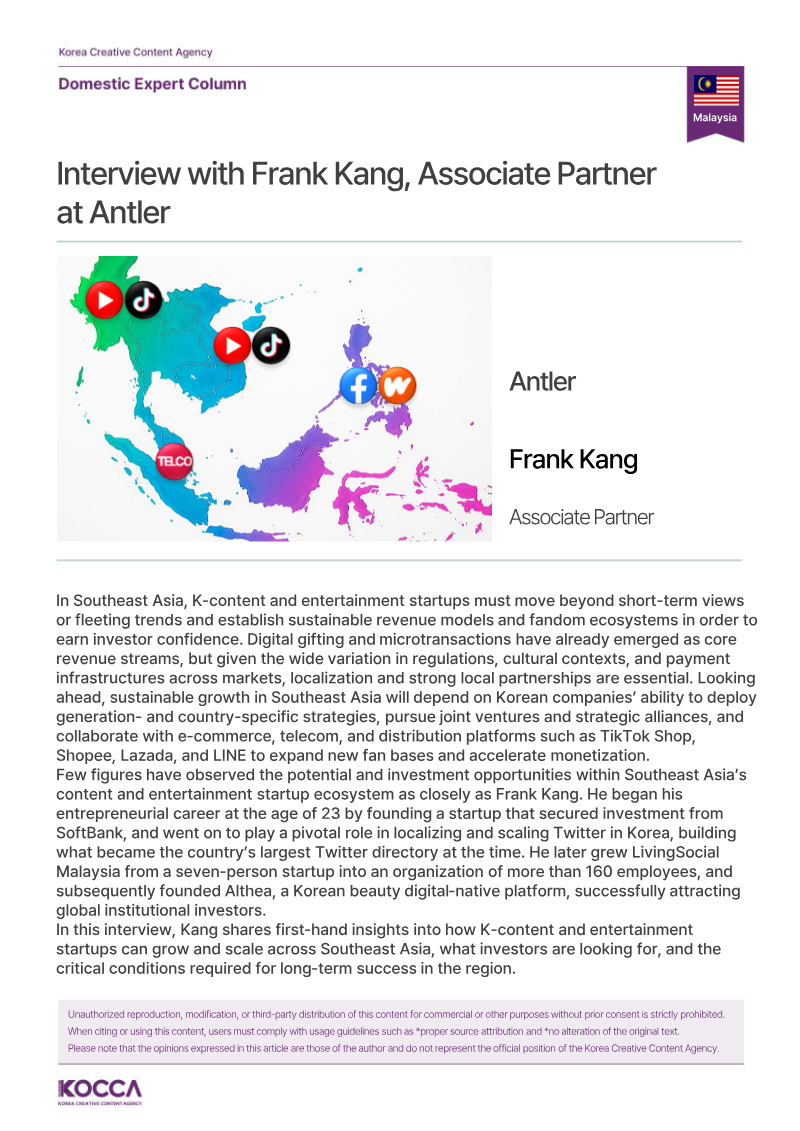
Korean content and entertainment startups are being urged to treat Southeast Asia as a primary growth engine rather than a peripheral market. Success hinges on deep localisation that goes beyond subtitles, requiring partnerships with local “co‑pilots” that can navigate fragmented linguistic, regulatory and payment landscapes in cities such as Jakarta, Manila and Bangkok. By embedding region‑specific monetisation schemes—micro‑transactions, live‑commerce, and hybrid free‑plus‑premium models—companies can align with the mobile‑wallet‑driven habits of Southeast Asian fans and convert grassroots enthusiasm into sustainable revenue streams.
The region’s fandom operates as a decentralized, grassroots network where fans act as unpaid marketers, driving earnings through digital stickers, low‑priced concert tickets and other micro‑purchases that often outpace traditional subscription revenues seen in Korea or Japan. Promising niches include short‑form video, webtoons and IP‑centric ecosystems, mobile‑first games, and live‑commerce platforms, all of which benefit from early community testing and strong local alliances. Trust capital built by global Korean acts such as BTS and BLACKPINK demonstrates the willingness of Southeast Asian audiences to pay for authentic, culturally resonant experiences.
Investors now demand proven revenue traction and genuine localisation before committing capital, and scalable startups are expected to adopt modular, locally adapted business models. Exits are likely to occur through mergers and acquisitions rather than public listings, underscoring the strategic importance of establishing a resilient foothold in Southeast Asia as a launchpad for broader global expansion.
- Korean entertainment and content startups must treat Southeast Asia as a primary growth engine rather than a peripheral market to achieve sustainable expansion.
- Success requires deep localisation through local 'co-pilots' to navigate fragmented linguistic, regulatory, and payment landscapes in key hubs like Jakarta, Manila, and Bangkok.
- Revenue models should shift toward mobile-wallet-driven micro-transactions, live-commerce, and hybrid free-plus-premium structures to align with local consumption habits.
- Startups should leverage decentralized, grassroots fan networks that drive revenue through digital stickers and low-priced micro-purchases, which often outperform traditional subscription models.
- High-growth niches include short-form video, webtoons, IP-centric ecosystems, and mobile-first games that utilize early community testing and local alliances.
+1
KOCCA – Korea Creative Content AgencyJan 2025