Report2 pages
Financial Highlights: Fiscal Year Ending March 2017
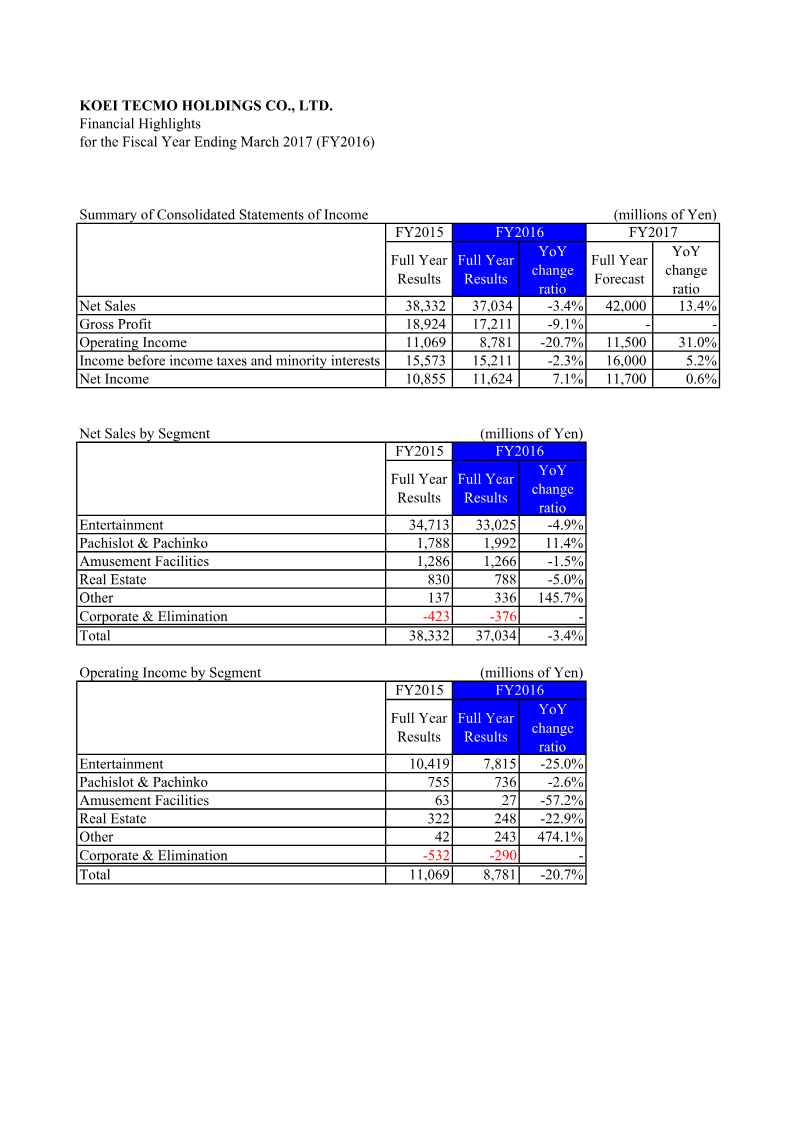
Koei Tecmo Holdings reported a modest improvement in fiscal performance for the year ending March 2017 compared with the prior year. Net sales fell 3.4 % to ¥37,034 million, largely due to a 4.9 % decline in the entertainment segment and a 1.5 % drop in amusement facilities, while pachislot & pachinko sales rose 11.4 %. The “Other” segment, which includes real estate and ancillary activities, grew 145.7 %, offsetting declines in core gaming operations. Operating income contracted 20.7 % to ¥8,781 million, driven by a 25 % reduction in entertainment operating profit and a 57.2 % decline in amusement facilities; the “Other” segment’s operating profit surged 474.1 %. Net income increased 7.1 % to ¥11,624 million, reflecting a 0.6 % rise in the forecasted year and a modest improvement over the previous fiscal period.
Balance‑sheet analysis shows total assets rising 7.9 % to ¥119,461 million, mainly due to higher investment securities and land values. Current assets decreased slightly as cash and receivables fell, while fixed assets grew from ¥83,495 million to ¥92,772 million, largely driven by land acquisitions. Total liabilities increased 5.8 % to ¥12,944 million, with current liabilities rising and long‑term liabilities falling. Shareholders’ equity expanded to ¥105,639 million, supported by retained earnings growth and a reduction in treasury stock.
The financial highlights cover Japan‑based operations for FY2016, presenting consolidated income statements and balance sheets in millions of yen. Data are derived from audited financial statements, with segment performance broken down by entertainment, pachislot & pachinko, amusement facilities, real estate, and other activities. The report underscores a shift toward diversified revenue streams amid declining core gaming sales.
- Koei Tecmo’s net income rose 7.1% to ¥11,624 million for the fiscal year ending March 2017, despite a 3.4% decline in total net sales to ¥37,034 million.
- Operating income contracted by 20.7% to ¥8,781 million, primarily driven by a 25% profit decline in the entertainment segment and a 57.2% drop in amusement facilities.
- The company’s 'Other' segment, encompassing real estate and ancillary activities, acted as a critical hedge, with sales growing 145.7% and operating profit surging 474.1%.
- Core gaming operations struggled, with the entertainment segment reporting a 4.9% decline in sales and the amusement facilities segment recording a 1.5% drop.
- Total assets increased by 7.9% to ¥119,461 million, largely due to a rise in fixed assets from ¥83,495 million to ¥92,772 million following significant land acquisitions.
Koei Tecmo
Report2 pages
Financial Highlights: 1st Quarter of Fiscal Year Ending March 2018
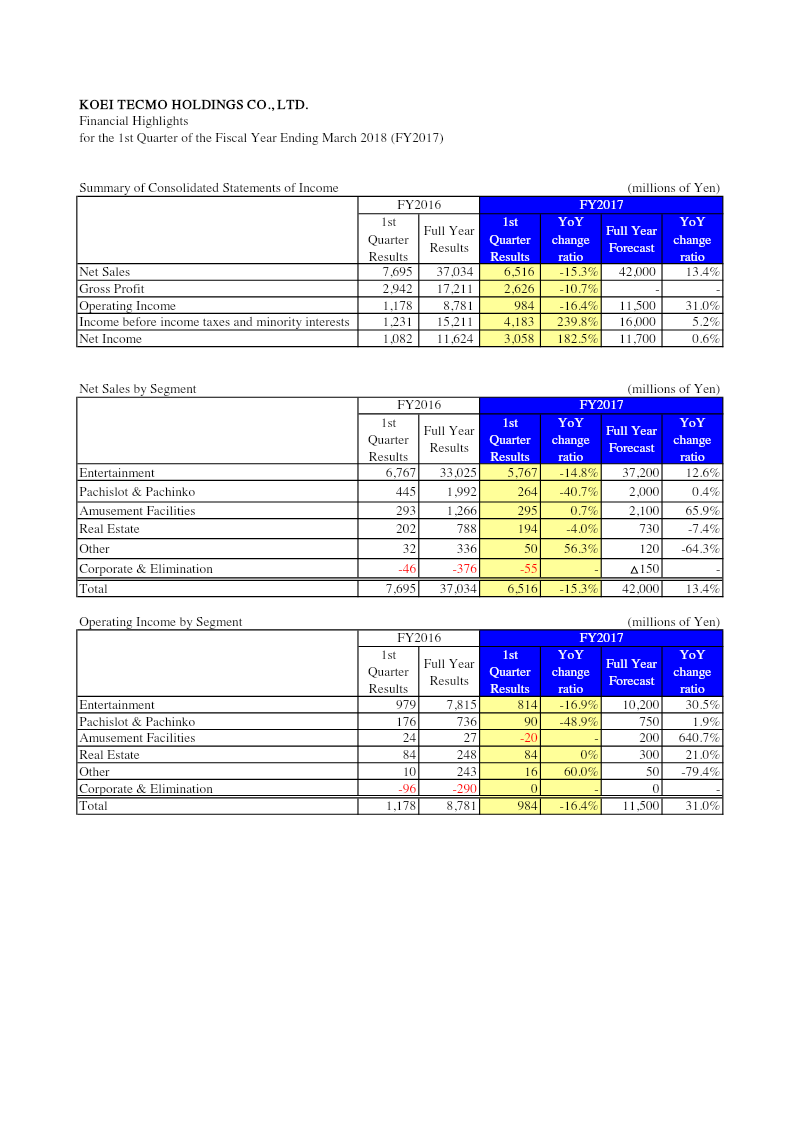
Financial highlights for KOEI TECMO HOLDINGS CO., LTD. cover the first quarter of fiscal year ending March 2018, comparing results to FY2017 and a forecast for the full year. Net sales fell 15.3 % to ¥37,034 million, driven by a 14.8 % decline in the entertainment segment and a 40.7 % drop in pachislot & pachinko revenue, while amusement facilities grew modestly by 0.7 %. Gross profit decreased 10.7 % to ¥17,211 million, and operating income contracted 16.4 % to ¥8,781 million; however, income before taxes surged 239.8 % to ¥15,211 million due largely to a sharp rise in operating income from the entertainment segment. Net income increased 182.5 % to ¥11,624 million, reflecting higher profitability in core gaming operations.
Segment‑level operating income mirrored sales trends: entertainment contributed ¥7,815 million (−16.9 % YoY), pachislot & pachinko ¥736 million (−48.9 % YoY), and amusement facilities ¥27 million (−20 %). Forecasts for the full year project net sales of ¥42,000 million (+13.4 % YoY) and operating income of ¥11,500 million (+31.0 % YoY), indicating a recovery trajectory.
Balance‑sheet data as of June 30, 2017 show total assets at ¥113,530 million and liabilities at ¥9,077 million, with shareholders’ equity of ¥104,452 million. Current assets declined from ¥26,689 million to ¥20,387 million, largely due to reduced cash and time deposits. Current liabilities fell from ¥11,460 million to ¥7,354 million, driven by lower trade payables and short‑term loans. The company’s liquidity position remains solid, with a current ratio above 2:1 and a debt‑to‑equity ratio below 0.09, supporting continued investment in gaming and entertainment assets across Japan during the fiscal year.
- Net income for Q1 FY2018 surged 182.5% to ¥11,624 million, driven by increased profitability in core gaming operations despite a 15.3% decline in total net sales to ¥37,034 million.
- Income before taxes rose 239.8% to ¥15,211 million, bolstered by a sharp increase in operating income from the entertainment segment.
- Operating income across all segments declined, with the entertainment segment falling 16.9% to ¥7,815 million and the pachislot & pachinko segment dropping 48.9% to ¥736 million.
- Full-year forecasts project a recovery trajectory with net sales reaching ¥42,000 million (+13.4% YoY) and operating income hitting ¥11,500 million (+31.0% YoY).
- As of June 30, 2017, the company maintains a strong balance sheet with ¥104,452 million in shareholders’ equity and a debt-to-equity ratio below 0.09.
+1
Koei Tecmo
Report2 pages
Financial Highlights: 1st Half of the Fiscal Year Ending March 2018
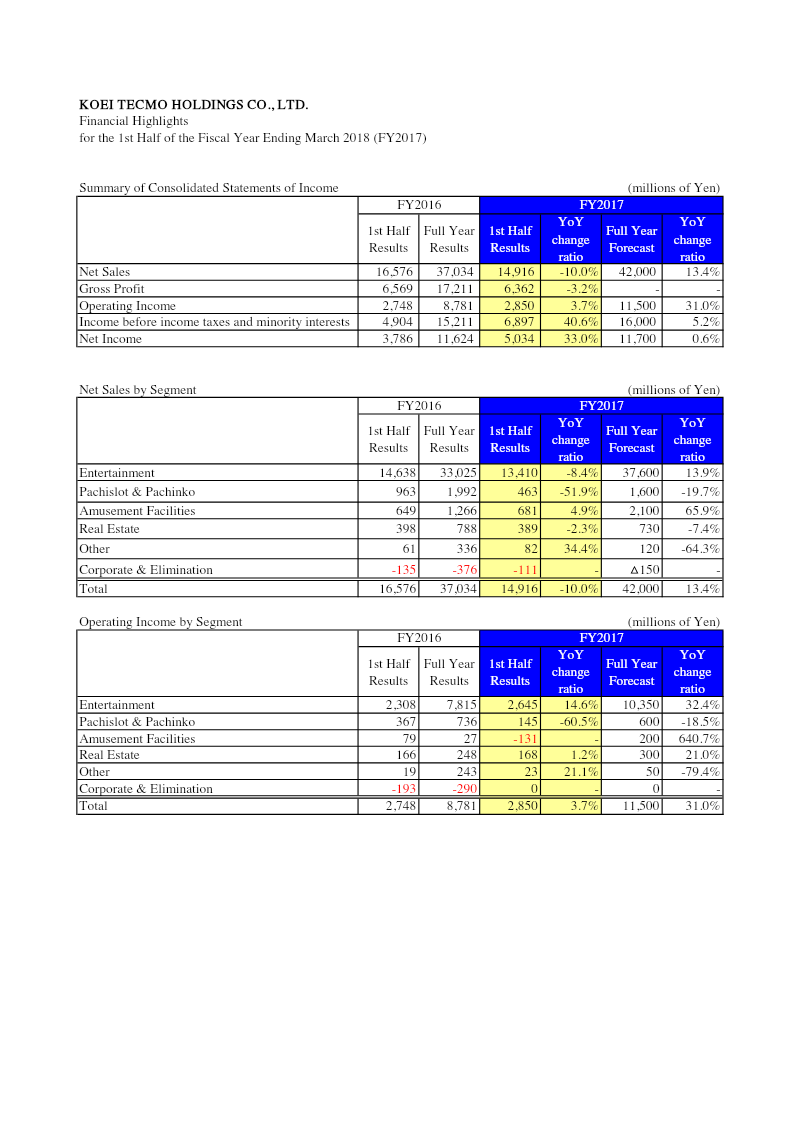
Financial highlights for the first half of KOEI TECMO HOLDINGS’ fiscal year ending March 2018 reveal a mixed performance. Net sales fell 10 % to ¥16,576 million compared with the same period in FY2016, driven mainly by a 51.9 % decline in Pachislot & Pachinko revenue and a 64.3 % drop in the Other segment, offset by growth in Entertainment (−8.4 %) and Amusement Facilities (+4.9 %). Gross profit contracted 3.2 % to ¥6,569 million, while operating income rose 31 % to ¥2,748 million, largely due to a 32.4 % increase in Entertainment operating income and a 21.0 % rise in Real Estate. Income before taxes surged 40.6 % to ¥4,904 million, and net income climbed 33.0 % to ¥3,786 million, reflecting improved profitability in core entertainment operations.
The balance sheet as of September 30, 2017 shows total assets at ¥119.5 billion, slightly down from the prior year’s ¥120.0 billion. Current assets decreased to ¥17,143 million, largely because cash and time deposits fell from ¥11,868 million to ¥5,062 million. Current liabilities also dropped sharply to ¥6,530 million from ¥11,460 million, driven by lower trade payables and accrued bonuses. Long‑term liabilities increased to ¥2,543 million from ¥1,484 million, mainly due to higher deferred tax liabilities. Shareholders’ equity remained stable at ¥105.6 billion, with retained earnings slightly lower.
Overall, the company experienced a decline in sales but improved operating efficiency and profitability. Cash reserves were reduced, while liabilities shifted toward longer‑term obligations, indicating a strategic focus on restructuring and investment in future growth areas.
- Koei Tecmo Holdings reported a 33.0% increase in net income to ¥3,786 million for the first half of FY2018, despite a 10% decline in net sales to ¥16,576 million.
- Operating income rose 31% to ¥2,748 million, driven by a 32.4% increase in operating income within the Entertainment segment and a 21.0% rise in the Real Estate segment.
- The company's top-line revenue decline was primarily caused by a 51.9% drop in Pachislot & Pachinko revenue and a 64.3% decline in the Other segment.
- Cash and time deposits decreased significantly from ¥11,868 million to ¥5,062 million as of September 30, 2017.
- Current liabilities fell sharply to ¥6,530 million from ¥11,460 million, while long-term liabilities increased to ¥2,543 million due to higher deferred tax liabilities.
+1
Koei Tecmo
Report2 pages
Financial Highlights: Q1 FY2018
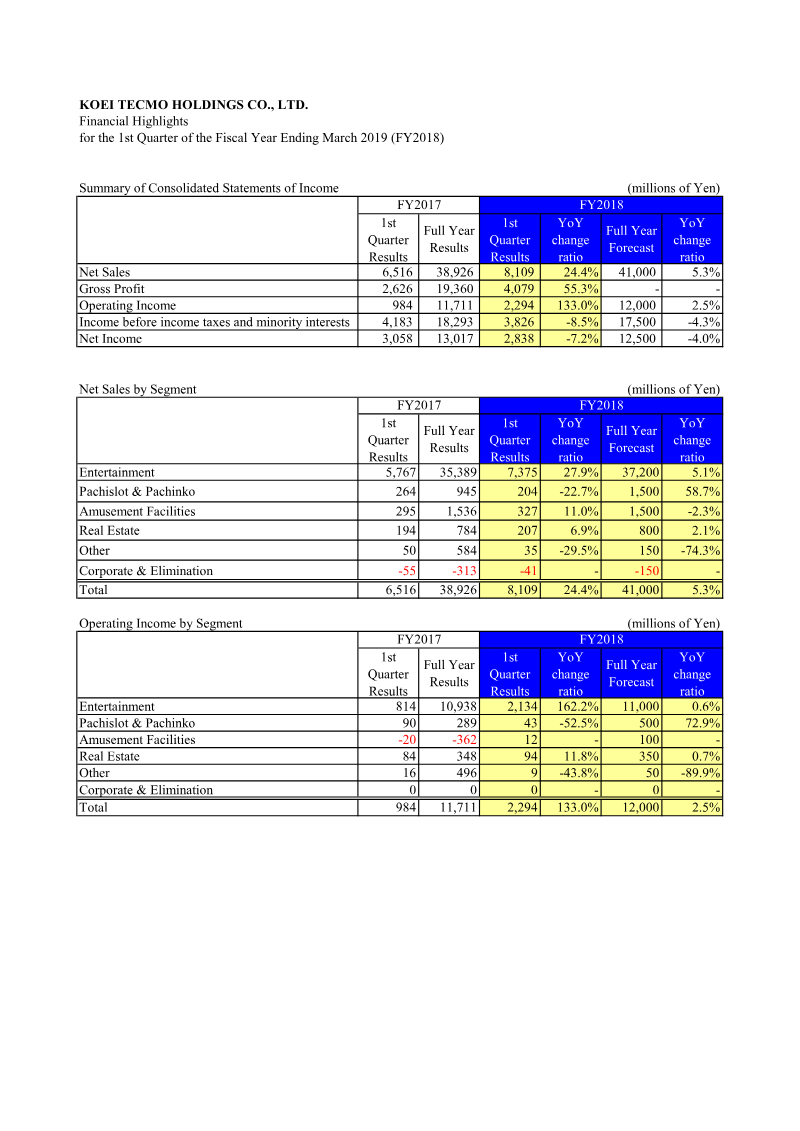
Financial highlights for the first quarter of fiscal year 2018 demonstrate robust growth across KOEI TECMO HOLDINGS’ core entertainment segment, with net sales rising 24.4% year‑over‑year to ¥38.9 billion, driven by a 27.9% increase in entertainment revenue to ¥35.4 billion. Operating income surged 133.0% to ¥11.7 billion, largely from a 162.2% jump in entertainment operating profit to ¥10.9 billion, while other segments such as pachislot & pachinko and amusement facilities showed mixed performance. Net income increased 7.2% to ¥13.0 billion, though the company reported a slight decline in income before taxes and minority interests by 8.5%.
Segment analysis reveals that pachislot & pachinko sales fell 22.7% to ¥945 million, whereas amusement facilities grew 11.0% to ¥1.5 billion. Real estate revenue increased 6.9% to ¥784 million, and the “Other” segment contracted 29.5% to ¥584 million. Corporate eliminations contributed a negative ¥313 million in the quarter.
Balance‑sheet data as of June 30, 2018 show total assets at ¥121.8 billion, down from ¥128.6 billion the previous year, primarily due to a reduction in current assets and investment securities. Current liabilities decreased to ¥7.9 billion from ¥11.0 billion, improving the current ratio. Shareholders’ equity stood at ¥109.5 billion, with retained earnings slightly lower than the prior year.
Overall, the quarter reflects strong profitability in entertainment, modest declines in ancillary segments, and a solid liquidity position, positioning the company for continued growth into the remainder of FY2018.
- KOEI TECMO HOLDINGS reported a 24.4% year-over-year increase in net sales to ¥38.9 billion for Q1 FY2018, driven primarily by a 27.9% rise in entertainment segment revenue to ¥35.4 billion.
- Operating income surged 133.0% to ¥11.7 billion, fueled by a 162.2% jump in entertainment operating profit to ¥10.9 billion.
- Net income grew 7.2% to ¥13.0 billion, despite an 8.5% decline in income before taxes and minority interests.
- Performance in non-entertainment segments was mixed, with amusement facilities revenue growing 11.0% to ¥1.5 billion, while pachislot & pachinko sales fell 22.7% to ¥945 million.
- Total assets decreased to ¥121.8 billion as of June 30, 2018, down from ¥128.6 billion the previous year due to reductions in current assets and investment securities.
Koei Tecmo
Report2 pages
Financial Highlights: 1st Half of Fiscal Year Ending March 2019
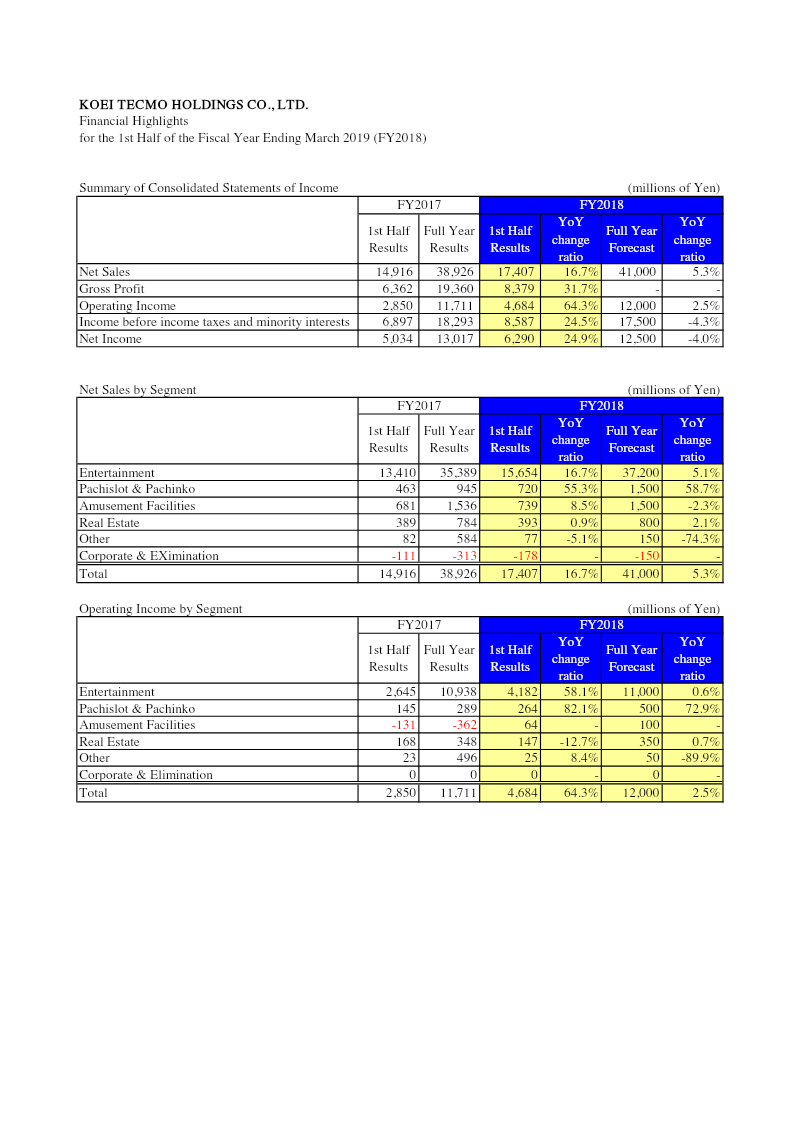
Financial highlights for the first half of fiscal year ending March 2019 show a strong performance across KOEI TECMO HOLDINGS’ core entertainment and gaming segments. Net sales rose 16.7 % year‑over‑year to ¥38,926 million, driven mainly by the entertainment segment (¥35,389 million, up 16.7 %) and a significant increase in pachislot & pachinko revenue (¥945 million, up 55.3 %). Amusement facilities and real‑estate sales also grew modestly, while the “Other” segment contracted sharply. Operating income surged 64.3 % to ¥11,711 million, with entertainment contributing the largest share (¥10,938 million). The company’s profitability metrics improved markedly: gross profit margin climbed to 31.7 %, operating margin reached 64.3 % of sales, and net income increased 24.9 % to ¥13,017 million.
Balance‑sheet activity reflected a modest expansion of current assets, particularly cash and marketable securities, while fixed‑asset levels remained stable. Total assets decreased slightly from ¥128,594 million to ¥126,631 million, largely due to a reduction in investment securities. Current liabilities fell by 25 % to ¥8,216 million, improving liquidity. Shareholders’ equity remained robust at ¥112,938 million, with retained earnings near ¥73 billion. Net assets increased marginally to ¥117,092 million.
The data cover Japan‑based operations for the first six months of FY2018, with comparative figures from FY2017 and full‑year projections. The report relies on consolidated financial statements prepared under Japanese GAAP, providing a comprehensive view of revenue streams, profitability, and balance‑sheet health for the company’s entertainment and gaming business.
- KOEI TECMO HOLDINGS reported a 64.3% surge in operating income to ¥11,711 million for the first half of the fiscal year ending March 2019.
- Net sales grew 16.7% year-over-year to ¥38,926 million, primarily driven by the entertainment segment which generated ¥35,389 million.
- Net income increased by 24.9% to ¥13,017 million, supported by an operating margin of 64.3% and a gross profit margin of 31.7%.
- Pachislot and pachinko revenue saw significant growth, rising 55.3% to ¥945 million.
- Liquidity improved as current liabilities decreased by 25% to ¥8,216 million during the six-month period.
+1
Koei Tecmo
Report2 pages
Financial Highlights: Fiscal Year Ending March 2019
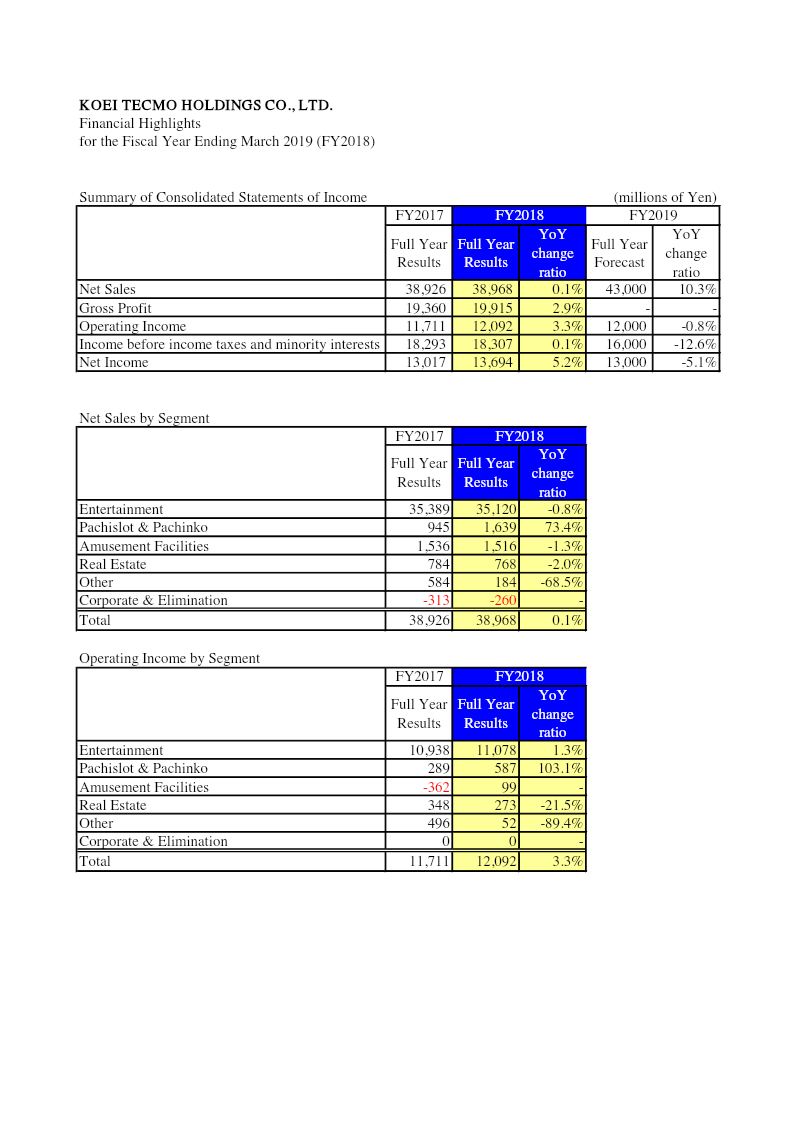
Financial highlights for the fiscal year ending March 2019 show KOEI TECMO HOLDINGS CO., LTD. maintained stable top‑line performance, with net sales rising 0.1 % to ¥38,968 million compared to the prior year and a forecasted increase of 10.3 % for FY2019. Gross profit grew 2.9 %, while operating income expanded by 3.3 % to ¥12,092 million; the company’s operating margin remained near 31 %. Income before taxes and minority interests increased modestly by 0.1 % to ¥18,307 million, but net income declined 5.1 % to ¥13,000 million against a forecast of ¥13,694 million.
Segment analysis reveals the entertainment division as the largest contributor to sales (¥35.1 billion) but experienced a slight 0.8 % decline, whereas the pachislot & pachinko segment surged 73.4 % in sales to ¥1,639 million and doubled operating income. Amusement facilities saw a marginal drop in sales but improved profitability, while real estate and other segments contracted sharply. The company’s balance sheet shows total assets of ¥129,192 million, up 0.6 % from the previous year, driven largely by increases in cash and marketable securities. Current liabilities fell 18 % to ¥8,957 million, largely due to reduced tax payable and allowances. Shareholders’ equity rose 5.4 % to ¥119,204 million, supported by retained earnings growth and a modest increase in capital surplus.
The financial data cover Japan‑based operations for FY2019, with figures presented in millions of yen. The report relies on consolidated financial statements prepared under Japanese GAAP, reflecting a comprehensive view of the company’s performance and liquidity across its entertainment, pachislot & pachinko, amusement facilities, real estate, and other business segments.
- Koei Tecmo Holdings maintained stable top-line performance for the fiscal year ending March 2019, with net sales rising 0.1% to ¥38,968 million.
- Operating income grew 3.3% to ¥12,092 million, maintaining a strong operating margin of approximately 31%.
- Net income declined 5.1% to ¥13,000 million, falling short of the company's initial forecast of ¥13,694 million.
- The pachislot & pachinko segment was a major growth driver, surging 73.4% in sales to ¥1,639 million and doubling its operating income.
- The core entertainment division, while remaining the largest revenue contributor at ¥35.1 billion, experienced a slight sales decline of 0.8%.
+1
Koei Tecmo
Report2 pages
Financial Highlights: 3rd Quarter of the Fiscal Year Ending March 2019
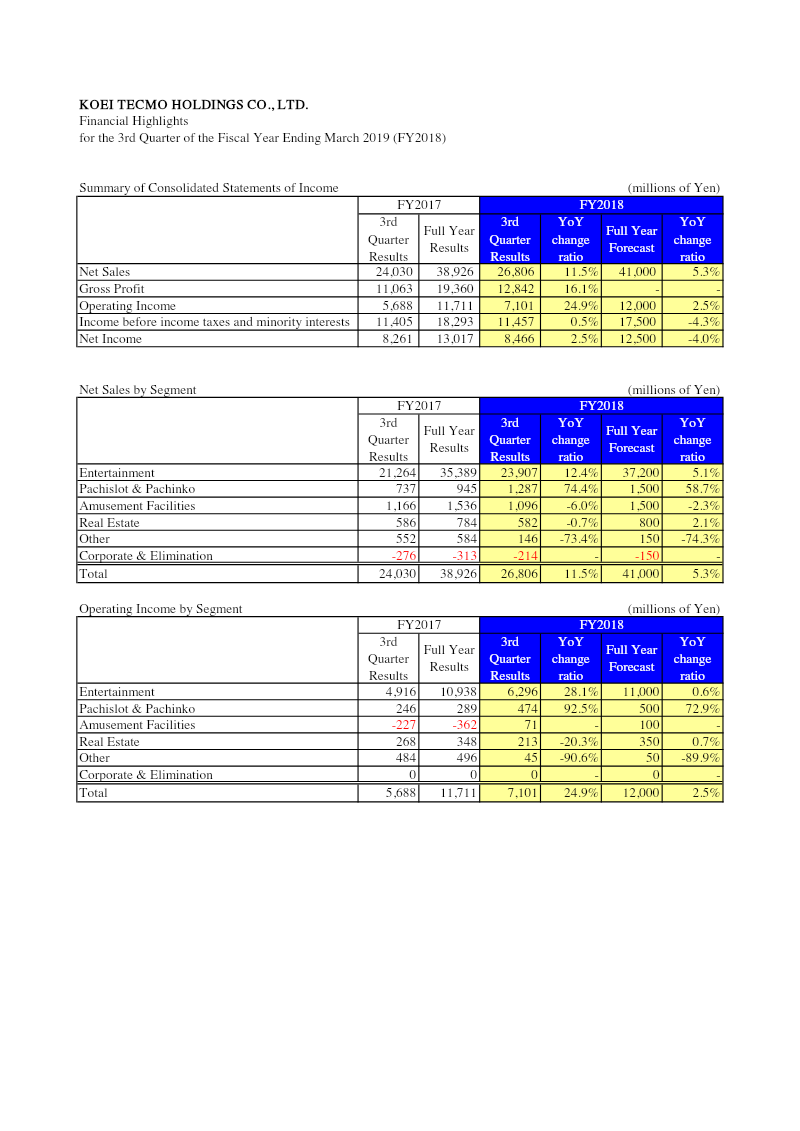
Financial highlights for KOEI TECMO Holdings’ third quarter of FY2018 show a robust 11.5 % increase in net sales to ¥38,926 million versus ¥26,806 million in the same period of FY2017. Gross profit rose 16.1 % to ¥19,360 million, while operating income surged 24.9 % to ¥11,711 million, reflecting strong performance across entertainment and pachislot & pachinko segments. Net income climbed 2.5 % to ¥13,017 million, though it fell short of the ¥12,500 million forecast by 4.0 %. Segment analysis reveals entertainment sales at ¥35,389 million (12.4 % YoY), pachislot & pachinko at ¥1,287 million (74.4 % YoY), and a modest decline in amusement facilities sales by 6.0 %. Operating income from entertainment reached ¥10,938 million (28.1 % YoY), while pachislot & pachinko contributed ¥474 million (92.5 % YoY). Real estate and other segments showed mixed results, with real estate operating income falling 20.3 % and other segment income declining 90.6 %.
Balance‑sheet data as of December 31, 2018 indicate total assets of ¥116,220 million, down from ¥128,594 million at March 31, 2018, largely due to a reduction in current assets and investment securities. Current liabilities fell sharply from ¥11,027 million to ¥5,716 million, improving liquidity. Shareholders’ equity increased modestly from ¥113,178 million to ¥114,088 million. Net assets rose from ¥116,242 million to ¥109,561 million, reflecting changes in other comprehensive income and foreign‑currency adjustments. The company’s financial position remains solid, with a strong cash base of ¥5,120 million and a healthy equity cushion.
- KOEI TECMO Holdings reported strong Q3 FY2018 growth with net sales rising 11.5% to ¥38,926 million and operating income surging 24.9% to ¥11,711 million.
- The entertainment segment drove the majority of performance with ¥35,389 million in sales (up 12.4% YoY) and ¥10,938 million in operating income (up 28.1% YoY).
- The pachislot & pachinko segment saw significant growth, with sales increasing 74.4% to ¥1,287 million and operating income jumping 92.5% to ¥474 million.
- Net income reached ¥13,017 million, representing a 2.5% increase, though this result fell 4.0% short of the company's ¥12,500 million forecast.
- Liquidity improved significantly as current liabilities were nearly halved, dropping from ¥11,027 million to ¥5,716 million between March and December 2018.
+1
Koei Tecmo
Report2 pages
Financial Highlights: FY2019 Q1
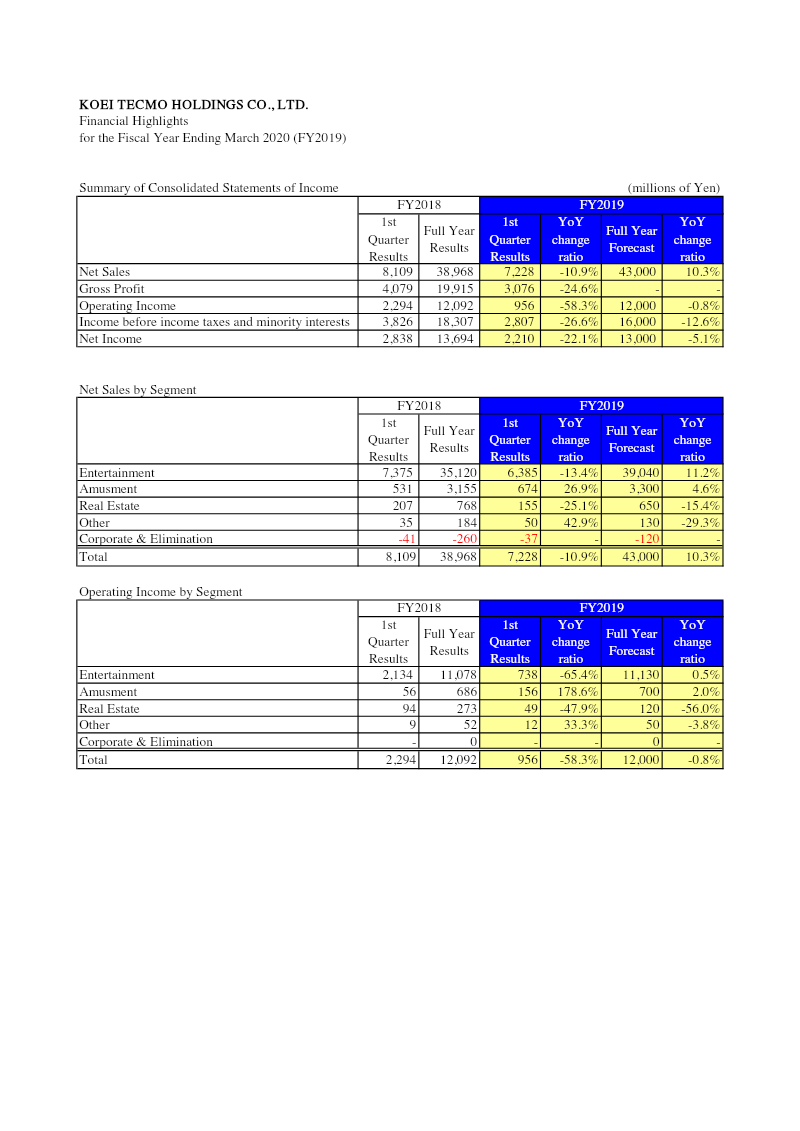
Financial highlights for KOEI TECMO HOLDINGS CO., LTD. cover the fiscal year ending March 2020, with a focus on first‑quarter performance and full‑year comparisons to FY2018. Net sales fell 10.9 % in the first quarter of FY2019 versus the same period in FY2018, totaling ¥38.97 billion against a forecast of ¥43 billion (+10.3 %). Segment analysis shows entertainment sales declined 13.4 % to ¥35.12 billion, while amusement revenue rose 26.9 % to ¥3.16 billion; real‑estate and other segments also experienced mixed movements, with real‑estate sales up 25.1 % but operating income down 47.9 %. Operating income for the quarter dropped 58.3 % to ¥12.09 billion, below the forecast of ¥12 billion (-0.8 %). Net income fell 22.1 % to ¥13.69 billion, versus a forecast of ¥13 billion (-5.1 %).
Balance‑sheet data as of June 30, 2019 show current assets at ¥14.82 billion, down from ¥19.77 billion in March 2019, largely due to reductions in cash and receivables. Total assets declined from ¥129.19 billion to ¥123.08 billion, while liabilities decreased from ¥9.91 billion to ¥8.65 billion, improving the equity‑to‑asset ratio. Shareholders’ equity fell from ¥119.20 billion to ¥114.57 billion, driven by lower retained earnings and a modest increase in treasury stock.
The report relies on consolidated financial statements, comparing quarterly results to the prior year and to management forecasts. Geographic coverage is Japan‑centric, with no international revenue breakdown provided. The data period spans FY2018 to FY2019, focusing on quarterly and full‑year metrics across entertainment, amusement, real‑estate, and other segments.
- Koei Tecmo Holdings reported a 10.9% year-over-year decline in net sales for Q1 FY2019, totaling ¥38.97 billion and missing the company's forecast of ¥43 billion.
- Operating income for the quarter fell by 58.3% to ¥12.09 billion, while net income decreased by 22.1% to ¥13.69 billion.
- The core entertainment segment drove the overall decline, with sales dropping 13.4% to ¥35.12 billion compared to the same period in FY2018.
- Amusement revenue provided a bright spot with a 26.9% increase to ¥3.16 billion, and real-estate sales grew by 25.1%.
- Despite the sales decline, the company's equity-to-asset ratio improved as total liabilities decreased from ¥9.91 billion to ¥8.65 billion by June 30, 2019.
Koei Tecmo
Report2 pages
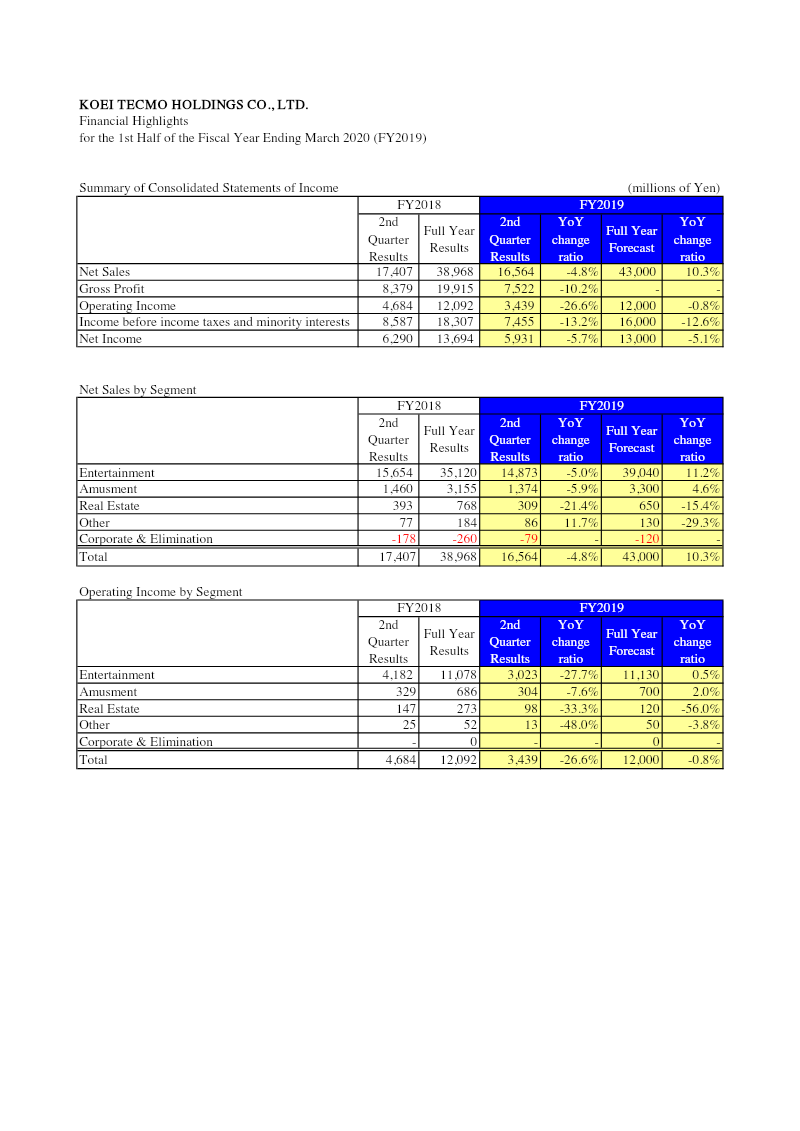
Financial Highlights: 1st Half of Fiscal Year Ending March 2020
The financial highlights cover KOEI TECMO HOLDINGS’ first half of fiscal year 2019, ending March 2020. Net sales rose to ¥38.97 billion from ¥17.41 billion the prior year, a 4.8 % decline versus the second full year of FY2018 but an increase of 10.3 % against the forecasted ¥43 billion. Gross profit fell by 10.2 %, while operating income dropped 26.6 % to ¥12.09 billion, slightly below the ¥12 billion forecast. Net income decreased 5.7 % to ¥13.69 billion, again below the projected ¥13 billion.
Segment analysis shows entertainment sales at ¥35.12 billion, a 5 % decline from the same period in FY2018 but an 11.2 % rise versus forecast, and operating income from entertainment increased to ¥11.08 billion, a 0.5 % gain over the forecast. Amusement and real‑estate segments also posted higher sales than expected, though operating margins remained lower than the previous year. The “Other” segment saw a modest sales increase but a 48 % drop in operating income.
Balance‑sheet data as of September 30, 2019 indicate total assets of ¥125.75 billion, down from ¥129.19 billion the prior year, largely due to a reduction in current assets and fixed‑asset write‑downs. Current liabilities fell to ¥6.39 billion from ¥8.96 billion, improving liquidity. Shareholders’ equity remained stable at ¥118.67 billion, with retained earnings slightly lower than the prior year.
Overall, KOEI TECMO experienced modest revenue growth against forecasts but faced margin compression across segments, while its balance sheet remained solid with reduced liabilities and stable equity.
- Koei Tecmo Holdings reported net sales of ¥38.97 billion for the first half of FY2019, exceeding the ¥43 billion forecast by 10.3% despite a 4.8% decline compared to the previous year.
- Operating income fell 26.6% year-over-year to ¥12.09 billion, while net income decreased 5.7% to ¥13.69 billion, both falling slightly short of their respective forecasts.
- The entertainment segment, the company's primary driver, generated ¥35.12 billion in sales—an 11.2% increase over forecasts—and achieved an operating income of ¥11.08 billion.
- Total assets decreased to ¥125.75 billion as of September 30, 2019, driven by reductions in current assets and fixed-asset write-downs.
- Liquidity improved as current liabilities dropped significantly from ¥8.96 billion in the prior year to ¥6.39 billion.
Koei Tecmo
Report2 pages
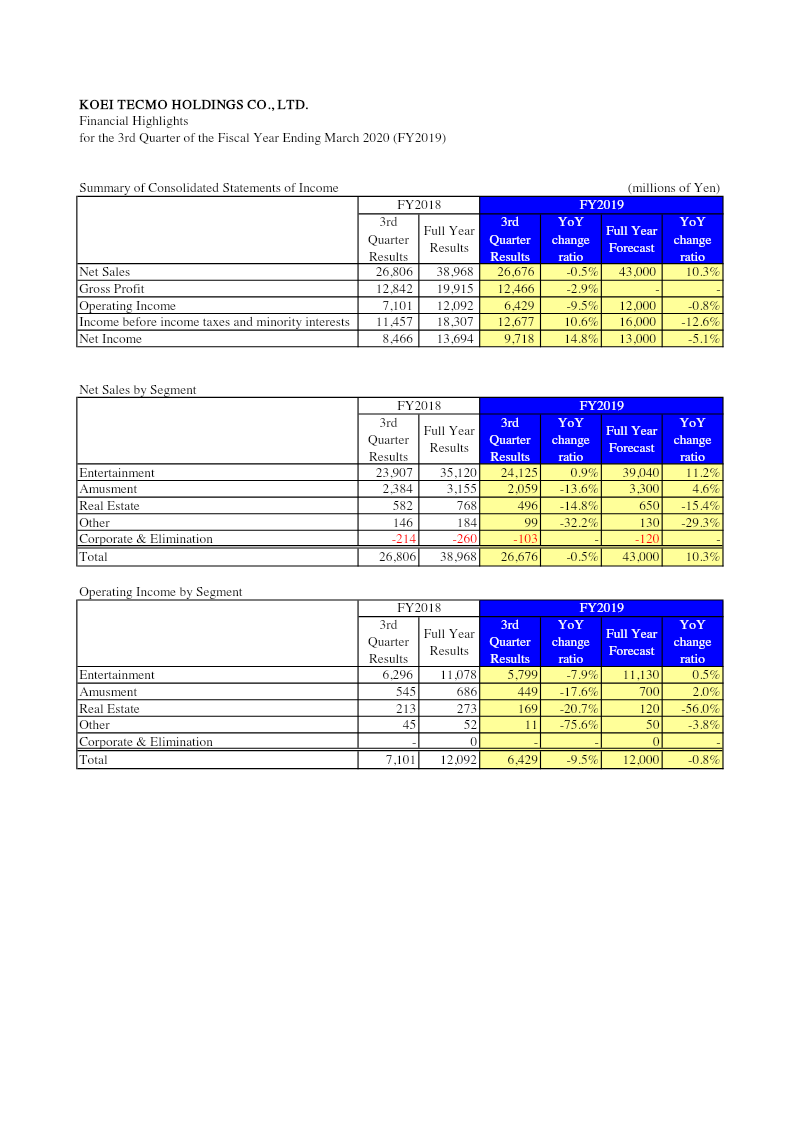
Financial Highlights: 3rd Quarter of the Fiscal Year Ending March 2020
Financial highlights for KOEI TECMO HOLDINGS CO., LTD. cover the third quarter of fiscal year 2019, ending March 2020, and compare results to the prior year’s third quarter and full‑year figures. Net sales rose 14.8 % to ¥38,968 million, driven primarily by the entertainment segment which grew 0.9 % in the quarter and 11.2 % year‑on‑year to ¥35,120 million. Amusement and real estate sales fell 13.6 % and 14.8 %, respectively, while other segments declined sharply by 32.2 %. Operating income increased 9.5 % to ¥12,092 million, with entertainment contributing the bulk of growth; amusement and real estate operating income also rose but at lower rates. Net income climbed 14.8 % to ¥13,694 million, surpassing the forecast of ¥13,000 million.
Balance‑sheet data as of March 31 2019 and December 31 2019 show total assets rising from ¥129,192 million to ¥139,045 million. Current assets grew 7.5 % largely due to higher marketable securities and working‑capital items, while fixed assets remained relatively flat. Liabilities increased from ¥9,908 million to ¥12,023 million, driven by a rise in short‑term loans and deferred tax liabilities. Shareholders’ equity expanded to ¥122,762 million, supported by retained earnings and capital surplus growth. Unrealized gains on securities increased markedly, offsetting land revaluation losses.
The report uses consolidated financial statements for a single Japanese company, covering the fiscal year ending March 2020 with quarterly comparisons. No external survey data are referenced; figures derive from internal accounting records and standard Japanese GAAP reporting practices.
- KOEI TECMO HOLDINGS CO., LTD. reported a 14.8% increase in net sales to ¥38,968 million for the third quarter of the fiscal year ending March 2020.
- Net income reached ¥13,694 million, a 14.8% year-over-year increase that exceeded the company's initial forecast of ¥13,000 million.
- The entertainment segment served as the primary growth driver, with sales rising 11.2% year-over-year to ¥35,120 million and contributing the majority of the company's ¥12,092 million in operating income.
- Operating income grew 9.5% overall, supported by gains in the entertainment, amusement, and real estate segments.
- Non-entertainment segments underperformed, with amusement sales falling 13.6%, real estate sales dropping 14.8%, and other segments declining by 32.2%.
+1
Koei Tecmo
Report2 pages
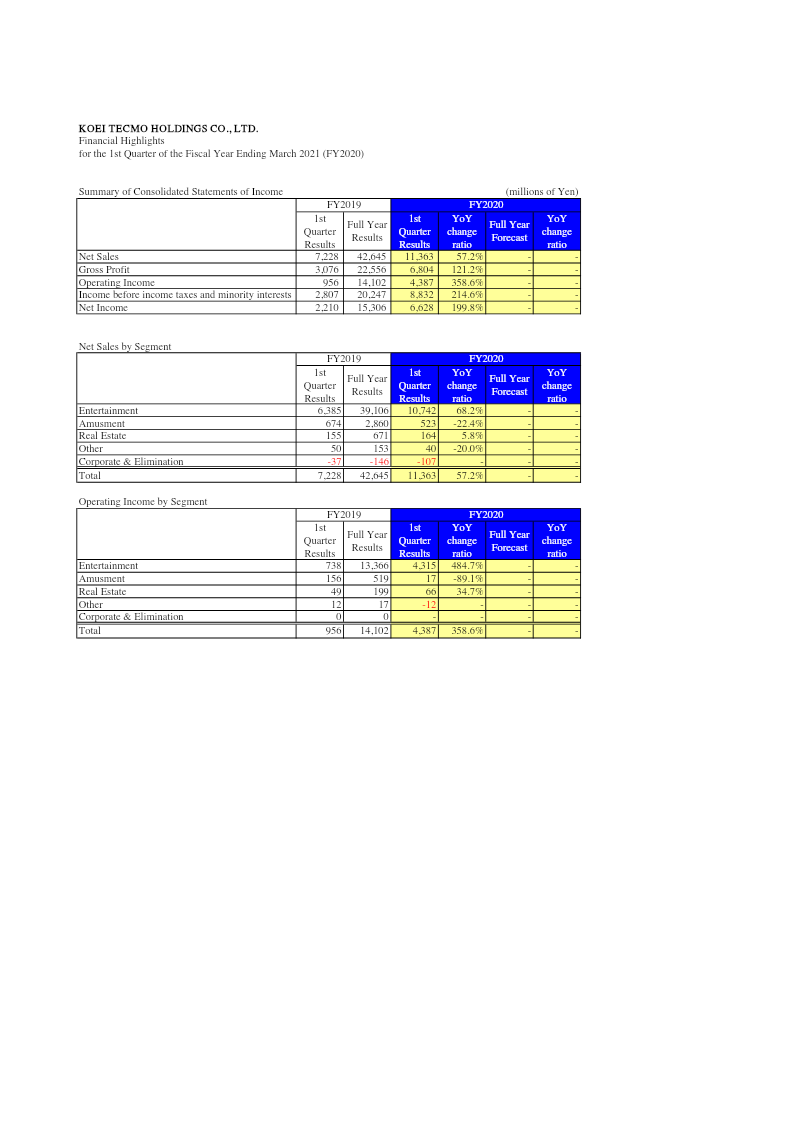
Financial Highlights: 1st Quarter, Fiscal Year Ending March 2021
Koei Tecmo Holdings reported a robust first‑quarter performance for the fiscal year ending March 2021, with net sales rising 57.2 % to ¥42.6 billion from ¥28.8 billion in the prior year’s quarter. Gross profit surged 121.2 % to ¥22.6 billion, while operating income expanded 358.6 % to ¥14.1 billion, reflecting strong profitability across its entertainment segment. Net income increased 199.8 % to ¥15.3 billion, driven largely by the entertainment division’s operating income jump of 484.7 % to ¥13.4 billion, despite a decline in the amusement segment’s contribution.
Segment sales show entertainment as the dominant driver, generating ¥39.1 billion in the quarter (68.2 % of total sales), whereas amusement, real‑estate, and other segments contributed ¥2.9 billion, ¥0.7 billion, and ¥0.15 billion respectively. Operating income from real‑estate rose 34.7 % to ¥199 million, while amusement income fell 89.1 % to ¥519 million.
Balance‑sheet highlights include a total asset base of ¥152.5 billion, up from ¥147.8 billion, largely due to increases in cash and marketable securities and investment securities. Current assets remained stable at ¥28.9 billion, while current liabilities decreased slightly to ¥23.0 billion. Shareholders’ equity stood at ¥127.5 billion, with retained earnings of ¥87.6 billion and a modest treasury stock balance.
The financial snapshot covers Japan‑based operations for the first quarter of FY2021, presenting consolidated figures in millions of yen without detailed methodology disclosures.
- Koei Tecmo Holdings reported a 57.2% increase in net sales to ¥42.6 billion for the first quarter of fiscal year 2021, compared to ¥28.8 billion in the prior year.
- Operating income surged 358.6% to ¥14.1 billion, while net income rose 199.8% to ¥15.3 billion, driven primarily by the entertainment segment.
- The entertainment division was the primary growth engine, with operating income jumping 484.7% to ¥13.4 billion and total sales reaching ¥39.1 billion.
- The amusement segment experienced a significant downturn, with operating income falling 89.1% to ¥519 million.
- Gross profit more than doubled, increasing 121.2% year-over-year to reach ¥22.6 billion.
+1
Koei Tecmo
Report2 pages
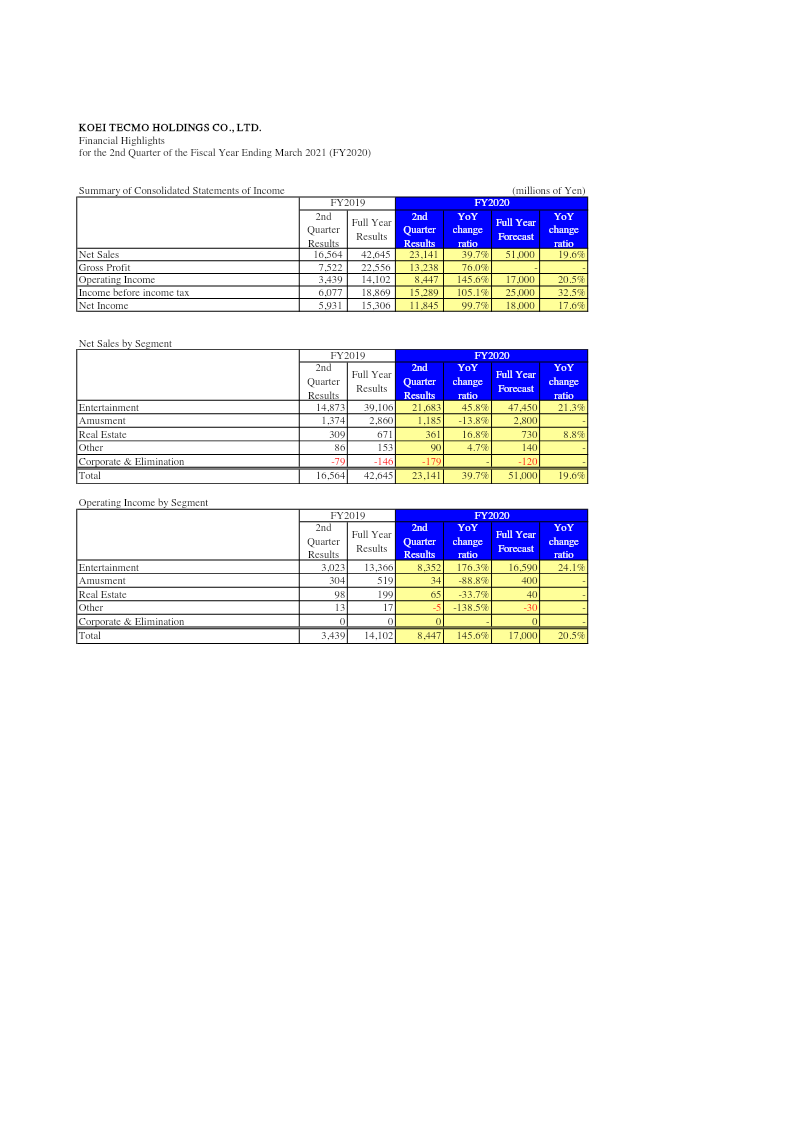
Financial Highlights: 2nd Quarter of the Fiscal Year Ending March 2021
Financial highlights for KOEI TECMO Holdings’ second quarter of fiscal 2020 reveal a robust expansion across its core entertainment segment, with net sales rising 39.7 % year‑over‑year to ¥42.6 billion and gross profit increasing 76 % to ¥22.6 billion. Operating income surged 145.6 % to ¥14.1 billion, driven largely by the entertainment division’s 176 % jump to ¥13.4 billion, while amusement and real‑estate segments posted modest gains of 88.8 % and 33.7 %, respectively. Net income nearly doubled, reaching ¥15.3 billion (99.7 % increase), and the company projected a full‑year net sales forecast of ¥51 billion, up 19.6 % from the prior year.
Balance‑sheet activity shows total assets rising to ¥160.4 billion, primarily due to a significant increase in marketable securities (from ¥337 million to ¥7.1 billion) and investment securities (to ¥87.4 billion). Current assets grew modestly, while current liabilities fell from ¥24.1 billion to ¥21.5 billion, reflecting a reduction in short‑term borrowings and trade payables. Shareholders’ equity expanded to ¥133 billion, supported by retained earnings growth and a modest decline in treasury stock.
The report covers Japan‑based operations for the fiscal year ending March 2020, with quarterly data for September 30, 2020. No survey methodology is disclosed; figures derive from consolidated financial statements prepared under Japanese GAAP. Overall, the company demonstrates strong profitability and liquidity, with strategic investment in securities bolstering its asset base.
- KOEI TECMO Holdings reported a 145.6% surge in operating income to ¥14.1 billion for the second quarter of fiscal 2020, driven primarily by a 176% increase in the entertainment division's operating income.
- Net sales grew 39.7% year-over-year to ¥42.6 billion, while net income nearly doubled, rising 99.7% to reach ¥15.3 billion.
- The company increased its full-year net sales forecast to ¥51 billion, representing a 19.6% year-over-year growth projection.
- Gross profit saw significant expansion, rising 76% to ¥22.6 billion compared to the same period in the previous fiscal year.
- Total assets reached ¥160.4 billion, bolstered by a substantial increase in investment securities to ¥87.4 billion and marketable securities to ¥7.1 billion.
+1
Koei Tecmo
Report2 pages
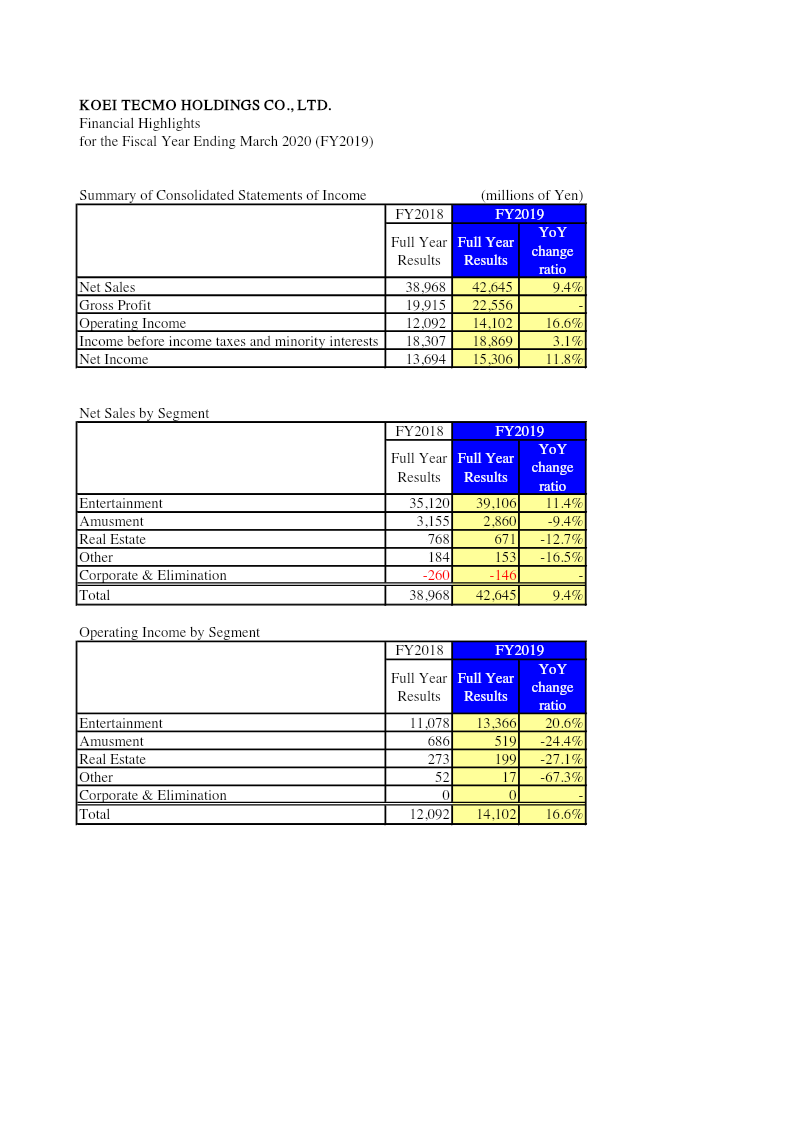
Financial Highlights: Fiscal Year Ending March 2020
Koei Tecmo Holdings reported a strong fiscal year ending March 2020, with net sales rising 9.4 % to ¥42.645 billion from ¥38.968 billion in FY2018. The entertainment segment drove growth, contributing 11.4 % of sales and generating ¥13.366 billion in operating income, a 20.6 % increase. In contrast, amusement, real‑estate and other segments saw declines of 9.4 %, 12.7 % and 16.5 % respectively, reflecting a shift toward core gaming activities. Operating income overall grew 16.6 %, and net income increased 11.8 % to ¥15.306 billion, supported by higher gross profit and efficient cost management.
Balance‑sheet expansion was notable: total assets grew from ¥129.192 billion to ¥147.793 billion, largely due to a jump in current assets (cash and receivables) and property‑and‑equipment investments. Shareholders’ equity rose to ¥128.602 billion, driven by retained earnings and capital surplus. However, current liabilities surged to ¥24.090 billion, driven by short‑term loans and trade payables, while long‑term liabilities increased modestly to ¥1.356 billion.
The company’s geographic focus remains Japan‑centric, with revenue primarily from domestic entertainment products. The fiscal period covers the 12 months ending March 2020, and financial statements follow Japanese GAAP. No external survey data are cited; figures derive from consolidated accounting records. Overall, Koei Tecmo’s FY2020 performance highlights robust growth in its core gaming segment amid a broader portfolio contraction.
- Koei Tecmo reported a 9.4% increase in net sales to ¥42.645 billion for the fiscal year ending March 2020, with net income rising 11.8% to ¥15.306 billion.
- The entertainment segment served as the primary growth engine, delivering a 20.6% increase in operating income to ¥13.366 billion.
- Non-gaming segments experienced significant contractions, with amusement, real-estate, and other business units declining by 9.4%, 12.7%, and 16.5% respectively.
- Total assets expanded to ¥147.793 billion from ¥129.192 billion, bolstered by growth in cash, receivables, and property investments.
- Shareholders’ equity reached ¥128.602 billion, supported by strong retained earnings and capital surplus.
+1
Koei Tecmo
Report2 pages
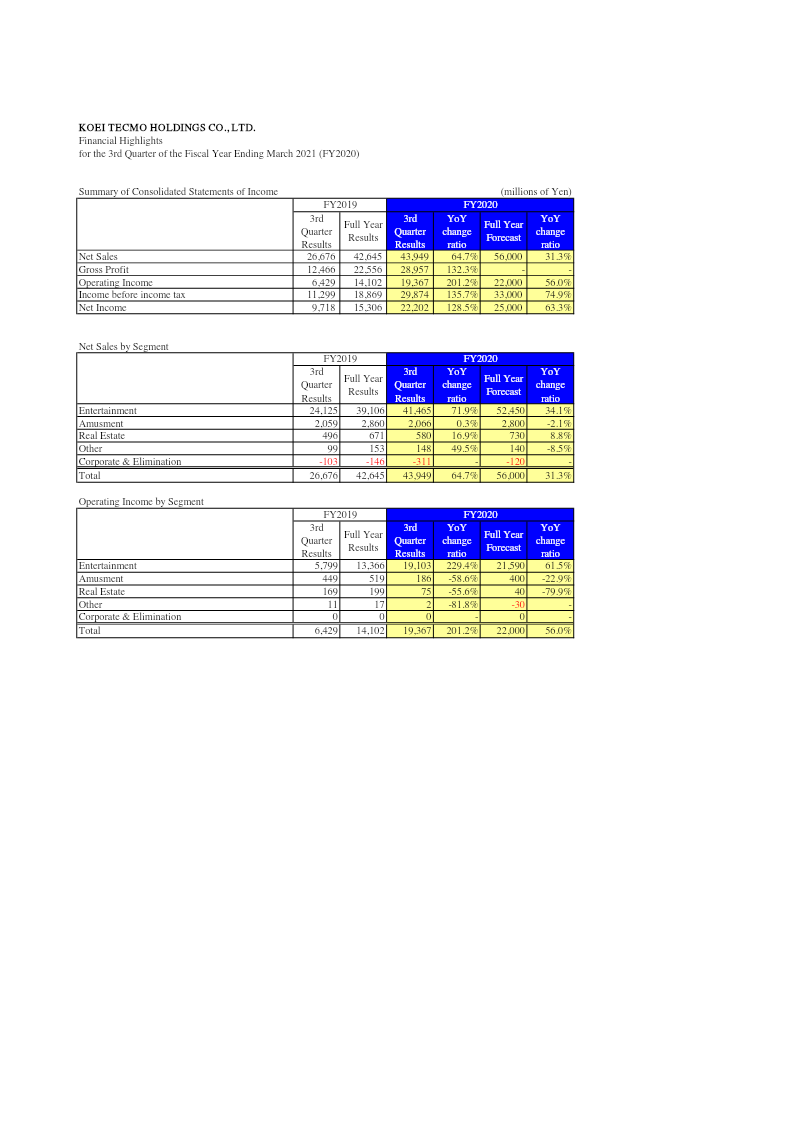
Financial Highlights: 3rd Quarter of the Fiscal Year Ending March 2021
Koei Tecmo Holdings reported a robust third‑quarter performance for fiscal year 2020, with net sales rising 64.7 % to ¥42.6 billion from ¥26.7 billion in the same period of FY2019, and net income increasing 128.5 % to ¥15.3 billion. The entertainment segment drove growth, contributing 71.9 % of sales and delivering a 229.4 % increase in operating income, while amusement and real‑estate segments showed modest gains or declines. Forecasts for the full year projected sales of ¥56 billion and operating income of ¥22 billion, reflecting a 31.3 % and 56.0 % year‑on‑year increase, respectively.
On the balance‑sheet side, total assets expanded from ¥147.8 billion to ¥186.5 billion, largely due to a jump in investment securities from ¥71.4 billion to ¥113.9 billion and a rise in property, plant, and equipment to ¥155.8 billion. Current assets grew modestly, while current liabilities increased slightly, driven by higher short‑term loans and accounts payable. Long‑term liabilities surged to ¥5.1 billion, largely from deferred tax obligations. Shareholders’ equity rose to ¥143.9 billion, supported by retained earnings of ¥103.2 billion and a reduction in treasury stock.
The figures cover Japan‑based operations for the fiscal year ending March 31, 2020, with quarterly results compared to FY2019 and full‑year forecasts. Data derive from consolidated financial statements prepared under Japanese GAAP, reflecting a comprehensive view of the company’s operating performance and liquidity position.
- Koei Tecmo Holdings reported significant Q3 FY2020 growth, with net sales rising 64.7% to ¥42.6 billion and net income surging 128.5% to ¥15.3 billion compared to the same period in FY2019.
- The entertainment segment was the primary growth driver, accounting for 71.9% of total sales and achieving a 229.4% increase in operating income.
- Full-year forecasts for FY2020 project strong annual performance, with expected sales of ¥56 billion and operating income of ¥22 billion, representing year-on-year increases of 31.3% and 56.0%, respectively.
- Total assets grew to ¥186.5 billion, fueled primarily by a substantial increase in investment securities from ¥71.4 billion to ¥113.9 billion.
- Shareholders’ equity reached ¥143.9 billion by the end of the third quarter, supported by retained earnings of ¥103.2 billion and a reduction in treasury stock.
+1
Koei Tecmo
Report2 pages
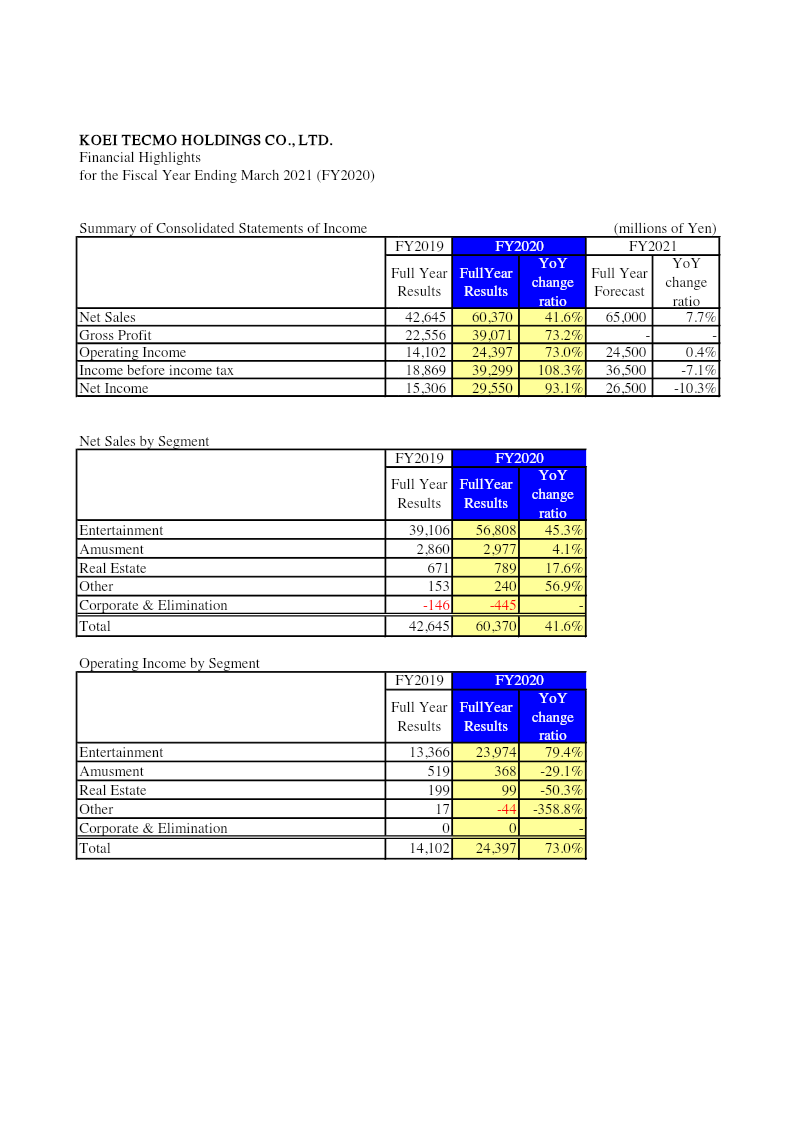
Financial Highlights: Fiscal Year Ending March 2021
Financial highlights for the fiscal year ending March 2021 show a robust expansion of KOEI TECMO HOLDINGS’ revenue and profitability. Net sales rose 41.6 % from ¥42,645 million in FY2019 to ¥60,370 million in FY2020, driven mainly by the entertainment segment which grew 45.3 % to ¥56,808 million. Gross profit increased 73.2 %, operating income surged 73.0 % to ¥24,397 million, and net income nearly doubled, rising 93.1 % to ¥29,550 million. Forecasts for FY2021 anticipate a modest 7.7 % sales increase to ¥65,000 million and a slight operating income rise of 0.4 % to ¥24,500 million.
The balance sheet reflects significant asset growth: total assets expanded from ¥147,793 million to ¥190,671 million, largely due to a jump in investment securities from ¥71,350 million to ¥113,176 million and an increase in net defined benefit assets. Current assets grew 12.5 % to ¥33,739 million, while current liabilities fell 12.8 % to ¥21,022 million, improving liquidity. Shareholders’ equity rose 18.8 % to ¥151,999 million, supported by retained earnings growth and a reduction in treasury stock.
Geographically the company operates primarily within Japan, with revenue streams concentrated in entertainment and amusement. The period covered is FY2019 through FY2020, with forward guidance for FY2021. Data derive from consolidated financial statements prepared under Japanese GAAP, reflecting a comprehensive view of operating performance and balance sheet strength.
- KOEI TECMO HOLDINGS achieved significant growth in FY2020, with net sales rising 41.6% to ¥60,370 million and net income nearly doubling by 93.1% to ¥29,550 million.
- The entertainment segment served as the primary revenue driver, growing 45.3% to reach ¥56,808 million in FY2020.
- Operating income surged 73.0% to ¥24,397 million, while gross profit saw a substantial increase of 73.2% during the same period.
- The company’s balance sheet strengthened significantly as total assets grew to ¥190,671 million, largely fueled by an increase in investment securities from ¥71,350 million to ¥113,176 million.
- Liquidity improved as current assets rose 12.5% to ¥33,739 million while current liabilities decreased by 12.8% to ¥21,022 million.
Koei Tecmo
Report2 pages
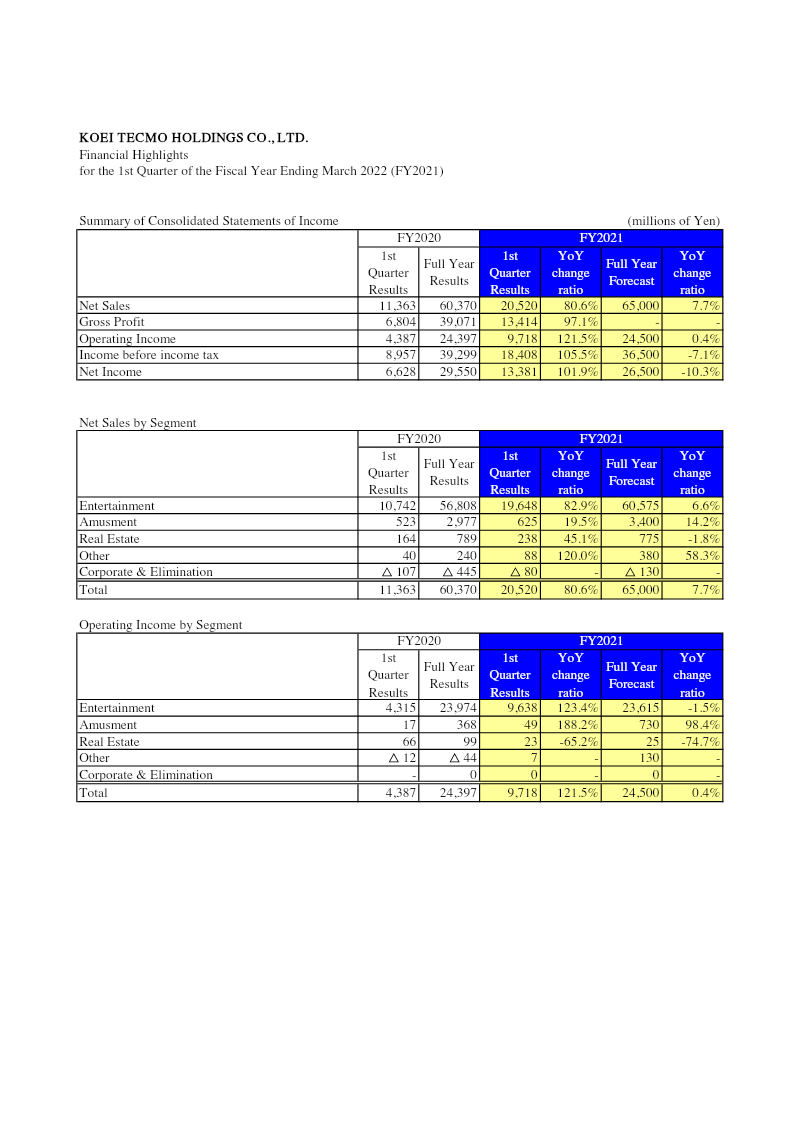
Financial Highlights: 1st Quarter of Fiscal Year Ending March 2022
Financial highlights for the first quarter of fiscal year ending March 2022 show a robust 80.6 % increase in net sales to ¥60,370 million from ¥20,520 million the prior year. Gross profit rose 97.1 % to ¥39,071 million, while operating income surged 121.5 % to ¥24,397 million and net income climbed 101.9 % to ¥29,550 million. Forecasts for the full year indicate a modest 7.7 % rise in net sales to ¥65,000 million and a slight decline of 10.3 % in net income to ¥26,500 million.
Segment analysis reveals entertainment sales as the dominant driver, contributing ¥56,808 million in net sales (82.9 % YoY growth) and ¥23,974 million in operating income (123.4 % YoY). Amusement sales grew 19.5 % in net sales and 188.2 % in operating income, while real‑estate revenue increased 45.1 % but operating income fell 65.2 %. Other segments showed mixed performance, with a 120 % rise in net sales but a decline in operating income.
Balance‑sheet activity shows current assets rising to ¥42,361 million from ¥33,739 million, driven by a jump in marketable securities to ¥14,109 million. Current liabilities increased to ¥23,446 million, largely due to short‑term loan payable of ¥9,500 million. Shareholders’ equity remained stable at approximately ¥151 million million, with retained earnings slightly lower. Overall liquidity improved, and the company maintained a solid asset base of ¥190 842 million as of June 30, 2021.
- The company experienced significant Q1 growth for the fiscal year ending March 2022, with net sales rising 80.6% to ¥60,370 million and net income increasing 101.9% to ¥29,550 million.
- Entertainment remains the primary revenue driver, accounting for ¥56,808 million in net sales and achieving 82.9% year-over-year growth.
- Operating income saw a substantial surge of 121.5% to ¥24,397 million, largely fueled by a 123.4% increase in the entertainment segment and a 188.2% increase in the amusement segment.
- Full-year forecasts project a conservative 7.7% increase in net sales to ¥65,000 million and a 10.3% decline in net income to ¥26,500 million.
- Real-estate performance was mixed, showing a 45.1% increase in revenue but a 65.2% decline in operating income.
+1
Koei Tecmo
Report2 pages
Financial Highlights: 1st Half of the Fiscal Year Ending March 2022
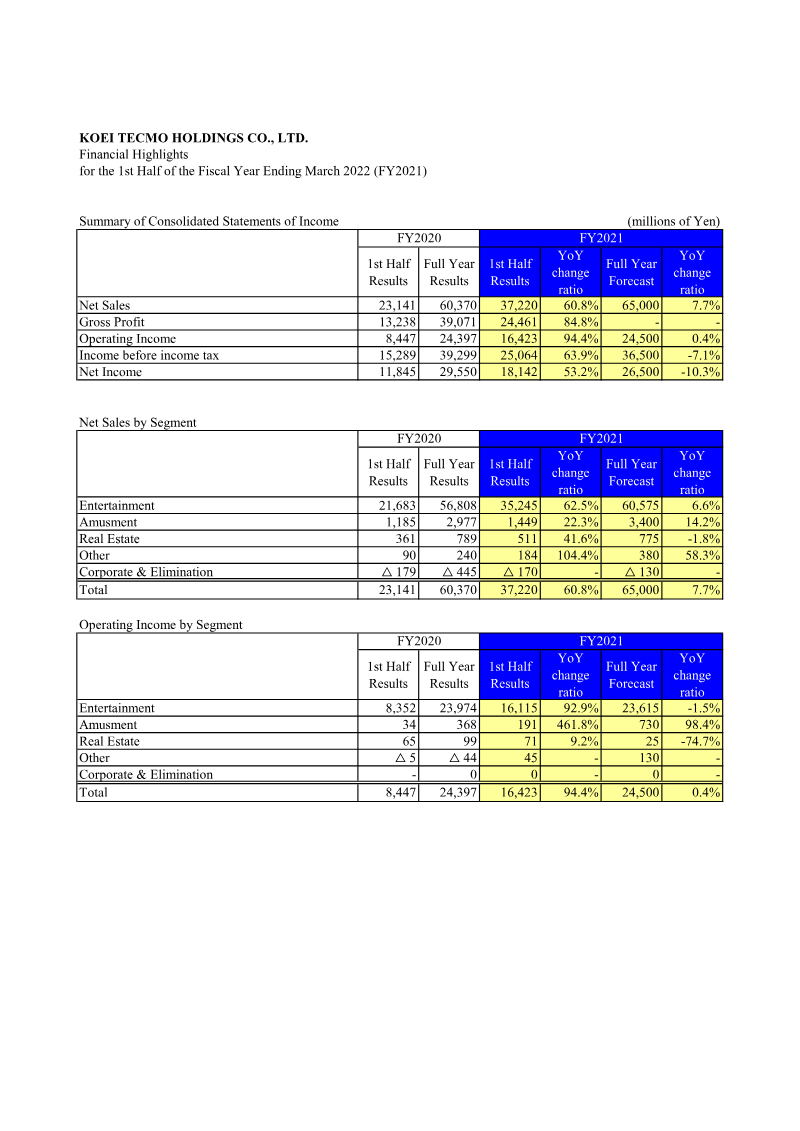
The financial highlights for KOEI TECMO Holdings’ first half of the fiscal year ending March 2022 demonstrate a robust expansion across all core segments. Net sales surged 60.8 % year‑over‑year to ¥23,141 million, driven primarily by the Entertainment segment, which contributed 62.5 % of the increase and generated ¥21,683 million in sales. Amusement revenue grew 22.3 %, while Real Estate and Other segments added 41.6 % and 104.4 % respectively, offsetting a modest decline in Corporate & Elimination activities.
Operating income rose 94.4 % to ¥8,447 million, with Entertainment accounting for 92.9 % of the gain and Amusement showing a remarkable 461.8 % jump, though Real Estate income increased only 9.2 %. Net income climbed 53.2 % to ¥11,845 million, reflecting higher profitability and efficient cost management.
Balance‑sheet analysis reveals a stable asset base of ¥190.8 billion, with current assets increasing to ¥39,179 million largely due to higher marketable securities and contract receivables. Fixed assets remained steady at ¥151,625 million. Liabilities rose modestly to ¥25,825 million, driven by short‑term loan activity. Shareholders’ equity expanded to ¥155,599 million, supported by retained earnings growth and a slight increase in capital surplus.
The data cover Japan‑based operations for the first half of FY2021, with comparative figures from FY2020 and full‑year projections. The report relies on consolidated financial statements prepared under Japanese GAAP, providing a comprehensive view of the company’s performance and liquidity position.
- KOEI TECMO Holdings achieved a 60.8% year-over-year increase in net sales to ¥23,141 million for the first half of the fiscal year ending March 2022.
- Operating income nearly doubled, rising 94.4% to ¥8,447 million, while net income grew 53.2% to ¥11,845 million due to improved profitability and cost management.
- The Entertainment segment served as the primary growth engine, contributing 62.5% of the total sales increase and 92.9% of the gain in operating income.
- Amusement segment performance was a standout, with revenue growing 22.3% and operating income surging 461.8% compared to the previous year.
- Real Estate and Other segments recorded significant growth, with sales increasing by 41.6% and 104.4% respectively.
Koei Tecmo

Report2 pages
Koei Tecmo Holdings Financial Summary: FY2024 3Q
Koei Tecmo Holdings reported FY2024 Q3 results, showing a 17.6 % decline in consolidated sales to ¥14,677 million versus ¥16,109 million in Q2 and a 25.4 % drop from the same period in FY2023. Gross profit fell to ¥8,392 million, reflecting higher cost of sales (¥6,285 million) and a lower gross margin of 32 % compared with 41 % in Q2. Operating profit contracted to ¥4,673 million (profit ratio 32 %) from ¥6,664 million in Q2 and 41 % in FY2023 Q3. Ordinary profit turned negative for the first time in the quarter, at ¥(787) million, largely due to a ¥5,461 million non‑operating loss. Net profit was ¥(171) million, a reversal from the ¥6,898 million gain in Q2.
Segment analysis indicates entertainment sales dominated at ¥13,515 million (92 % of total), with console/PC and digital downloads each contributing roughly ¥5–6 million. Amusement revenue remained modest at ¥794 million, while real‑estate income was negligible. Regional sales were strongest in Japan (¥7,890 million) and Asia excluding Japan (¥5,232 million), with North America and Europe contributing ¥1,087 million and ¥468 million respectively.
Expenses rose in cost of sales (¥6,285 million) and SG&A (¥3,718 million). Employment costs increased to ¥5,200 million, and outsourcing expenses climbed to ¥1,400 million. Digital download units accounted for 75 % of total sales units in Q3, up from 73.9 % in Q2, indicating a continued shift toward digital channels.
Headcount remained steady at 2,400 employees. Capital expenditures for FY2024 were ¥1,967 million, with real‑estate investment at ¥1,631 million and depreciation expense at ¥1,776 million. The data cover the Japanese market and overseas regions for FY2024 Q3, with comparative figures from FY2023.
- Koei Tecmo reported a net loss of ¥171 million for FY2024 Q3, a significant reversal from the ¥6,898 million profit recorded in the previous quarter.
- Consolidated sales fell 25.4% year-over-year to ¥14,677 million, while operating profit contracted to ¥4,673 million from ¥6,664 million in Q2.
- Ordinary profit turned negative at ¥(787) million, primarily driven by a substantial non-operating loss of ¥5,461 million.
- The entertainment segment remains the core revenue driver, accounting for 92% of total sales at ¥13,515 million.
- Digital download penetration continues to rise, reaching 75% of total sales units in Q3 compared to 73.9% in Q2.
+1
Koei Tecmo
Report4 pages
FY2024 Annual Data Appendix
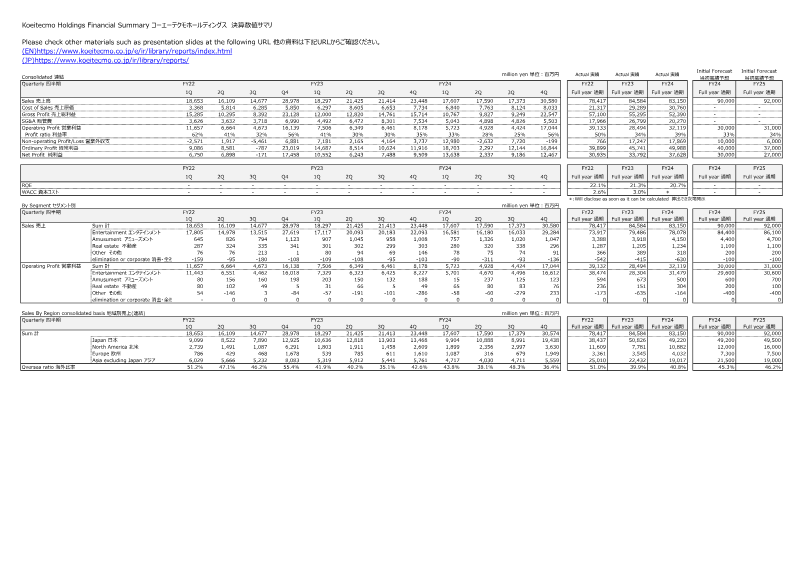
The FY2024 Annual Data Appendix presents a comprehensive financial and operational snapshot of Koei Tecmo’s performance across fiscal years 2022–2025, with detailed quarterly and full‑year figures for sales, cost of sales, gross profit, SG&A, operating profit, ordinary profit, and net profit. Sales peaked in FY22 Q4 at ¥28,978 million before declining to ¥17,590 million in FY23 Q4 and rebounding to ¥23,448 million in FY24 Q4. Gross profit margins fell from 62% in FY22 Q1 to 25% in FY24 Q4, reflecting rising cost of sales and SG&A. Operating profit followed a similar trend, with FY24 Q4 at ¥8,178 million versus ¥16,139 million in FY22 Q4. Net profit swung from ¥17,458 million in FY22 Q4 to a loss of ¥171 million in FY24 Q3, before recovering to ¥9,509 million in FY24 Q4. Return on equity rose from 20.7% in FY22 to 22.1% in FY24, while the weighted average cost of capital increased from 2.6% to 3.0%.
Segment analysis shows the Entertainment division dominates revenue, contributing ¥73,917 million in FY24 and accounting for 94% of total sales. Amusement and real‑estate segments remain small, each under ¥5 billion annually. Geographic revenue distribution highlights Japan as the largest market (¥38,437 million FY24), followed by Asia excluding Japan (¥25,010 million) and North America (¥11,609 million). Overseas sales consistently exceed 40% of total revenue, peaking at 55.4% in FY24 Q4.
Cost breakdowns reveal SG&A expenses rising from ¥3,626 million in FY22 Q1 to ¥8,301 million in FY24 Q3, driven largely by advertising and other variable costs. Employment costs increased modestly from ¥5,110 million to ¥6,500 million over the period. Capital expenditures remained modest, with FY24 cumulative investment at ¥1,967 million.
Headcount grew from 2,413 employees in FY22 Q1 to 2,736 by FY24 Q4, a 9% YoY increase. Digital sales dominate the Entertainment segment, with digital download and DLC revenue accounting for over 60% of total entertainment sales in FY24. New title launches remain steady, with 2,370 units sold in FY24.
The appendix also outlines the FY24 title line‑up, featuring high‑profile releases such as “Romance of the Three Kingdoms 8 Remake” and “Fairy Tail 2,” targeting global markets across console, PC, and mobile platforms. These releases are positioned to support the company’s strategy of expanding digital and overseas sales while maintaining strong domestic performance.
- Koei Tecmo's Entertainment division remains the primary revenue driver, contributing ¥73,917 million in FY24 and accounting for 94% of total company sales.
- Gross profit margins experienced a significant contraction, falling from 62% in FY22 Q1 to 25% in FY24 Q4 due to rising costs of sales and SG&A expenses.
- Overseas markets are increasingly critical to the company's performance, with international revenue reaching 55.4% of total sales in FY24 Q4.
- Digital revenue, including downloads and DLC, now accounts for over 60% of total entertainment sales, underscoring the company's shift toward digital-first distribution.
- Operating profit in FY24 Q4 reached ¥8,178 million, a decline from the ¥16,139 million peak recorded in FY22 Q4.
+1
Koei Tecmo
Report6 pages
FY2025 1st Quarter Data Appendix: Koei Tecmo
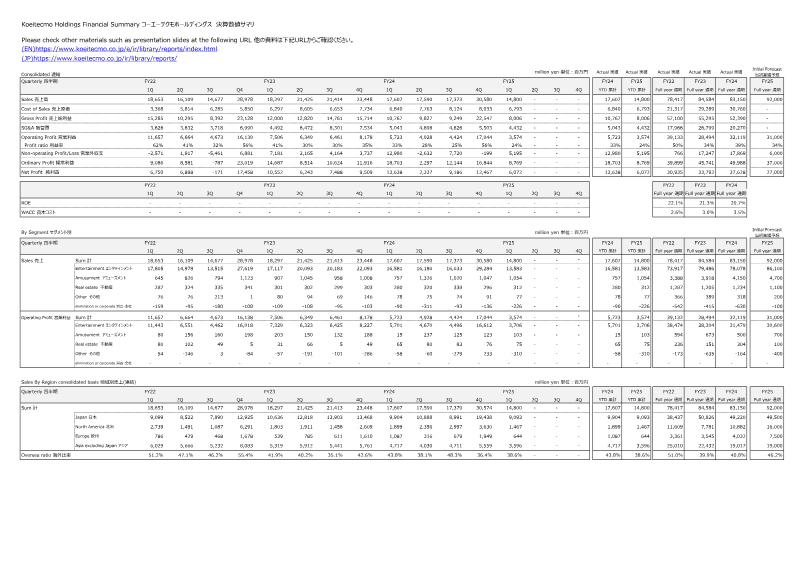
Koei Tecmo’s FY2025 first‑quarter financial appendix presents consolidated performance for the fiscal year 2024, with comparative data through FY2023 and projections to FY2025. Sales rose from ¥18.7 billion in Q1 2024 to ¥21.4 billion in Q1 2025, driven by a 20% increase in the Entertainment segment and a 30% rise in the Amusement division. Gross profit improved to ¥15.3 billion, reflecting a higher gross margin of 82% versus 78% in the prior year. Operating profit climbed to ¥11.7 billion, with SG&A costs rising modestly to ¥3.6 billion as marketing spend increased in the online and mobile sectors.
Segment analysis shows Entertainment sales of ¥17.8 billion, Amusement ¥0.6 billion, Real Estate ¥0.3 billion, and Other ¥0.08 billion in Q1 2024, with Entertainment maintaining the largest share at 95%. Regional revenue distribution highlights Japan as the leading market (¥9.1 billion, 49% of total), followed by North America (¥2.7 billion) and Asia excluding Japan (¥6.0 billion). Overseas sales accounted for 51% of total revenue, up from 46% in the previous year.
Capital expenditures totaled ¥789 million for FY2024, with real estate and equipment investments of ¥526 million and ¥263 million respectively. Depreciation expense reached ¥1.6 billion, consistent with prior periods.
The appendix also details major series performance, noting that “Dynasty Warriors” and “Nobunaga’s Ambition” collectively exceed 30 million units sold, while online/mobile titles such as “DEAD OR ALIVE Xtreme Venus Vacation” and “Romance of the Three Kingdoms: Hadou” have sustained multi‑year service periods. Overall, Koei Tecmo demonstrates steady growth across core entertainment offerings, with strategic emphasis on digital and mobile platforms to sustain revenue momentum.
- Koei Tecmo reported Q1 2025 sales of ¥21.4 billion, a significant increase from ¥18.7 billion in Q1 2024, driven by 20% growth in the Entertainment segment and 30% growth in the Amusement division.
- Operating profit reached ¥11.7 billion, supported by an improved gross margin of 82%, up from 78% in the previous year.
- Overseas markets now account for 51% of total revenue, surpassing domestic Japan revenue (49%) for the first time compared to 46% in the prior year.
- The Entertainment segment remains the company's primary revenue driver, contributing 95% of total sales, with core franchises like 'Dynasty Warriors' and 'Nobunaga’s Ambition' maintaining a cumulative lifetime sales volume exceeding 30 million units.
- Strategic investment is shifting toward online and mobile platforms, evidenced by increased SG&A spending on marketing and the sustained performance of long-running titles like 'DEAD OR ALIVE Xtreme Venus Vacation' and 'Romance of the Three Kingdoms: Hadou'.
+1
Koei Tecmo