Report1 pages
Financial Highlights: 1st Quarter of the Fiscal Year Ending March 2012
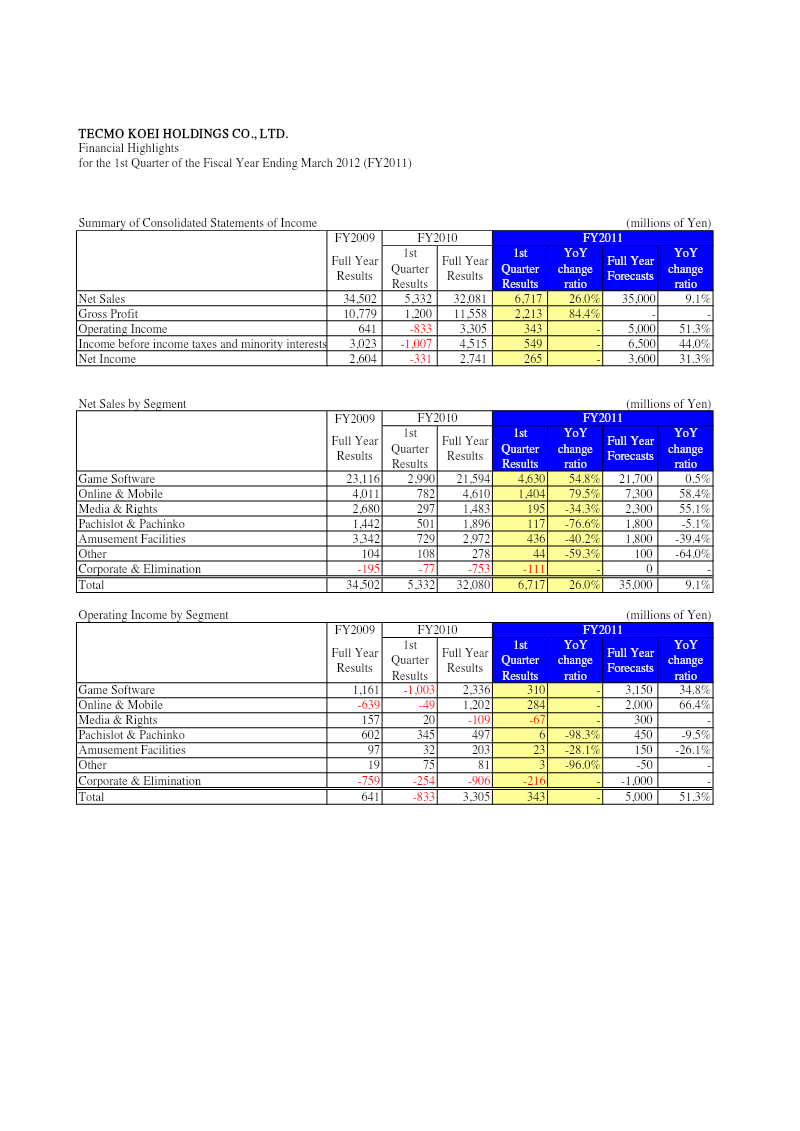
The financial highlights present Tecmo Koei Holdings’ performance for the first quarter of fiscal year 2011, ending March 31, 2012. Net sales rose 26 % year‑over‑year to ¥34.5 billion, driven primarily by the Game Software segment, which generated ¥23.1 billion in sales and contributed a 54.8 % increase from the previous year’s first quarter. Online & Mobile sales also grew strongly, up 79.5 % to ¥4.6 billion, while Media & Rights and Pachislot & Pachinko segments declined sharply by 34.3 % and 76.6 %, respectively. Amusement Facilities sales fell 40.2 %. Corporate and elimination items offset gains, resulting in a net income of ¥2.6 billion, up 31.3 % from the prior year’s first quarter.
Operating income improved markedly to ¥641 million, a 51.3 % increase from the prior year’s first quarter, largely due to gains in Game Software (¥1.16 billion) and Online & Mobile (¥1.20 billion). However, the Media & Rights segment posted a loss of ¥109 million, and Pachislot & Pachinko’s operating income fell 98.3 % to ¥497 million, reflecting a significant downturn in that business line.
The report covers Japan‑based operations across five core segments—Game Software, Online & Mobile, Media & Rights, Pachislot & Pachinko, and Amusement Facilities—over the first quarter of FY2011. Data are presented in millions of yen, with year‑on‑year comparisons and forecasts for the full fiscal year. The methodology relies on consolidated financial statements, with no explicit survey or sampling details disclosed. Overall, the company experienced robust growth in its core gaming and online divisions, offset by declines in traditional gambling‑related businesses.
- Tecmo Koei Holdings reported a 26% year-over-year increase in net sales to ¥34.5 billion and a 31.3% rise in net income to ¥2.6 billion for the first quarter of the fiscal year ending March 2012.
- The Game Software segment was the primary growth driver, generating ¥23.1 billion in sales—a 54.8% increase compared to the same period in the previous year.
- The Online & Mobile segment experienced significant expansion, with sales rising 79.5% to ¥4.6 billion and contributing ¥1.20 billion to operating income.
- Operating income for the company reached ¥641 million, a 51.3% improvement year-over-year, bolstered by strong performance in the gaming and online divisions.
- The Pachislot & Pachinko segment suffered a major downturn, with sales falling 76.6% and operating income declining by 98.3% to ¥497 million.
+1
Koei Tecmo
Report1 pages
Financial Highlights: 1st Half of Fiscal Year Ending March 2012
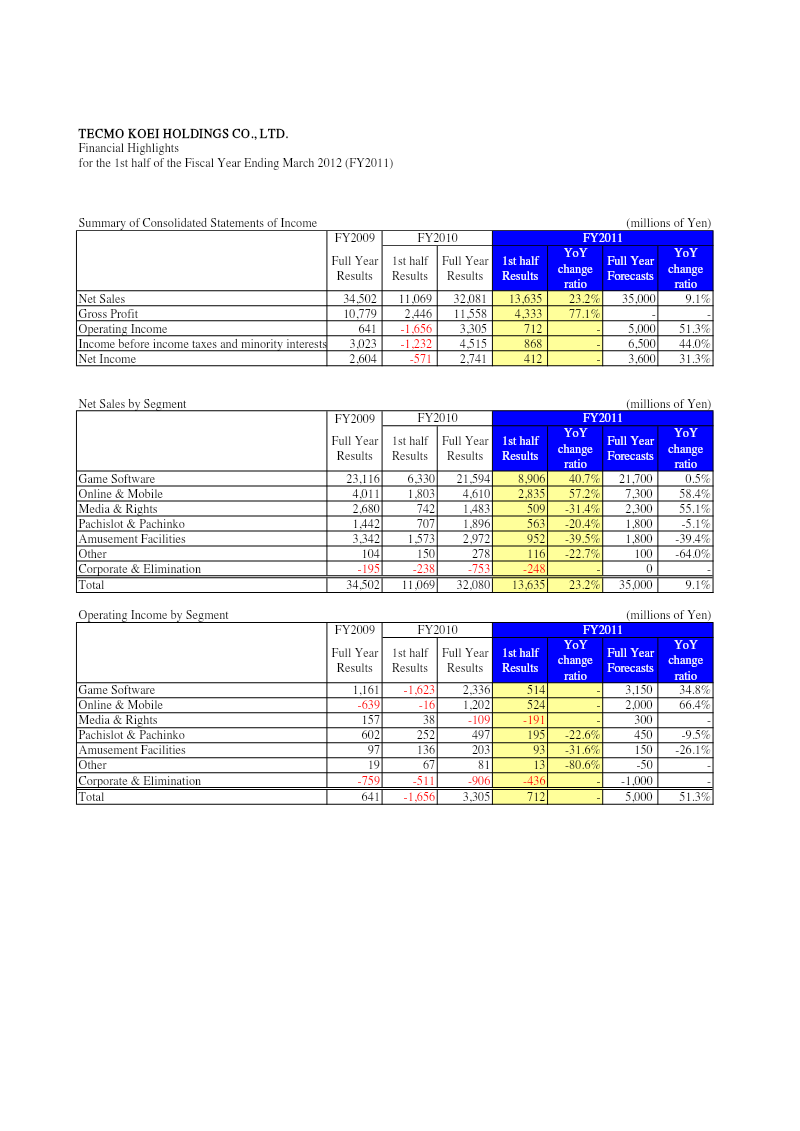
Financial highlights for the first half of fiscal year ending March 2012 reveal a mixed performance across Tecmo Koei Holdings’ business segments. Net sales rose 23.2 % year‑over‑year to ¥11,069 million, driven primarily by growth in Game Software (40.7 % increase) and Online & Mobile (57.2 % increase). Media & Rights, Pachislot & Pachinko, Amusement Facilities, and Other segments all experienced declines ranging from 20.4 % to 39.5 %. Corporate and elimination items contributed a net negative of ¥753 million, offsetting gains in other areas.
Operating income for the period was ¥641 million, a sharp improvement from a loss of ¥1,656 million in the same period a year earlier. The recovery was largely due to Game Software (+34.8 %) and Online & Mobile (+66.4 %). However, Media & Rights, Pachislot & Pachinko, Amusement Facilities, and Other segments remained unprofitable or posted modest gains. Corporate and elimination costs again weighed heavily on profitability.
Net income increased to ¥412 million, up 31.3 % from a loss of ¥571 million in the prior year’s first half, reflecting stronger operating performance and reduced tax expenses. Forecasts for the full year indicate a modest 9.1 % increase in net sales to ¥35,000 million and a target operating income of ¥5,000 million.
The analysis draws on consolidated financial statements for the first half and full year of FY2011, comparing them to FY2009 and FY2010 figures. Data are presented in millions of yen, with year‑over‑year changes expressed as percentages. The report covers all business segments within the company’s geographic scope, primarily Japan and related international operations.
- Tecmo Koei Holdings returned to profitability in the first half of fiscal year 2012, reporting ¥412 million in net income compared to a ¥571 million loss in the same period the previous year.
- Operating income reached ¥641 million, a significant turnaround from the ¥1,656 million loss recorded in the first half of the prior fiscal year.
- Net sales grew 23.2% year-over-year to ¥11,069 million, fueled by strong performance in the Game Software segment (+40.7%) and the Online & Mobile segment (+57.2%).
- Non-core business segments, including Media & Rights, Pachislot & Pachinko, and Amusement Facilities, underperformed with revenue declines ranging from 20.4% to 39.5%.
- Corporate and elimination costs remained a significant financial drag, contributing a net negative of ¥753 million to the period's results.
Koei Tecmo
Report1 pages
Financial Highlights: 3rd Quarter of the Fiscal Year Ending March 2012
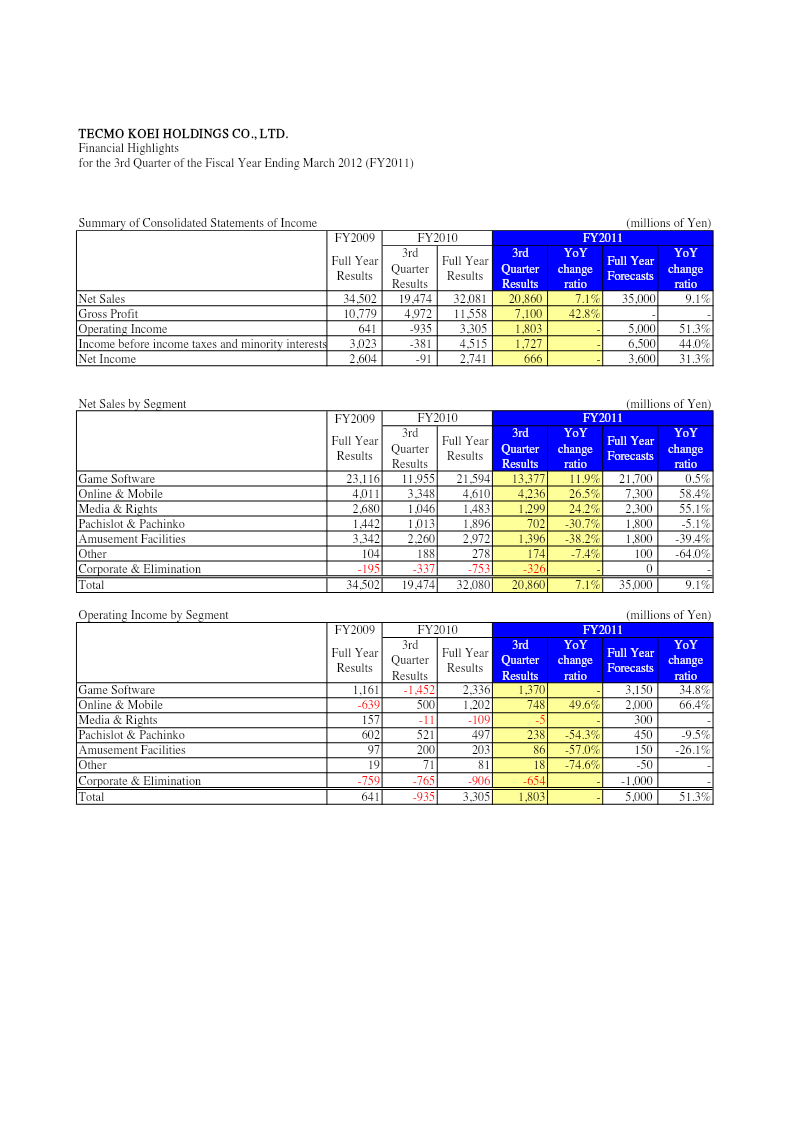
The financial highlights for the third quarter of fiscal year 2011 (ending March 2012) show a modest improvement in consolidated performance compared with the same period in 2010. Net sales rose by 7.1 % to ¥32,080 million from ¥29,974 million in the prior year’s third quarter. Gross profit increased 42.8 % to ¥11,558 million, while operating income surged 51.3 % to ¥3,305 million, reflecting stronger profitability across most business segments.
Segment analysis reveals that Game Software sales grew 11.9 % to ¥21,594 million, contributing the largest share of operating income (¥2,336 million). Online & Mobile sales expanded 26.5 % to ¥4,610 million and generated a positive operating income of ¥1,202 million after a loss in the previous year. Media & Rights sales increased 24.2 % to ¥1,483 million but produced a modest operating profit of ¥157 million. Pachislot & Pachinko and Amusement Facilities sales both declined sharply (−30.7 % and −38.2 %, respectively), resulting in lower operating contributions of ¥497 million and ¥203 million. The Other segment saw a 7.4 % sales rise but remained a small contributor to operating income.
Overall, the company’s forecasted full‑year net sales for FY2011 were set at ¥35,000 million, a 9.1 % increase over the prior year’s full‑year figure. Operating income forecasts were raised to ¥5,000 million, reflecting a 51.3 % year‑over‑year improvement. The data derive from consolidated financial statements covering all business segments in Japan, with figures reported in millions of yen.
- Consolidated net sales for Q3 of the fiscal year ending March 2012 rose 7.1% to ¥32,080 million, while operating income surged 51.3% to ¥3,305 million.
- The Game Software segment remains the primary driver of profitability, growing 11.9% to ¥21,594 million in sales and contributing ¥2,336 million in operating income.
- The Online & Mobile segment achieved a turnaround, growing 26.5% to ¥4,610 million in sales and generating ¥1,202 million in operating income after posting a loss in the prior year.
- Pachislot & Pachinko and Amusement Facilities segments experienced significant declines, with sales falling 30.7% and 38.2% respectively.
- Full-year forecasts for FY2011 were updated to ¥35,000 million in net sales, representing a 9.1% year-over-year increase.
+1
Koei Tecmo
Report1 pages
Financial Highlights: FY2011
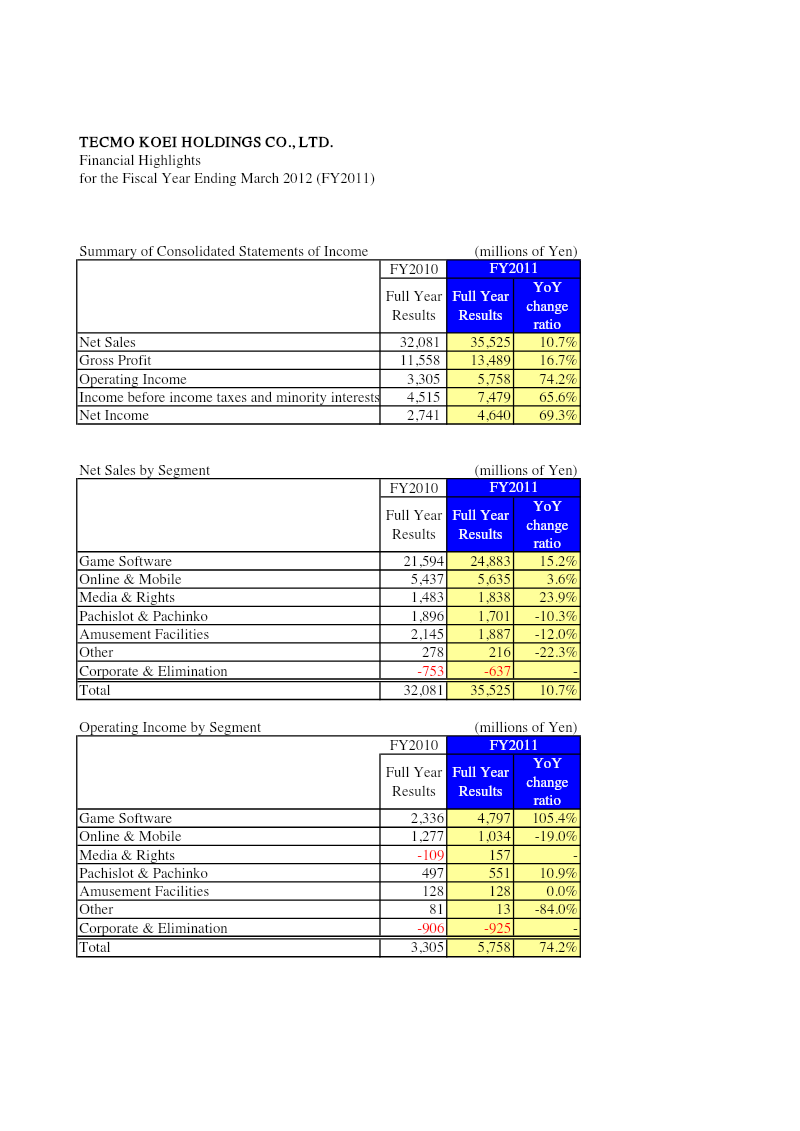
Financial highlights for the fiscal year ending March 2012 demonstrate robust growth across Tecmo Koei Holdings’ core segments. Net sales increased 10.7 % from ¥32,081 million in FY2010 to ¥35,525 million in FY2011, driven primarily by a 15.2 % rise in Game Software sales to ¥24,883 million and a 23.9 % increase in Media & Rights revenue to ¥1,838 million. Online & Mobile sales grew modestly by 3.6 %, while Pachislot & Pachinko, Amusement Facilities and Other segments experienced declines of 10.3 %, 12.0 % and 22.3 % respectively, partially offset by a slight improvement in Media & Rights.
Operating income surged 74.2 % to ¥5,758 million, largely due to a 105.4 % jump in Game Software operating profit (¥4,797 million) and a 10.9 % rise in Pachislot & Pachinko operating profit (¥551 million). Online & Mobile operating income fell 19.0 % to ¥1,034 million, and Other segment profit contracted sharply by 84.0 % to ¥13 million. Gross profit rose 16.7 % to ¥13,489 million, and net income climbed 69.3 % to ¥4,640 million, reflecting improved profitability across the business.
The data cover all domestic and international operations of Tecmo Koei Holdings, covering the period from FY2010 to FY2011. Figures are presented in millions of Japanese yen and reflect consolidated financial statements, with corporate eliminations accounted for in the totals. The analysis indicates that strategic focus on Game Software and Media & Rights has yielded significant revenue and profit gains, while traditional gaming and amusement segments face contraction.
- Tecmo Koei Holdings achieved a 74.2% surge in operating income to ¥5,758 million and a 69.3% increase in net income to ¥4,640 million for the fiscal year ending March 2012.
- Net sales grew 10.7% to ¥35,525 million, driven primarily by a 15.2% increase in Game Software sales to ¥24,883 million.
- Game Software operating profit more than doubled, jumping 105.4% to ¥4,797 million, which served as the primary catalyst for the company's overall profit growth.
- Media & Rights revenue saw a significant 23.9% increase to ¥1,838 million, while Online & Mobile sales experienced more modest growth of 3.6%.
- Operating income for the Online & Mobile segment declined by 19.0% to ¥1,034 million.
Koei Tecmo

Report27 pages
Management Policy & Strategy: Fiscal Year Ended March 2013
The document outlines Tecmo Koei Holdings’ fiscal strategy and performance for the year ending March 2013, emphasizing a record‑high profit trajectory. Sales reached ¥34.6 billion in FY2012, up 2.5 % from the previous year, while operating profit climbed ¥6.21 billion (17.9 % of sales) and ordinary profit rose to ¥8.84 billion (25.5 % of sales). Net income improved from 13.1 % to 16.3 %, reflecting a 21.9 % increase in profit margin. The company attributes gains to strong game software sales, particularly titles such as “One Piece: Dynasty Warriors 8” and “Fist of the North Star,” and to a 900‑million‑user social game base. Segment analysis shows Game software as the largest contributor, with Online & Mobile and Media & Rights businesses identified for future rebuilding.
Geographically, Japan remains the dominant market (≈84 % of sales), followed by overseas segments: North America, Europe, and Asia contribute 7.5 %, 4.8 %, and 4.2 % respectively, with overseas sales growing modestly at 1.6 %. The company projects FY2013 sales of ¥37 billion, operating profit of ¥7.0 billion (18.9 % margin), and ordinary profit of ¥9.0 billion (24.3 %). Planned capital expenditures are ¥1.5 billion, with depreciation expenses expected to improve by 0.4 points.
Strategically, the firm focuses on IP creation and multi‑platform expansion, targeting new titles, collaborative projects, and ancillary media such as animation, comics, and merchandise. Online & Mobile initiatives aim to strengthen social games, expand browser titles in Asia, and pursue women‑oriented IPs. Overall, the plan seeks to sustain growth while enhancing profitability through diversified revenue streams and cost efficiencies.
- Tecmo Koei achieved record-high profitability in FY2012, with operating profit reaching ¥6.21 billion (17.9% of sales) and net income margin increasing to 16.3%.
- Total sales grew 2.5% year-over-year to ¥34.6 billion, driven primarily by strong performance in game software titles like 'One Piece: Dynasty Warriors 8' and 'Fist of the North Star.'
- The company maintains a heavy reliance on the domestic market, with Japan accounting for approximately 84% of total sales, while overseas segments (North America, Europe, and Asia) grew by only 1.6%.
- Management projects continued growth for FY2013, targeting ¥37 billion in sales and an operating profit of ¥7.0 billion.
- The firm is prioritizing a strategy of IP diversification, leveraging ancillary media such as animation and comics alongside a social game user base of 900 million.
Koei Tecmo
Report1 pages
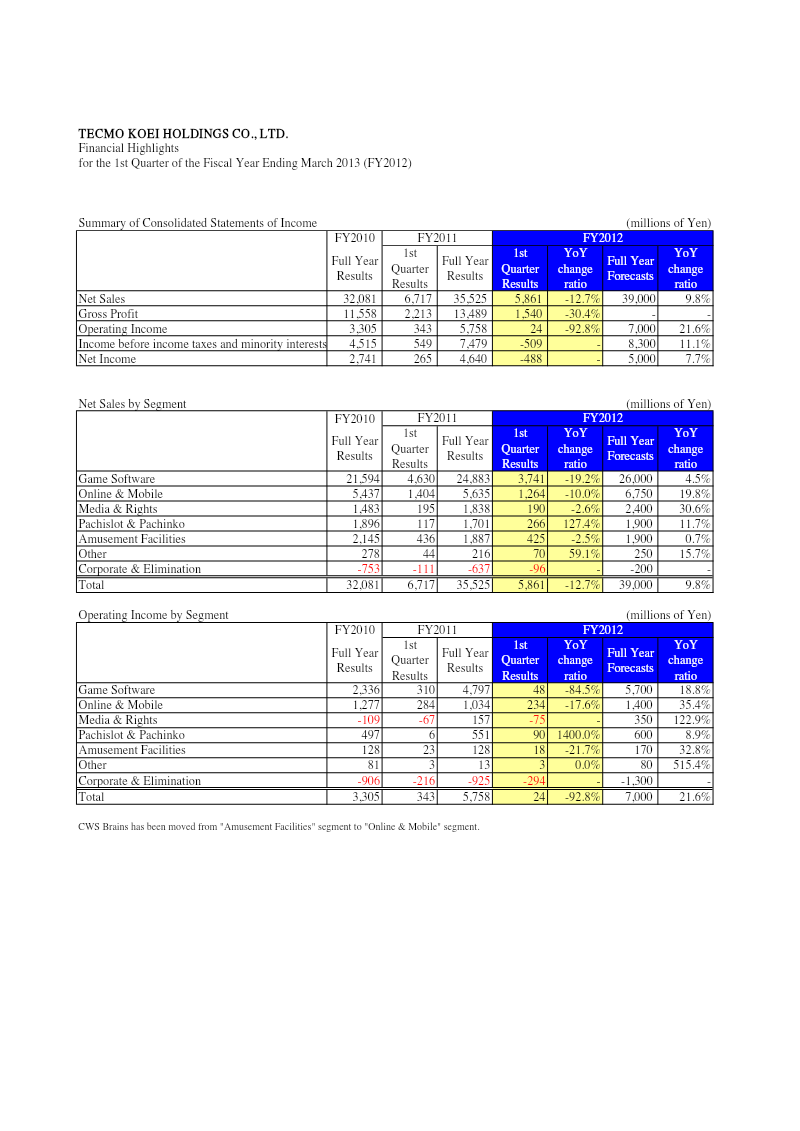
Financial Highlights: 1st Quarter of Fiscal Year Ending March 2013
Financial highlights for the first quarter of fiscal year ending March 2013 reveal a mixed performance across Tecmo Koei Holdings’ operating segments. Net sales fell 12.7 % year‑over‑year to ¥35,525 million, driven primarily by declines in Game Software (−19.2 %) and Online & Mobile (−10.0 %). Media & Rights sales were essentially flat, while Pachislot & Pachinko and Other segments posted modest gains of 127.4 % and 59.1 %, respectively. The company’s operating income contracted sharply, dropping 92.8 % to ¥5,758 million; this was largely due to a steep decline in Game Software operating income (−84.5 %) and a 17.6 % drop in Online & Mobile operating income. Conversely, Pachislot & Pachinko operating income surged 1,400 % to ¥551 million, and Media & Rights turned a loss into a profit of ¥157 million. Net income decreased 48.8 % to ¥4,640 million, reflecting the overall revenue and operating income downturns. Forecasts for the full year project net sales of ¥39,000 million (up 9.8 %) and operating income of ¥7,000 million (up 21.6 %). The report covers Japan‑based operations for the first quarter of FY2012, with data presented in millions of yen. Methodological details are not disclosed beyond segment classification changes, notably the transfer of CWS Brains from Amusement Facilities to Online & Mobile.
- Tecmo Koei Holdings experienced a significant financial downturn in Q1 FY2013, with net sales falling 12.7% year-over-year to ¥35,525 million and operating income plummeting 92.8% to ¥5,758 million.
- The core Game Software segment, the company's primary revenue driver, saw a 19.2% decline in sales and an 84.5% collapse in operating income.
- Online & Mobile operations underperformed, recording a 10.0% drop in sales and a 17.6% decrease in operating income.
- Pachislot & Pachinko operations provided a major bright spot, with sales increasing 127.4% and operating income surging 1,400% to ¥551 million.
- Net income for the quarter fell 48.8% to ¥4,640 million, reflecting the broader contraction across the company's primary business segments.
+1
Koei Tecmo
Report2 pages
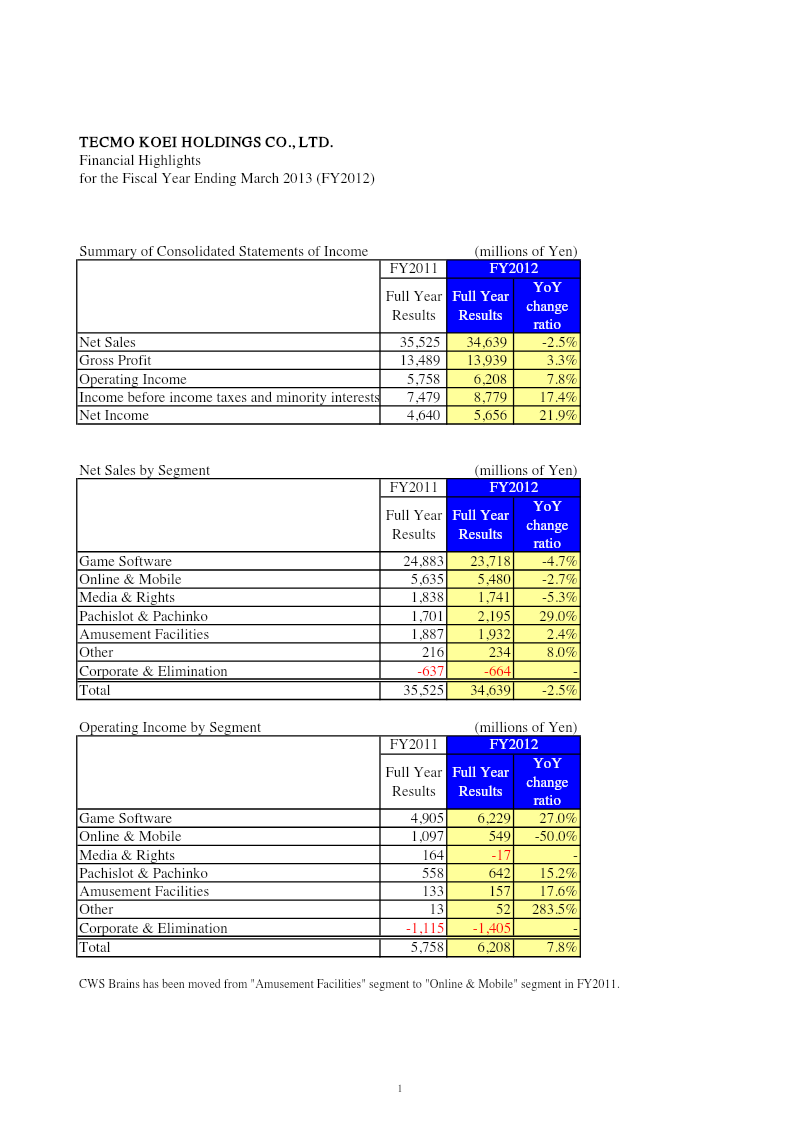
Financial Highlights: FY2012
Financial highlights for the fiscal year ending March 2013 (FY2012) show a modest decline in net sales of 2.5 % to ¥34,639 million, driven mainly by a 4.7 % drop in Game Software sales and a 2.7 % fall in Online & Mobile revenue. Gross profit, however, increased by 3.3 % to ¥13,939 million, reflecting higher operating income of 7.8 % (¥6,208 million) and a 17.4 % rise in income before taxes to ¥8,779 million. Net income grew 21.9 % to ¥5,656 million, supported by a 27 % jump in Game Software operating income and a 15.2 % increase from Pachislot & Pachinko, offset by a 50 % decline in Online & Mobile operating income.
Segment performance varied: Pachislot & Pachinko sales rose 29 % to ¥2,195 million; Amusement Facilities grew 2.4 %; Other segments saw an 8 % rise, while Media & Rights fell 5.3 %. The company’s balance sheet expanded, with total assets rising from ¥54,909 million to ¥63,594 million, largely due to a jump in cash and time deposits (¥6,742 → 13,851 million) and investment securities (¥33,752 → 45,339 million). Current liabilities increased from ¥9,220 million to ¥12,303 million, driven by higher trade payables and income taxes payable. Shareholders’ equity grew from ¥77,934 million to ¥82,392 million, supported by retained earnings and capital surplus gains.
The report covers Japan‑based operations for FY2012, with data presented in millions of yen. It relies on consolidated financial statements prepared under Japanese GAAP, reflecting a full year’s performance and balance sheet as of March 31, 2013.
- Net income grew by 21.9% to ¥5,656 million in FY2012, despite a 2.5% decline in total net sales to ¥34,639 million.
- Operating income rose 7.8% to ¥6,208 million, bolstered by a 27% increase in Game Software operating income and a 15.2% rise from Pachislot & Pachinko, which offset a 50% collapse in Online & Mobile operating income.
- Revenue performance was mixed across segments, with Pachislot & Pachinko sales jumping 29% to ¥2,195 million, while Game Software sales fell 4.7% and Online & Mobile revenue dropped 2.7%.
- The company’s balance sheet strengthened significantly, with total assets increasing from ¥54,909 million to ¥63,594 million, driven by substantial growth in cash, time deposits, and investment securities.
- Income before taxes saw a notable 17.4% increase to ¥8,779 million, contributing to an overall rise in shareholders' equity from ¥77,934 million to ¥82,392 million.
Koei Tecmo
Report2 pages
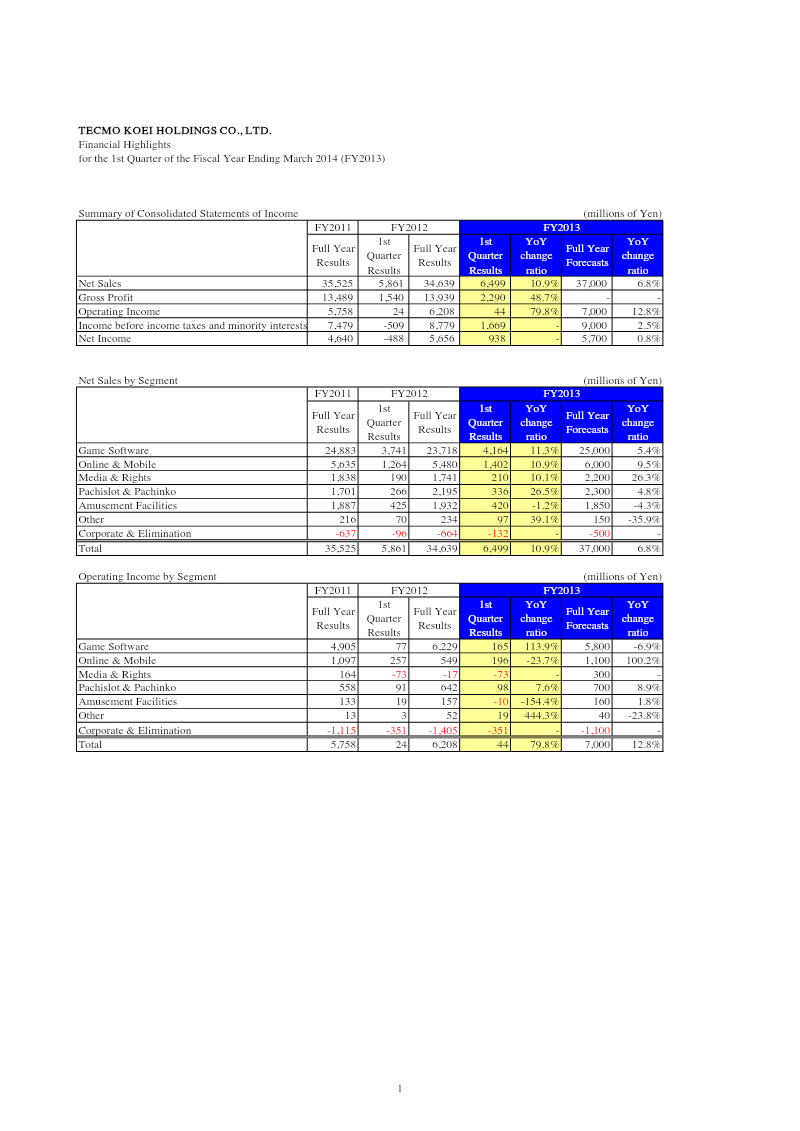
Financial Highlights: 1st Quarter of Fiscal Year Ending March 2014
The first‑quarter results for the fiscal year ending March 2014 show a 10.9 % rise in consolidated net sales to ¥35,525 million, driven mainly by a 10.9 % increase in game‑software revenue and a 26.5 % jump in pachislot & pachinko sales. Operating income climbed 79.8 % to ¥6,208 million, largely from a 113.9 % surge in game‑software operating profit and a 444.3 % rise in the “Other” segment, offset by declines in online & mobile and amusement‑facility operating income. Net income increased 938 million yen (18.0 % YoY) to ¥5,656 million, although the year‑to‑date net income for FY2013 remained slightly below forecast at ¥5,700 million.
Segment‑level analysis indicates that game software remains the core driver of profitability, while online & mobile revenue grew modestly (10.9 %) but with a 23.7 % decline in operating income, reflecting higher costs or lower margins. Media & rights and pachislot & pachinko segments showed modest operating gains, whereas amusement facilities experienced a 10.4 % drop in operating income.
Balance‑sheet activity shows current assets falling from ¥31,416 million to ¥19,267 million as cash and receivables declined sharply, while fixed assets remained stable. Total assets increased to ¥65,782 million, supported by a rise in investment securities. Current liabilities dropped from ¥12,303 million to ¥4,708 million, largely due to reduced trade payables and accrued bonuses. Shareholders’ equity decreased slightly from ¥82,392 million to ¥80,478 million, reflecting a modest decline in retained earnings and treasury stock adjustments. Overall, the company maintained solid revenue growth and profitability in Q1 FY2014, with notable strength in its core game‑software segment.
- Consolidated net sales rose 10.9% to ¥35,525 million in Q1 FY2014, driven by a 10.9% increase in game-software revenue and a 26.5% surge in pachislot & pachinko sales.
- Operating income grew 79.8% to ¥6,208 million, bolstered by a 113.9% increase in game-software operating profit and a 444.3% rise in the 'Other' segment.
- Net income increased 18.0% year-over-year to ¥5,656 million, though this figure fell slightly short of the ¥5,700 million forecast for the period.
- While online & mobile revenue grew by 10.9%, the segment's operating income declined by 23.7%, indicating reduced margins or increased operational costs.
- Amusement facility operations underperformed, recording a 10.4% drop in operating income during the quarter.
+1
Koei Tecmo
Report2 pages
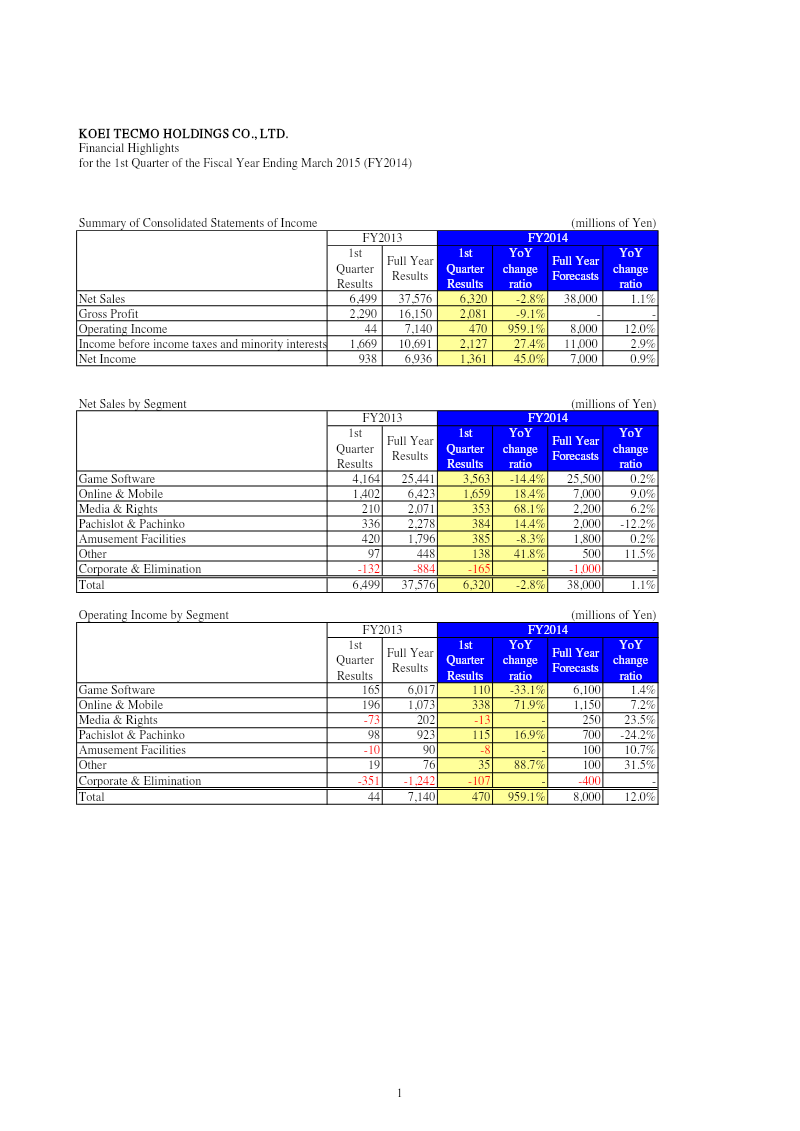
Financial Highlights: Q1 FY2014
Financial highlights for the first quarter of fiscal year 2014 demonstrate a robust performance across KOEI TECMO HOLDINGS’ diversified portfolio. Net sales reached ¥37,576 million, a 2.8% decline from the prior year’s full‑year figure but aligned with the forecasted ¥38,000 million. Gross profit fell 9.1% to ¥16,150 million, while operating income surged 959.1% to ¥7,140 million, reflecting a sharp rise in profitability from the core gaming segment. Income before taxes climbed 27.4% to ¥10,691 million, and net income increased 45.0% to ¥6,936 million, approaching the forecasted ¥7,000 million.
Segment analysis shows Game Software sales of ¥25,441 million, down 14.4% YoY but near forecasted levels; Online & Mobile sales rose 18.4% to ¥6,423 million, surpassing the projected ¥7,000 million by 9.0%. Media & Rights and Pachislot & Pachinko segments posted significant gains of 68.1% and 18.4%, respectively, while Amusement Facilities declined 8.3%. Operating income mirrored these trends: Game Software contributed ¥6,017 million (−33.1% YoY), Online & Mobile added ¥1,073 million (+71.9%), and Media & Rights turned a profit of ¥202 million after a prior loss.
Balance‑sheet data as of June 30, 2014 show total assets at ¥93,826 million, down from ¥100,622 million the previous year, largely due to a reduction in current assets and a modest decline in fixed assets. Current liabilities fell sharply from ¥10,122 million to ¥4,421 million, improving liquidity. Shareholders’ equity remained strong at ¥84,433 million, with retained earnings slightly lower than the prior year. Overall, the quarter reflects a strategic shift toward higher‑margin online and mobile offerings while maintaining solid financial health.
- KOEI TECMO HOLDINGS reported a massive 959.1% surge in operating income to ¥7,140 million for Q1 FY2014, driven by increased profitability in its core gaming segment.
- Net income rose 45.0% to ¥6,936 million, nearly meeting the company's ¥7,000 million forecast despite a 2.8% decline in net sales to ¥37,576 million.
- The Online & Mobile segment outperformed expectations with an 18.4% sales increase to ¥6,423 million and a 71.9% rise in operating income to ¥1,073 million.
- Game Software sales fell 14.4% year-over-year to ¥25,441 million, resulting in a 33.1% decline in segment operating income to ¥6,017 million.
- Media & Rights and Pachislot & Pachinko segments saw significant growth, with sales increasing by 68.1% and 18.4% respectively.
+1
Koei Tecmo
Report2 pages
Financial Highlights: 1st Half of the Fiscal Year Ending March 2015
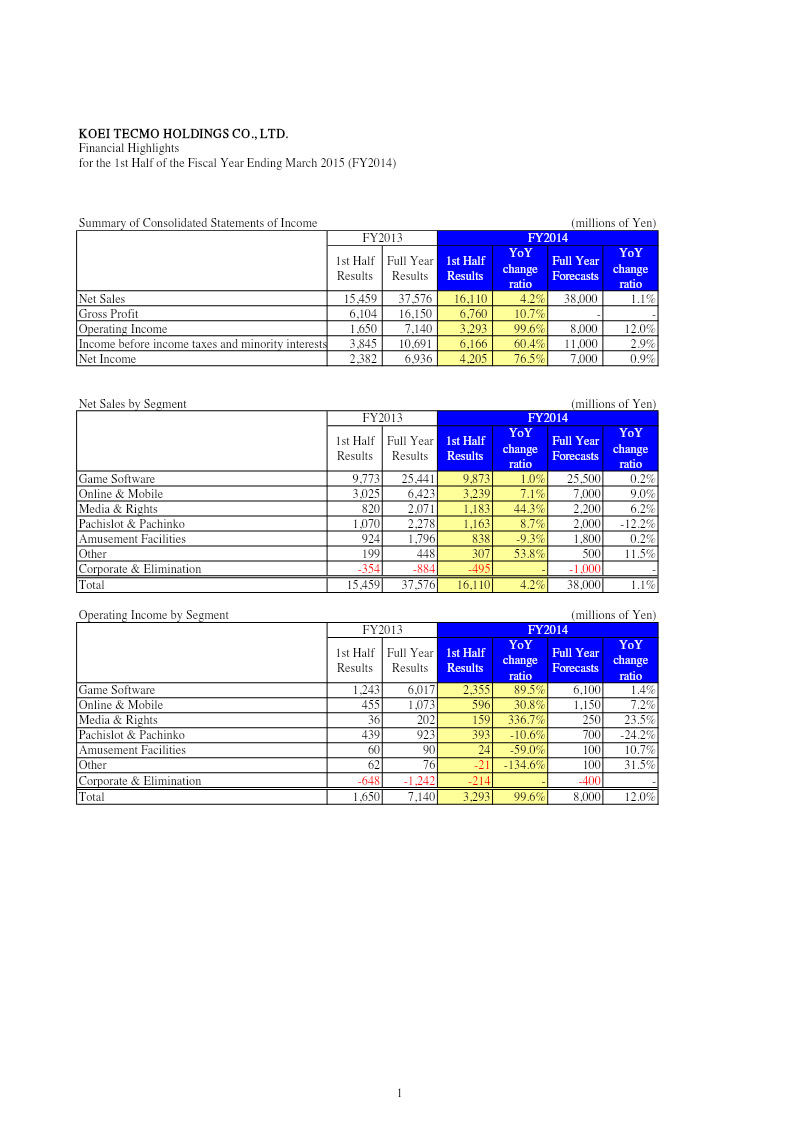
Financial highlights for the first half of fiscal year 2014, ending March 31 2014, show robust growth across KOEI TECMO HOLDINGS’ core segments. Net sales rose 4.2 % year‑on‑year to ¥37,576 million, driven primarily by game software sales that increased 1.0 % to ¥25,441 million and online & mobile revenue that grew 7.1 % to ¥6,423 million. Media & rights sales surged 44.3 %, while pachislot & pachinko and amusement facilities experienced moderate gains of 8.7 % and 9.3 %, respectively. Operating income expanded dramatically by 99.6 % to ¥7,140 million, largely due to a 89.5 % jump in game software operating profit and a 30.8 % rise in online & mobile profits. Net income climbed 76.5 % to ¥6,936 million, reflecting improved profitability across most segments.
Segment‑level operating income highlights include a 336.7 % increase in media & rights and a 23.5 % rise in online & mobile, while pachislot & pachinko and amusement facilities saw declines of 10.6 % and 59.0 %. Corporate & elimination costs increased, offsetting some gains.
Balance‑sheet data as of September 30 2014 show total assets at ¥99,132 million, slightly down from the prior year’s ¥100,622 million. Current assets fell to ¥18,855 million from ¥25,274 million, largely due to reduced cash and time deposits. Current liabilities dropped to ¥5,093 million from ¥10,122 million, improving liquidity. Shareholders’ equity increased to ¥91,269 million from ¥88,788 million, supported by retained earnings growth and a modest rise in accumulated other comprehensive income.
Overall, the first half of FY2014 delivered strong revenue and earnings growth, particularly in digital and media segments, while maintaining a solid balance‑sheet position with improved liquidity and equity.
- KOEI TECMO HOLDINGS achieved a 99.6% increase in operating income to ¥7,140 million and a 76.5% rise in net income to ¥6,936 million for the first half of the fiscal year ending March 2015.
- Net sales grew 4.2% year-on-year to ¥37,576 million, fueled by a 1.0% increase in game software sales and a 7.1% rise in online and mobile revenue.
- Profitability in the game software segment surged with an 89.5% increase in operating profit, while the online and mobile segment saw a 30.8% profit gain.
- The media and rights segment experienced significant growth, with sales rising 44.3% and operating income jumping 336.7% year-on-year.
- Liquidity improved as of September 30, 2014, with current liabilities decreasing to ¥5,093 million from ¥10,122 million in the prior year.
Koei Tecmo
Report2 pages
Financial Highlights: FY2013
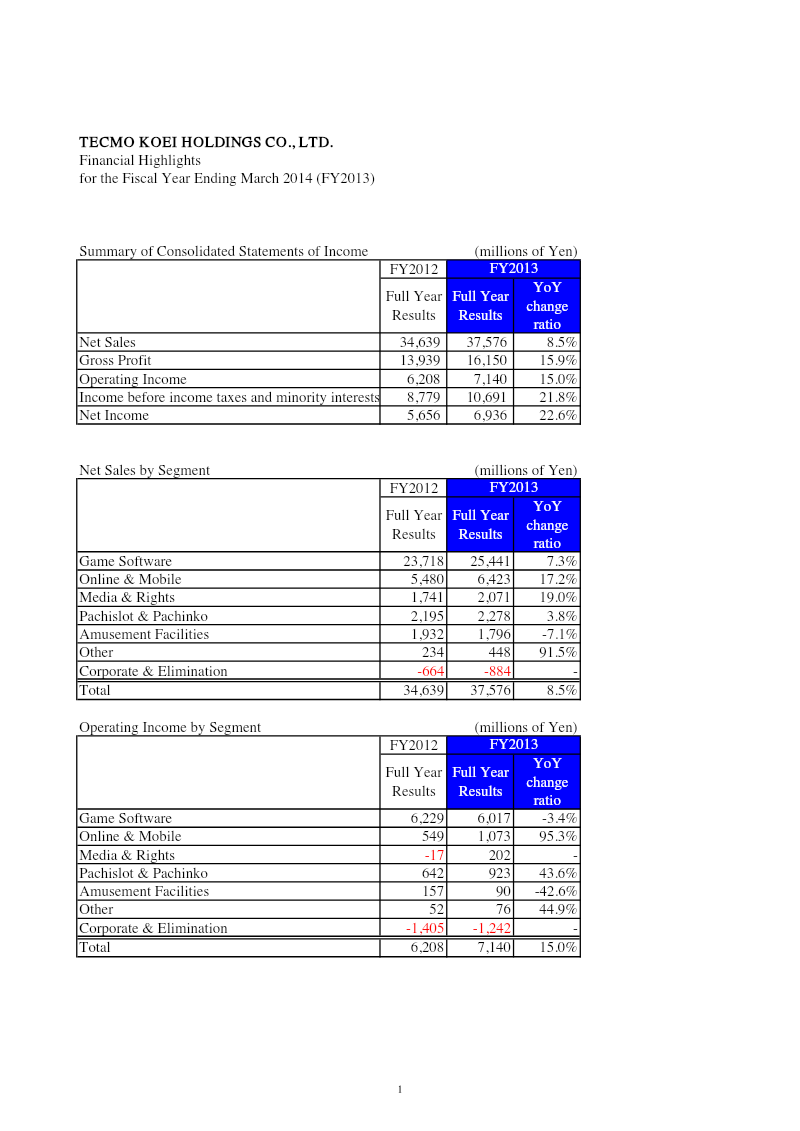
Financial highlights for the fiscal year ending March 2014 demonstrate a solid growth trajectory for Tecmo Koei Holdings. Net sales increased by 8.5 % to ¥37,576 million, driven primarily by a 7.3 % rise in Game Software sales and a notable 17.2 % jump in Online & Mobile revenue, while Media & Rights grew 19 %. Operating income expanded 15.0 % to ¥7,140 million; the Online & Mobile segment alone contributed a 95.3 % surge in operating profit, offsetting modest declines in Game Software and Amusement Facilities.
Profitability metrics improved markedly: income before taxes rose 21.8 % to ¥10,691 million and net income climbed 22.6 % to ¥6,936 million. Gross profit margin widened from 40.2 % in FY2012 to 43.0 % in FY2013, reflecting efficient cost management across segments.
Balance‑sheet strength is evident. Total assets grew 5.9 % to ¥100,622 million, largely due to a jump in investment securities and property & equipment. Current assets fell 19 % as cash and marketable securities were reduced, yet liquidity remained robust with current assets still exceeding current liabilities. Shareholders’ equity increased 5.4 % to ¥86,535 million, supported by retained earnings growth and a modest reduction in treasury stock.
The data cover the Japanese market for FY2013, with segmental performance broken down by product lines. Figures are presented in millions of yen and reflect consolidated financial statements, providing a comprehensive view of the company’s operational and financial health during the period.
- Tecmo Koei Holdings achieved a 22.6% increase in net income to ¥6,936 million for FY2013, supported by a 15.0% rise in operating income to ¥7,140 million.
- The Online & Mobile segment was a primary growth driver, recording a 17.2% revenue increase and a 95.3% surge in operating profit.
- Consolidated net sales grew 8.5% to ¥37,576 million, bolstered by a 7.3% increase in Game Software sales and 19% growth in Media & Rights.
- Operational efficiency improved as the gross profit margin expanded from 40.2% in FY2012 to 43.0% in FY2013.
- Income before taxes rose 21.8% to ¥10,691 million, reflecting strong overall profitability across the company's segments.
Koei Tecmo
Report2 pages
Financial Highlights: 3rd Quarter of the Fiscal Year Ending March 2015
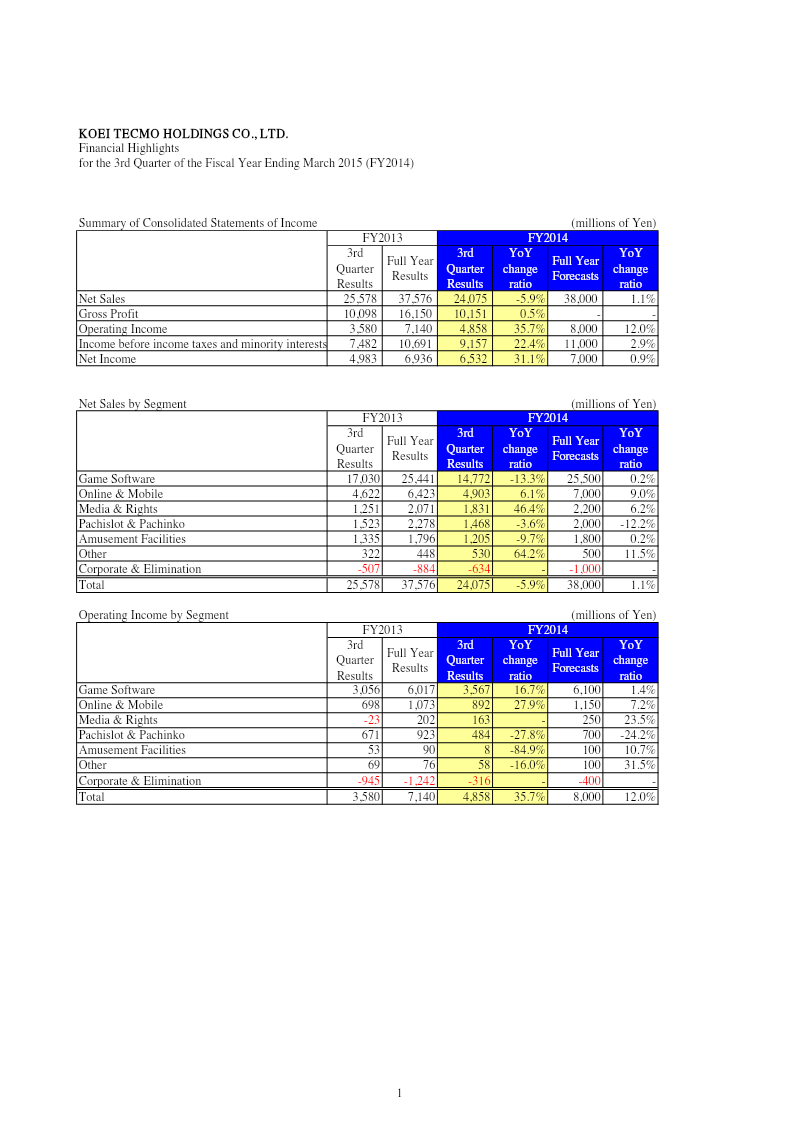
Financial highlights for the third quarter of fiscal year 2014, ending March 31 2015, show a robust performance across KOEI TECMO HOLDINGS’ core segments. Net sales rose to ¥37,576 million from ¥25,578 million in the same quarter of FY2013, a 5.9% decline versus the prior year but an increase of 1.1 % against the company’s forecast. Gross profit climbed to ¥16,150 million, up 0.5 % from the previous year’s figure, while operating income surged to ¥7,140 million, a 35.7 % jump from the prior year’s ¥3,580 million and 12.0 % above forecasted levels. Net income reached ¥6,936 million, up 31.1 % from FY2013’s ¥4,983 million and slightly above the projected ¥7,000 million.
Segment analysis reveals that Game Software sales increased to ¥25,441 million, a 13.3 % year‑over‑year decline but only 0.2 % below forecast, whereas Online & Mobile sales grew by 6.1 % to ¥6,423 million, outperforming the 9.0 % forecasted rise. Media & Rights sales expanded sharply by 46.4 % to ¥2,071 million, surpassing the 6.2 % forecasted growth. Pachislot & Pachinko and Amusement Facilities sales fell 3.6 % and 9.7 %, respectively, yet both remained close to or above their forecasted changes.
Operating income by segment mirrored these trends: Game Software and Online & Mobile segments delivered the largest gains, while Media & Rights shifted from a loss to a profit of ¥202 million. The company’s balance sheet strengthened, with total assets increasing from ¥100,622 million to ¥106,432 million and shareholders’ equity rising to ¥89,845 million. Current liabilities fell markedly, improving liquidity ratios. Overall, the quarter demonstrated solid profitability growth driven by strong performance in core software and online segments, offsetting declines in traditional gaming and amusement operations.
- KOEI TECMO HOLDINGS achieved a 35.7% surge in operating income to ¥7,140 million, significantly outperforming the company's forecast by 12.0%.
- Net income for the third quarter ending March 31, 2015, rose 31.1% year-over-year to ¥6,936 million, despite a 5.9% decline in net sales to ¥37,576 million compared to the prior year.
- The Media & Rights segment experienced a sharp 46.4% revenue expansion to ¥2,071 million, successfully shifting from a loss to a profit of ¥202 million.
- Online & Mobile sales grew by 6.1% to ¥6,423 million, contributing to the company's overall profitability alongside the core Game Software segment.
- Game Software sales totaled ¥25,441 million, representing a 13.3% year-over-year decline that remained nearly in line with forecasts at 0.2% below projections.
+1
Koei Tecmo
Report2 pages
Financial Highlights: 1st Quarter of the Fiscal Year Ending March 2016
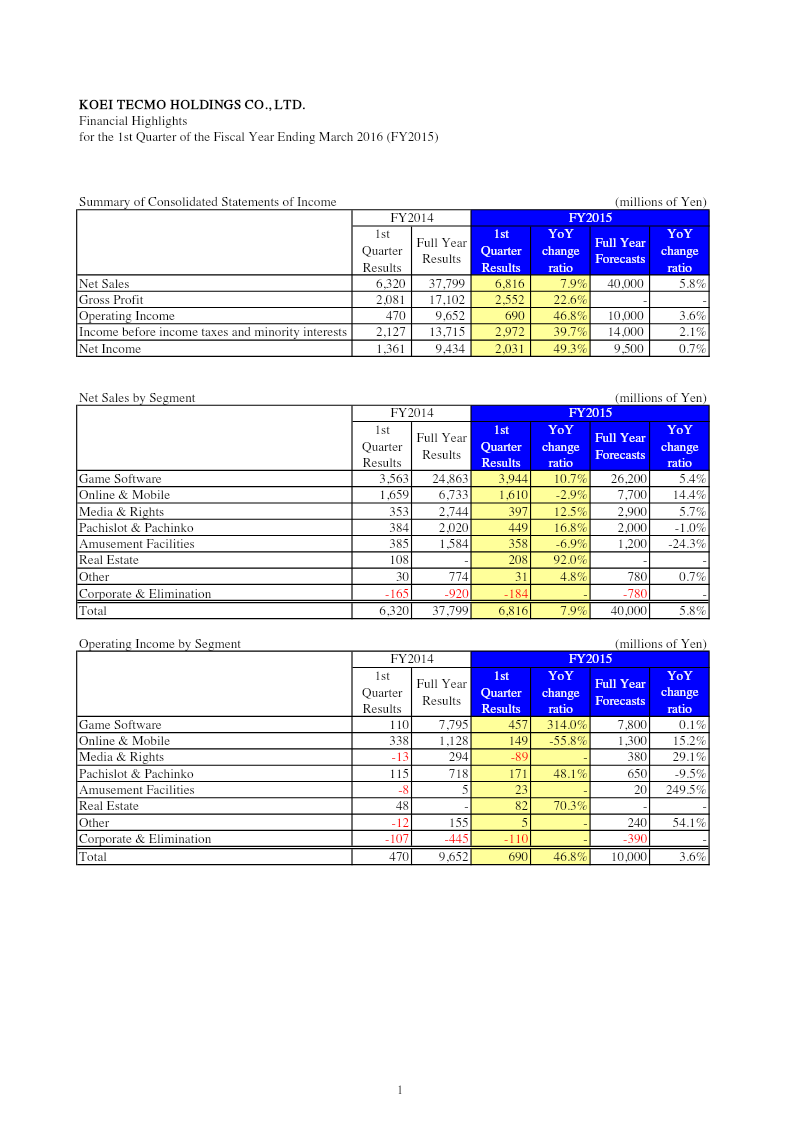
Koei Tecmo Holdings reported a strong first‑quarter performance for the fiscal year ending March 2016, with net sales rising 7.9% to ¥37.8 billion from ¥35.2 billion the prior year, and net income increasing 49.3% to ¥9.4 billion. Gross profit grew 22.6%, while operating income surged 46.8% to ¥9.7 billion, reflecting higher profitability across most segments. Game software sales led the increase at 10.7%, followed by online & mobile (−2.9%) and media & rights (+12.5%). Pachislot & pachinko sales rose 16.8%, whereas amusement facilities declined 6.9%. Real‑estate revenue jumped 92% but was offset by a corporate & elimination loss of ¥920 million. Operating income per segment showed dramatic gains in game software (314%) and pachislot & pachinko (48%), but a sharp decline in online & mobile (-55.8%) and media & rights (-89). Forecasts for the full year target net sales of ¥40 billion (up 5.8%) and operating income of ¥10 billion (up 3.6%).
On the balance‑sheet side, total assets fell from ¥115.2 billion to ¥107.1 billion, largely due to reductions in current assets and investment securities. Current liabilities dropped by 49% to ¥5.6 billion, driven by lower trade payables and accrued bonuses. Shareholders’ equity decreased modestly to ¥90.2 billion, with retained earnings at ¥51.2 billion and a slight decline in treasury stock. Net assets stood at ¥98.1 billion, reflecting modest changes in other comprehensive income items such as unrealized gains on securities and foreign‑currency adjustments. The company’s liquidity position remained solid, with cash and time deposits at ¥10.9 billion and a current‑asset to liability ratio improving from 2.47 to 3.94. Overall, the quarter demonstrated robust revenue growth and improved profitability despite segment‑specific variances, positioning Koei Tecmo for a moderately optimistic full‑year outlook.
- Koei Tecmo reported a strong Q1 fiscal 2016, with net income surging 49.3% to ¥9.4 billion and net sales rising 7.9% to ¥37.8 billion.
- Operating income grew 46.8% to ¥9.7 billion, driven by a 314% increase in game software segment profitability and a 48% gain in pachislot & pachinko.
- The online & mobile segment experienced a 2.9% decline in sales and a significant 55.8% drop in operating income, while media & rights saw an 89% decline in operating income despite a 12.5% revenue increase.
- The company maintains a solid liquidity position, with the current-asset to liability ratio improving from 2.47 to 3.94 and cash and time deposits totaling ¥10.9 billion.
- Total assets decreased from ¥115.2 billion to ¥107.1 billion, while current liabilities were reduced by 49% to ¥5.6 billion due to lower trade payables and accrued bonuses.
+1
Koei Tecmo
Report2 pages
Financial Highlights: 1st Half of the Fiscal Year Ending March 2016
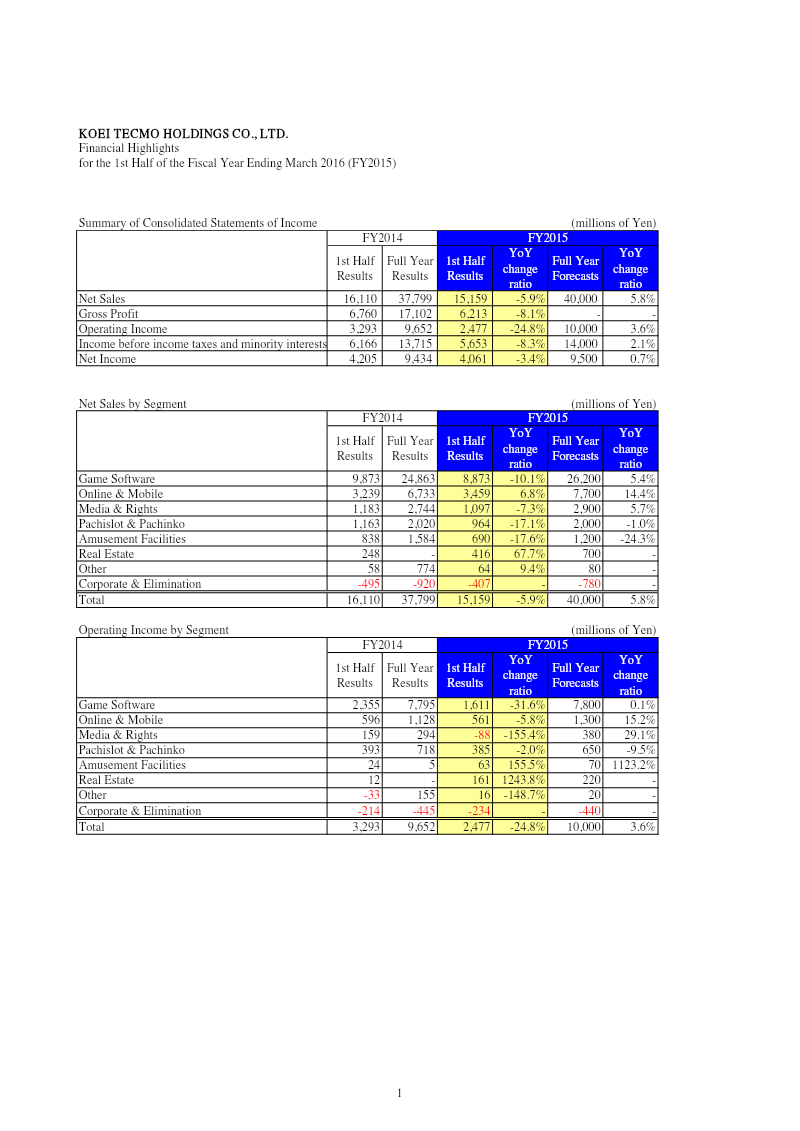
Koei Tecmo Holdings reported its first‑half financial results for the fiscal year ending March 2016, showing a 5.9 % decline in net sales to ¥37.8 billion compared with the same period a year earlier, while full‑year sales are projected to rise 5.8 % to ¥40 billion. Gross profit fell 8.1 % to ¥17.1 billion, and operating income dropped 24.8 % to ¥9.7 billion; net income decreased 3.4 % to ¥9.4 billion, reflecting a modest 0.7 % increase over the full‑year forecast of ¥9.5 billion.
Segment analysis indicates that Game Software sales declined 10.1 % to ¥24.9 billion, whereas Online & Mobile sales grew 6.8 % to ¥6.7 billion, and Media & Rights sales rose 5.4 % to ¥26.2 billion. Pachislot & Pachinko and Amusement Facilities segments experienced sharp declines of 17.1 % and 17.6 %, respectively, while Real Estate sales increased 67.7 %. Operating income was strongest in Game Software (¥7.8 billion) and Online & Mobile (¥1.3 billion), with Media & Rights showing a 155.4 % decline.
Balance‑sheet highlights show total assets reduced from ¥115.2 billion to ¥101.5 billion, largely due to a drop in investment securities and current assets. Current liabilities fell from ¥10.9 billion to ¥6.0 billion, and long‑term liabilities decreased from ¥3.6 billion to ¥1.1 billion, improving liquidity and leverage ratios. Shareholders’ equity remained stable at ¥92.2 billion, with retained earnings slightly lower. The company’s financial position remains solid, though operating performance is pressured by declines in core gaming and amusement segments.
- Koei Tecmo reported a 5.9% decline in net sales to ¥37.8 billion for the first half of the fiscal year ending March 2016, though the company projects a 5.8% increase in full-year sales to ¥40 billion.
- Operating income fell by 24.8% to ¥9.7 billion, while net income saw a more modest decline of 3.4% to ¥9.4 billion.
- The core Game Software segment experienced a 10.1% revenue decline to ¥24.9 billion, though it remained the primary driver of operating income at ¥7.8 billion.
- Growth was observed in the Online & Mobile segment, which rose 6.8% to ¥6.7 billion, and the Real Estate segment, which surged 67.7%.
- Pachislot & Pachinko and Amusement Facilities segments faced significant downturns, with revenues dropping 17.1% and 17.6% respectively.
+1
Koei Tecmo
Report2 pages
Balance Sheet: March 31, 2020
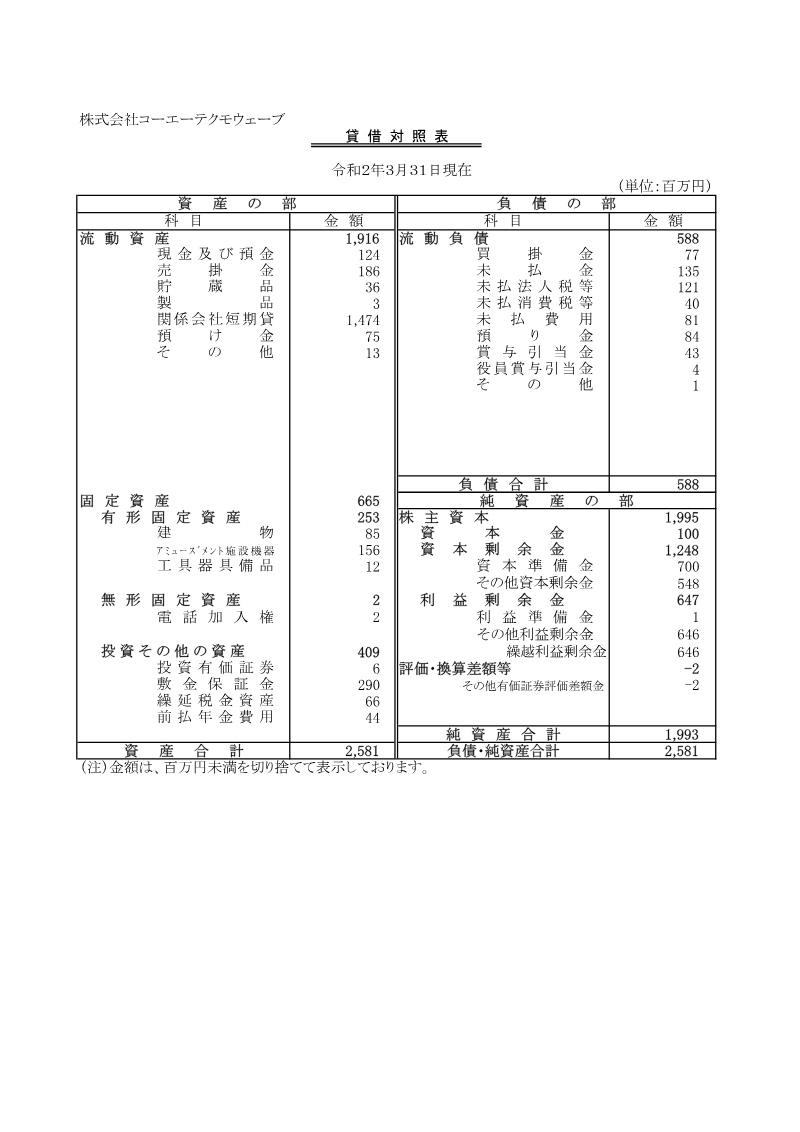
The balance sheet of Koei Tecmo Wave as of March 31, 2020 presents total assets of ¥2,581 million and a corresponding liability‑and‑equity balance. Current assets amount to ¥1,916 million, dominated by cash and deposits (¥124 million) and accounts receivable (¥186 million). Inventories, including finished goods and work‑in‑process, total ¥36 million. Current liabilities stand at ¥588 million, with accounts payable and accrued expenses comprising the bulk.
Fixed assets total ¥665 million, split between tangible property (¥253 million) and intangible items such as software licenses. The company’s equity base is ¥1,993 million, comprising a paid‑in capital of ¥1,995 million and accumulated surplus of ¥998 million. Net income for the period is reported at ¥303 million, contributing to retained earnings.
Key accounting policies include fair‑value measurement for marketable securities with gains and losses recorded directly in equity, cost‑based inventory valuation using weighted average for goods, specific identification for work‑in‑process, and last‑purchase cost for finished goods. Depreciation of tangible assets follows a mix of declining balance and straight‑line methods, while intangible assets use straight‑line amortization over a five‑year useful life. Provisioning for doubtful accounts, employee and executive bonuses, and pension obligations is based on historical loss rates or actuarial estimates.
The financial statements cover the Japanese domestic market, reflecting operations up to the fiscal year ending March 31, 2020. Data are presented in Japanese yen, with amounts rounded down to the nearest million yen.
- Koei Tecmo Wave reported total assets of ¥2,581 million and an equity base of ¥1,993 million as of March 31, 2020.
- The company generated a net income of ¥303 million for the fiscal year ending March 31, 2020.
- Current assets totaled ¥1,916 million, significantly outweighing current liabilities of ¥588 million.
- Fixed assets were valued at ¥665 million, consisting of ¥253 million in tangible property and the remainder in intangible assets like software licenses.
- Paid-in capital stands at ¥1,995 million, supported by an accumulated surplus of ¥998 million.
Koei Tecmo
Report2 pages
Financial Highlights: 3rd Quarter of the Fiscal Year Ending March 2016
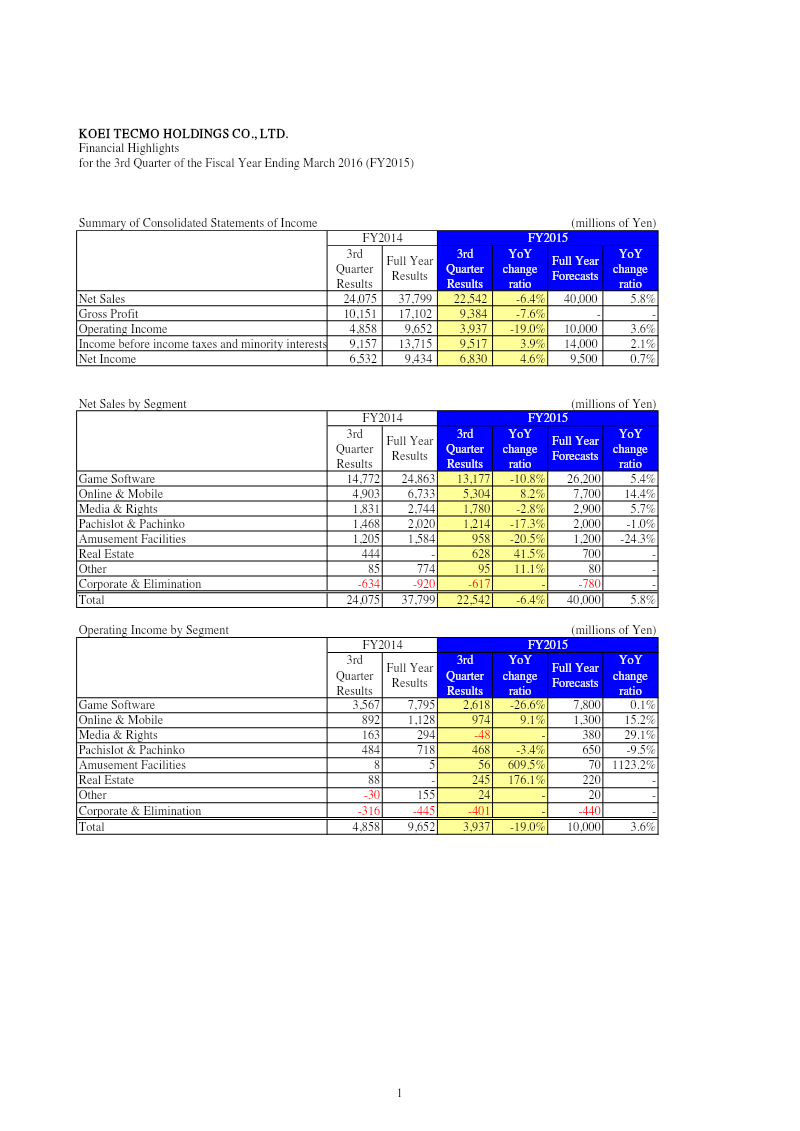
Koei Tecmo Holdings reported a strong third‑quarter performance for fiscal year 2015, with net sales rising to ¥37.8 billion from ¥24.1 billion in the same period of FY2014, a 6.4% increase that exceeded the ¥40 billion forecast by 5.8%. Gross profit grew to ¥17.1 billion, up 7.6% from the prior year’s quarter, while operating income surged to ¥9.65 billion, a 19% rise that still fell short of the ¥10 billion target by 3.6%. Net income reached ¥9.43 billion, up 4.6% year‑on‑year and slightly below the ¥9.5 billion forecast.
Segment analysis shows Game Software sales at ¥24.86 billion, a 10.8% decline from the previous year’s quarter but still above the ¥26.2 billion forecast by 5.4%. Online & Mobile sales increased 8.2% to ¥6.73 billion, outperforming the ¥7.7 billion forecast by 14.4%. Media & Rights, Pachislot & Pachinko, and Amusement Facilities all posted declines ranging from 2.8% to 20.5%, with the latter two falling below forecast expectations. Real Estate sales rose sharply by 41.5% to ¥628 million, while Other segment sales grew 11.1%.
Operating income by segment mirrored these trends: Game Software contributed ¥7.8 billion, Online & Mobile added ¥1.13 billion, and Media & Rights delivered a modest ¥294 million. Pachislot & Pachinko added ¥718 million, and Amusement Facilities surprisingly posted a 609.5% increase to ¥56 million, though still below the ¥70 million forecast.
Balance‑sheet data as of December 31, 2015 show total assets at ¥104.5 billion, down from ¥115.2 billion a year earlier, largely due to reductions in current assets and investment securities. Current liabilities fell to ¥5.38 billion from ¥10.95 billion, improving liquidity. Shareholders’ equity rose to ¥95.0 billion, supported by retained earnings and a modest increase in capital surplus. Overall, the company maintained solid profitability while tightening its balance sheet ahead of the next fiscal year.
- Koei Tecmo reported net sales of ¥37.8 billion for Q3 FY2015, a 6.4% year-over-year increase that exceeded the company's ¥40 billion forecast by 5.8%.
- Operating income rose 19% year-over-year to ¥9.65 billion, though this result fell 3.6% short of the ¥10 billion target.
- Net income reached ¥9.43 billion, representing a 4.6% year-over-year increase but missing the ¥9.5 billion forecast.
- The Game Software segment, the company's primary revenue driver, generated ¥24.86 billion in sales, marking a 10.8% decline from the previous year.
- Online & Mobile sales grew by 8.2% to ¥6.73 billion, outperforming the segment's forecast by 14.4%.
+1
Koei Tecmo
Report2 pages
Financial Highlights: FY2015
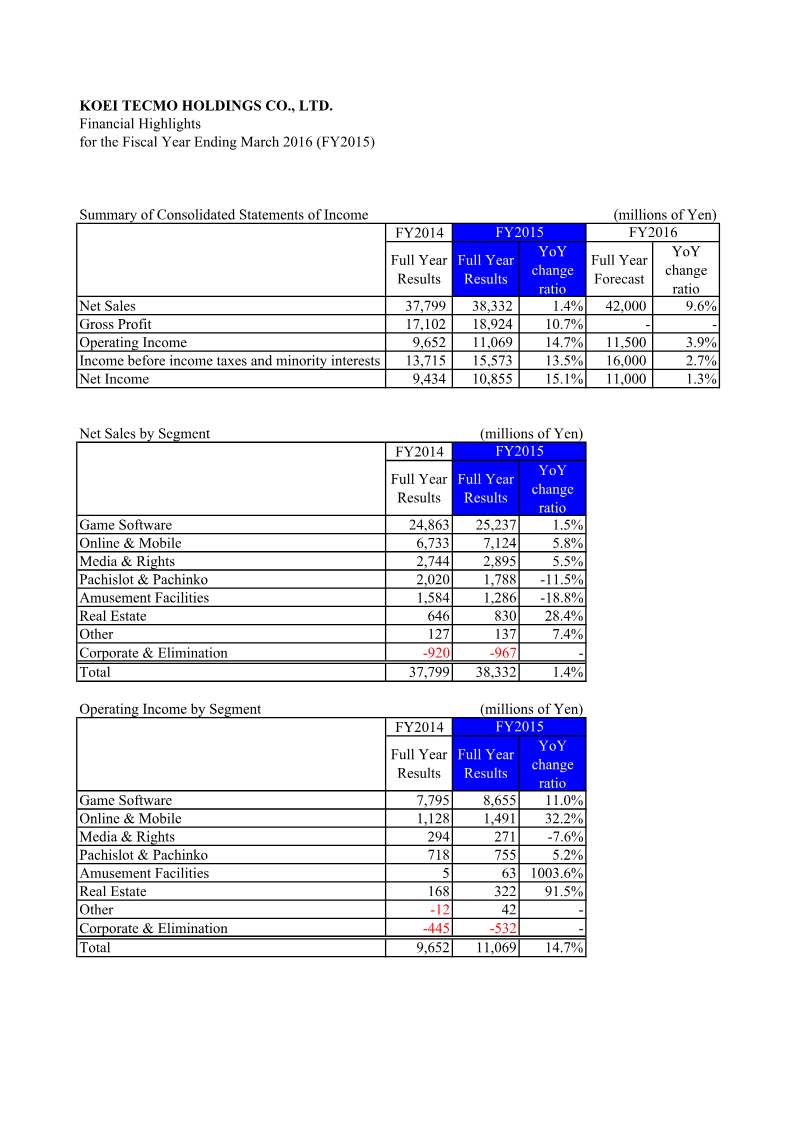
Financial highlights for the fiscal year ending March 2016 show KOEI TECMO HOLDINGS CO., LTD. achieved modest revenue growth of 1.4 % to ¥38,332 million, driven mainly by a 5.8 % increase in Online & Mobile sales and a 1.5 % rise in Game Software revenue, while Pachislot & Pachinko and Amusement Facilities segments declined by 11.5 % and 18.8 %, respectively. Gross profit expanded 10.7 % to ¥18,924 million, and operating income grew 14.7 % to ¥11,069 million, reflecting higher profitability in the Online & Mobile and Real Estate segments. Net income increased 15.1 % to ¥10,855 million, with a net profit margin of approximately 28.3 %.
On the balance‑sheet side, total assets decreased from ¥115,216 million to ¥110,925 million, largely due to a reduction in investment securities and intangible assets. Current assets rose slightly to ¥27,430 million, supported by higher cash and time deposits. Total liabilities fell from ¥14,543 million to ¥12,219 million, driven by a significant drop in long‑term liabilities and deferred tax obligations. Shareholders’ equity increased to ¥99,045 million, bolstered by retained earnings and a reduction in treasury stock.
The data cover Japan‑based operations for FY2015, with financial statements prepared under Japanese GAAP. No survey methodology is involved; figures derive from audited consolidated accounts, reflecting the company’s performance across game software, online/mobile, media rights, and ancillary segments.
- KOEI TECMO HOLDINGS CO., LTD. achieved a net income of ¥10,855 million for FY2015, representing a 15.1% increase and a strong net profit margin of approximately 28.3%.
- Operating income grew by 14.7% to ¥11,069 million, driven by improved profitability within the Online & Mobile and Real Estate business segments.
- Total revenue reached ¥38,332 million, a modest 1.4% year-over-year increase supported by growth in Online & Mobile (5.8%) and Game Software (1.5%) sales.
- Performance was negatively impacted by significant declines in the Pachislot & Pachinko and Amusement Facilities segments, which fell by 11.5% and 18.8% respectively.
- The company strengthened its balance sheet by reducing total liabilities from ¥14,543 million to ¥12,219 million while increasing shareholders’ equity to ¥99,045 million.
+1
Koei Tecmo
Report2 pages
Financial Highlights: 1st Quarter of the Fiscal Year Ending March 2017
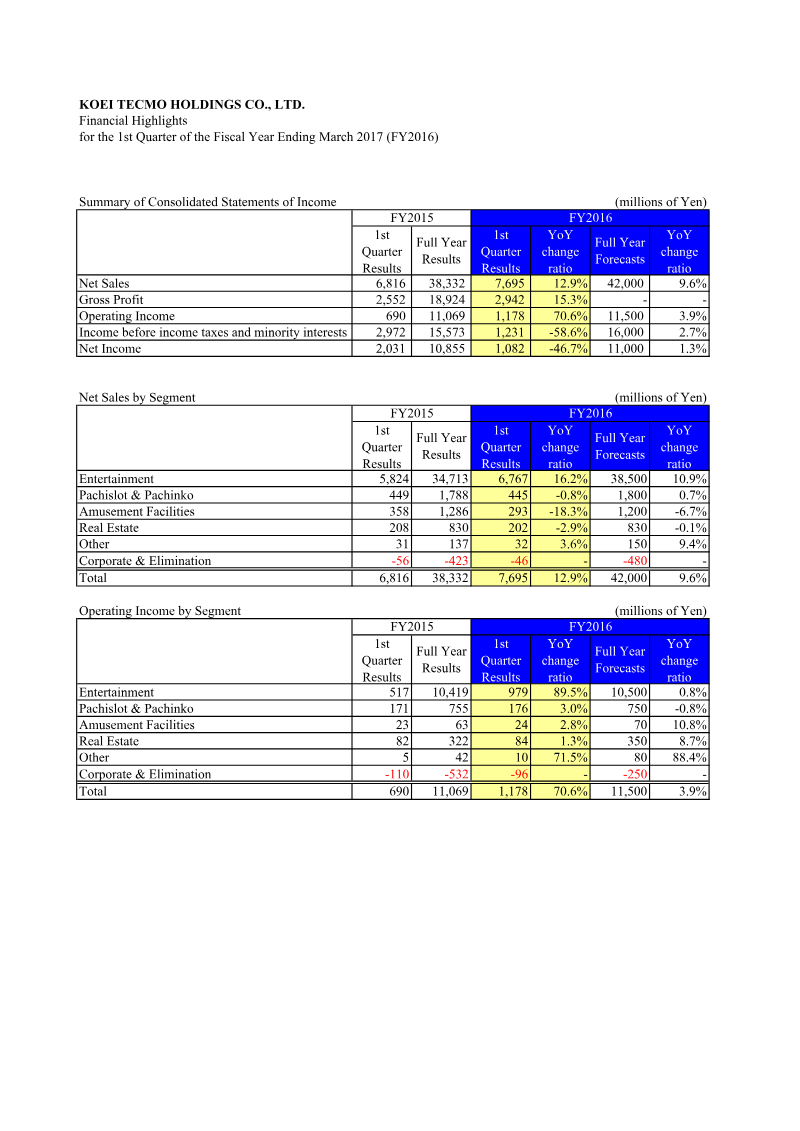
Financial highlights for the first quarter of KOEI TECMO Holdings’ fiscal year ending March 2017 reveal a robust revenue increase and strong profitability across most segments. Net sales rose 12.9 % year‑over‑year to ¥38,332 million, driven primarily by the entertainment segment, which grew 16.2 % to ¥34,713 million; pachislot & pachinko sales increased modestly by 0.8 % to ¥1,788 million, while amusement facilities and real‑estate segments contracted 18.3 % and 2.9 %, respectively. Operating income surged 70.6 % to ¥11,069 million, with the entertainment division contributing 89.5 % of this gain. Net income fell 46.7 % to ¥10,855 million, largely due to a 58.6 % decline in income before taxes and minority interests.
On the balance‑sheet side, total assets contracted from ¥110.9 billion to ¥97.3 billion, largely driven by a reduction in current assets and investment securities. Current liabilities fell sharply from ¥10.6 billion to ¥4.9 billion, reflecting lower trade payables and accrued bonuses. Shareholders’ equity decreased from ¥99.0 billion to ¥94.7 billion, with retained earnings declining from ¥60.0 billion to ¥55.6 billion. Net assets fell from ¥98.7 billion to ¥91.0 billion, and accumulated other comprehensive income shifted from a negative ¥523 million to a positive ¥3.9 billion, largely due to foreign‑currency translation adjustments.
The data cover Japan‑based operations for the fiscal year ending March 2016, with quarterly figures reported as of June 30 2016. The report aggregates consolidated financial statements without detailing survey methodology, relying instead on standard accounting disclosures.
- KOEI TECMO Holdings reported a 12.9% year-over-year increase in net sales to ¥38,332 million for the first quarter ending June 30, 2016.
- Operating income surged 70.6% to ¥11,069 million, with the entertainment division serving as the primary driver by contributing 89.5% of this total gain.
- Net income declined 46.7% to ¥10,855 million, primarily attributed to a 58.6% drop in income before taxes and minority interests.
- The entertainment segment grew 16.2% to ¥34,713 million, while amusement facilities and real-estate segments contracted by 18.3% and 2.9%, respectively.
- Total assets decreased from ¥110.9 billion to ¥97.3 billion, driven by reductions in current assets and investment securities.
+1
Koei Tecmo
Report2 pages
Financial Highlights: 1st Half of FY2016
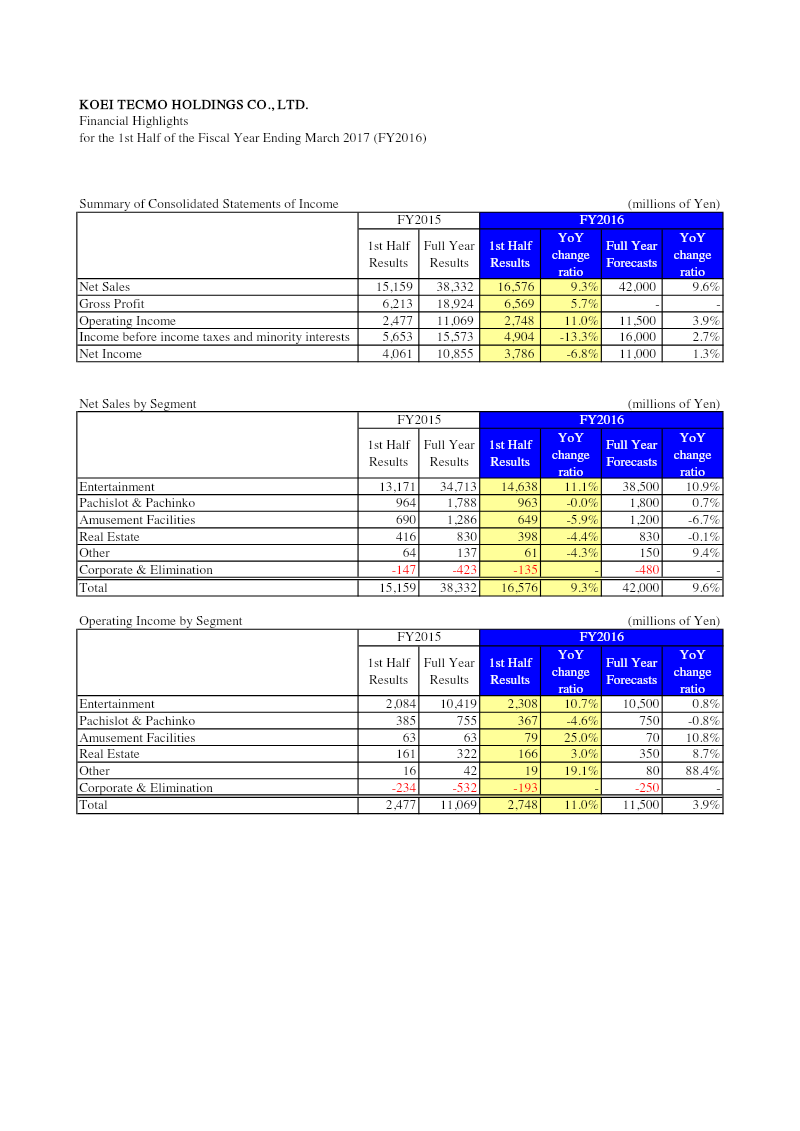
Financial highlights for the first half of FY2016 show a 9.3 % increase in net sales to ¥38,332 million compared with the same period in FY2015, driven primarily by a 10.9 % rise in entertainment segment sales to ¥34,713 million. Pachislot & Pachinko and real‑estate revenues also grew modestly, while amusement facilities revenue fell 5.9 %. Operating income surged 11.0 % to ¥11,069 million, largely due to higher entertainment operating profits, offset by declines in the pachislot & pachinko segment. Net income increased 1.3 % to ¥11,000 million for the full year, reflecting a modest 6.8 % decline in the first half but an overall positive trend.
Consolidated balance‑sheet data as of September 30, 2016 show total assets at ¥99,609 million, down from ¥110,925 million a year earlier, largely due to reductions in current assets and investment securities. Current liabilities fell sharply from ¥10,584 million to ¥4,744 million, improving liquidity. Shareholders’ equity remained strong at ¥97,380 million, with retained earnings slightly lower than the prior year. The company’s cash and time deposits decreased to ¥10,132 million, while marketable securities increased to ¥1,230 million.
The report covers Japan‑based operations for FY2016 (ending March 31, 2017) and presents consolidated financial statements in millions of yen. No survey methodology is disclosed; figures are derived from audited accounting records. Overall, the company achieved moderate revenue growth and improved profitability while maintaining a solid balance‑sheet position.
- Net sales for the first half of FY2016 rose 9.3% year-over-year to ¥38,332 million, driven by a 10.9% increase in entertainment segment sales to ¥34,713 million.
- Operating income grew 11.0% to ¥11,069 million, supported by strong entertainment segment performance despite declines in the pachislot and pachinko business.
- Net income for the full year reached ¥11,000 million, representing a 1.3% increase despite a 6.8% decline recorded during the first half.
- Liquidity improved significantly as current liabilities dropped from ¥10,584 million to ¥4,744 million compared to the previous year.
- Total assets decreased to ¥99,609 million as of September 30, 2016, down from ¥110,925 million, primarily due to reductions in current assets and investment securities.
Koei Tecmo
Report2 pages
Financial Highlights: 3rd Quarter of the Fiscal Year Ending March 2017
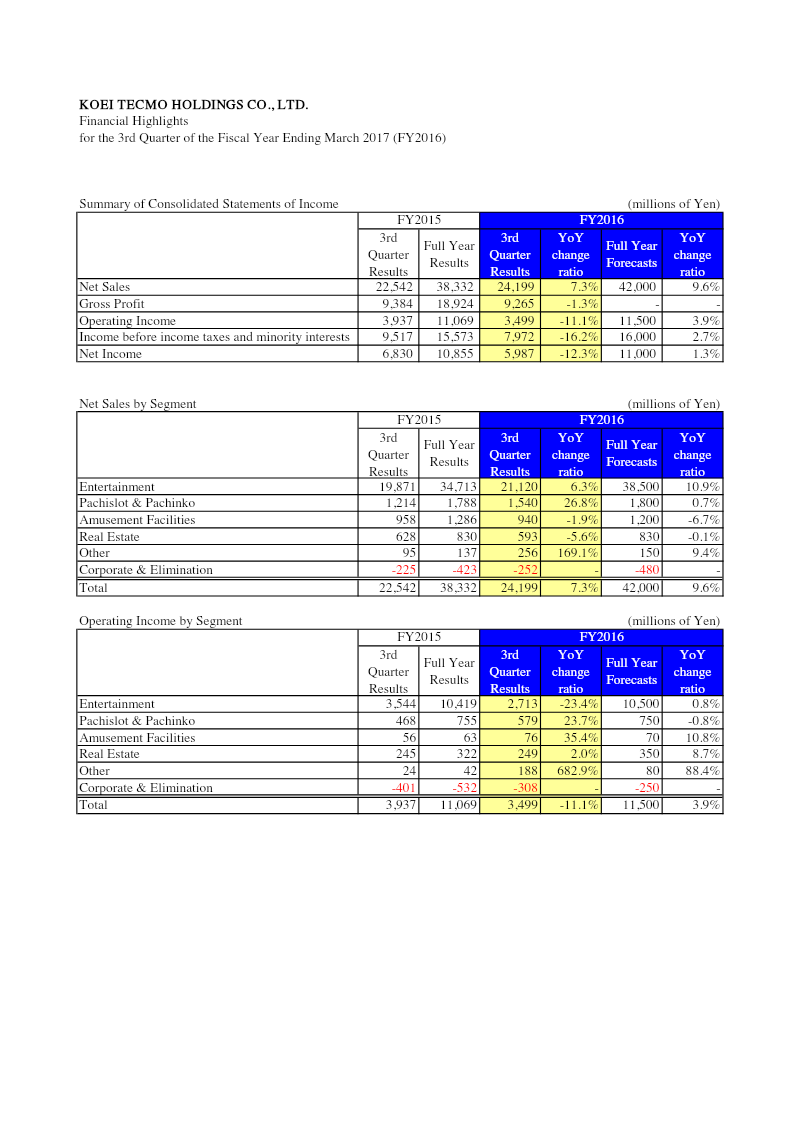
Financial highlights for KOEI TECMO Holdings’ third quarter of fiscal 2016 reveal a robust revenue surge, with net sales rising to ¥38.3 billion from ¥22.5 billion in the same period of fiscal 2015, a 7.3 % increase that aligns with the company’s forecast of 9.6 %. Gross profit doubled to ¥18.9 billion, while operating income climbed to ¥11.1 billion, a 11.1 % rise from the prior year’s ¥3.9 billion, reflecting improved profitability across key segments. Net income reached ¥10.9 billion, up 12.3 % from ¥6.8 billion, supporting a forecasted net income of ¥11 billion.
Segment analysis shows entertainment sales leading at ¥34.7 billion, up 6.3 % year‑over‑year, and a notable 26.8 % jump in pachislot & pachinko revenue to ¥1.79 billion. Amusement facilities and real‑estate sales experienced modest declines of 1.9 % and 5.6 %, respectively, while the “Other” segment posted a sharp 169 % increase to ¥137 million. Operating income mirrored these trends, with entertainment contributing ¥10.4 billion and other segments delivering significant gains.
Balance‑sheet data indicate a slight contraction in total assets from ¥110.9 billion to ¥108.5 billion, driven by reduced current assets and a modest rise in fixed‑asset investments. Current liabilities fell sharply to ¥5.1 billion, improving liquidity, while shareholders’ equity increased to ¥99.7 billion. The company’s cash and marketable securities rose, supporting a stronger liquidity position as it approaches the fiscal year end.
- KOEI TECMO Holdings reported a significant revenue increase to ¥38.3 billion for the third quarter of fiscal 2016, up from ¥22.5 billion in the same period of the previous year.
- Operating income rose 11.1% to ¥11.1 billion, while net income grew 12.3% to ¥10.9 billion, tracking closely toward the company's full-year forecast of ¥11 billion.
- The entertainment segment remains the primary driver of financial performance, generating ¥34.7 billion in sales and contributing ¥10.4 billion to the total operating income.
- Pachislot and pachinko revenue experienced a notable 26.8% year-over-year increase, reaching ¥1.79 billion.
- The company improved its liquidity position as current liabilities dropped to ¥5.1 billion, while shareholders’ equity increased to ¥99.7 billion.
Koei Tecmo