1 free read left. Create a free account for unlimited reading + AI research.
Create free accountWhitepaper European Conference on Games Based Learning (ECGBL)
1 free read left. Create a free account for unlimited reading + AI research.
Create free accountWhitepaperEuropean Conference on Games Based Learning (ECGBL)
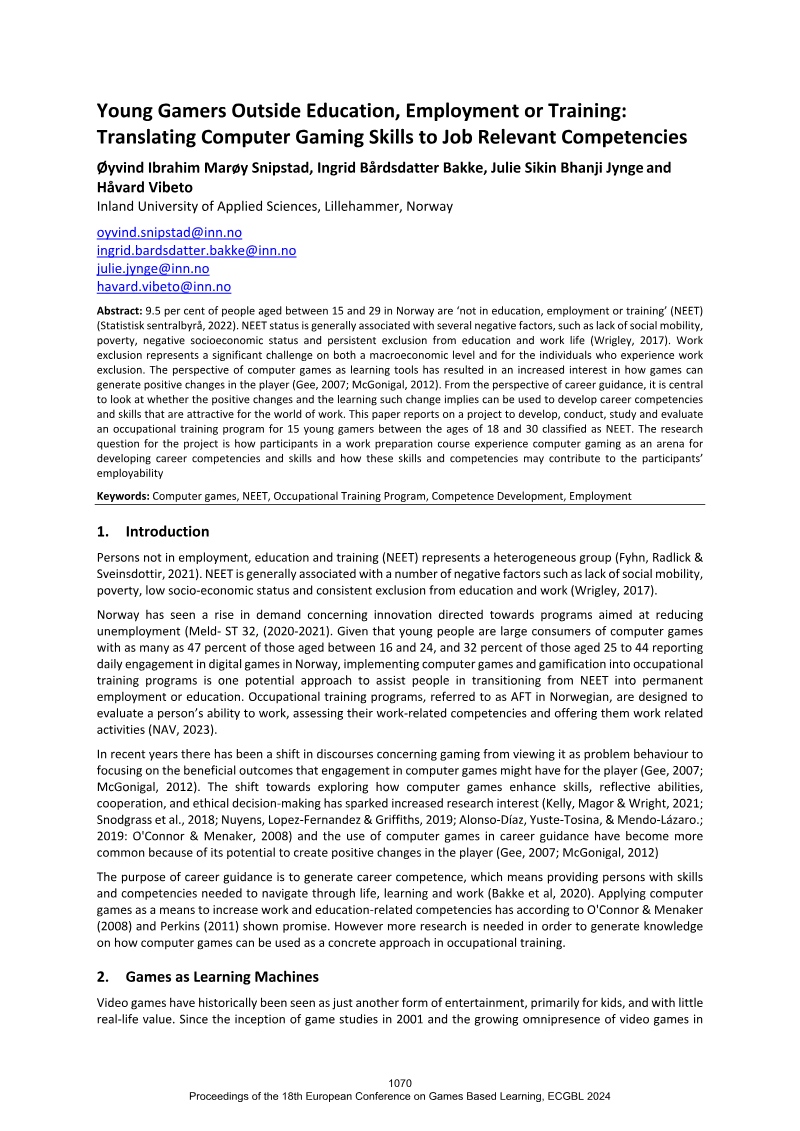
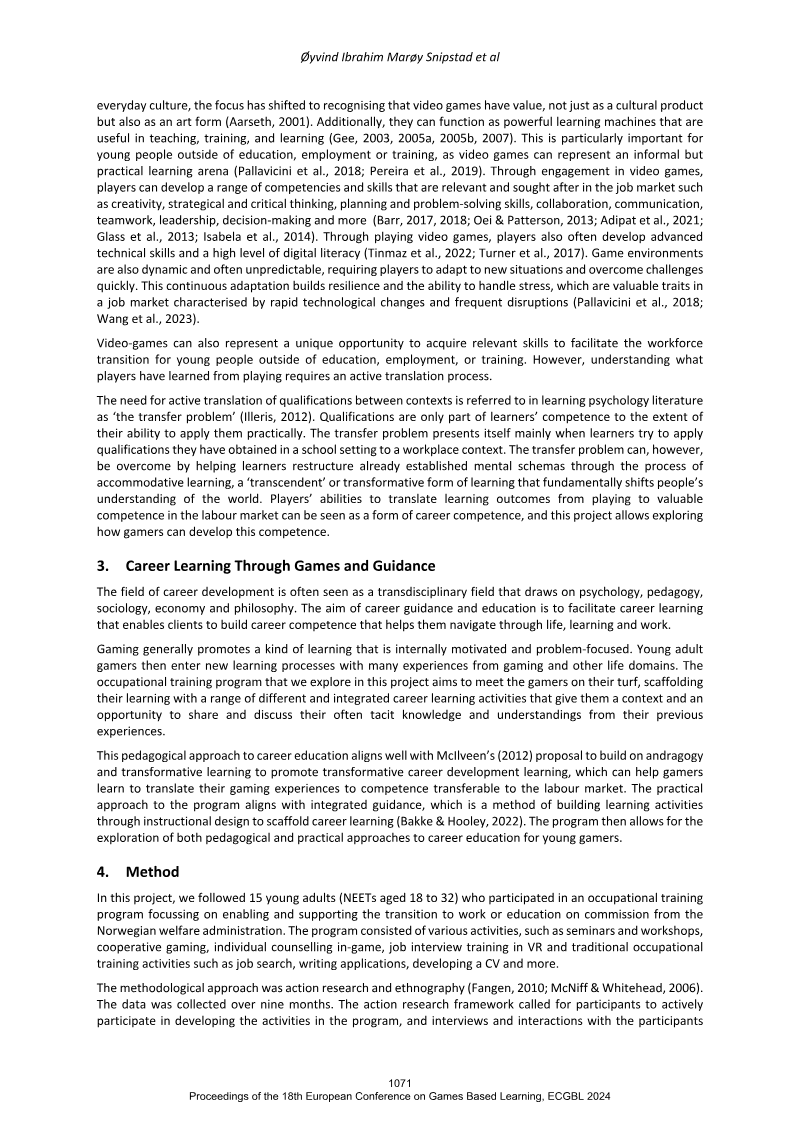
The share of young people aged 15 to 29 who are not in education, employment or training is 9.5 percent in Norway.
This study examines whether computer gaming can serve as a credible arena for developing career competencies among young people classified as not in education, employment or training (NEET) in Norway. Motivated by the high rate of NEET status among Norwegian youth, which stands at 9.5 percent for those aged 15 to 29, and by growing evidence that games can build transferable skills, the authors describe a project that designed and evaluated an occupational training program for 15 gamers aged 18 to 32. The guiding research question concerns how participants experience gaming as a space for building career competencies and how those skills might contribute to their employability.
The theoretical framing draws on the idea that games function as learning machines, cultivating problem-solving, strategic thinking, collaboration, leadership, digital literacy and resilience. The authors emphasize that such learning does not transfer automatically to the labour market and instead requires an active translation process, which they connect to the "transfer problem" in learning psychology. Career guidance concepts such as transformative career development learning and integrated guidance are presented as the pedagogical basis for helping participants recognize and articulate their gaming experience in work-relevant terms.
Methodologically, the work applies action research and ethnography over a nine-month period. Participants helped shape program activities, which combined seminars, cooperative in-game counselling, virtual reality job interview training and conventional job-search support. Data came from participant observation, focus groups and individual interviews conducted both in person and inside the game environment. The analysis is planned as a thematic, experience-based narrative study. As a work-in-progress, the paper reports only preliminary themes from an AI-assisted screening of the data, including problem-solving, critical thinking, strategic planning, teamwork, language, logistics management, systematic organisation, handling complex systems and improved social skills. Findings on employability outcomes have not yet been established.



European Conference on Games Based Learning (ECGBL) · 2026



European Conference on Games Based Learning (ECGBL) · 2026



European Conference on Games Based Learning (ECGBL) · 2026



European Conference on Games Based Learning (ECGBL) · 2026



European Conference on Games Based Learning (ECGBL) · 2026



European Conference on Games Based Learning (ECGBL) · 2026



European Conference on Games Based Learning (ECGBL) · 2026



European Conference on Games Based Learning (ECGBL) · 2026



European Conference on Games Based Learning (ECGBL) · 2026



European Conference on Games Based Learning (ECGBL) · 2026



European Conference on Games Based Learning (ECGBL) · 2026



European Conference on Games Based Learning (ECGBL) · 2026
European Conference on Games Based Learning (ECGBL) · 2026