1 free read left. Create a free account for unlimited reading + AI research.
Create free account
When Gameplay met Narrative - A Love Story on a Budget PG Connects #2
Key insights
5 takeaways- 01Establish a single, cohesive guiding idea at the start of production to ensure all gameplay mechanics, UI design, and narrative themes remain unified.
- 02Anchor development in a central thematic message to prioritize core systems, which helps small studios manage budget constraints by eliminating extraneous or disconnected features.
- 03Incorporate direct community feedback during iterative release cycles to refine mechanics and ensure the narrative vision remains aligned with player expectations.
- 04Utilize a modular, episodic development model to maintain financial viability while allowing for iterative content expansion.
- 05Maintain a disciplined workflow when using episodic releases to balance the pressure of strict shipping deadlines with the need for high-quality player experiences.
Ask AI about this video
Transcript
there we are in Swedish we would say yummy Elias but you can say genius is perfectly fine I'm gonna I'm gonna practice just you can mute yourself and sit in the background and thank you then I will go through start my presentation and share my screen here we are can you see okay thank you so much for
having me my name has mentioned is on my alias or antigen alias and I'm here to talk to you about when gameplay meta-narrative which is a love story on a budget but first off who I so I'm bassist dokkum Sweden and I am the founder and creative director of a company called valiant game studio I have made games in different ways since 2011 my first jobs were like an internship and some freelancing and so on my first real time job was as a QA tester at paradox in Stockholm and then I moved on to be a QA manager and so on before I decided to go in the in 2015 in there knows a couple of years it was a freelance two bits I was a game design teacher part-time and so on but in 2017 it was time to be full-time indie for free oh so I found a
talent game studio I found my co-founder Laura and so on and I have a great passion for the romance between gameplay and story so one of my my things I really like to focus on when making games sometimes it looked like this like you're doing a picture I'm just gonna drop that without in a context because it's funnier that way and we are a tiny tiny studio audience we make meaningful games to promote underrepresented in still hope and favor the journey we're actually just two people working full-time it's me and my co-founder Lara Blanca and as I mentioned we are based in Stockholm we have a combined 29 years of experience so with my 9 years you can quickly figure out that Lara has 20 years of working with games and we both develop games in-house and we also publish games
so the first game that we made internally is called pendulous wink we have released that over about one and a half years and a full game was released in March of this year we also publish a board game about Romanian marriage negotiations called sestra we had a very successful Kickstarter for that and we're just about to actually deliver all the products to our players we are publishing a game called midwinter which I made when I was a solo indie we are now taking over and publishing that and right now we are working on a game called Collider crafts which we are launching in early access hopefully next week if everything goes to occur according to plan alright so this talk is also going to be a case study basically about a pendulum swing the first game that we've made with aliens in case you don't know open your swing is a pointed click adventure it's a fantasy version of the American
Roaring Twenties and it's you get to explore memorable 1920s fantasy world where you interact with the friend and romance hundreds of characters with unique quests and you do this as an already rich and famous hearing and when we started working on Pintrest wing I wanted to do something that I always do when I start a new project because I write on the side and so on as well and something that's very important to me personally is to find what the guiding idea is I have a whole talk on this specific topic so I'm not gonna be able to go into super detail but just explain what I mean by I don't think that all games need to be driven by a story they don't have to be narrative driven games but even very mechanically driven games do say something what do you like it or not even if you take precautions not to
really have a story or have a subject matter that you're dealing with you're still saying something so my suggestion is to really take control of the message that you're sending to make sure that you're actually saying what you think you're saying and not sending any mixed messages or anything and especially if you are making a narrative driven game really take and I can take care of the message that you're sending make sure that you can package it in a way that really makes sense to players they are walking away with the experience that you you want them to walk away with so for us that meant that we really considered what is the purpose of this story what emotions and insights do we want the player to walk away with what would the world look like if everyone played this game would it be a better world would it be a worse world or would it just be indifferent like you would nothing happen and for us Italians it's important to at least in some way try to
make the world a little bit better because as game developers we are taking up a lot of the pair's time so why not make sure that they also they don't don't just have a fun experience but also can learn something once you have found something that you want to say to the player then the next step is how can you deliver that guiding idea to the player and like really focus on bringing that idea to in our case a pentose swing the core message the guiding idea that we wanted to focus on was that we're not so different after all and prejudice against other people is very destructive and it ruins lives of course not all games have to have this formal message but to us it was very important to to focus on the topic that's very close to our hearts and sort of focus the rest of the whole experience around the core idea so we sat down and thought
okay so if this is the core idea that we're gonna bring to the player what do we need in order to to make this experience but it was quite obvious that we needed a diverse cast it's kind of hard to talk about prejudice when if all of your characters look the same we wanted to use recently recognisable tropes that we could explore and also subvert we want to ability for the player or give the ability for the player to explore different experiences and see the consequences different actions that they took so we wanted the world to actually you know respond to the choices that the other pair made we wanted of course to read which wide audience so we wanted the experience to be very accessible we didn't want to have like a high difficulty bar or anything that would block people from playing the game because we didn't want to just preach require kick in open doors who wanted to reach out as many people as possible so that we could like
have this discussion with as many people as possible we wanted to visually make this something that a lot of player would recognize so they would like to see our game like okay I get it I understand which type of game this is but at the same time we wanted to deliver care twists to what they were expecting from that kind of game so in our case this meant that our choice fell on fantasy characters and tropes because most people know what an elf is what a dwarf is an orc and Goblin and they will have certain expectations of what a character all that had this race what they would be like which gave us a lot of opportunity to talk about okay so you think you know what an orc is how do you know that and so one can play with the peers sort of prejudice about fantasy races we wanted to make it look visually like a classic top-down RPG so that a
player who has play for example there's gate open there's a return to do that sort of game but I can easily recognize the sort of setting and sort of hi book gameplay this would be but instead of putting it in a medieval fantasy setting we said put it in the 1920s and this as many there are many reasons why we chose to do that but it's a very interesting era it has all the glamour and the fun stuff that can be really fun to play around with in a game but at the same time it was an era of great social upheaval there were a lot of things going on and it was certainly a lot of people that did not experience the glamour of the 1920s so it was a really good era for us to focus on this on in this game we also chose to make this a non violent game and I want to focus on that in particular because this is of course tightly connected to the gameplay of the game and pretty much
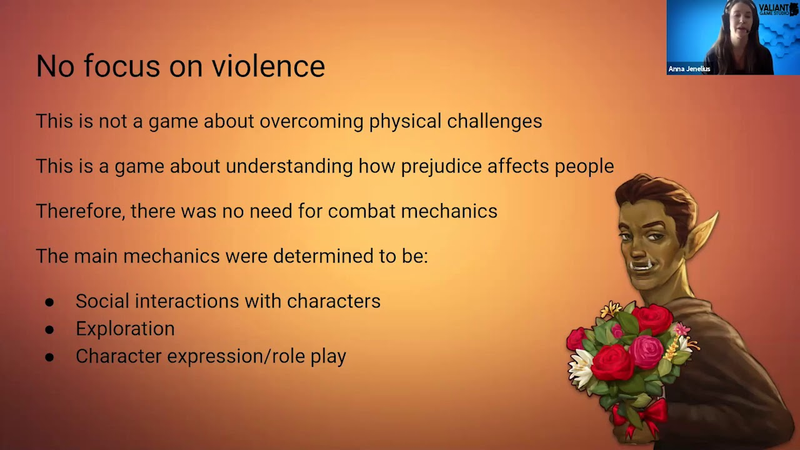
like this game is not like the core of this game is not to overcome physical challenges it's a game about understanding how prejudice affects people so just didn't make sense to put arbitrary fighting in the players way like it did not add to the core experience that we were like the core idea that we wanted to deliver to the player and honestly like there are so many games that have great combat mechanics and we just didn't feel like competing with that we are not Italian it's particularly interested in that in creating that sore mechanics if there are already so many people that's so good at it why compete with that why not make something else so we just said it oh it's gonna be a non non violent game not gonna be any combat mechanics we sort of Eve involved that into the story you are already a famous Heron who has already saved the world you would be overpowered anyway so we sort of vote that in tonight it wouldn't make sense for her to be people like it would just
be you it wouldn't work so instead we decided that the main mechanics would be focused around socially directions with the characters in the world around exploration and about character expression and roleplay and knowing roughly what the gameplay would be go back to the guiding idea and sort of build the systems in order of importance depending on how closely they sort of related to the idea that so that's where we started and we could work our way forward from there and then as we went along we could make the more sort of French mechanics so as you can see this is one of the very first gifts that I made developing this wing this is just like assets store assets you're just thrown into to see people if things worked but as you can see already here this is like week two or something of
development maybe a week one you can already see that you can choose topics and dialogues the character responds to you you can see on the left hand side here that already we have the journal so you can get quests and you can finish them and also a backpack so already here you could get items you can give items to characters as one so the very core of the experience was there from the very very start and that's that has continued to be the whole core of this experience and knowing what is the most important part of the game also helped us keep iterating and making the party game better as we went along as you can see on the left side here early on when you were in a dialogue with a character for example all that the everything that a character said was just floating above their head like in bubbles but we realized that this just wasn't polished
enough and I could it's sent a message to the player like we didn't pay that much attention to this like we didn't actually polish it that much so you don't have to pay attention either like I think the player can tell how much you as a developer has put into something and they will also like focus their attention on what they like what they can see that you have put effort into so we decided to redo the whole UI of the dialogue system so we didn't change how that looks actually work but just a way we we we changed that when we realized okay this is the most important part of experience it can't be this it can't look at this bad so what you see in the right-hand side is here is from the released trailer of this game and as you can see we have actually you're a much closer to the character you're talking to you can see yourself all the time and like it's just much more focused on this
like you are in a dialogue right now you should really and then when we had all of these core mechanics sort of in place that's why we could start adding the content and I could talk about this in length as well but I'm just gonna mention that when you have a few hundred characters just make sure to have a good system to keep track of everything this was a very interesting experience too just because all of these characters in our game are unique they have their own name they have their own place in the story and so on so it was a challenge to keep track of everything if you're doing anything like this in a few churches get a Vicky gets something where everyone everyone can see who is who and where are they everything because it's gonna be about the honor on a budget part of
this love story we knew right from the start that it would be very hard to get full funding for this entire game when I founded the studio there was no money at all the artists that work with us basically like I scraped together some money to pay her initially but mostly she she just trusted that there would be money at some point so knowing that I built the story structure in a way that like as you can see in this picture there are basically puzzle pieces and I could remove some of them or we could remove some of the minister would still make sense and more importantly even if we removed some chapters of this story we would still be delivering on the guiding idea so the play would still walk away with the same sort of like okay I think I get it I know what this is about so this really health is like keeping focus okay we don't have to have all this fluff it would be nice and of course the story is gonna be much better
but what is actually important okay these parts are important but as long as we deliver on this like fundamental experience it's fine even if you don't get full funding even if we can't deliver all of this and this meant that we could start like mapping this into areas okay what are we building first okay so we need this chapter needs this to sort of make sense so it can be like an area of the city okay so and actually quite early in development we realized okay but now that we have this like modular story why not actually make this make this an episodic game why not release it in episodes to the players as well and that's exactly what we did so
on the top right here you see three episodes have been finished so three areas of the game have been released a player and then every third month we would open up another area of the city so the Paris could go to one more area and continue the storyline so they wouldn't just buy another DFC basically and that would open up this area and yeah and after we had released all the episodes we could finally finish like the whole product which we did in the March of this year so the bottom right here you see the final product the whole city's a lot didn't go to all of these areas and like sort of experienced the whole story without any interruptions so it became an episodic game that initially also became a whole game we did have to find some image of some additional funding to be able to complete the whole game but still
internally we still had the opportunity to see this as sort of a an early access game because we learned so much from the payers while we were developing it seeing what they did what did it like and so on and that was really really helpful to us so I'll be the first to admit only talking to characters all the time can be a bit tedious so we did understand after a while that we had to find other mechanics as well and we wanted to push it up a little bit and our community might be small but it's really amazing and the more we could understand them understand our players the better we could design new features and see sort of the direction we should go in the future so when we learn about them we realize that ok we should probably focus more on character customization for example we put more
time into the dating options because that's something out there seem to be really enjoying and also we just open up strike you can have a bunch of animal companions following you around because for some reason people seem to really like having their critters following you around who woulda guessed people like cute animals so yeah and also watching people play this game meant that we could adjust the content like where to put effort as well one thing for example that we realized was that the first island that you visits in the game it's like almost like the tutorial island was way too small you were not invited enough into the story before like being thrown into the like the larger part of the game the city that you go to so based on like watching people play which we were able to do because we were leasing episodically based on that we we went back and actually made the decison
initial island almost double what it was in the beginning another thing that we did was we added content in collaboration with our players so for example we made a post we posted on social media saying hi are you do you feel like you are underrepresented in games could you please tell us about your experience and maybe we can add a character based on you in our game so it it's this blue haired elf ear is based on one of our players as you can see she even made some fanart of herself it's very cute another thing we did was add books that our players wrote and added them to the library that we have in the game and all of this also ties back into the guiding idea because like this is at the end of a game about showing the diversity of people and experiences and showing that yeah we're we're all you
know we're all different or we're all the same depending on how you look at it and that's great so wants to celebrate that so instead of just showing our perspective and characters to be had created we wanted to expand a little bit and showing our experiences and adding content content that other people had made as well and of course we rewarded people with a free key to the game as well if they so to summarise in Pentos swing it was very important to us to make the story and the gameplay speak the same language so that we didn't sort of give one one message with the gameplay another with actual story we had a clear guiding idea that we wanted to get across and that pretty much guided all of our creative decisions through the whole process and also the feedback from our players really helped us guide the development of the game as we went along and that is under my
presentation thank you so much hey it's great thank you so much and yet we do have a few questions that came in during the talk question from Lorraine who asked would you say that games with a strong story slash narrative have more potential for derivative works or derivative works yeah for like sequels all right I mean yes no I think all games can have sequels because like you can always expand on mechanics as well but definitely like in our case we what took the most time for us was to create the assets right - to actually write the dialogues - to build all of these areas but for example making a second game in this in the same city would be much
easier than making this this first game because like now we have all of the assets like we could literally make another small standalone game taking place in the same world and it would be so much easier than of course we still have to write the dialogues but just making all the assets that's the hard merch basically so I mean so yes and no and I can of course like what people have fall in love with in this game is the world right so saying that yeah you can go back to this world that you like to meet these characters again that might be very appealing but on the other hand like more mechanics driven game I'd be like yeah we already have the mechanics literally if we just need to switch to setting or we need to just add a little bit more mechanics or something so let's say both yes or no I think there are merits - to all kinds of games and I think that doesn't think that answers the question it's just comes
from like access creation that's necessarily a given that it's easy whatever the story alright another question came in is ask the players are so diverse depending on to countries and cultures they come from how would you advise we work on character customization without falling into generalization oh that's a really good question I mean first of all you should probably be very like open to like localization is more than just vocalizing text right so actually like listening to people from different cultures and probably taking in consultants that really help you with this like make you realize okay I don't know this color doesn't mean the same in Europe as it does in Japan for example for us like we knew that this game would be hard to localize anyway because
there's just so much text we don't have the budgets to localize text so we haven't put that matter much effort into that process I will be honest but still like we are making such a loaded social like political games like we know that there will be controversy like for example we have a lot of LGBTQ representation in the game and we know that in some culture stuff that will already we are already being very like going to areas that might be controversial so like we're kind of prepared to to take the discussion like if you didn't feel like I don't know if you feel like this could have been better we are very ready to take that discussion and we we try to do as much as possible before we release the game and we are ready to continue the process of learning and listening and so on I don't know if that answers the question but I think just being open and trying to like listening to people from
different cultures and taking in consultants and so on is the best way to all right we have another question from I mean I'm butchering names all morning but I was writing important code say congratulations on your release what would you say were benefits and drawbacks for going with an episodic format and if it's to me it was definitely being able to to to direct with the players like honestly I mean this process has been more than two and a half years from start to finish and like doing that just not knowing at all what would happen like being in a basement and just like then releasing and hoping it will go well that would drive me up absolutely crazy so having at least a small community like cheering us on like being like really fans that has really
helped and knowing that at least some people like what we're doing that has been very very helpful and seeing like how they interact with it what do they like what should we focus on more and so on drawbacks I mean it is very stressful to be live from such an early stage the game was definitely I mean it was very buggy and it was definitely not as polished as we would have liked to be when we started releasing so like having this schedule like every three months we will release another episode I like having to really plan like being ready to release every third month so that that stress was definitely a drawback I think it was worth it but I don't think this is necessarily the way we're gonna do it every time because like if it's some games but I don't think if it's all of them right we do have some quiet time for more
questions and there's great questions coming in so anonymous question romance seems can often feel a little unnatural fall into a kind of emotional uncanny valley how do you make the emotional interactions through organic that is great question as well it's been both beneficial and a drawback for us to basically write everything by hand so all of the dialogues are like really I literally I have been sitting there like hmm I wonder what the player would say here okay maybe that's like everything it's like there's no mechanic to it it's not like you you give this person a flower and then staff goes up somewhere so because it's not mechanical we could have a more I think a realistic way of depicting this sometimes do you just mess up and sometimes you just say something that this character didn't like and sorry like there are the romance options like sometimes you just
don't match with someone so of course like all other moments this is just like my take on this this is how I think romance looks but I think putting a lot of time into it and trying to be as like thinking as many ways as possible like what would players feel about this and like just trying to explore all the avenues as much as possible like that's it also be playful with it like okay but this character realizes this and this character really likes this so you can really feel that okay you're actually dating this character now it's not just another one of these pretty much the same romance options and of course not everyone can do this it depends on the type of game you're making it definitely takes a lot of time doing everything literally by hand like this but yeah I think it's just like players will be able to tell how much time you've really put into your own minds options and do take your time if you really want the players to focus on it I think it's my
like take away there's there's more amazing questions coming in but I'm afraid it is time to to wrap up so we can stay on schedule and move on to to the next talk which is a panel and I'd like to thank you so much for your wonderful talk thank you insights and people who want to follow up well your contact details are still on screen so [Music] just ping me on Twitter or send me an email I'll drop in to this court as well if there are any questions they're cool thanks so much thank you you
Summary
Establishing a cohesive guiding idea at the onset of production is essential for ensuring that gameplay mechanics and narrative themes remain unified. By anchoring development in a central message—such as the exploration of prejudice—small studios can align non-violent mechanics and user interface design to create focused, impactful experiences. This strategic alignment allows teams with limited resources to prioritize core systems that reinforce the intended emotional resonance, effectively managing budget constraints by avoiding the development of extraneous or disconnected features.
Adopting a modular, episodic development model serves as a practical framework for studios operating under financial limitations. This iterative approach facilitates continuous engagement with the player base, allowing developers to refine mechanics and expand content based on direct community feedback. While this methodology ensures the narrative vision remains central throughout the production cycle, it also necessitates a disciplined workflow to navigate the inherent pressures of meeting strict release deadlines. The necessity of shipping early-stage builds requires a careful balance between maintaining momentum and ensuring the quality of the player experience.
Ultimately, the integration of narrative and gameplay is a deliberate design process that demands early conceptual clarity and operational flexibility. By focusing on a singular, thematic core and utilizing iterative release cycles, developers can successfully navigate the challenges of independent production. This methodology not only optimizes the use of limited budgets but also fosters a deeper connection between the game’s mechanics and its storytelling, resulting in a more cohesive and resonant final product.