1 free read left. Create a free account for unlimited reading + AI research.
Create free account
The power of audio
Key insights
5 takeaways- 01Treating audio as a late-stage development task due to budget constraints causes developers to overlook a critical psychological lever for creating cohesive and profitable gaming experiences.
- 02Music functions as a sophisticated communication tool that directly enhances player immersion, engagement, and monetization rather than serving as a mere aesthetic afterthought.
- 03Scientific research confirms that audio exerts measurable physiological effects on players, including changes in heart rate variability, task performance, and spatial perception.
- 04Developers can trigger specific emotional responses through six core psychological mechanisms: brainstem reflexes, episodic memory, emotional contagion, visual imagery, evaluative conditioning, and musical expectancy.
- 05Strategic integration of musical patterns—specifically the satisfaction or subversion of rhythmic and melodic expectations—actively engages the player's brain during gameplay.
Ask AI about this video
Transcript
[Music] [Music] a bit of a rough night last night I'm going to drink some water right so basically everyone here in this room listens to music it's a foregone a foregone conclusion what we don't really know is why we listen to music obviously it gives us pleasure hmm but why included in your games why use it in advertising why use it in your media content and that's what we're going to look at today is how to pick good music and once you understand what makes music good then you can understand how to use it so the modern world's it absolutely
throws distractions at us left and right I mean every single person in this room gets hit by thousands of brands every day all screaming for your attention your mobile phone billboards Spotify adverts pop-up ads it's like endless and every single one of you has become incredibly good and efficient at blocking out all of this noise and that's a problem it's a problem for you as game designers it's a problem for people who are in advertising we've gotten just good at being like not focus not listening it's blocked - so how do you get around that well the good news is is that you have music music really helps you break through this barrier that people have created and it does that by connecting with people emotionally only music has this unique ability to consistently make you feel
emotion to like give you tingles on your skin to make you feel excited to make you feel sad - like complement your mood so music is actually the secret weapon in this arms race for taking people's attention and once we know why the music affects us then we can look at how to apply it to the brands and games and company that we're building so why should you include music music is an important part of all of our lives as we already said and music is one of those key elements that makes people feel emotion and if someone feels emotion while they're playing your game they're gonna come back and they're going to want to repeat that emotional connection when they start coming back the likelihood that they spend money or monetize also increases so that's the first reason the second reason is immersion if you get
the music right in a game or in a video it takes all the hard work that you've put into the mechanics into the game design into the art and it just amplifies it I've been talking to a lot of people here and interestingly enough it seems that music is actually one of the last things that gets decided in a game and it's very often just put in at the end it's like oh [ __ ] games launching next week we need music blah blah blah this guy make music for us and yeah it works but you're missing out on a huge thing because believe it or not music is communication and it's an incredibly overlooked method of communication and an incredibly powerful one so music is the shorthand of emotion I think that's a great quote so to really harness the power of music we're going to look at why it affects us and how we can apply that so let's get started before 2007 people had no clue
whatsoever why music made us feel emotional scientists looked at things they studied really hard measurable facts and they came up with some really interesting stuff so scientists looked at when people listen to music their heart rate went up if they listen to other music their heart rate went down you can make people feel happy you could make people feel sad and all of this they measured they even went and did some really interesting ones when people listen to music and you look at faces you rate the faces as being more attractive people who listen to music report greater sexual satisfaction which is why pornography has music but that's another talk we'll keep going other things people are able to complete repetitive tasks quicker and with more accuracy when they listen to music my favorite experiment out of the entire thing is that test subjects were asked to walk an
unknown distance and group a were given music and group B were given no music so the test subjects walked their distance and at the end the scientist was like how far do you think you walked the people without music vastly overestimated I don't know like ten kilometers like twenty farmers but the people who had music underestimated it and they were putting down answers like two kilometers three kilometers when actual fact there was five kilometers so music has all these incredible physical effects on us but we never knew why it made us feel emotion we knew why it affected us physiologically so these two geniuses Patrick and Uslan and Daniel fast fuel [ __ ] not that pronunciation I know I haven't they released in 2008 paper called the emotional response to music the need to consider underlined mechanisms so these lads they looked at all those previous experiments that we were talking about and they tried to find some overall common mechanics that
tied it all together and they came up with these six mechanics they sound scary but it's actually pretty fun we're gonna go into it and you're gonna be uh yeah should I know that okay so the first mechanism is called brainstem reflexes the second is episodic memory the third one is emotional contagion the fourth one is visual imagery the fifth one is evaluative conditioning and the last one is at my feet musical expectancy so we're gonna go into the one by one and we'll listen to some examples so the first one is brainstem reflexes it's the oldest and most primal part of our brain so that's when we hear a sound that's like sudden quick and sharp it gets our attention and this is because evolutionarily speaking monkeys who paid attention to these sounds lived longer that lived longer than monkeys that did not pay attention to these sounds so other examples are like I said sudden
loud noises very high frequency sounds like this when we pay attention to these noises we survived and because we survived we passed on our genes and now humans have this inbuilt thing in their brain where they're like oh that noise other things are low frequency sounds these all indicate danger here's another example so there's a very deep part of your brain that gets triggered when you hear sounds in this brainstem reflexes
category and you pay attention that's great because we can use this later on I'll show you how the last example is very fast moving sounds or sounds that vary in pitch we it's no surprise that ambulance sirens do that for a reason it gets your attention so the next mechanism we're going to look at is episodic memory and this is where you connect a very specific event in your life to a song now the best example that I can give is from a study in 1978 is when a gentleman studied the oh darling it's our song phenomenon so many couples have a song from when they first met from when they first kissed when they first danced I don't know but that is the perfect example of episodic memory it's a very specific song that is connected with a very specific event and when you hear the song you have an
emotional response to it because it reminds you of the event [Music] [Applause] [Music] okay I saw some smiles in the crowd so maybe some people knew what that song was it's from Final Fantasy seven and it's one of the fight scenes and the music that goes with it so when you design games this episodic memory is incredibly important if your storyline or your gameplay builds up to something
the music that a person hears is connected forever in their mind with that moment so episodic memory you can then play the music later in your advertising or media content and it triggers the emotion that they had at that time okay so bear that in mind as game designers episodic memory is very very important because you create this connection it also happens with movies Jurassic Park theme song Titanic theme song new name so the third mechanism is emotional contagion this is a really interesting one basically when we hear a piece of music we identify with the person who wrote the music and what they were feeling at the time so if something is sad so the music has a slow tempo it has a minor key it has a very low timbre we identify with the composer at the time and we copy his emotional response
so we feel sadness as well and this is the third mechanism for how we feel emotion for music let's look at an example [Music] there's not a single person in this room I would bet that thinks that that is a happy song it's not it's a sad song and as humans were able to identify this interestingly it's something that we're actually born with children as young as 3 & 4 can correctly identify the emotions within music and basically our
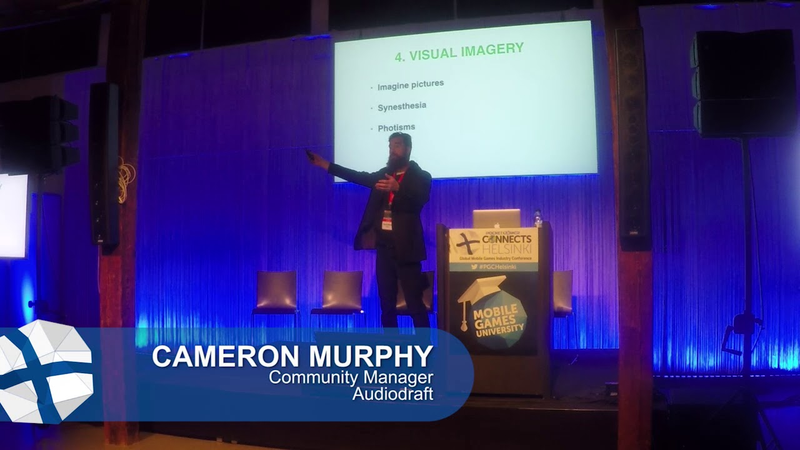
ability to do this is linked with our ability to feel compassion so if you see someone trip you're like oh [ __ ] you get embarrassed for them if you see someone get kicked in the balls you're like oh man as humans we feel this compassion for other people and it's the same thing with music we feel the emotion of the composer and it's a very very strong thing and it's a very very good mechanism to use when you're designing your games so the fourth way is visual imagery this is the most controversial one when you listen to music some people not everyone you get images and pictures in their head this is linked to something called synesthesia where your senses get crossed so people can when they think of a color they associate it with a number if they look at a shape they smell a certain flavor or something like this it's like crosswire so when
you listen to music you get visual imagery in your mind's eye and then this imagery causes an emotional response interestingly enough when you close your eyes and you see these images they're called photos UM's they've been studied scientifically and I'll tell you more about them for the next thing I would like you to close your eyes and we're going to listen to a piece of music and I want you to just enjoy it and let me know if you see anything [Music]
[Music] okay the reason that this is controversial is not everyone has this ability in fact it's maybe like 80% of the population can see music in their head the other 20% they just don't what is super
interesting is that if that 20% of people who don't see images I'm not condoning this or saying you should do it but if these people take psychedelic drugs or smoke marijuana it increases the chances of them seeing visuals in their head and this stays with them for the rest of their life so it's something that you can fix I'm not saying I can fix it for you but it's a good one to know okay did everyone some people put your hand up did you see something maybe not okay good good good excellent right so the next thing is called a value of conditioning and so like episodic memory where an emotion was connected with a specific event for evaluative conditioning it's much broader so when you hear a certain song over time and you connect this with emotion so for example like the Happy Birthday song okay we all hear it on our birthday on
our birthdays we feel happy so when we hear the Happy Birthday song we feel a little bit happy so it's something that has to occur repeatedly over time after some people church bells sound evil or serious because they associate it with funerals they associated with church they associated with all of this stuff so the key thing here is repetitiveness over time for me personally whenever I hear like I'm from Ireland by the way I've been living away from Ireland for five years and whenever I hear Irish music I get very homesick so we're gonna listen to this as an example last night as I flowers
[Music] we mine to I slept [Music] so for everyone it's an incredibly personal thing that's evaluative conditioning because not everyone has the same experiences over time so this is a very difficult one to trigger in people so it's not something you can really design for okay [Music]
so over the course of growing up as children we would have played with games consoles that would have used 8-bit processors 8-bit cards to produce the music this music is now an entire genre called bit pop or chip tune and what they're doing is they're using exactly this evaluative conditioning to trigger a sense of nostalgia in you by emulating the songs and sounds from your childhood there you go so the last one is called musical expectancy that's where when we listen to music we in our heads for some reason we think we know where it's going to go if the music satisfies that and goes where we wanted to we get a little a
little hit of dopamine or adrenaline if the music doesn't go where we want it to go it is also it gives us an emotional response to it for example that's why remixes are so so popular it's something that you know but remixed in a completely different way so it kind of confronts your expectation and gives you an emotional response to it we're gonna look at an example so this is musical expectancy deaded yeah there you go your brain wants to finish it because it knows this and when it does finish it it's like okay cool we're gonna listen to one of my favorite remixes at the moment so this is a song that many many people know I think it's James Brown but it's mixed in a very different way and yeah let's enjoy it [Music]
[Applause] [Music] chavo baby don't you [Music] [Applause] [Music] [Applause] [Music] trouble trouble trouble [Music] [Applause] chugga-chugga-chugga [Music]
so modern music has turned this musical expectancy into a formula there's this thing that many of you may or may not be familiar with called a drop where composer builds up your expectancy the music gets faster it gets faster it gets quieter a little bit but it keeps building and then there's this moment of release and that's the expectancy part and many people get an emotional response to that we're gonna look at an example next in the 70s and 80s many rock bands were taking a lot of drugs and experimenting and they wanted to break this expectation so we're gonna look at an example here [Music]
[Music] [Music] [Applause] [Music] [Applause] [Music] so again it starts off like a classic rock song it builds up you have the expectation that it's gonna maybe continue with riff or some screaming and then you have Austrian yodeling which is
a bit of a break of expectation so I'm running out of time those are the six musical mechanisms what I would urge you to do as game designers is to look at those mechanisms and try and figure out which one you can apply to get to your end desired result so if you want to get people's attention you use the first one which is the primal stem reflexes if you want to make people feel happy if you want to make people feel sad use music that use the emotional contagion mechanism if you want people forever and always to associate a certain moment in your game with their certain song you use the evaluative conditioning so by just taking a little bit of time to pay attention to the music that you use you could have a much bigger impact on your players their satisfaction their immersion and their overall enjoyment and ultimately your monetization thanks
very much there you go we do have time for questions so you guys have any questions [Music] it's almost an exercise hi good stuff did you actually pick the hocus pocus from the baby drivers soundtrack because I love the movie recently seen as a great song it's a fantastic song well done are you from the Netherlands by any chance no no you're not you're from Finland okay usually there's one person in the crowd from the Netherlands who correctly identifies that song because they're Dutch band I don't know where I got it from I might have just pulled it from the internet and that a little hole in each question but anyhow nice of man well done as partners more
you can feel free to chat to me I'm gonna be around all day so if you have any questions I want to do it in a personal way just come chat to me I have one if I if I may yes why do you think that in other creative media liking films people understand the power of of the soundtrack so so clearly and so easily and then in games is so complicated for the designers to understand how they can use music to create these emotions it's a super good point I think that the main constraint is budget when you're making a movie you have the budget for it you work with a composer and many of us were on really tight budgets and I think this is the biggest barrier but it doesn't need to be there are many companies who do it for a good price there are many people individuals that do it as well and yeah it adds a lot to it okay very good point
[Music] [Music]
Summary
The primary purpose of this analysis is to demonstrate how game developers can leverage the psychological power of music to enhance player immersion, increase user engagement, and drive monetization. In an increasingly distracted digital landscape, music serves as a critical tool for breaking through sensory noise by establishing direct emotional connections with the audience. The central thesis posits that music is not merely an aesthetic afterthought but a sophisticated form of communication that, when strategically integrated, amplifies game mechanics and narrative impact.
The analysis identifies six core psychological mechanisms that explain how music triggers emotional responses: brainstem reflexes, which utilize primal reactions to sound to capture attention; episodic memory, which links specific gameplay moments to lasting emotional associations; emotional contagion, where players mirror the composer’s intended mood; visual imagery, which triggers internal mental representations; evaluative conditioning, which builds emotional responses through repetition; and musical expectancy, which engages the brain through the satisfaction or subversion of rhythmic and melodic patterns.
These findings are supported by scientific research, including studies on heart rate variability, task performance, and spatial perception, which confirm that music exerts measurable physiological effects on human behavior. While the gaming industry often treats audio as a late-stage development task due to budget constraints, the analysis argues that this approach overlooks a powerful psychological lever. By intentionally applying these six mechanisms, developers can create more cohesive, memorable, and profitable experiences. The scope of this discussion encompasses the broader digital entertainment industry, with a specific focus on the intersection of game design, psychology, and audio production.





















Comments