1 free read left. Create a free account for unlimited reading + AI research.
Create free accountWhitepaper Loading... The Journal of the Canadian Game Studies Association
1 free read left. Create a free account for unlimited reading + AI research.
Create free accountWhitepaperLoading... The Journal of the Canadian Game Studies Association
This approach often strips games of their playful context and material history.
It's like preserving a butterfly in a killing jar, losing its vibrant movement and natural habitat.
Videogame preservation faces a critical tension between formal institutional archiving and the inherent, mutable vitality of digital play. Traditional museum practices often treat games as static, formalist objects, prioritizing source code and rigid classification systems that effectively function as a killing jar, stripping the medium of its playful context and material history. This approach fails to capture the essence of games, which exist as living, evolving entities rather than fixed artifacts. By shifting from the fan-led chronicle era to a formal collection era, institutions risk deadening the very objects they intend to preserve.
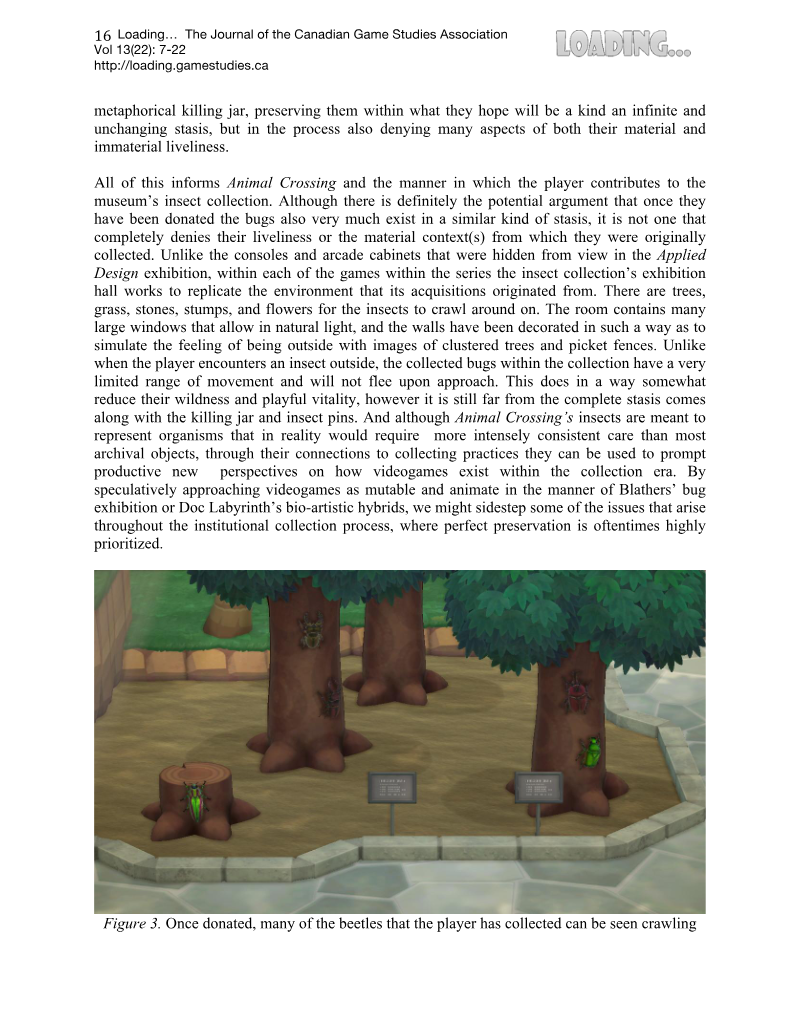
The collecting mechanics within Animal Crossing serve as a compelling framework for reimagining these archival strategies. Unlike traditional taxonomic displays that isolate specimens, the game’s museum exhibition attempts to preserve the context and liveliness of its subjects. This model aligns with broader cultural practices, such as the encyclopedic archiving seen in Japanese media, which prioritize the preservation of an object’s dynamic environment. By treating games as living entities, curators can better honor the complex, shifting nature of digital culture.
Contemporary curatorial efforts, such as those led by Marie Foulston in exhibitions like Design/Play/Disrupt, demonstrate the efficacy of this lively methodology. By rejecting uniform classification systems in favor of contextual, immersive environments, these initiatives allow games to be understood as evolving cultural artifacts. Ultimately, the preservation of videogames requires a departure from static, object-oriented approaches. Archivists must instead adopt frameworks that embrace the vitality of play, ensuring that the history of the medium remains as vibrant and interactive as the games themselves.
Each row is a game or company this document names, each column a document, oldest first. A mark means that document names it. Select a row to see those documents.
Loading... The Journal of the Canadian Game Studies Association · 2026
Loading... The Journal of the Canadian Game Studies Association · 2026
Loading... The Journal of the Canadian Game Studies Association · 2025
Loading... The Journal of the Canadian Game Studies Association · 2025
Loading... The Journal of the Canadian Game Studies Association · 2025
Loading... The Journal of the Canadian Game Studies Association · 2025
Loading... The Journal of the Canadian Game Studies Association · 2024
Loading... The Journal of the Canadian Game Studies Association · 2024
Loading... The Journal of the Canadian Game Studies Association · 2024
Loading... The Journal of the Canadian Game Studies Association · 2024
Loading... The Journal of the Canadian Game Studies Association · 2022
Loading... The Journal of the Canadian Game Studies Association · 2022
International Journal of Role-Playing · 2026