1 free read left. Create a free account for unlimited reading + AI research.
Create free account
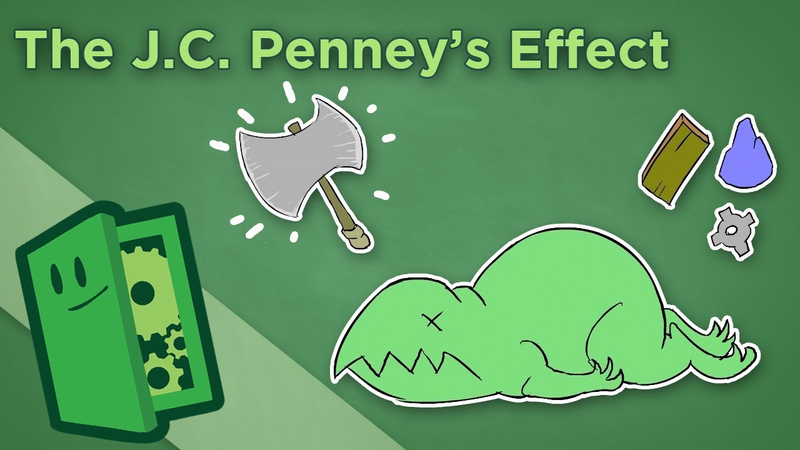
The J.C. Penney's Effect - Designing "Fair" vs "Feels Good" Systems - Extra Credits
Key insights
5 takeaways- 01Player engagement is driven more by the psychological perception of value and immediate feedback loops than by the objective fairness or efficiency of a game system.
- 02Developers can bridge the gap between efficient design and player satisfaction by using UI elements like progress bars and unlock notifications to visualize and reward the accumulation of abstract components.
- 03The J.C. Penney 'Fair and Square' pricing initiative demonstrates that removing deceptive marketing practices like artificial sales can cause catastrophic consumer loss because users prioritize the emotional satisfaction of a 'deal' over honest pricing.
- 04In the MMO Firefall, replacing traditional rare loot drops with universal crafting components creates a more equitable system but risks failing to trigger the dopamine response associated with receiving a tangible, pre-made item.
- 05Abstract progression systems, such as gathering crafting materials, struggle to replicate the sense of immediate, concrete advancement provided by equipping powerful, named items.
Ask AI about this video
Transcript
Some of you may know that we made a few episodes for Red 5's upcoming Firefall explaining some of its design and challenges. Lots of fun. We've had a few more thoughts on the game since then, one of which struck us as a great idea for an episode topic. It's a pretty important design problem and Firefall represents a pretty perfect example, so here we go. Rather than starting with Firefall, let me start this episode by telling you a story. At first the story might not seem to have anything to do with the game we're here to talk about, but really that's how most great game design stories go. So, let me tell you a tale of marketing. A year and a half ago J.C. Penney, a major department store chain in the United States, declared a bold new initiative for their company. They had just brought on a new CEO and he decided that they were going to be honest with their customer. No more deception, no more tricks. So, he started something they called fair and square pricing. First, they did away with sales because sales in the US are usually deceptive. When an item would go on sale, it was simply being priced at
what the planners at corporate HQ considered the standard retail value. And if the customer ever bought something while it wasn't on sale, they were simply buying it at a ludicrous markup. This is actually a pretty common practice in the US, but in department stores it's especially bad. So, in J.C. Penney's case, they would normally end up with 60% or more of its inventory listed as on sale on a regular basis. In fact, some items would actually be perpetually on sale being labeled 20% off 100% of the time, even though that was the highest price they'd ever been sold at. So, J.C. Penney's put an end to it. They were going to respect the customer and treat them as peers. They declared that every item would be listed as its actual retail price all year round. Next, they declared that you could return anything to any store so long as it was in good condition. Didn't matter when you brought it back. Finally, they did away with deceptive pricing. They stopped labeling anything 99 cents and started to actually tag everything at its real price. So, something previously labeled $4.99 would now be labeled $5. They wanted to show that they they going to trust the consumer's intellect, that they weren't going to treat them like children or rubes to be duped, that they were going
to deal with them fairly on what they felt was a good product. This failed colossally. In a year's time they lost almost a million and a half customers and an estimated 700 million dollars and they still haven't recovered from it. But why? It seems like such a good idea and in a humanitarian sense it is, but it's just not how human beings work. Even though the new sales practices were clearly better for the consumer, they didn't feel better. Even though they were eminently more fair, they didn't feel more fair. Buying a $20 pair of jeans for $20 feels all right. It feels like you got an okay pair of jeans at the store, but buying a $60 pair of jeans for $20 feels awesome. It feels like you just got a stellar pair of jeans at a screaming deal, even if they are the exact same pair of jeans. Context is important for us as human beings and perceived value is sometimes more important to us than real objective value, even though rationally we know it shouldn't be. And that, to bring this all back around, is the trouble I see Firefall's crafting system running into. For those of you who haven't tried out the beta, pretty much everything is built through crafting. Unlike a traditional MMO RPG, when an enemy is defeated, they don't drop loot. Instead,
they drop crafting components. When looked at objectively, this is actually pretty awesome, but I'm not sure it always feels awesome. You know how in traditional MMO RPGs, all the time loot will drop that you can't use. An epic longsword will drop and just because you're a mage, you can't even roll for it, even though you spent four hours grinding like everyone else to make it drop. Well, in Firefall, that will never happen. Since everything is crafted, all the drops can be relevant to everyone. A rare mineral pops out and maybe one class uses it to build an upgrade to their jetpack, while another could use it to upgrade their gun, but everyone can use it. The more traditional drop system is there for the purpose of wasting your time. It's there to increase how long you stay subscribed without forcing the developers to create more content. As a consumer, this is just bad for us. This isn't really what we want and actually it's a little abusive when you think about it. The Firefall system is strictly better and yet, which feels better? Getting a Purple as Wyhender of Ultimate Badassitude or getting a piece of Coralite? Would you rather get a cool little picture of something with stats that you can equip right away and see
numbers go up or crystals that can be used to craft many different things when you get back to town? Because I have a feeling that the item drops feel more substantial. I think that even though it is strictly worse for us as players, getting that little icon that I can drag directly on my character right away feels like progress. It's much more tangible and immediate, much more direct. So, I believe that even though Firefall's system is strictly better for the player, that's not how it's going to be perceived. This thing which they've put a huge amount of work into to create a better paradigm for loot in an MMO, might, like the J.C. Penney's fair and square plan, not get the love from customers it looks like it deserves. Because in games, like in sales, how something feels is much more important than how it actually is. We've been trying to brainstorm good solutions to this problem. Perhaps they could do something to make the value more clear. Perhaps something like allowing you to select what items you want to work towards and putting a bar in the top right corner that filled whenever you got minerals. So, whenever you picked up something, your progress was clear. Or perhaps if they only showed you items that you had found the minerals to craft and flashed new item unlocked across the screen whenever you picked up a new kind of mineral. That would make it feel
better even though it wouldn't change play. Actually, you know what? I would like to add something up you. What I've described here in this episode is what I predict is going to play out, but I don't really have data to work with. So, let's just do a survey right here. Send us an email at this address telling us your preference. Do you like the idea of Firefall's current crafting reward system or do you think you would still like a more traditional item based system better? For the subject line, put either gear or components depending on which system you're voting for and maybe even write some reasons why in the body of the email. Now, there are all sorts of other concerns like that an item based system might not allow for as fast-paced gameplay with picking up loot slowing everything down. But for the moment, let's disregard those concerns. At the most basic level, which system would you like better? The results aren't going to influence anything. This is just for the general science of game design. This question of feel versus actuality is really important for the study of game design, and I've never had such a good test case for it before. So, let us know. I'm really curious to find out which one most of you prefer. Thanks much. We'll see you next time.
Summary
The core thesis of this analysis is that in game design, as in retail, objective fairness and efficiency are often secondary to the psychological perception of value. Using the failed "fair and square" pricing initiative of J.C. Penney as a primary case study, the discussion illustrates how removing deceptive marketing practices—such as artificial sales and price anchoring—can lead to a catastrophic loss of consumer interest. Even when a system is objectively more honest and beneficial for the user, it may fail because it lacks the emotional satisfaction of a perceived "deal" or immediate, tangible reward.
This psychological principle is applied to the crafting-heavy loot system of the MMO Firefall. While the game’s design replaces traditional, often frustrating loot drops with universal crafting components—a system that is objectively more efficient and equitable for all player classes—it risks failing to provide the same dopamine-inducing "feel" as receiving a rare, named item. The analysis suggests that the immediate gratification of equipping a powerful, pre-made item creates a sense of tangible progress that abstract crafting materials struggle to replicate.
To bridge the gap between objective design improvements and player satisfaction, the analysis proposes implementing UI elements that visualize progress, such as progress bars or unlock notifications, to make the collection of components feel more rewarding. Ultimately, the argument posits that game developers must prioritize the "feel" of a system to ensure player engagement, as human behavior is driven more by perceived value and immediate feedback loops than by the rational benefits of a more efficient, fair, or streamlined design.




















Comments