1 free read left. Create a free account for unlimited reading + AI research.
Create free account
The current M&A market for games & predictions for 2017
Key insights
6 takeaways- 01The 2016 games industry M&A market reached a record $24.1 billion in disclosed deal value, nearly doubling the previous 2014 record of $12.5 billion.
- 02Four mega-deals, including Tencent’s acquisition of Supercell and Activision’s purchase of King, accounted for over 80% of the total 2016 market value.
- 03Mega-deals typically command valuation multiples of three to four times revenue, while smaller studios often rely on performance-based earn-out structures to bridge valuation gaps.
- 04Acquirers prioritize studios that demonstrate a proven track record, profitability, specialized technical expertise, and the ability to provide unique, non-overlapping content.
- 05Market consolidation is being driven by a 'land grab' strategy where large publishers acquire studios to combat rising user acquisition costs and leverage live-ops capabilities.
- 06Total deal value is expected to decline in 2017 due to a scarcity of large, independent mobile targets, shifting the focus toward mid-sized consolidation and the fragmented user acquisition marketing sector.
Ask AI about this video
Transcript
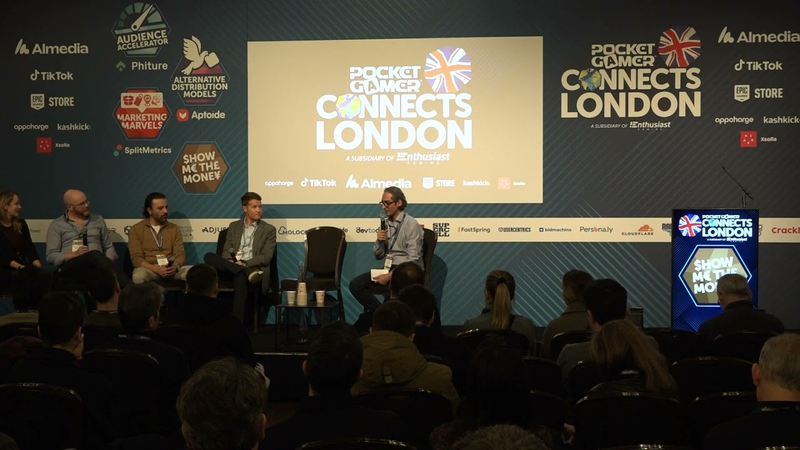
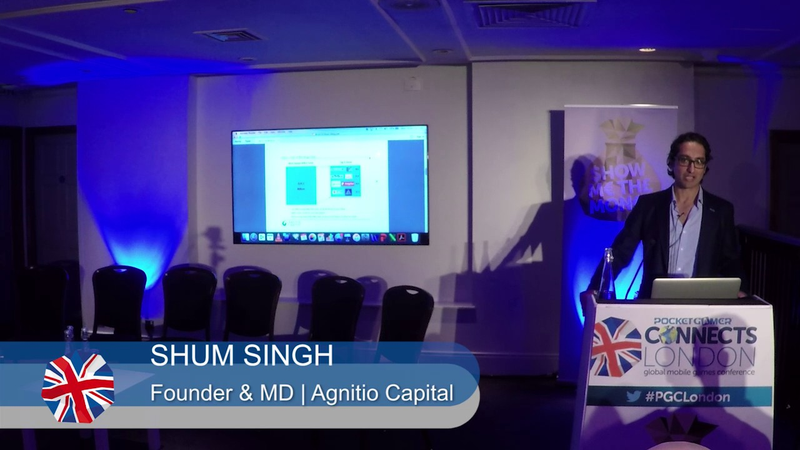
[Music] so I think that some of you probably heard me speak before at Pocket Gamer it's great to see it comes so big so i think we all really Oh Chris a huge thanks particularly for making the conference here in London putting kind of UK on the map and what I found really particularly interesting this year and I think Chris mentioned it to me was that there's 1,700 people coming here and and what's actually more interesting is from over 50 countries so I think that that actually dovetails nicely into this presentation because most of the transactions in our industry are global in nature and are a cross-border in nature so first just a couple of points on AG nisha capital we were probably one of
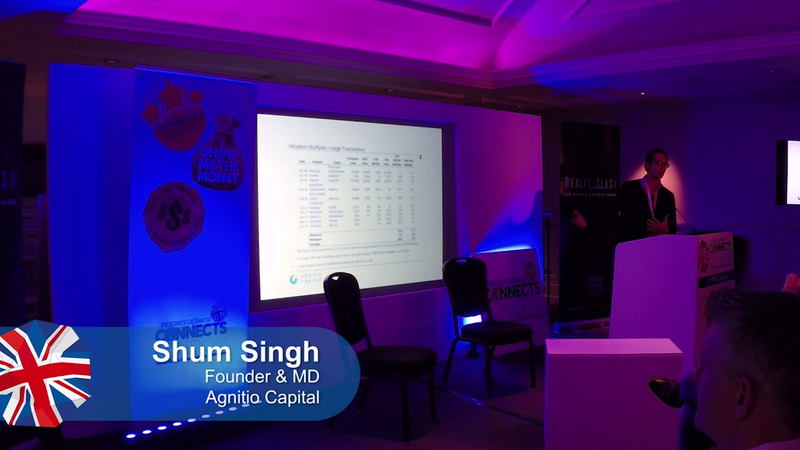
the longest standing if if not the oldest European Investment Bank focused on games we were founded in 2003 were fully authorised and regulated by the financial conduct authority here in the UK that's kind of the equivalent of the SEC in the u.s. we're headquartered here in London but we actually recently opened an office in Seattle in the US which is run by my business partner David bloom which many of you might know he's been an industry veteran for many years he successfully started and sold a number of games studios in the past as mentioned we're kind of exclusively focused on a game specter primarily mobile but also online we again since we're an investment bank and again I don't want to I guess I want to be very vague about exactly what our principal activities are we are an advisor first and foremost so I'll go through some of
the recent transactions and again why we've decided to focus on ma rather than fundraising as I've done in the past so very recently literally just a few weeks ago we advised a company called Babel games on the sale of that business to still front group if you're not familiar Babel games is the leading Middle East North Africa focused mobile game publisher and still front is a publicly-listed diversified online and mobile gaming developer and publisher listed in Sweden and shortly prior to that in October we advised a very successful studio based in the u.s. out of Madison Wisconsin called pair blue on the sale of its most successful IP dragon soul which many of you might have played it's an action RPG at the time of the sale is about a top 40 grossing over all a pin in the u.s. charts and about a
top 100 to the top 150 on iOS so so quite successful and in fact had even better chart position in other countries and we sold that degree which is one of the largest publicly listed mobile gaming developers in Japan and frankly worldwide and prior to that a last summer we sold tickets oi which is a Finnish base pure play mobile gaming developer original IP developer to a company called Anna mocha brands which is based in Hong Kong but actually listed in Australia I think a robbery on who's sitting in the back there is going to speak more about that transaction a little bit later and we also actually do make investments very very selectively that's David and myself where we will actually lead sort of more angel rounds or syndicates some of those investments
include hutch games which you might be familiar with here in the UK developers of MMX hillclimb social scale which is a nexon investee company which is about to release a very interesting title and Gunjan games which is based in Brighton so I think everybody in this room is probably aware of how prolific 2016 was in terms of M&A absolutely phenomenal in terms of just sheer numbers when you compare it to historical kind of averages of M&A and I think there's probably some points prior to that which which could set the scene as to why 2016 was so prolific I think everybody's aware of just how dominant the larger players are continuing to become and previously everybody would talk about cracking or trying to make an attempt to get into the top 100 well actually that's really kind of more sort of top 200 or top 300 if you think about it now
and a lot of that is driven just behind the sheer amount of resource they have not only in terms of marketing spend you a capabilities cross-promotional capabilities so that's just leading to them having more and more multiple titles not even in the top 100 top 200 and top 300 I think Keith alluded to previously CPI costs particularly when you're looking to market a much more hardcore complex game continuing to increase a lot of that again is possible by I guess or in some ways it gets forced by larger players who want to just crowd out the market who've actually managed to increase the LTVs of their games so which leads to them acquiring users profitably to be very very challenging and cost of development are actually going up if you want to compete with these larger players significantly since the triple-a quality and polish of those
games that they're releasing are just continuing to increase and another really important point that I think a lot of us may not be aware of but but certainly will be is is the mobile gaming part of the entire games industry the mobile gaming sector itself is actually the largest component so that's larger than console now and larger than PC online which leads to 2016 so I think if you go back starting from 2010 up until about 2013 you'll see the historical average for the amount completed deals let's say M&A deals announced deals that we actually were disclosed the deal values kind of being around four to five billion three four five billion dollar mark and then 2014 you had a pretty phenomenal year which was the record-setting year in that year of about twelve and a half billion
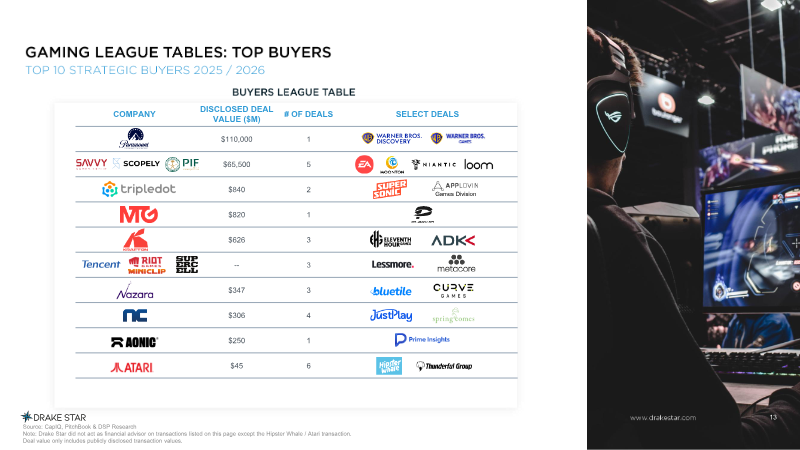
dollars and then last year actually went down significantly but actually probably fairly in line with typical historical averages and then when you compare that to last year what's just absolutely amazing is it's almost double of the previous record-setting year of 12.5 and came in at 24 120 point one but I think it's also noteworthy to talk about the mega deals that occurred last year that I think we're all aware about everybody remembers a 10-cent and super cell at eight point six billion Activision and King at 5.9 billion the consortium led by giant which acquired played to go 4.4 billion and again another consortium led by private equity fund from China orient haunt a capital that acquired app 11 for 1.4 billion if you add all that up just those four deals which equals slightly higher than 20 billion that's more than eighty percent of the entire 2016 market
just for deals now that's completely unprecedented never happened before in our industry so kind of leads to a lot of points that I'll go through a little bit later so so really what I think of 2016 yes it was a record-breaking year but what I think of it is certainly it's the year of the mega deal so the market was super super active for really dominant large players and if you think about it the two largest players in the mobile free to play space were acquired last year by revenue supercell and king and if you strip those out you kind of get back to historical averages so what what really contributed to that to those 2016 results so I talked previously a little bit about the trends leading up to it but actually you you have now are quite an interesting
dynamic rapidly evolving industry so console Giants who completely miss mobile I think Activision being one of them had to from a really defensive point of view acquired King they really had no choice and really had no mobile play and kind of the writing was on the wall as I mentioned previously Mobile has become the single largest part of the entire game space and then of course you have geographic expansion so a lot of Asian publishers that I'm sure many of us are familiar with are continuing to purchase and acquire US and European leading players Tencent supercell being the largest transaction but that was obviously the plate to go deal in the app 11 deal and a number of smaller PC deals as well you also had non games industry players moving into into the game space and again as I mentioned these were some of the Chinese
consortiums that led the transaction at the plate tikka and also you had some consortiums non games that actually acquired jagex here in the UK that quired a big point in germany and splash damage here in the UK as well most of those mega deals that I alluded to were of mobile free-to-play studios the exception being at levin and i think i mentioned already that there were a few pc M&A deals so what are require is paying for these businesses well it's fairly easy and at least well I mean let me take a step back there's a lot of M&A deal activity and a lot of number of deals that we track that actually contributed to that 20 4.1 billion dollar figure that I mentioned in 2016 however there's not a lot of data available for a lot of those smaller to mid-size deals so in some cases we might be able to glean through press releases whatnot we might be able
to find what a revenue multiple was or ebitda multiple but at least from a large mega-deal perspective we do have the multiples we do know what we're paid and the average is really kind of if you're looking at it from a latest 12 months of revenue of the target company so this would be super cell this would be king you're looking at around three to four times sales and paid in cash up front and on an ebitda basis you're looking at really just over ten I didn't want to list out all the small to mid-size because they're just frankly too many moved go on from pages so I've just provided the summary here what is interesting to note is if you look at the maximum and minimum and average ranges you have a lot more discrepancy then you did in the previous slide of kind of 4.1 to six if you look at the average to the maximum and the minimum for maximum them in here if you look at
the minimum to the maximum you're looking at 0.3 sales multiple up to as high as 7.6 so you really have this profound range and I'll talk about that a little bit further but there's a lot of characteristics contributing to why and acquire would pay point three times sales or seven point six but the average is came in at about 1.9 so just under two times sales without an earn-out now I think also a lot of you are aware for the smaller the company you have the more risk and acquire is going to take to buy your company so one way to offset that risk and ensure you continue to operate and hit your numbers and make and make well and agree to performance targets that they'll that they'll obviously ascribe to your business going forward is they'll still arrange or kind of structure and earn out for you so two to three years usually is the kind of standard earn-out structure for a lot of smaller to mid-sized deals that are that are that are being negotiated in our in
our industry and with those assuming you could hit those or announce then the sales multiple actually gets to 3.2 and fairly similar to what the large players are getting so so do bear in mind though that a lot of these companies and in fact some of the transactions we structured last year are very typical of that companies we advise they'll get a certain amount of cash or shares up front as consideration and based upon their revenue and profit performance over the next couple of years go get additional cash and shares um so I think again if you're a smaller player it really depends you know what you're looking for and MV acquire you're looking you're discussing with to negotiate the kinds of multiples that would be attractive to you and be attractive to them so again I'm not going to get too much into negotiating I want to focus more on just kind of strict data in this presentation but if
you have additional questions you know you want to talk more about what it takes actually position and exit your you know or position your company for and exit happy to chat about that later but again the larger players will always generally receive higher multiples and receive those in cash and I think I've already described some of the previous that last point there um and so what contributes to that again wide range of multiples at least for the smaller and mid-sized players I guess there's a lot of characteristics that acquires are looking for some of these points I think I already touched on but but team is probably one of the most important is is what kind of track record does your team have what what types of games have they have they done it but you know how they done the past well how is that core team evolved have been working together for a multiple number of years have they sold businesses previously in the game space how long have they been in the industry
how well do they know the acquires do they speak at conferences all of these things really contribute to decreasing the amount of risk that an acquirer is going to really take on and ultimately pay two year to you for your studio of course being profitable will help immensely especially if you're if you're looking to get sold as we are in a very mature industry now but again that's not necessarily in that important especially when it comes to other factors for some of these acquires and I mentioned even at the beginning of the presentation that a lot of the transactions in our space are cross-border are global in nature so geographic expansion is it's really quite an important point for a lot of acquires and again also acquiring very specific skill sets could be you weigh expertise that they might be lacking could be development capabilities triple-a for instance polish or production capabilities could be LiveOps running LiveOps which is
again increasingly becoming more more important and ultimately i think really and what really contributed to to those mega deals was market share so larger and larger players are really trying to battle for an ever decreasing amount of market share even though if you look at the absolute numbers of mobile they continue to grow but it's being concentrated in fewer and fewer hands so that's what leads to this land grab and that's why we think that the dominant players will actually move even a certain downstream and start a quiet amid midsize players just because there's frankly not that many large players left particularly in the mobile free to play space the two largest players were acquired last year so other sort of mid-sized players are going to become more and more attractive in fact at the end of last year which the actual
deal value wasn't officially announced but net marble acquired cabanas largest studio which the Vancouver studio which actually makes up about 85 actually more not about ninety percent of their revenue which really leads to at least if you're kind of an established whether you're small med large player if you're as long as long as you're established it really you're kind of in this situation and where we are in terms of the frenzy of M&A activities you're either going to be in acquire and be the aggressor and and and go out and either raise money or you or you have profit profits from which to actually go out and make acquisitions you have the requisite M&A capabilities and can conduct those transactions or you position yourself and try to acquire and try to make all those characteristics that I described the previous slide as appealing as possible to a potential acquirer and if you're not going to acquire well you know then our view is find other
like-minded players emerged with them try to see where you could kind of create vertical or horizontal offering so if you're only focused on a particular genre or category games maybe there's another like minded studio that has a you know another entirely different category of games and you ultimately decide hey you know for for surviving and we can realize some economies of scale let's continue to merge and see what we can do but maintaining the status quo I think is going to be difficult which leads me to the final slide so I think I think some of these predictions some of you guys are probably familiar with and wouldn't take too much to really figure out but but Asian players will definitely continue to consolidate they are very aggressive and and and are particularly interested from China on acquiring profitable players us players we think will continue to be absent I'm talking about companies like EA singha
THQ we think they'll just probably focus on smaller deals primarily on the west coast small to mid-sized players as I think I've moved into as long as you can continue to have those characteristics that i mentioned continue to focus on those types of appealing attributes you'll be fine you'll continue to get peace evaluations one area that we think is highly fragmented which really needs to consolidate is in the you a marketing services space and finally we think that there's due to the scarcity of large mega deals that are simply available the 2017 figure is going to be significantly lower than that 20 4.1 billion figure in 2060 and if 24 is any sort of indicator for this year well q1 of last year came at about 78 million q2 King that about 10 billion q3 at about 6 billion and 24 was only 500 million in deal value so
yeah that's it thank you [Applause] questions yep can you hear me you're from S&P global you mentioned there being a lack of large independent players who are those large remaining players of the market whoo-hoo Argyll are there any less two RVs well I mean there certainly are some and I think I mentioned there's kind of more mid-sized players so mid-sized players would be you know Scully companies like that you know that are kind of a big game you know here in Europe companies like that that are kind of in the sort of 202 billion-dollar sort of enterprise value range you know these are these are the types of studios that are remaining the sort of mega deals that I was alluding to those kinds
of companies supercell a king even now Kabam is effectively gone those large Bahamas certainly in the Western markets are are just becoming scarce and scarce or to acquire thank you hey I'm thinking about the reverse do you see a case where you'll have the mobile companies actually going out there looking for console pc players that are not in mobile app successfully establish themselves in pc and console it's a good question i have thought about this in the past actually we've I've approached large mobile players in the past and from a buy-side perspective to say hey you know you're in this really challenging super difficult market and you're and you know these are just some of the largest players that I mentioned and said you know you might it might really be who've you two probably diversify your portfolio and think about
moving to PC online console I think they're just so wrapped up in in their space and because it's just so rapidly I mean literally changes on a daily basis I don't see that happening I think if anything they're more likely especially specifically if they're a larger one they're more likely to them probably just require smaller mobile free-to-play assets or what I think is you'll see because I mentioned it the you a marketing services face is highly fragmented I can see them more likely acquiring companies in that space [Music] you
Summary
The mergers and acquisitions landscape in the games industry experienced a record-breaking year in 2016, characterized by an unprecedented volume of mega-deals. The industry saw a total of $24.1 billion in disclosed deal value, nearly doubling the previous record of $12.5 billion set in 2014. This surge was driven primarily by four major transactions—including Tencent’s acquisition of Supercell and Activision’s purchase of King—which collectively accounted for over 80% of the year's total market value.
The primary thesis driving this activity is the consolidation of market power among dominant players. As mobile gaming has surpassed console and PC sectors in size, large companies are aggressively acquiring studios to secure market share, combat rising user acquisition costs, and leverage superior marketing and live-ops capabilities. This environment has created a "land grab" dynamic where major entities, particularly Asian publishers, are actively acquiring Western studios to facilitate geographic expansion and diversify their portfolios.
Valuation multiples for these transactions vary significantly based on company size and risk profile. While mega-deals typically command multiples of three to four times revenue, smaller to mid-sized studios often see lower initial valuations, frequently supplemented by earn-out structures tied to performance targets over two to three years. Key attributes that increase a studio's appeal to acquirers include a proven team track record, profitability, specialized technical expertise, and the ability to offer unique, non-overlapping content.
Looking ahead to 2017, the market is expected to see a decline in total deal value due to the increasing scarcity of large, independent mobile targets. The industry is shifting toward mid-sized consolidation, where smaller studios must either merge to achieve economies of scale or position themselves as attractive acquisition targets. Future activity is expected to focus on the fragmented user acquisition marketing sector, while large mobile players are likely to remain focused on their core mobile assets rather than diversifying into console or PC markets.