1 free read left. Create a free account for unlimited reading + AI research.
Create free accountWhitepaperHindawi Publishing Corporation
Distilling the key insights…
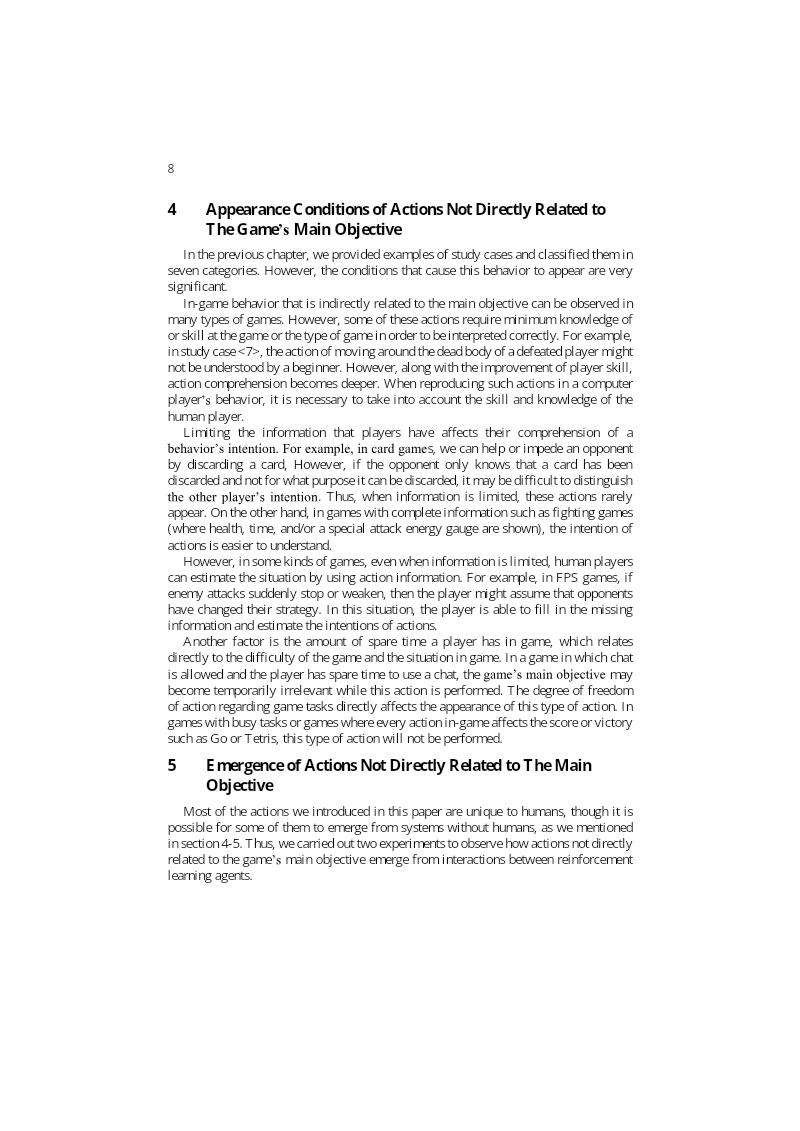
The Tactical Agent Personality (TAP) model introduces an automated framework for game agent adaptation that replaces manual expert scripting with a weighted network of action probabilities. By utilizing feed-forward neural networks, this approach enables non-player characters to dynamically adjust their behavior in response to player actions and team dynamics. The primary objective is to enhance agent versatility and performance across diverse genres, including first-person shooters, real-time strategy games, and role-playing games, while maintaining a necessary balance between behavioral diversity and competitive effectiveness.
The framework extends into a hierarchical learning structure, incorporating Strategic Agent Personality (SAP) modules to bridge the gap between immediate tactical responses and long-term strategic planning. In real-time strategy environments, this system employs reinforcement learning and command injection to converge on winning strategies against scripted opponents. Empirical testing confirms that agents capable of adapting to their entire team outperform those focused solely on the player, indicating the emergence of implicit cooperative behaviors. These findings are supported by a robust foundation of research spanning several decades, which validates the integration of probabilistic selection with domain-specific rule bases.
While the model demonstrates statistically significant performance gains over traditional scripted agents, practical implementation faces challenges related to computational complexity. As the model scales to accommodate more sophisticated behaviors, it encounters dimensionality issues and diminishing returns. Consequently, while the hierarchical framework provides a scalable solution for managing large numbers of agents, simpler iterations of the TAP model often prove more viable for current industry development cycles. The research ultimately establishes a scalable, automated path for creating more responsive and varied artificial intelligence in modern gaming.
Entertainment Computing · 2023