1 free read left. Create a free account for unlimited reading + AI research.
Create free accountWhitepaperHindawi Publishing Corporation
Distilling the key insights…
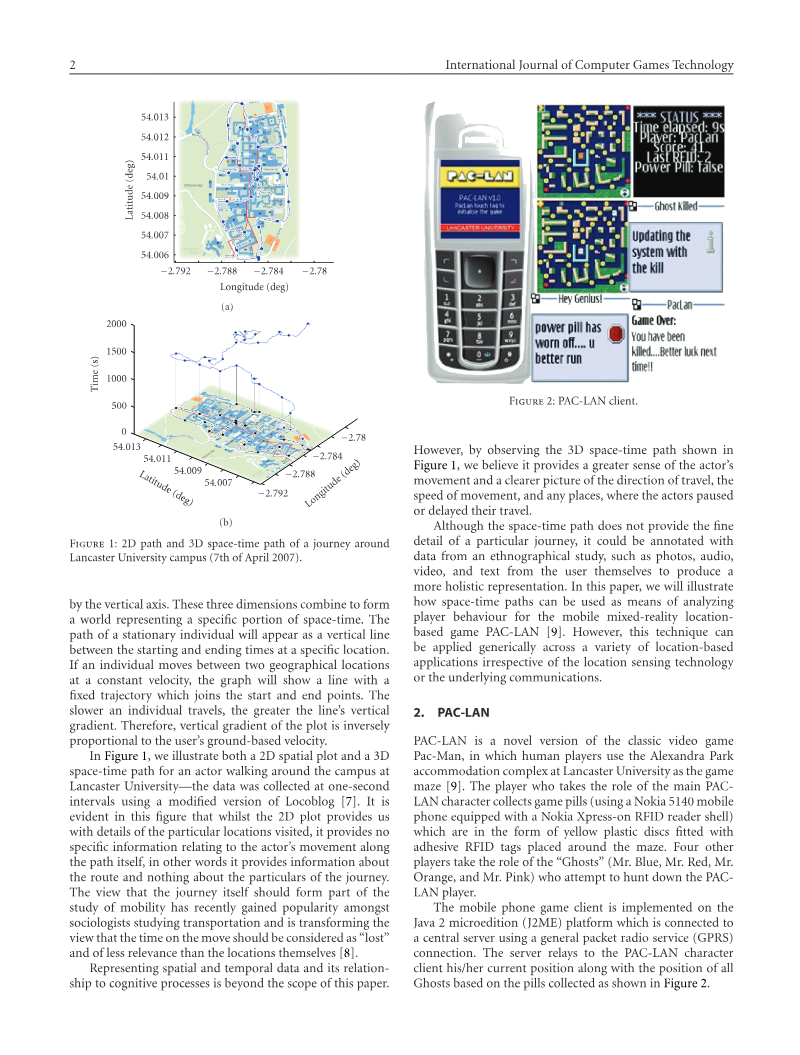
The research explores the application of space-time path visualization as a quantitative method for analyzing player behavior in pervasive, location-based games. By adapting a technique originally developed by human geographers to track migration patterns, the study demonstrates how 3D visualizations can represent the spatial and temporal movements of mobile actors. The primary thesis is that these 3D models provide a more comprehensive understanding of movement, velocity, and pauses than traditional 2D mapping, offering a valuable tool for both game researchers and ethnographers studying mobile environments.
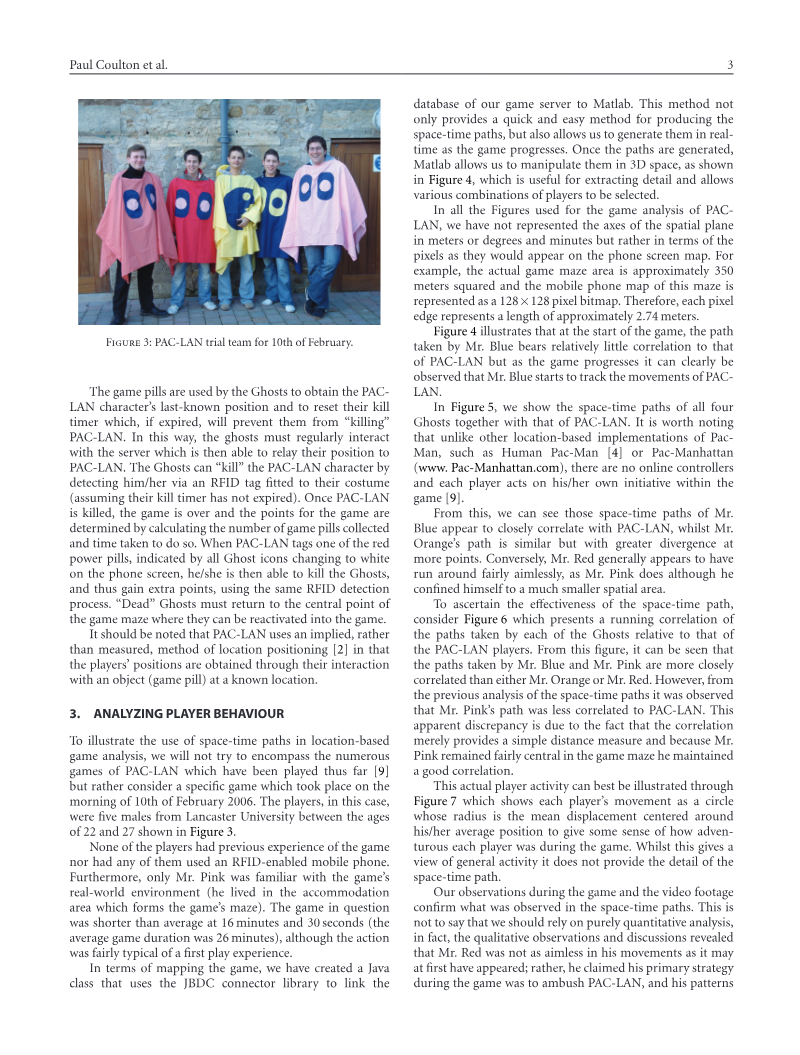
The methodology centers on the analysis of PAC-LAN, a mixed-reality game played on the Lancaster University campus. Data was collected at one-second intervals using RFID-enabled mobile phones and processed via a Java-based system linked to a Matlab environment. This allowed for the real-time generation of 3D paths, which were then compared against qualitative observations and distance-based correlation metrics. The study examined a specific 16-minute game session involving five participants, using the resulting visualizations to identify movement patterns, such as tracking behaviors and strategic positioning, that were not immediately apparent through standard 2D analysis.
The findings indicate that space-time paths effectively capture the complexities of journeys in mobile games. When combined with qualitative data—such as video footage or participant accounts—these visualizations offer a holistic view of player interaction. The research concludes that this technique is highly adaptable to various location-based services, regardless of the underlying sensing technology. By addressing key challenges in data capture, synchronization, and representation, the approach provides a robust framework for future ethnographic studies of mobile actors in ubiquitous computing environments.
Hindawi Publishing Corporation · 2015

Hindawi Publishing Corporation · 2015
Hindawi Publishing Corporation · 2011
Hindawi Publishing Corporation · 2011
Hindawi Publishing Corporation · 2009
Hindawi Publishing Corporation · 2009
Hindawi Publishing Corporation · 2008
Hindawi Publishing Corporation · 2008
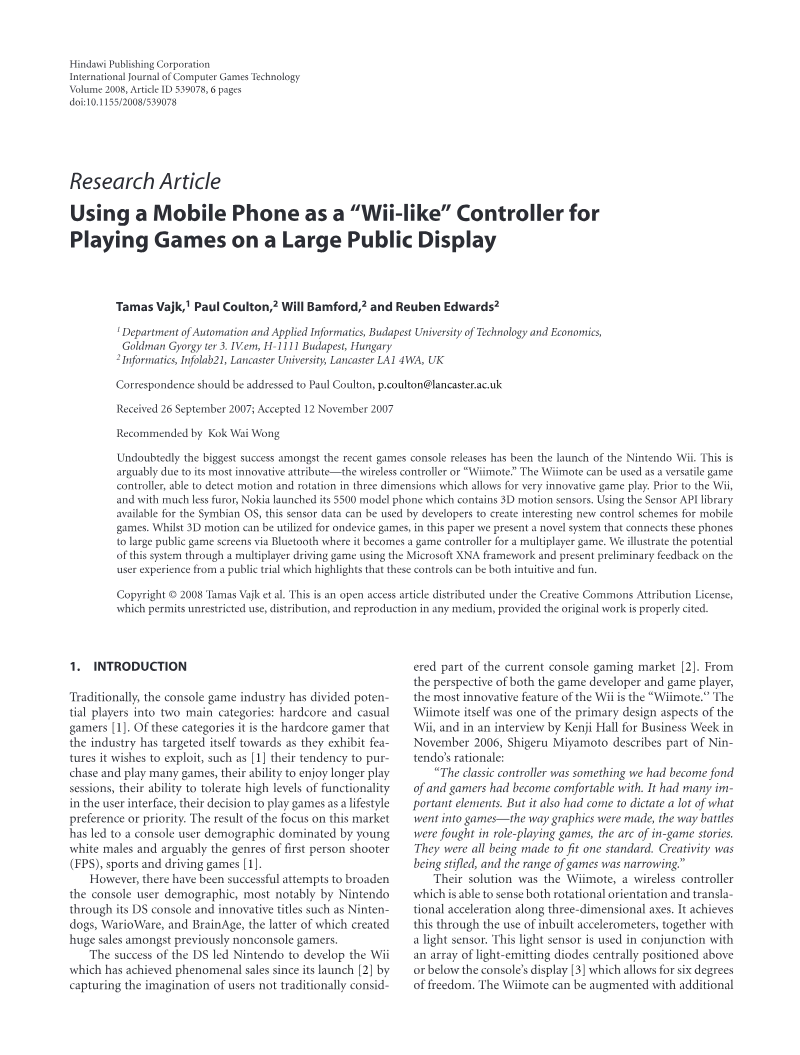
Hindawi Publishing Corporation · 2007
Entertainment Computing · 2026













Comments