1 free read left. Create a free account for unlimited reading + AI research.
Create free accountWhitepaper European Conference on Games Based Learning (ECGBL)
1 free read left. Create a free account for unlimited reading + AI research.
Create free accountWhitepaperEuropean Conference on Games Based Learning (ECGBL)
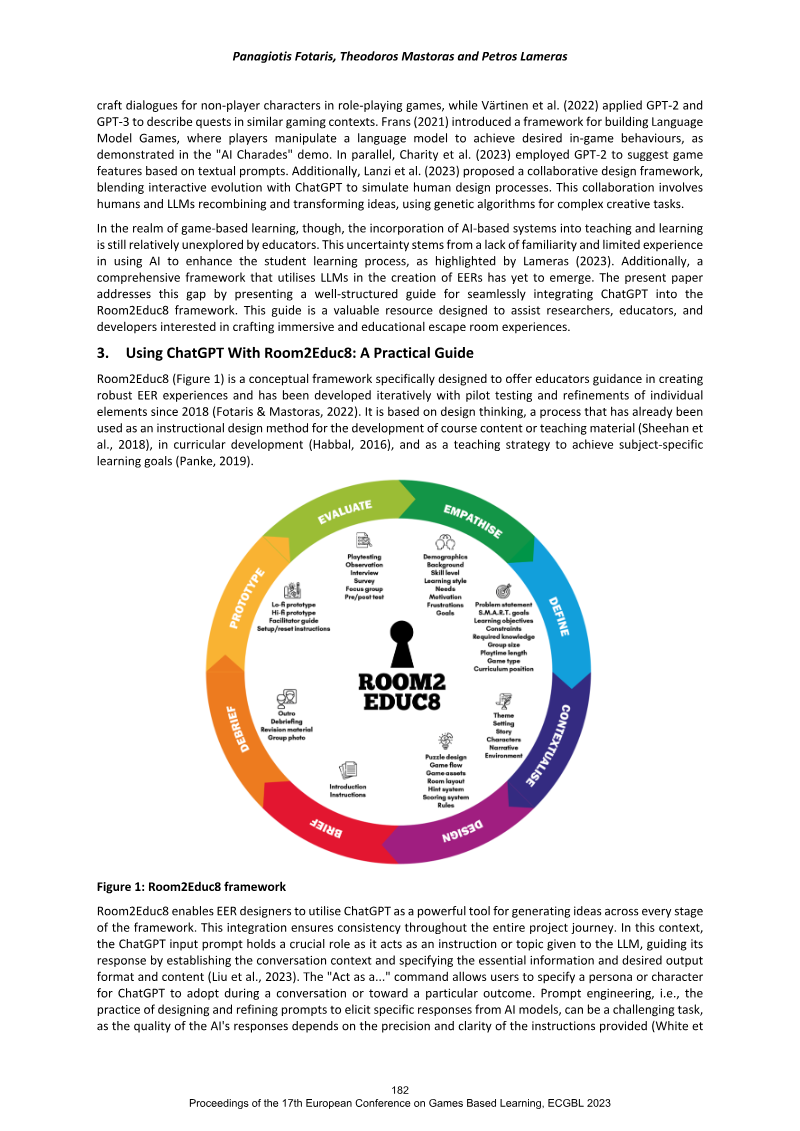
It is a design-thinking framework intended to guide educators in creating educational escape rooms. The steps run from empathise and define through to evaluate.
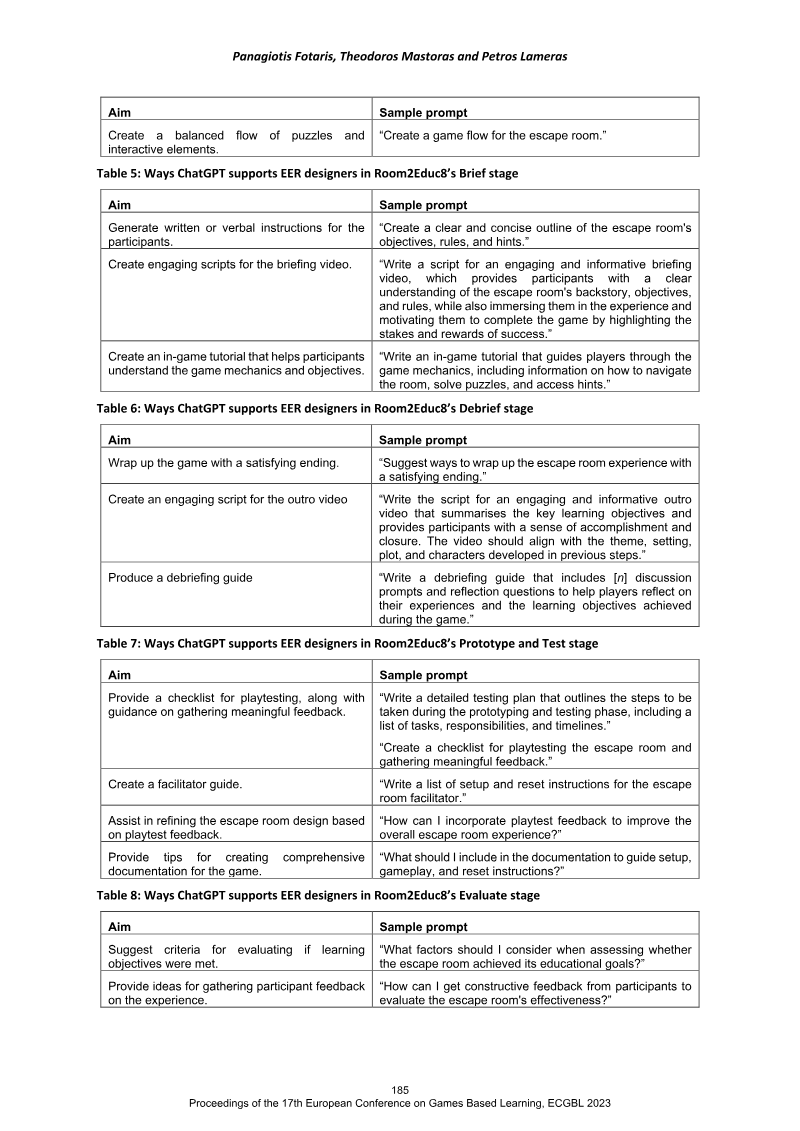
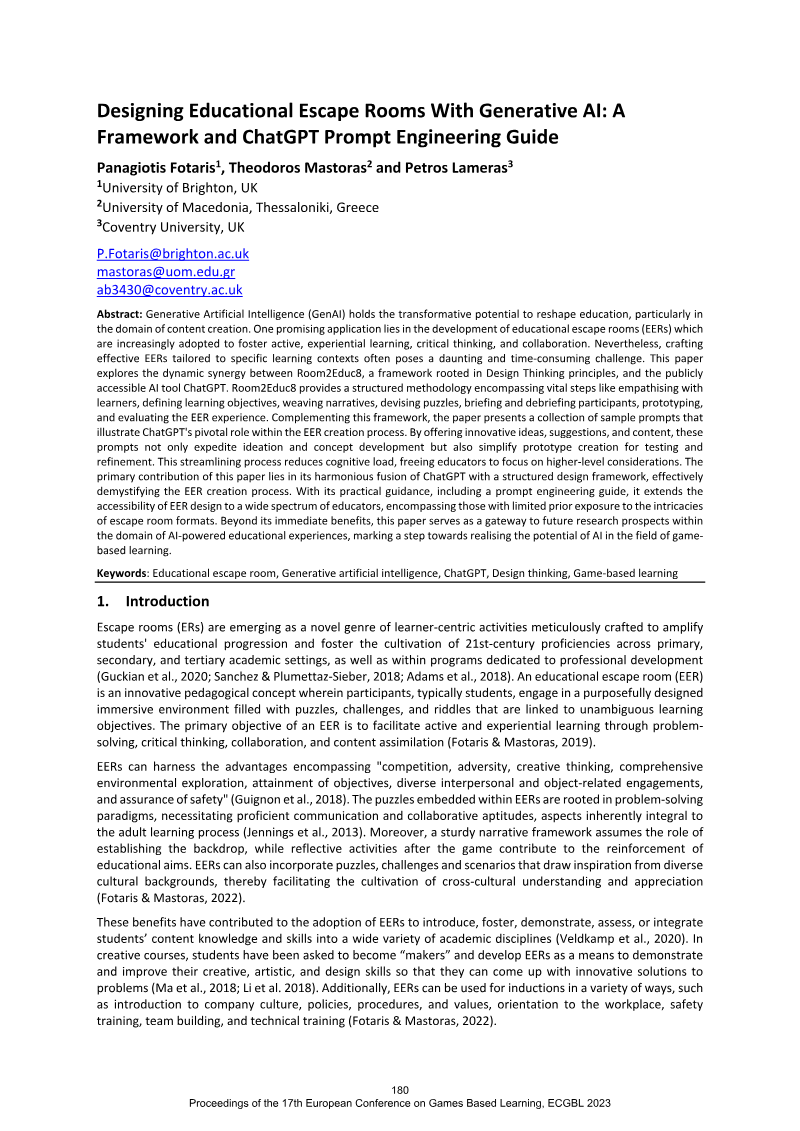
Room2Educ8 is a design-thinking-based conceptual framework intended to guide educators in creating educational escape rooms (EERs). Its authors position it against existing EER frameworks, such as escapED, SEGAM, and the approaches of Eukel and Morrell, Nicholson and Cable, and COMET, which they observe have rarely been validated for usability or usefulness. The framework structures EER design as a nine-step cycle: empathise, define, contextualise, design, brief, debrief, prototype and playtest, document, and evaluate. Its early stages focus on learner personas, SMART goal-setting, and narrative development, while later stages address physical environment, puzzle structure, hint and scoring systems, briefing and debriefing, prototyping, documentation, and evaluation.
The framework's validation rests on a four-year mixed-methods study involving 104 postgraduate students who collectively created 26 escape rooms between 2018 and 2022. Survey ratings of clarity, usability, and usefulness fell roughly between 3.9 and 4.4 on a five-point scale, and focus group responses were consistently positive. The authors are careful to characterise this as an internal validation conducted within a single university course, rather than an independent assessment of learning outcomes, and they stress that the study measured the framework's usefulness to designers rather than its effects on learners.
The paper argues that the framework can foster collaborative problem-solving, judgement, self-reflection, and empathy by incorporating learners' own perspectives into the design process. Two limitations are acknowledged explicitly. The framework was written for educators but was validated largely by participants without formal education backgrounds, and validation has so far been internal only. Planned future work includes trials with education students, pre-service teachers, and practitioners, along with external evaluation of the effects the resulting escape rooms have on learners.



European Conference on Games Based Learning (ECGBL) · 2026



European Conference on Games Based Learning (ECGBL) · 2026



European Conference on Games Based Learning (ECGBL) · 2026



European Conference on Games Based Learning (ECGBL) · 2026



European Conference on Games Based Learning (ECGBL) · 2026



European Conference on Games Based Learning (ECGBL) · 2026



European Conference on Games Based Learning (ECGBL) · 2026



European Conference on Games Based Learning (ECGBL) · 2026



European Conference on Games Based Learning (ECGBL) · 2026



European Conference on Games Based Learning (ECGBL) · 2026



European Conference on Games Based Learning (ECGBL) · 2026



European Conference on Games Based Learning (ECGBL) · 2026



European Conference on Games Based Learning (ECGBL) · 2026



European Conference on Games Based Learning (ECGBL) · 2026
European Conference on Games Based Learning (ECGBL) · 2025