1 free read left. Create a free account for unlimited reading + AI research.
Create free accountArticle Take This
1 free read left. Create a free account for unlimited reading + AI research.
Create free accountArticleTake This
This primer addresses the increasing concerns about extremist exploitation within digital games and the radicalization of gamers. It defines extremism as the advocacy of extreme views, often involving hostile action against an out-group, and radicalization as the escalation of an individual's extremist orientation, leading to support for or participation in violent actions. The focus is on the spread and normalization of extremist ideologies within gaming spaces, contributing to radicalization processes.
Extremism in games manifests in various forms, including game content, propaganda, fundraising, and the normalization of rhetoric. A recent study of adult gamers indicated that 20% reported exposure to white supremacist content, while significant percentages of women (47%), African Americans (44%), and LGBTQ+ players (37%) experienced identity-based harassment. The primer clarifies that video games do not cause violence, but rather serve as environments where extremist ideologies are shared and normalized. Radicalization is presented as a gradual process influenced by individual vulnerabilities and situational factors, leading to increasingly radical beliefs and behaviors.
The process of radicalization often begins in basic in-game communication channels for relationship building and propaganda, then funnels individuals to more complex game-adjacent platforms like Discord for coordination and content sharing. Certain characteristics of online games and communities, such as a lack of effective moderation, opportunities for community building, and higher rates of toxicity, make them particularly vulnerable to exploitation by extremist actors. The primer emphasizes that addressing this issue requires a multi-stakeholder approach, involving game studios, research organizations, nonprofits, and government bodies. Recommendations are provided for parents and community members, encouraging awareness and open conversations about online gaming experiences, with further recommendations for the game industry and lawmakers available in the full report. This work is supported by a grant from the Department of Homeland Security.
Each row is a game or company this document names, each column a document, oldest first. A mark means that document names it. Select a row to see those documents.
Take This · 2026

Take This · 2026
Take This · 2024
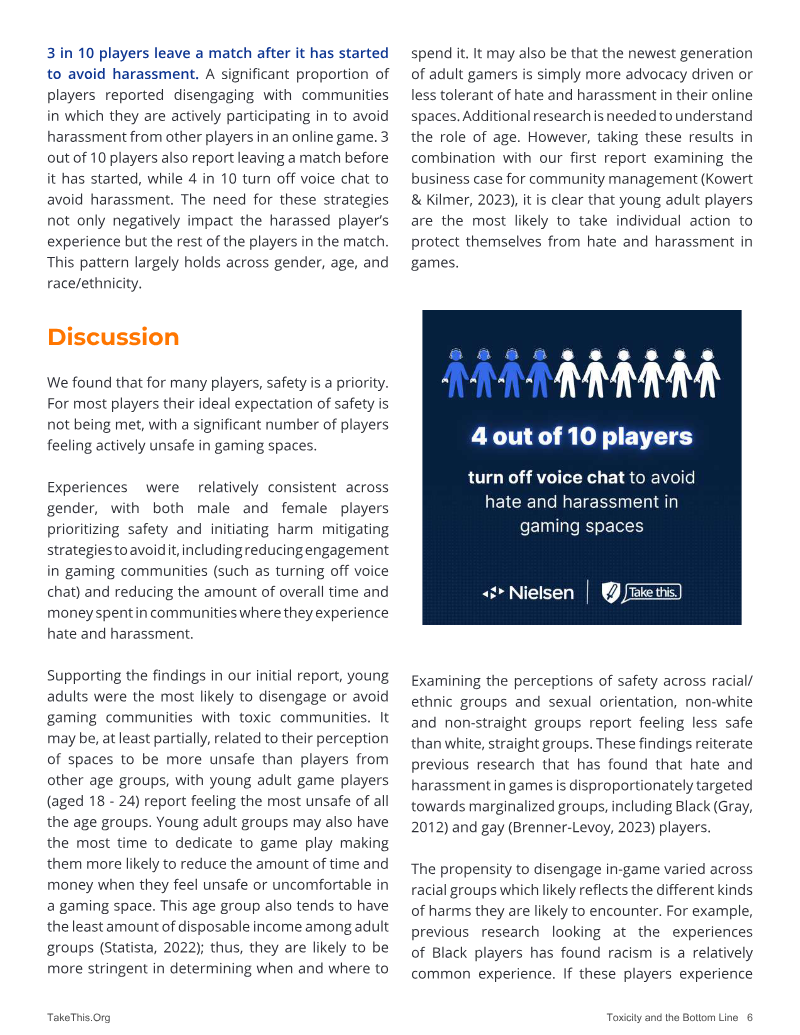
Take This · 2024

Take This · 2023
Take This · 2023

Take This · 2023

Take This · 2022

Take This · 2022
Take This · 2021

Take This · 2021

Bryter · 2021

The Game Business · 2026