1 free read left. Create a free account for unlimited reading + AI research.
Create free accountWhitepaper DiGRA
1 free read left. Create a free account for unlimited reading + AI research.
Create free accountWhitepaperDiGRA
POX: Save the People is a cooperative board game designed to teach players about herd immunity and the role of vaccination in public health.
The paper presents the design, development, and evaluation of POX: Save the People, a cooperative board game created by the Tiltfactor Laboratory at Dartmouth College in collaboration with the Mascoma Valley Health Initiative in New Hampshire. Its central aim is to teach players about herd immunity and the role of vaccination in public health, while also exploring how game design choices can shape player understanding of scientific concepts. The authors frame the project around questions of how board games can abstract scientific fact without introducing misconceptions and how knowledge transfers from play to real-world reasoning.
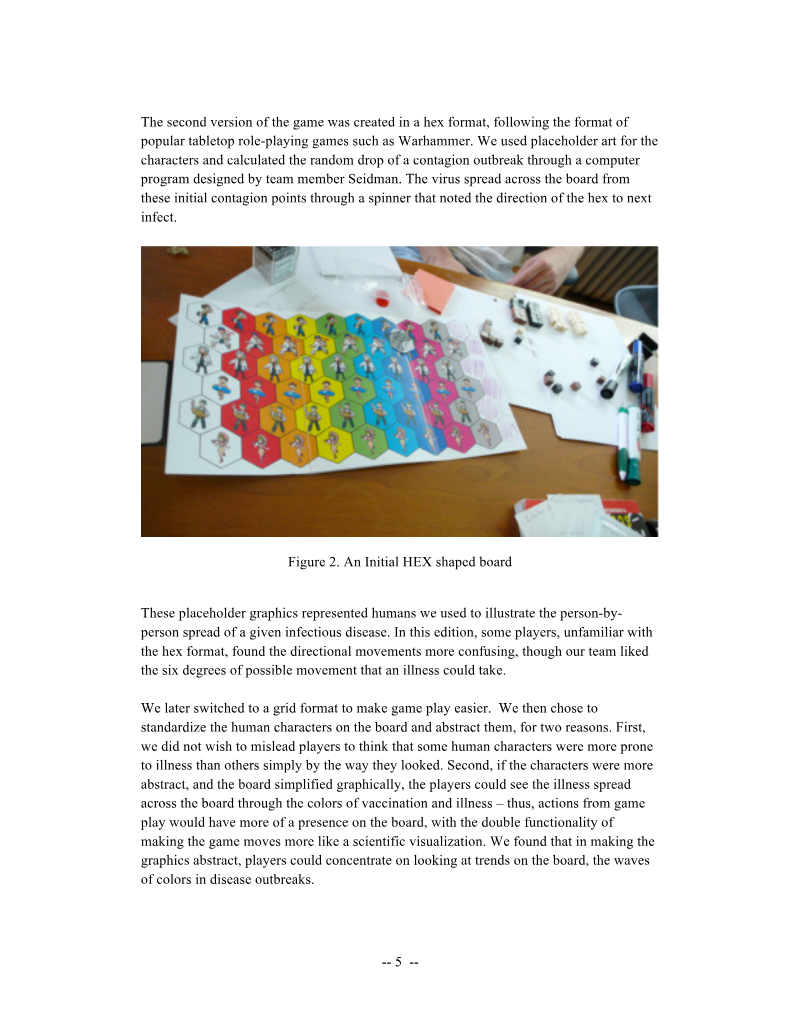
The paper grounds the game in epidemiological background, explaining herd immunity thresholds for diseases such as measles, pertussis, and polio, and citing outbreaks in the Marshall Islands and Mexico in 2003 to illustrate the consequences of falling below those thresholds. The design process, which took roughly six months beginning in summer 2010, moved from lightweight prototypes through hex and grid formats, with the team deliberately choosing abstract characters, collaborative rather than winner-take-all outcomes, and player-chosen outbreak locations. The authors candidly document several trade-offs, including the difficulty of defining a clear win state and the decision to sacrifice quantitative realism in vaccination rates for playability.
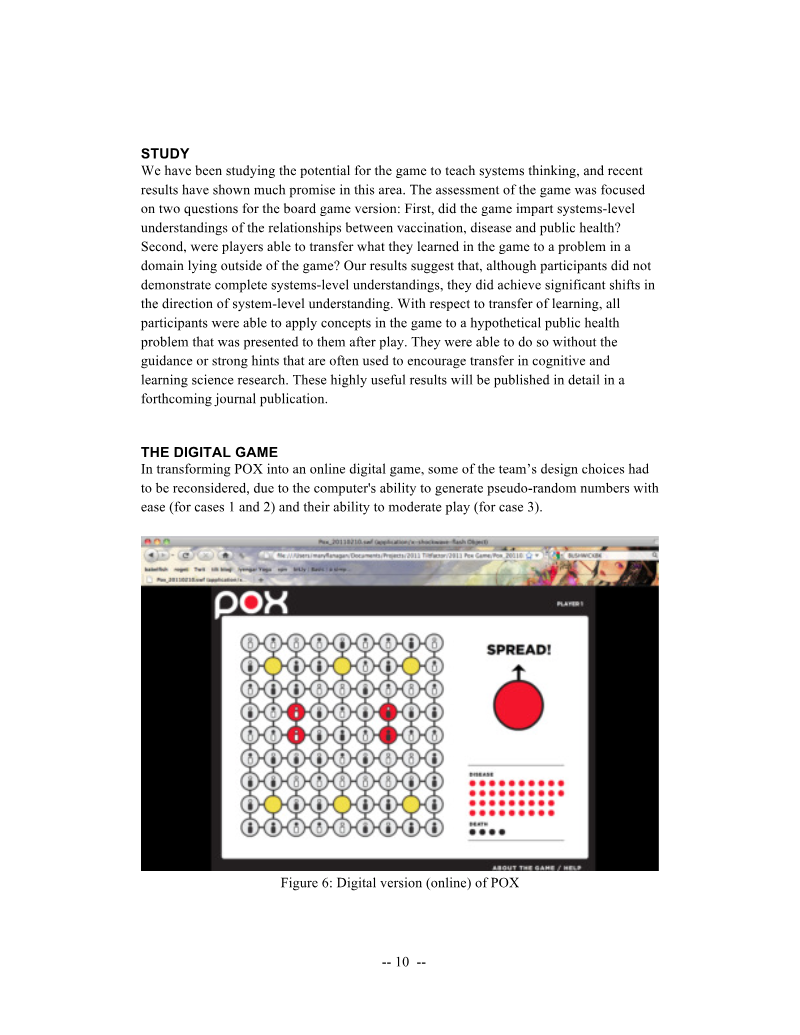
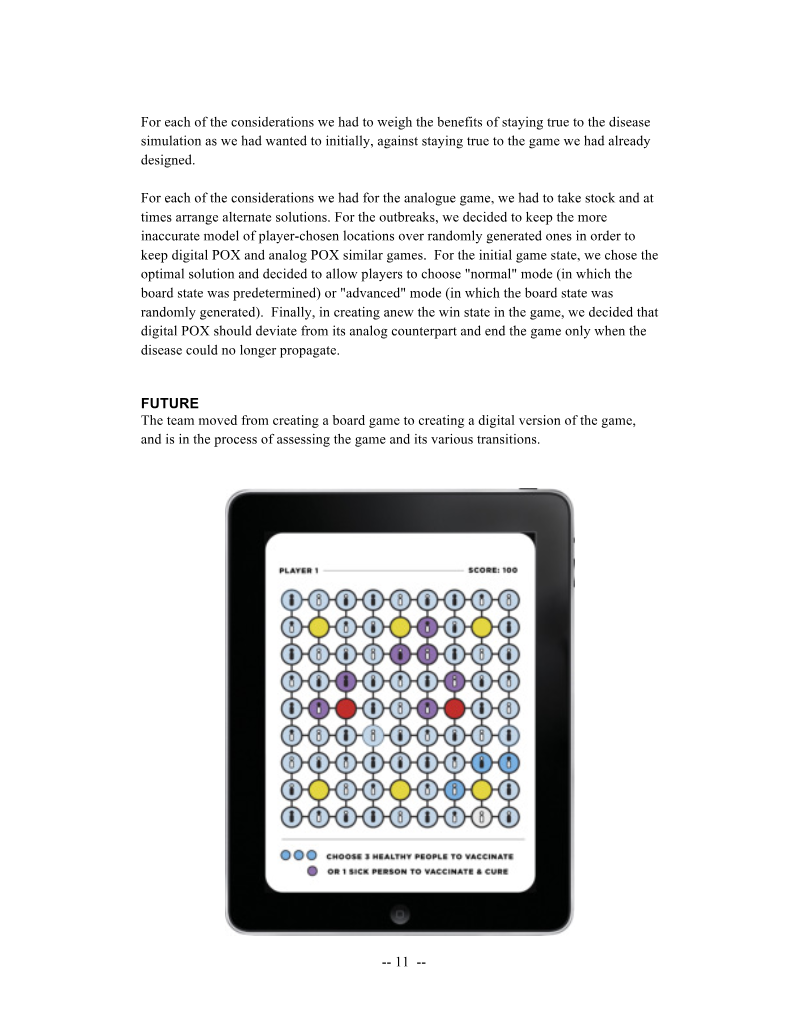
The authors report that a study of the board game version found players moved toward systems-level understanding of vaccination and disease, though not complete mastery, and that all participants applied game concepts to a novel public health problem without strong guidance. The paper also describes a digital adaptation that retained some analog choices while reconsidering others, such as randomized initial states offered as an optional advanced mode. The study's sample size and specific assessment methods are not detailed in the text, and the authors note that fuller results are forthcoming in a separate publication.

DiGRA · 2019



DiGRA · 2019



DiGRA · 2019

DiGRA · 2019



DiGRA · 2019



DiGRA · 2019



DiGRA · 2019



DiGRA · 2019



DiGRA · 2019



DiGRA · 2019



DiGRA · 2019



DiGRA · 2019

Game Developers Conference · 2021