1 free read left. Create a free account for unlimited reading + AI research.
Create free accountWhitepaper DiGRA
1 free read left. Create a free account for unlimited reading + AI research.
Create free accountWhitepaperDiGRA
The paper argues that The Last of Us, shaped by Western genre conventions, promotes these hegemonic ideals.
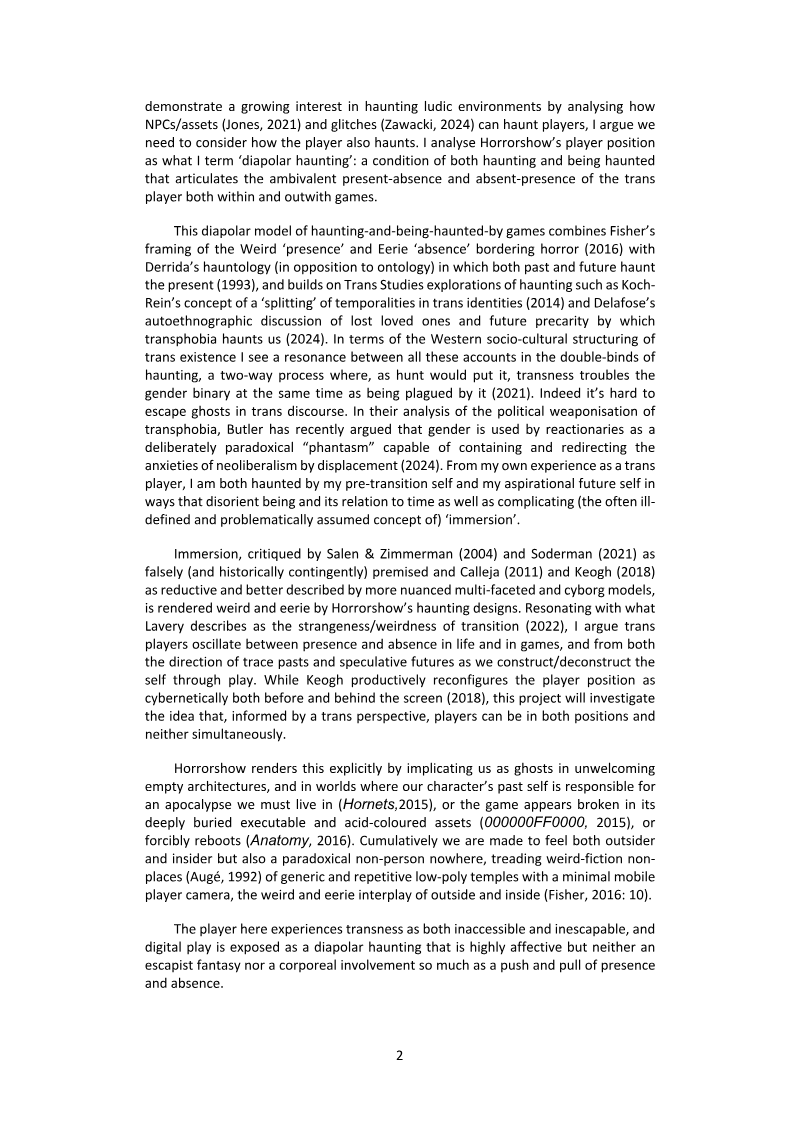
Adrienne Domasin's paper examines how a Black woman experiences identity formation when playing as a White male protagonist in Naughty Dog's The Last of Us. Drawing on her own ongoing gameplay, the author argues that the post-apocalyptic survival narrative, shaped by Western genre conventions, promotes White masculinity, privilege, and exceptionalism, forcing players from underrepresented communities to navigate their identities while embodying characters who represent those hegemonic ideals. The study positions video game embodiment and immersion as potentially more insidious than the stereotypes found in passive media.
The theoretical framework builds on W.E.B. Du Bois's concept of double consciousness, extended to a "triple consciousness" that accounts for the intersection of race, gender, and patriarchal structures experienced by Black women. The author contends that the inability to select a playable character's race and gender produces a complex mix of unease and pleasure, empowering yet unsettling, as players inhabit a identity historically linked to imperialism and colonialism. The analysis draws on theories of immersion, narrative structure, and character development, along with scholarship on gamer identity, transmedia storytelling, and the politics of race and gender in games.
Methodologically, the project combines ethnographic and autoethnographic approaches to investigate the uses, gratifications, and pleasures experienced by players from underrepresented communities who temporarily embody Whiteness during play. The work remains an ongoing inquiry, with the author's personal gameplay serving as a primary source of data and reflection, and it is presented as a contribution to understanding how identity is formed, constrained, and delimited within interactive narratives.
Each row is a game or company this document names, each column a document, oldest first. A mark means that document names it. Select a row to see those documents.

DiGRA · 2026

DiGRA · 2026



DiGRA · 2026



DiGRA · 2026



DiGRA · 2026



DiGRA · 2026



DiGRA · 2026



DiGRA · 2026

DiGRA · 2026



DiGRA · 2026



DiGRA · 2026

DiGRA · 2026
Extra Credits · 2012