1 free read left. Create a free account for unlimited reading + AI research.
Create free accountWhitepaper DiGRA
1 free read left. Create a free account for unlimited reading + AI research.
Create free accountWhitepaperDiGRA
It argues that rules, seen as the formal defining core of games, are problematic when games are considered apart from the social and cultural contexts in which they are played.
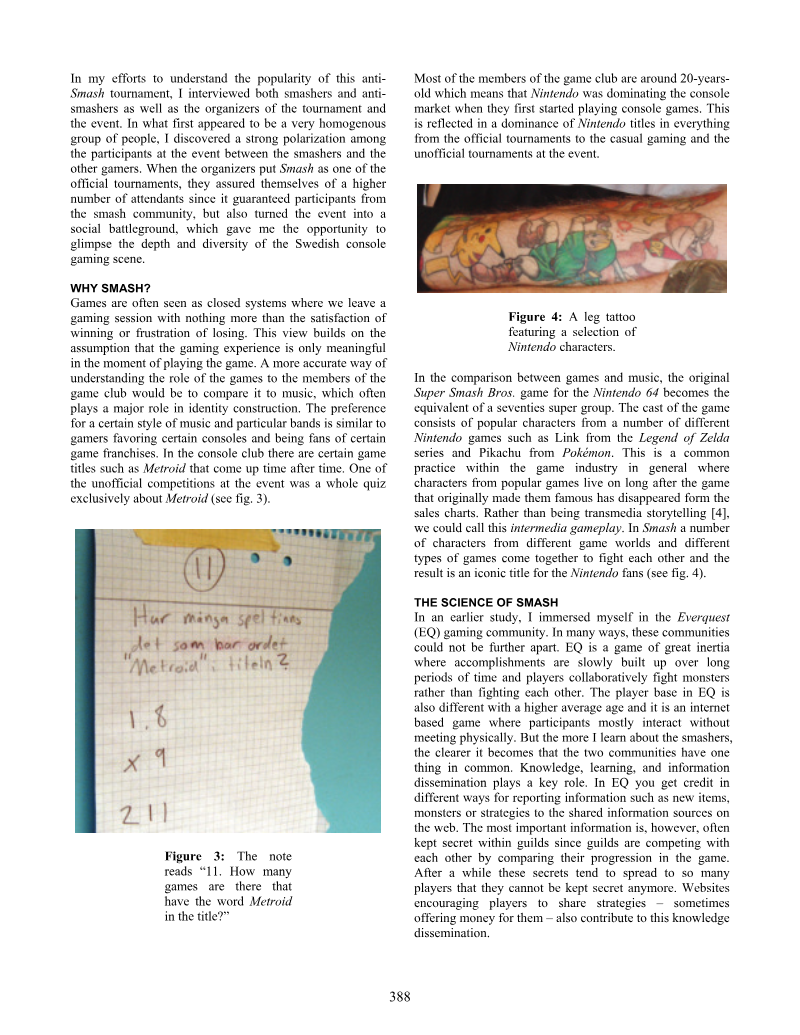
This study examines a Swedish console game club, focusing on how the rules of games are shaped by the social and cultural contexts in which they are played. Its central argument is that the idea of rules as a core, formal defining element of games is problematic when considered in isolation from situated play. The author builds this case through participant observation and interviews during the club's annual summer meeting, a week-long gathering of roughly eighty young adults, mostly in their late teens and early twenties, along with web forum monitoring before the event. The primary case is Super Smash Bros. Melee and a randomized variant called Random Smash, which the author uses to illustrate how a game's experienced form can shift dramatically while its core rules remain unchanged.
The findings highlight a sharp polarization within the club between "smashers," who treat the game as a competitive discipline with semi-professional commitment, and "anti-smashers," who value playing a wide variety of new titles. Random Smash, which randomizes characters, items, and win conditions, emerged as a compromise that subverted the competitive edge of the game and allowed both groups to participate. The study also draws parallels between the knowledge-sharing practices of the Smash community and those of EverQuest players, noting how player-created resources such as the SSBM Compendium of Knowledge shape understanding of the game more than designer intent does. Rules are thus presented as emergent, political tools used to negotiate community identity and values.
The scope of the study is narrow, centered on a single club and event in Sweden, and its findings rest on a small, self-selected empirical sample. Its theoretical contribution, however, is a call to balance formal game analysis, exemplified by Salen and Zimmerman, with social and cultural perspectives, so that rules are understood as one dimension among many rather than the foundation of game studies.
DiGRA · 2018
DiGRA · 2011