Loading the document
1 free read left. Create a free account for unlimited reading + AI research.
Create free accountWhitepaper DiGRA
1 free read left. Create a free account for unlimited reading + AI research.
Create free accountWhitepaperDiGRA
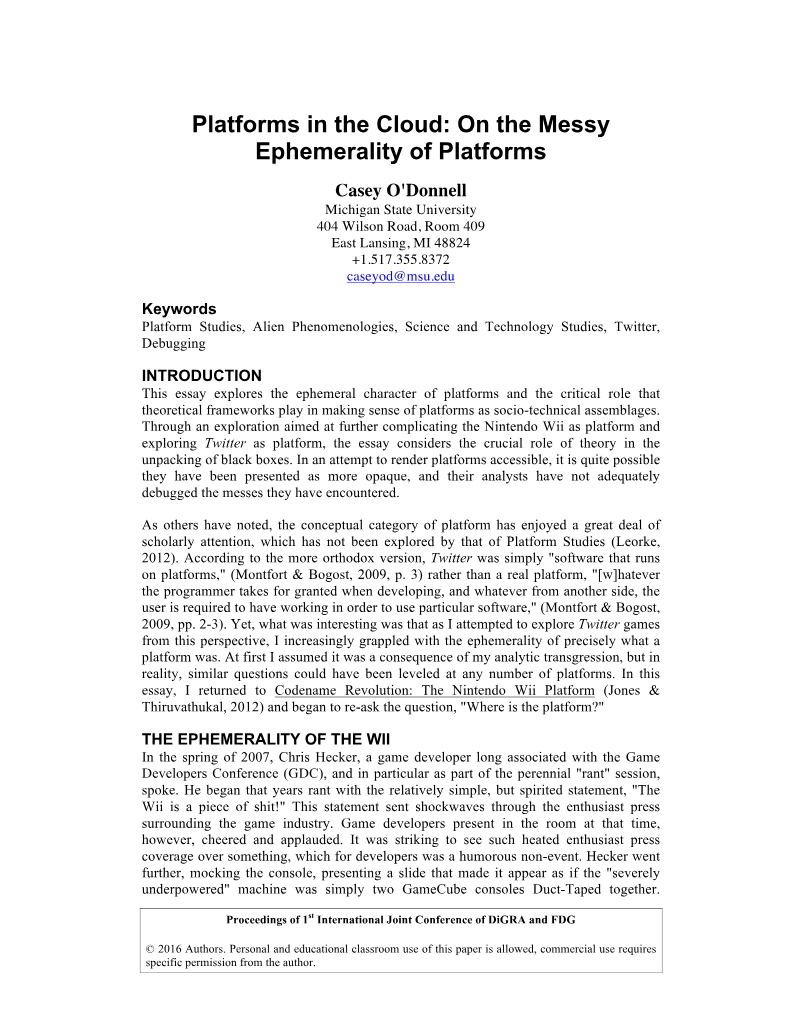
The essay argues that platforms are hard to locate and that prior Platform Studies scholarship has not adequately confronted this messiness.
The essay "Platforms in the Cloud: On the Messy Ephemerality of Platforms" critically examines the concept of a "platform" within Platform Studies, arguing for its ephemeral and complex nature. The author contends that existing theoretical frameworks often oversimplify platforms, presenting them as more opaque rather than accessible, and failing to adequately "debug the messes" encountered in their analysis. The primary thesis is that platforms are socio-technical assemblages whose definition is fluid and dependent on theoretical interpretation.
The analysis revisits the Nintendo Wii as a platform, highlighting its developmental origins as a modified GameCube DevKit. This historical detail, often overlooked in enthusiast discourse, underscores the continuous evolution and underlying technical dependencies of hardware platforms. The essay notes that Nintendo's SDKs, which dictate memory allocation, file formats, and even programming languages like Lua, are integral to the Wii platform but are often excluded from common definitions. This illustrates the difficulty in pinpointing where a platform precisely resides, as its components are layered and interconnected.
Further complicating the definition, the essay explores Twitter as a platform, particularly in the context of "Twitter games" developed during events like the Global Game Jam. It questions how to characterize the platform for games that integrate multiple web services (e.g., Google Maps, Gmail, Twitter, Facebook, HTML5, JavaScript, JSON, Flash, PHP, Chrome, WebKit, HTTP), noting that these elements themselves are constantly shifting. The author suggests that the theoretical assumptions made by researchers, such as those rooted in Object-Oriented Ontology and Alien Phenomenology, form the "lifeblood" of platform studies texts, shaping how material is interpreted and understood.
The scope of the essay is theoretical, focusing on the conceptualization of platforms in the game industry and broader digital contexts. It draws on examples from the Nintendo Wii (circa 2007) and Twitter games (circa 2011), engaging with existing scholarly work in Platform Studies. The methodology involves a critical re-examination of established platform definitions and an exploration of specific case studies to expose the inherent "messiness" and ephemerality of what constitutes a platform.
Each row is a game or company this document names, each column a document, oldest first. A mark means that document names it. Select a row to see those documents.

DiGRA · 2026

DiGRA · 2026



DiGRA · 2026



DiGRA · 2026



DiGRA · 2026



DiGRA · 2026



DiGRA · 2026



DiGRA · 2026



DiGRA · 2026

DiGRA · 2026



DiGRA · 2026



DiGRA · 2026