Distilling the key insights…
Activision Blizzard’s 2018 annual performance reflects a period of significant financial growth tempered by operational challenges and a strategic pivot toward core intellectual property. The company reported consolidated net revenues of $7.5 billion, a 7% year-over-year increase, and net income of $1.8 billion. This growth was primarily fueled by digital online channels, which accounted for 77% of total revenue, and the strong performance of key franchises including Call of Duty, Candy Crush, and World of Warcraft. Despite these gains, the company faced a decline in total monthly active users and failed to meet internal engagement and investment targets, prompting a 2019 restructuring plan designed to reduce organizational complexity and refocus resources on its most successful titles.
The company operates as a global leader in interactive entertainment across console, PC, and mobile platforms, with the United States and the United Kingdom serving as its primary geographic markets. A central theme of the 2018 fiscal year was the transition toward a recurring revenue model, supported by in-game content, subscriptions, and microtransactions. However, this model remains heavily dependent on a small portfolio of franchises, with the top three titles generating 58% of total revenue. Furthermore, the company faces substantial operational risks, including a heavy reliance on third-party digital storefronts like Apple, Sony, and Google, as well as ongoing legal and regulatory hurdles, most notably significant tax disputes in France and Sweden involving assessments exceeding $1 billion.
Financially, the company maintained a strong liquidity position, ending the year with $4.4 billion in cash and short-term investments while successfully reducing its long-term debt from $4.4 billion to $2.7 billion. The 2018 period also saw the adoption of new revenue recognition standards and the finalization of analysis regarding the 2017 U.S. Tax Reform Act. While the company continues to navigate an increasingly complex global regulatory landscape and intense industry competition, management remains focused on leveraging its owned intellectual property through expanded mobile delivery and esports to drive long-term stability and growth.
CD Projekt · 2026
CD Projekt · 2026
Ubisoft · 2026
Sony Group Corporation · 2026
Enthusiast Gaming Holdings · 2026
Aream & Co · 2026
Drake Star Partners · 2026
Capcom · 2026
Modern Times Group · 2026
Bandai Namco · 2026
Aream & Co · 2026
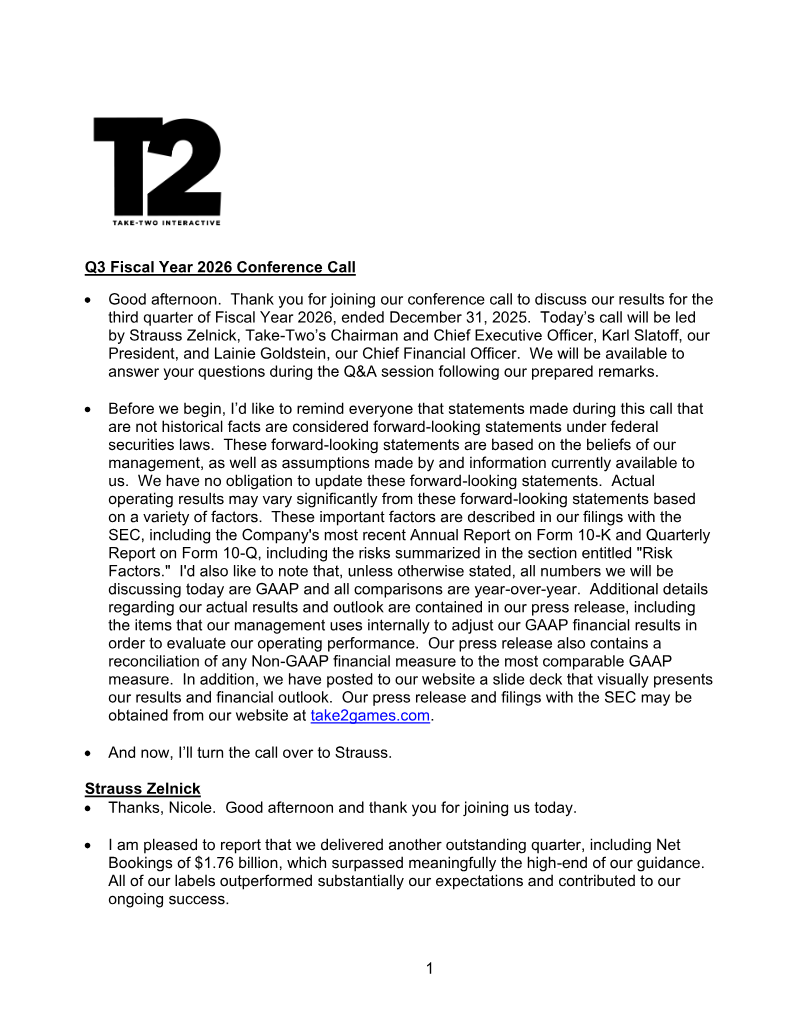
Take-Two Interactive · 2026