1 free read left. Create a free account for unlimited reading + AI research.
Create free account
One More Level - The Arbitrary Endpoint Trap - Extra Credits
Key insights
5 takeaways- 01The 'arbitrary endpoint trap' occurs when players continue gaming past the point of enjoyment to complete non-essential, self-imposed goals, leading to fatigue and diminished returns.
- 02Arbitrary endpoints are distinct from functional endpoints, such as reaching a save point to prevent progress loss, as they serve no mechanical necessity for the player's advancement.
- 03Players can reclaim agency by distinguishing between meaningful progress and system-imposed chores, specifically by choosing to end sessions while still engaged rather than pushing to complete artificial milestones.
- 04Developers use overlapping goals and the sunk cost fallacy to extend play sessions, aiming to convert initial engagement into long-term habit formation and player retention.
- 05Game designers, particularly in mobile and free-to-play sectors, intentionally exploit the human compulsion to complete tasks by using extrinsic motivators like progress bars and near-completion achievements.
Ask AI about this video
Transcript
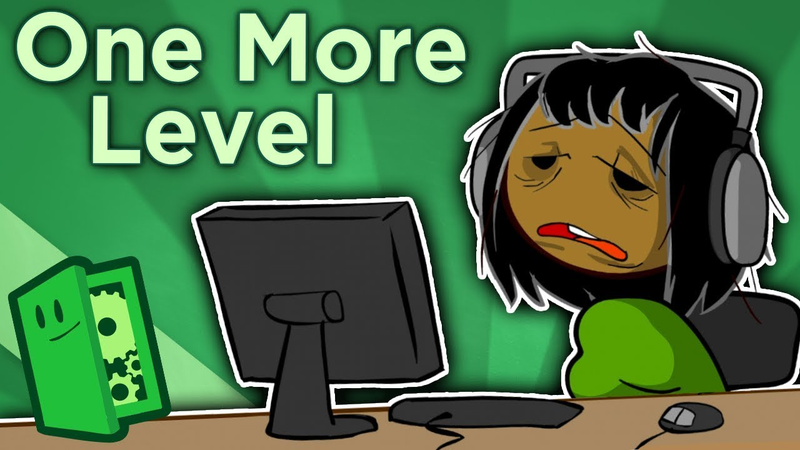
The only light is the glow of the monitor. The only sound is the game's gentle music. It is 3:00 a.m. You've got class in the morning and you should stop, but you're so close to getting that next level. We've all had that moment where we should stop playing, but then we tell ourselves, "I'll just keep going till I hit that next level. I'm almost there." Why do we do that? Is there any advantage to doing it right then at that moment rather than just getting that level the next day? Would you really lose anything by taking care of more important priorities now and just getting that next loot box tomorrow instead? No, you wouldn't. It's a trap. I don't know if this scenario has a proper term in psychology, but James and his designer friends usually call it the arbitrary end point trap. Arbitrary end points are things which seem like something you should wrap up before ending the session. Even though when you finish these things doesn't really
impact anything. It's kind of like when you're about to set down your book for the night, but then you notice that you're 10 pages from the end. So you decide, "Ah, heck. I'll finish it tonight just for the sake of finishing it." And sometimes this can actually have a negative impact on the experience. Keeping with the book example, you have invested 12 hours of reading to reach the end of this story and you probably would have gotten more out of the conclusion if you had read it when you weren't half asleep and exhausted. Or as another example, James knows a person who always always finishes all of the food on their plate even if by their own admission it makes the experience of dining less pleasant. And in games this is often one of the things that keeps us playing long after the game stopped being fun. I mean, have you ever had an amazing session of Overwatch and it has just been a blast, but you realize you're starting to feel a little bit sluggish and you can't really focus on it cuz you've just played so many rounds. You're about to quit. You're feeling pretty satisfied with that session, but then you notice
that you're only a game or two away from your next level. So, you slog your way through two more matches just to get that level, and then you quit. But, you don't really feel better for having done it. In fact, now you even feel less happy about your play session overall. Why is that? It's because you were no longer playing for the fun of the game. You were playing to finish a task. Worse still, that task was totally arbitrary. It was of your own making. No real benefit was gained by completing it right away. Why do we do this to ourselves? Well, because humans are hardwired to finish tasks. If we see a clear goal, and if we've already put some time in, if our sunk cost is already high, and achieving the goal's not too far away, we will usually just muscle through it, often without reflecting on why. Weirder still, if nobody gives us a goal for an activity, we will often just make one up. That is how we work. Now, I should point out that in games, as with most things in
life, not all end points are arbitrary. If you push yourself to just get to the next checkpoint so that the game saves and you don't lose your progress, that one's not arbitrary. It might still not be the smartest idea, and it really shouldn't be happening in modern games anyway, but in that scenario, there is a legitimate reason for handling that task before stopping. When I talk about arbitrary end points, I'm really talking about the end points which the player invents for themselves. The ones that don't actually serve as an end point, or need to be reached before quitting. They only exist in that annoying little part of your brain that says, "No, you can't stop yet. You're not done." But, the real trouble comes in when that pesky part of your brain is used against you by less than scrupulous game designers. Now, I'm not talking about leveling systems, or even most achievements. Yes, those are extrinsic goals, and yes, they are there to get you to play longer. Yeah, they're often just Skinner box traps, but at least they can serve some in-game function.
Maybe they're creating a progression curve or encouraging you to play in interesting ways. But even when those features are only there to manipulate you into extending your play time, they are designed to do so in the long term. They want to keep you coming back to play week to week. They're not designed specifically to keep you up at night. But if you look at a lot of free games, especially in the mobile space, they lean heavily on arbitrary end point traps. You see, many mobile companies have come to realize how important it is to keep a player's attention for a certain number of minutes the first time they sit down. The exact minute count is different from game to game, but especially for large games where they have tons of data on player behavior, they will have that statistic down to a science. After all, there are a million free games out there, but if they can manage to keep a player's attention long enough for them to figure out what makes the game fun, or more cynically, if they can keep your attention long enough for sunk cost fallacy to start to sink in, odds are pretty good that that player is going to keep playing and the dev won't
lose them to one of their competitors. So, if you fire up a new free to play game and the game keeps reminding you of how near you are to getting that next achievement, and especially if they have several progress bars counting up at once so that you're constantly like 75% of the way to finishing something, that is what they're trying to do. They are trying to feed your brain arbitrary reasons to keep playing just a little bit longer. It's not just that the game is promising you rewards for progress. After all, if that was all your brain wanted, you could just put the game down whenever and finish getting those rewards next time. No, no, it's really that those designers are trying to serve up a constant stream of new arbitrary end points for your brain to latch onto. Now, hopefully knowing this will help you to avoid such traps. Even more, I hope that knowing this will make it easier to notice when you're building those traps for yourself just so that your gaming time can be more enjoyable. Quit while you're still engaged. If the only reason you're still playing is just to finish your game chores, that's a pretty good sign that it's time to call
it a night. See you next week.
Summary
The arbitrary endpoint trap describes a psychological phenomenon where players continue gaming sessions past the point of enjoyment to reach self-imposed, non-essential goals. This behavior, often driven by a human compulsion to complete tasks, leads to diminished returns where the act of playing shifts from a source of entertainment to a chore. While some endpoints are functional—such as reaching a save point to prevent progress loss—arbitrary endpoints are defined by their lack of necessity, often resulting in fatigue and a negative overall experience.
This behavior is frequently exploited by game designers, particularly within the mobile and free-to-play sectors. Developers utilize extrinsic motivators like progress bars and near-completion achievements to keep players engaged during initial sessions. By presenting multiple, overlapping goals, designers leverage the sunk cost fallacy to ensure players remain invested long enough to form a habit or reach a point of retention. These mechanisms are specifically engineered to extend play sessions by providing a constant stream of artificial milestones that the brain feels compelled to resolve.
Recognizing these traps is essential for maintaining a healthy relationship with gaming. The analysis suggests that players should distinguish between meaningful progress and arbitrary tasks, advocating for the practice of ending sessions while still engaged rather than pushing through to complete chores. By identifying when these goals are self-constructed versus system-imposed, players can reclaim their agency, ensuring that gaming remains a recreational activity rather than a source of unnecessary exhaustion.

























Comments