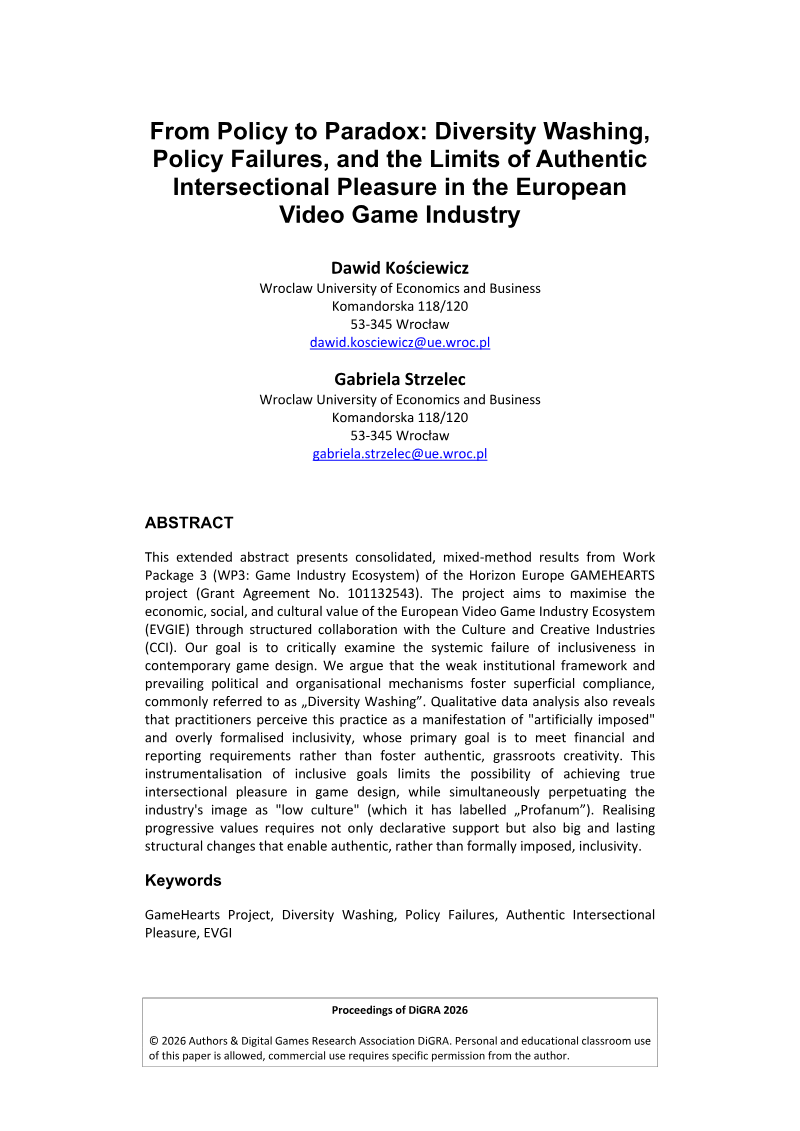
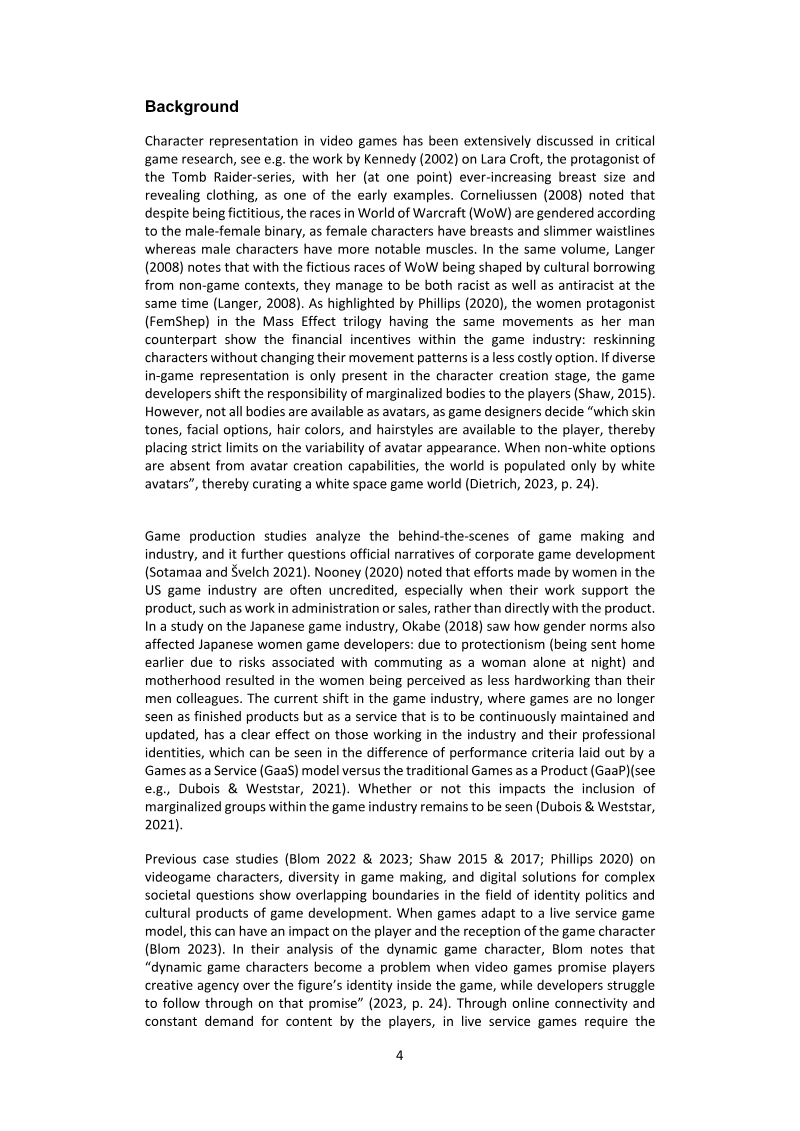
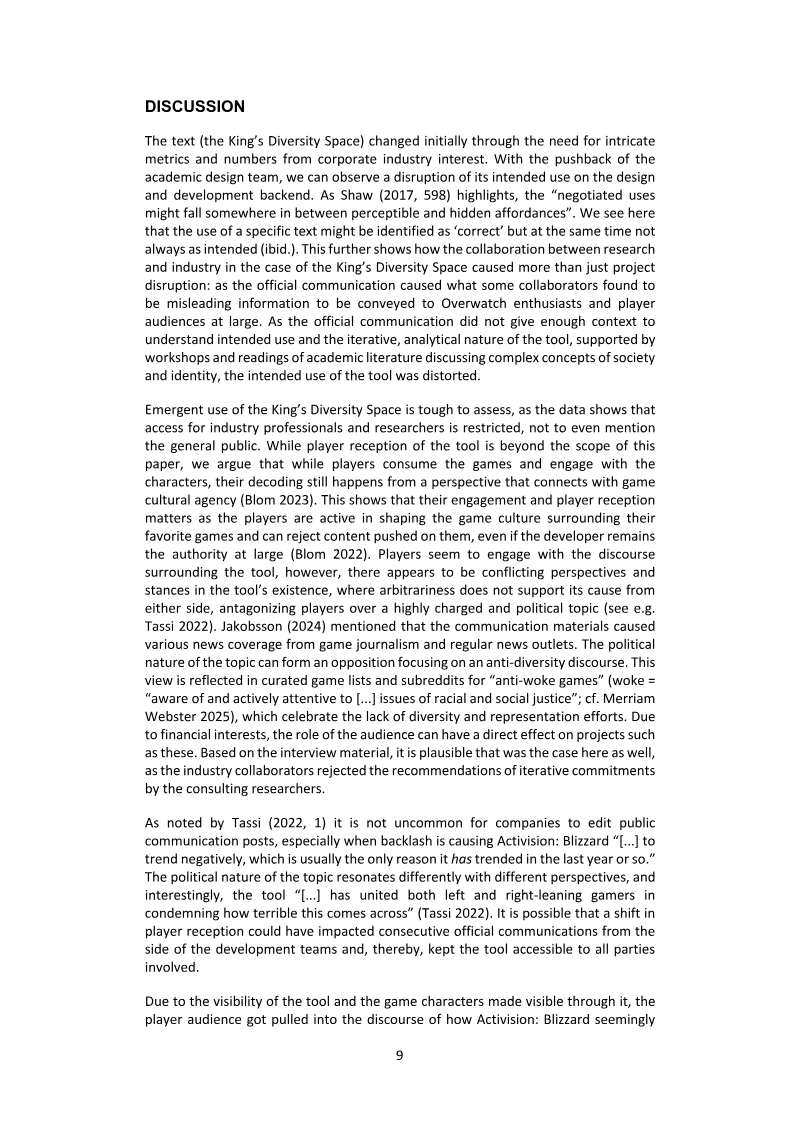
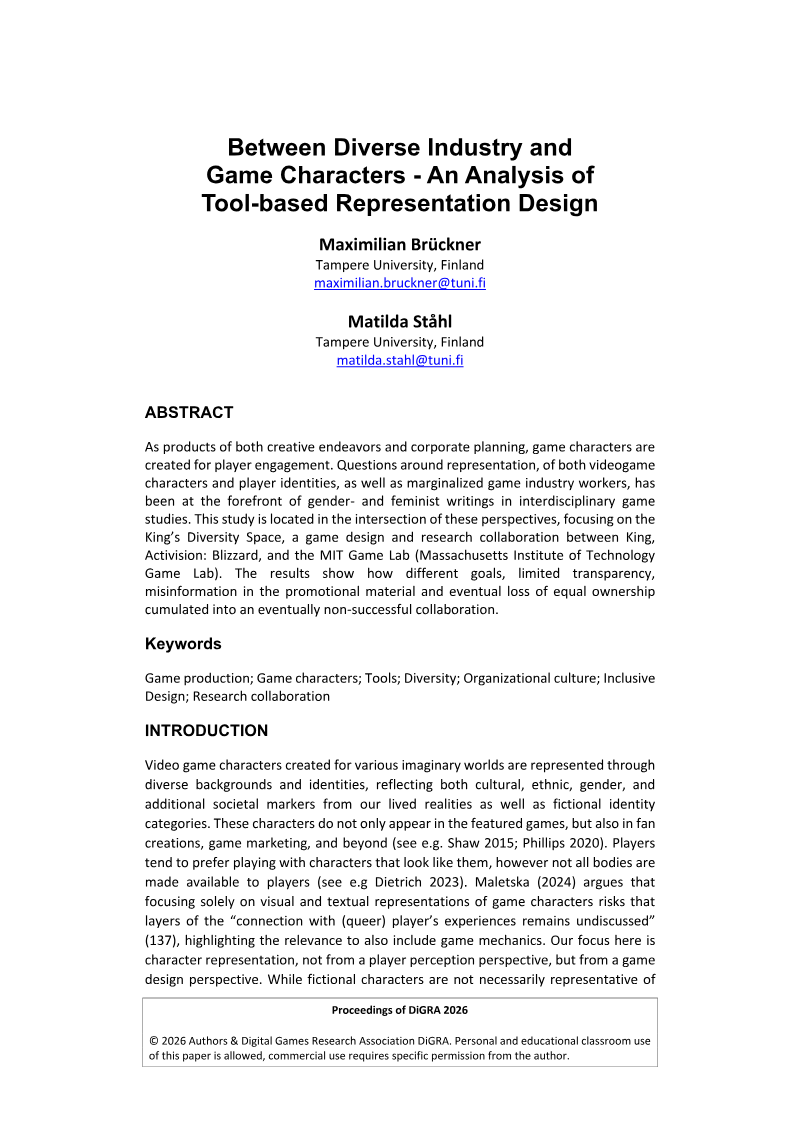
1 free read left. Create a free account for unlimited reading + AI research.
Create free accountWhitepaper DiGRA
1 free read left. Create a free account for unlimited reading + AI research.
Create free accountWhitepaperDiGRA
The paper proposes shifting from analyzing representations alone toward understanding player experience.
This paper proposes a design-oriented, participatory research-creation approach to studying non-monogamy in digital games. Its central argument is that, as non-monogamous relationships move from the margins of game culture into mainstream titles, the field should shift from analyzing representations alone toward understanding how players actually think about and experience these intimacies, and how creators might design them to better resonate with queer desires and identities. The work is framed by queer phenomenology, queer game studies, relational ethics of "significant otherness," and a research-creation framework termed "polydisciplinamory," which adapts the affective dimensions of polyamory to navigate multiple disciplines, methods, and creative outputs.
The methodology combines a multi-stage interview process with feminist speculative and critical design. Players complete open-ended questionnaires about their gaming and relationship histories, then take part in conversational "gaming interviews" conducted during play, which allow participants to revisit and extend their earlier responses. Findings from these interviews feed an iterative prototyping process alternating between player feedback and input from small, independent queer game developers based in Montréal. The approach is participatory and bottom-up, shaped by constraints that differ from commercial development, and is intended to combine players' informal design knowledge with developers' formal expertise.
A substantial focus of the paper is the Method for Design Materialization (MDM), which uses software version control to document a game's design trajectory. By pairing time-sliced code and materials with reflective journal entries, the author captures the reasoning behind design decisions. The paper examines the affordances and challenges of applying MDM in a research-creation context that involves players at multiple stages, offering guidance for researchers using participatory methods to make and study games. The work is presented as a dissertation-in-progress, so its prototypes and findings remain forthcoming.
Each row is a game or company this document names, each column a document, oldest first. A mark means that document names it. Select a row to see those documents.
European Conference on Games Based Learning (ECGBL) · 2026
European Conference on Games Based Learning (ECGBL) · 2026
DiGRA · 2026



DiGRA · 2026