1 free read left. Create a free account for unlimited reading + AI research.
Create free accountReport gamevironments
1 free read left. Create a free account for unlimited reading + AI research.
Create free accountReportgamevironments
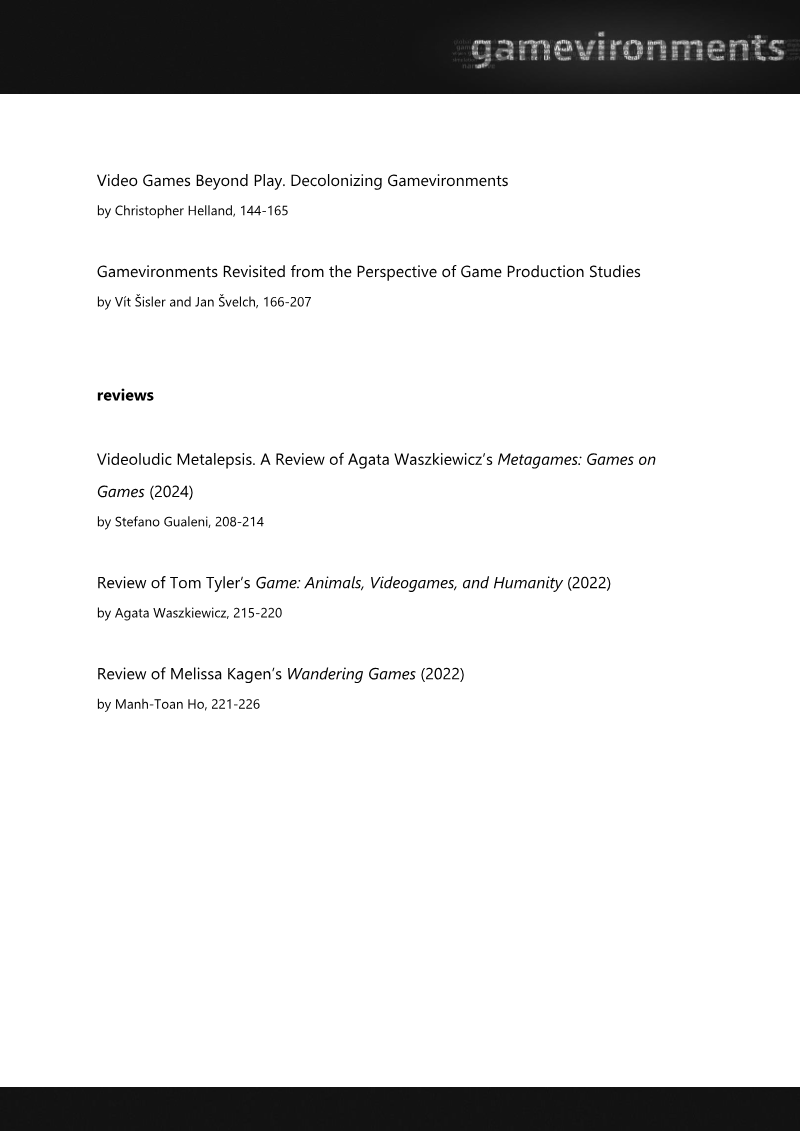
The issue argues that technical systems, cultural context, production practices, and player reception form one environment. It rejects treating a game as a narrow digital artifact.
"Gamevironments Revisited" (Issue 21, 2024) argues that game studies should treat technical systems, cultural contexts, production practices, and player reception as a single unified environment, or "gamevironment," rather than as a narrow digital artifact. The issue's central thesis, advanced most fully in Zhange Ni's article on ludonarratology and gamevironments, is that religion, storytelling, and gameplay are deeply entangled and must be analyzed together, with non-human actants and embodied player experience placed at the center of the analysis. Its primary case study is Black Myth: Wukong (2024), a Chinese AAA action game drawn from the Journey to the West novel, which serves as a test case for how cultural and religious traditions are reshaped under socialist and post-socialist conditions.
The contributions converge on several recurring findings. Analyses of the game suggest that it achieves a strong ludonarrative resonance, in which its narrative and ludic modules reinforce one another, yet its embodied sensory elements, the six roots, function as an empty signifier that is weakly integrated into play. This contrasts with the source novel, where the six thieves are actively overcome, a comparison that highlights a gap between narrative symbolism and mechanical design. Other sections argue that Wukong's transformations across retellings culminate in an allegory for the Chinese gaming industry, which alternately restricts and promotes games for economic and ideological reasons.
The issue's scope is primarily theoretical and interpretive, drawing on ludonarratology, 4E cognition, affect theory, and political-economic critiques of gamification and "playbor." It is centered on Chinese game culture and the Journey to the West tradition, with reference to the game's 2024 release and its reception in Chinese media. The contributions offer no quantitative data or original empirical results; their conclusions rest on close reading, case analysis, and scholarly framing. Taken together, the issue calls for more sophisticated, actant-centered and embodiment-focused approaches that treat games as complex, affective, and politically embedded systems.
Each row is a game or company this document names, each column a document, oldest first. A mark means that document names it. Select a row to see those documents.



gamevironments · 2026



gamevironments · 2026



gamevironments · 2026

gamevironments · 2026



gamevironments · 2026



gamevironments · 2025

gamevironments · 2025



gamevironments · 2025



gamevironments · 2025

gamevironments · 2025

gamevironments · 2025
gamevironments · 2025
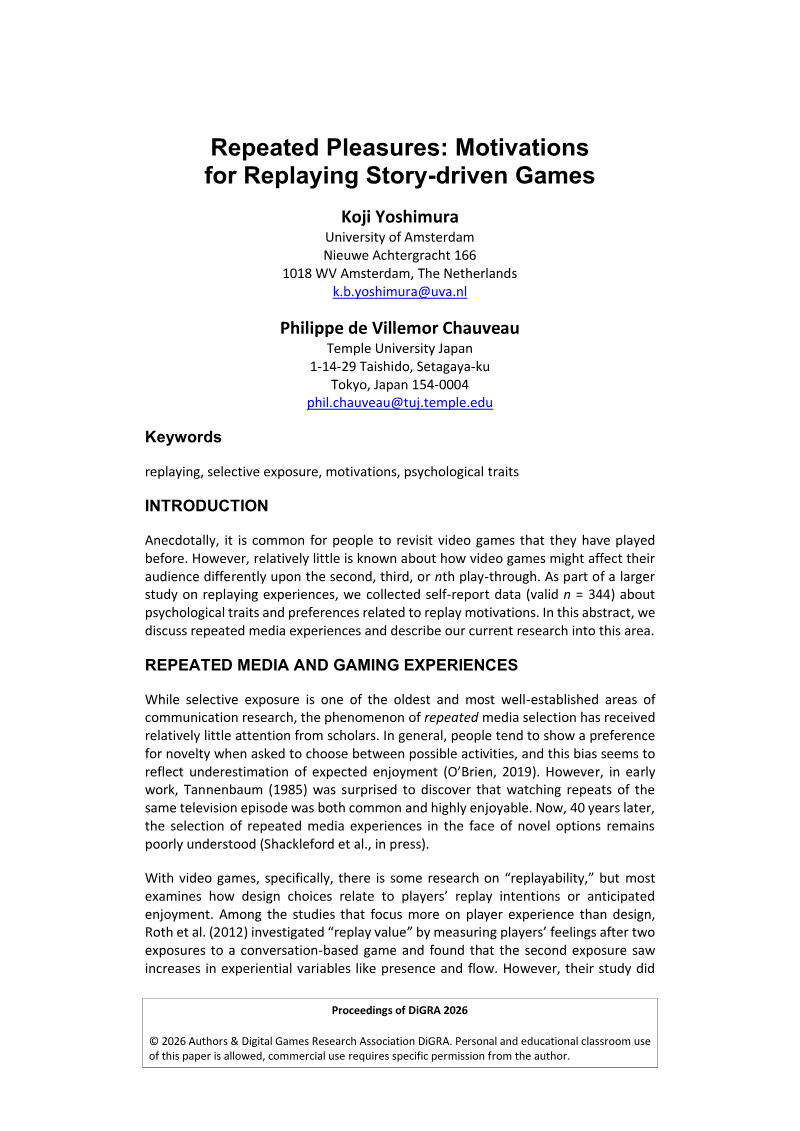
DiGRA · 2026