1 free read left. Create a free account for unlimited reading + AI research.
Create free account
Keynote: Competition Boost Retention
Key insights
6 takeaways- 01In Stumble Guys, a title with 90 million monthly active users, tournament participants demonstrate substantially higher retention rates, with the most engaged players reaching up to 90% retention.
- 02Integrating short-form, in-game tournaments significantly boosts daily retention rates by leveraging players' psychological desire for status and achievement.
- 03Tournament systems function as effective economic sinks by requiring in-game currency for entry, allowing developers to retain a portion of fees while distributing the remainder to winners.
- 04Successful implementation requires a robust technical foundation, including reliable matchmaking, real-time PvP capabilities, and the use of existing tournament SDKs to streamline development.
- 05Developer-provided tools that allow content creators to host and brand their own tournaments can foster organic community growth and reduce reliance on traditional marketing.
- 06Balancing competitive difficulty is essential to ensure that both winning and losing remain engaging components of the gameplay loop without discouraging the player base.
Ask AI about this video
Transcript
Next talk is actually me, so please stay. Um Um so I'm not going to make a talk about Photon per se. So it's really about uh there's going to be a lot of content and things that you can learn as well. Um so my goal here is that we uh go forward into um competition improve retention. So um let's see if we can move that forward. There we go. So first I thank you to be here in Seattle. Um at the Photon multiplayer track. So my name is Mark Wahl, so I've been in the online industry for a bit more than 20 years. I built studio for Ubisoft and Unity, but also built PlayFab you
probably know uh with James and Matt. And uh now pushing up Photon because I strongly believe that this decade is the decade of multiplayer. Well, the previous decade was about live game operation. So let's see what we can do for you. But a little bit about Photon and then that's going to be it about Photon. So we're growing like super strong. We have more than a billion players across our pool of games. So we are worldwide available including China. And uh so we have a new product called Photon Fusion which can build a battle royale games, but also smaller games if you like to. So we're extremely flexible. And um yeah, if you don't know Photon Anyone know Photon? Raise your hand. All right, there's few hands. That's cool. That's good. Okay, so let's start. So um three subjects that we have. So why competition? And then we're going to go into the uh tournaments per se and then uh where to start for you if you like to do that as well. So anyone know what that is? Raise your hand. Yeah. All right. All right. It's the ice
bucket challenge, isn't it? So um the ice bucket challenge was literally I challenge you. Which is competition from the start. Uh people don't realize how much this campaign was successful. So 150 million raised for ALS which is great. But 60% of the videos generated from this campaign were not mentioning the actual cause. And the reason behind it is that competition is intrinsic. intrinsic which means that if I challenge you to do something, your ego's going to be promoted. And then you do do you're going to do a narcissistic decision which is I'm going to participate as well and I can do it. And in the end the decision is pretty much selfish. And and that's there's a lot of studies around it and why this campaign was successful. And it's mainly about the competition side of things and not really about, you know, the actual cause that was behind it. So there's really good study to read
about it. So I encourage you to to look at that about the psychology behind it. But obviously competition is everywhere. So if we look in nature, for example, if you're a group of people and you're, you know, there's a bear in front of you and this bear wants to run after you, what is the best path to survive? So some people will say I'm going to run faster than all my other friends. So that way I'm going to be sure that I'm not the one getting caught by the bear. Or others will say let's cooperate together and try to scare the bear. But essentially it's a competition right away. And actually competition is everywhere. It's in every state of life. It is in economy. It is in the family. It is in politics. It is in product. It is in everything that makes us human. And if you look right away in the core of us, like in the cells that makes our body, there's a cells competition happening all through your life until you become an adult to choose how you're going to grow, how you're going to evolve, and
how it's going to make you better to survive and actually thrive uh in your life. So if you go all the way deep into our DNA, every time, every moment, every second there's competition happening into yourself. So in short, what is uh determining uh competition is the order, the status, but also the survival. Those are the three states that's going to influence your game design and that will actually make something happen. So if you look into gaming, we think about competition, we're going to think about e-sports, about the tournaments that is happening. And it's heavily pushed under like the price size and how many attendance you had. And obviously we had COVID, right? Recently. So it was very hard to organize a physical event. It was still happening online. Um so what's brought out of that and I there was good solution for it. And I think your computer is lagging a bit, but that's fine. Um it's it's short in-game tournaments. So
short in-game tournaments is really key to promote your retention inside of your game. Um so we're going to dive into this and why is it good for you and how you can do it as well. Um as I said, competition is important. Tournament is a solution to implement it in your game and that's a way that you can succeed as well. So here is a Stumble Guys. So Stumble Guys is uh accident made by us. Uh so we created a template for Photon Quantum which is one of our product. And we found that the gameplay was really cool. We decided to skin it and uh now we have Stumble Guys. So Stumble Guys is a 32 player game built on top of Photon Quantum. And all of what you're seeing now is on mobile working in uh countries where internet is not so good, but actually the gameplay is working very well no matter your connection. And uh competition is core to Stumble Guys. It's a elimination game. So every match that you're playing, you're trying
to uh eliminate your opponents and you move forward. Uh obviously there's a lot of metas on top of uh of Stumble Guys and one is tournaments. So you can subscribe to a tournament, you spend some hard core currency, and then you can participate into that uh tournament. Those tournaments can vary in length from 30 minutes to a few hours. Streamers themselves can also create their own tournament using our uh management system. Uh so that way they can, you know, promote promote to their community and have those huge I'm talking very big tournaments. So what happens is that these streamers starts to stream about the game and then you have this all organic effect of content happening on top of your game. So today um Stumble Guys is actually as popular as Candy Crush Saga according to Google Trends worldwide. We're pretty happy about that. Um you should also I should remind yourself that Stumble Guys is 100% organic.
There's absolutely zero marketing. Uh we're running at about 90 million uh players per month and it's still growing. So we're super happy about it. So let's look at the numbers. So since it's our game, we can be a open book and tell you everything about it. You have questions, we're going to answer that. No problem. So um as you're saying, so we see the bumps on the bottom left. Uh so those are concurrent users. So we have a top currently of 288,000 uh concurrent users. And this just keeps growing and growing and growing because of the effect of of competition, of the tournament, of the streamers. You combine all of these together, you shake it a little bit, and you have good numbers. And obviously you need a good game. The rating is good, 4.2. So we have about uh today we have about 11,000 tournaments that happen. Uh some of these tournaments can reach 30,000 people at the same time. So I repeat, every single of these players will spend hard core currency to participate in a
tournament. Before you go in a tournament, you have to be extremely good at Stumble Guys because, you know, you need to gather that money and then you can go in. Uh if you see at the bottom right, so that's like the the CCU count when uh when a tournament uh is going to happen. So let's say I register for a tournament going to happen in an hour. So, you know, I go do something else and then 10 minutes prior I'm going to say how I'm going to train a little bit in Stumble Guys. So I go play a little bit and then participate in a tournament and hopefully I'm going to win something. For players that participate in tournaments, the daily retention goes much higher. So the players who participate in those tournament, you can see the blue line versus the players that don't participate in tournaments, there's a huge difference. So we should do a better job actually at promoting tournaments in Stumble Guys. So again, like I highly encourage you to look at tournaments as a way to retain your players because of why. We call that the IKEA effect which is I put value in something, I put time and work into
something, I'm going to come back to measure myself versus the other people. Right? I was talking about intrinsic value earlier regarding the challenge in the ice bucket. It happens also into the mindset regarding gameplay. So you have to keep that in mind. But there's other examples. So there's a little game called Little Legend Puzzle which is uh in Alpha few games. But essentially it's super casual. It's a match three game. Uh super fluffy and you know, elevator music as you can hear. Um very casual. Anyone can play It's a fully full hard core PvP match three game. You know, sounds a bit crazy. But you can anyone can create a tournament at any time. So here I am going in the chat. Someone is saying, "Oh, I created a tournament. Join my tournament." So now I'm joining a tournament and it takes, you know, 30 seconds, 45 seconds. The tournament starts and then everyone competes to each other, and then it's a match three game.
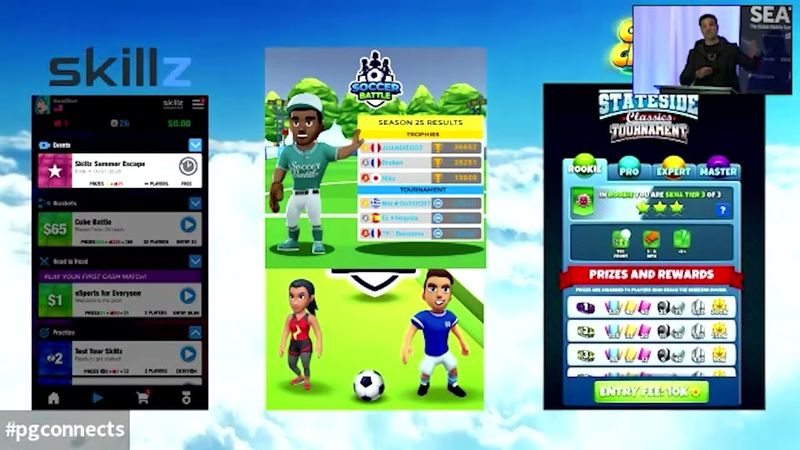
So, even in game plays that you think are not suitable for tournaments, you can do it as well. Obviously, when you go in the chat of this game, everyone is like, "Oh my god, I'm going to beat you, and then I'm going to beat you. You use this card." And so, you have this huge community bubble that is building on top of it. And then there's tons of metas, obviously. You can build your little house. You have cosmetic. You have stickers. You have a bunch of things you can do around the game to be able to extract other battle crates and having, you know, there's clans as well. There's leaderboards on clans, leaderboard single player, local, and all these things. Just keep them going. But essentially, again, the game is about elimination, about competition, about tournaments. So, you have a look at that. Um and definitely, there's other examples that we can that you can look for yourself. Uh so, skills, which is pay to win. So, if there's people here that does
some NFTs or web three or pay to win, look at the skills tournament system. It's a good way to learn. And otherwise, we have other games like a Golf Clash that is also using Photon. They do tournaments that last a week. So, much more different than the short tournaments, but it's working very well for them because when you play golf, there's 18 holes to do. It's pretty long. So, it's a lot of a lot of energy, a lot of of time you put inside of the game. And then Soccer Battle, which is also using a tournament system. But then you have to go on Discord, find your people, and then start a match. But then if you look also at Supercell's, you know, like you can have like clan tournaments that are in game. It improves the retention. You should look at these as well in term of examples of how to execute. Um so, if I go on, there we go. Um so, if we recapitulate a little bit, so tournaments will greatly improve, obviously, your player engagement
because you want to perform, you want to showcase that you're able to do it. So, you're going to train yourself. You're going to try to figure out what are the tips and tricks. You're going to go on the internet. You're going to see how the others are doing it. You're going to try to apply these things. And then if you involve streamers to be able to create content, so it means that they can create their own tournaments at any time. They can brand these tournaments. They will spread the love to their to their eyeballs that are looking at them every day, and it will just grow and grow and grow. And one thing that is important is that for all of these tournaments, there's a rake. So, rake is a term that is coming from the poker industry, actually, or even like the casinos, where a percentage of the fees that people pay to get inside of a tournament just keeps you know, keeps at the house, right? So, for example, for Stumble Guys, 30% of
the money of the art currency being spent by the players to participate in a tournament will stay in the house while all the rest of the money will be distributed in the winners. So, it's a good way to, you know, promote to have a sink in your game in term of economy. Um so, it's a good way to balance it and to move forward. Uh so, if we go like to the bare minimum of what can be a successful tournament system. So, obviously, you need your real-time PvP. If it's turn-based, you don't see the the other one, you you won't have the same effect. So, it's very important. So, in the match three game I was showing earlier, you see the other player playing. And that's very main to a real-time game. You have to see the others doing something. Obviously, you need cloud save. You need a leaderboard, a matchmaking here, the rating system that we just seen with Josh. And having a good economy, and obviously, you need
a CMS or a CRM to be able to see how your players behave and also to create those new tournaments for your players at any time. Um So, so what we created on our side is what we call tournament SDK for lack of a better word of a better name. But essentially, this is for all the Photon gaming circle members, you can have access to our tournament SDK and do exactly the same as in Stumble Guys. It gives you tools for you game designers, producers, or even developers to go in, plug in the APIs, obviously, but after that to to have like a a dashboard where you can create this content for for your players. And what you will end up, well, is a very cool tournament. Um so, I went a bit fast in my talk to showcase what what is um a tournament
for you, for competition, and how you can bring it forward. But essentially, the key of the talk is that if you bring players together that they compete between each other, they're going to definitely have a higher value that is going to be interesting to them, and that they will want to share even more to other players afterwards. Um so, yeah, so that was competition for retention. Thank you. So, anyone has a question? All right. Um yeah, someone's going to bring a microphone. All right, it's more for the people that are online. Thank you, people online, for watching from home or from work. We love you, even if you're not here. You're missing a good event. Um so, I I'm making an assumption here, and I may be wrong, but I'll lead into my question anyways.
I saw in the ratings for Stumble Guy there. Yep. It had a high number of ones. We've all got games, we know what that's like, but A high number of what? Uh one star ratings on there. Okay, yeah, yeah, sure. So, I'm I'm I'm curious, is that a result of people having I don't know, a negative experience through connectivity, through a wider range of devices? Is my assumption right? actually. So, it's not connectivity at all. So, uh why? Well, first, the game is extremely popular in India and Brazil and Southeast Asia, which is the internet is not, you know, reputable to be good. And the 32-player game is having fun. It's really about the gameplay. So, what happens is that um in Stumble Guy, as you saw, right? You you have all the players just run around. When you're super high level, you can pick someone and throw them out of the map. Right? So, so obviously, if you haven't grind enough to reach that cuz you can have
this option for free, then you get frustrated. And usually, it's about that. Um so, it's it's more about the gameplay, and some are saying, "Oh, those are bots that I'm playing against." Obviously, it's not. It's real players. Um so, it's really dissatisfaction regarding the game itself. So, then on our side, it's more about like, "Okay, what can we do to make these people happy?" But, you know, in general, you know, 4.2 is pretty good considering that there is over 1 million reviews. Um and um yeah. So, my my assumption was wrong. So, then my my question is, is can you speak to any challenges outside of just poor connectivity because again, like 32 players in a match is phenomenally amazing. I'm I'm a big believer in it, too. Yeah, so yeah, sure. So, go ahead, sorry. Yeah, and and and so, is there any challenges outside of just, you know, connectivity based on territory, but
Yeah, so so first, like when I was showing the, you know, the curve of concurrent players, so that is across five regions, right? So, you have South America, North America, Europe, Asia, and and another one. And so, essentially, you have to balance that, right? So, meaning that you cannot segregate too many players, right? So, to to make sure that you find a match as soon as possible so they can enjoy the game. So, here's one thing. Okay, here's another tip, okay, that is not in the slide. So, the first game you play is not against players. It's actually against bots, okay? Uh so, why is that we want the players to win? So, so we So, Quantum that we use, so Photon Quantum is what powers the game. It's a fully deterministic engine, so it means it's based on physics. It's input only. There's a lot of prediction reconciliation, so that works great. But then we also have our own bot SDK, so you can create bots. So, so what happens
is when you go in a region and there's not enough players, you want to have a 32-player game. So, let's say you have 18 players, so you connect those 18 players, and then you add 14 bots, right? Um but essentially, this doesn't happen anymore because the game is extremely popular. There's a game, there's players all the time. So, it's really something that happens at the start, but it's great cuz what you want to have is the players to experience the game so that they can, you know, have appreciation. They can go in the game play, enjoy it, even if there's bots around and a few players. And and that way, well, they're going to play again cuz if the game is fun, you're just going to stick to it. Um so, the challenge is um more about the execution of the first day of play. And and then after that, if you did your job really well regarding matchmaking, bots, making sure they can play the game as soon as possible. Then they're going to they're going to kind of come again because you saw the you know, the retention rate
50% for players that don't play tournament is very good and then if you for players that plays those tournament then it goes to 90%. So the retention is crazy good. So so yeah, so the the challenge is really to have good network library obviously. So I don't recommend anyone to do it on their own. It's going to take you 5-6 years to get something done or if you if you pick something that's after market. And and then it's really about you know, everything that Josh said earlier regarding ranking skill-based matchmaking and then the matchmaker itself. Yeah, and to handle that properly so then people have good match because you want players to both win and lose. So if they win too much they're going to leave. If they lose too much they're going to leave. So you have to balance that very well. So yeah, those are the tips. Yeah.
Cool. So no other question that's fine because now we have a super awesome talk which I don't have my paper about but anyway, so we have a talk about Gun Raiders super awesome VR game. VR is hard to do. It's hard to scale these games.
Summary
Competition serves as a fundamental driver of player retention and community engagement in modern multiplayer gaming. By leveraging the psychological desire for status and achievement, developers can utilize real-time tournaments to create deeper, more meaningful experiences. The core thesis posits that integrating competitive structures—specifically short-form, in-game tournaments—significantly boosts daily retention rates by encouraging players to train, improve, and return to the game to measure their skills against others.
Data from the title Stumble Guys illustrates the efficacy of this approach. Operating with 90 million monthly active users and zero traditional marketing, the game utilizes a tournament system that allows players to spend in-game currency for entry. Analysis shows that participants in these tournaments exhibit significantly higher retention rates compared to non-participants, with the most engaged players reaching up to 90% retention. The system also functions as an effective economic sink, as a portion of entry fees is retained by the house while the remainder is distributed to winners, helping to balance the game's economy.
Successful implementation requires a robust technical foundation, including real-time PvP capabilities, reliable matchmaking, and comprehensive management tools. Developers are encouraged to utilize existing tournament SDKs to streamline the creation of these events, which can be further amplified by streamer integration. By allowing content creators to host and brand their own tournaments, developers can foster organic growth and community building. Ultimately, the goal is to balance the competitive experience so that players feel challenged without becoming discouraged, ensuring that both winning and losing remain engaging parts of the gameplay loop.













Comments