1 free read left. Create a free account for unlimited reading + AI research.
Create free account
Jussi Kasurinen on the synergies between universities and game start-ups
Key insights
6 takeaways- 01Regional universities can act as vital economic hubs by providing early-stage game startups with essential infrastructure, including office space, specialized software licenses, and equipment.
- 02Universities can bridge the resource gap for startups by funding 'game business hatcheries' that lower the barrier to entry for new developers.
- 03Integrating industry-relevant curricula—such as Unity development, 3D mathematics, and agile project management—into computer science programs creates a reliable talent pipeline for local companies.
- 04The model fosters a symbiotic relationship where students gain practical experience through internships and thesis projects while startups secure a steady stream of skilled labor.
- 05To drive regional growth, academic institutions must shift their focus from purely theoretical research to providing practical, industry-aligned support that meets the immediate needs of the game sector.
- 06A three-year, 200,000-euro project in the Lappeenranta region successfully launched five new game companies and created 50 sustainable jobs by prioritizing direct industry support over traditional academic research cycles.
Ask AI about this video
Transcript
hello everyone uh my name is uh yur and some someone might know me as an author of the finished books software uh guide book the software testing and or the Ruby and rubyan rails programming but on today I'm here talking about our role in the Leia game industry Hub and overall what we did in the game cluster my topic today is probably somewhat unconventional I mean usually people come here to tell about uh how excellent results we got how everyone liked each each other but I'm here to talk about uh a topic which I think is important for the success of our work because uh I want to talk about how University does not have to be an terrible partner in your startup company for your startup
company or for business project or anything this idea comes from well uh the fact that laand the city and laand the region was quite heavily hit by the economic downturn and even more so because at the same time uh Nokia decided to change their PL development platform to something else from Symbian and other systems so while there was an economic downturn there was also a problem that the uh love on the region information technology companies were really heavily involved in subcontracting Nokia work so at this point I was given the uh task to come up with something I was given a budget and we were decided that we are going to be a partner in this uh game cluster project and as a research member in player game industry
Hub so basically my mission was that you are given a budget do something uh make a university research project out of it I thought about it a minute and said wait uh can I do something useful instead with the money okay so uh I'm going to bash our University uh type of research or project involvement here a bit of course if you have a company or you are representing a company which is doing excellent cooperation with some uh larger University in southern Finland I know that there's very Excell excellent G uh startup hatcheries and funding options available larger places uh but uh since you may be somewhat surprised to know that uh un uh La the University of Technology isn't actually the largest university in Nordic countries it's
actually one of the regional universities and has resources which are not similar to the uh GDP of a Central American country unlike some other places uh so uh usually what universities do in these uh projects well of course since we tend to want to collect information do process uh modeling and stuff like that it also means that well universities usually do interviews arrange workshops have seminars have meetings and are constantly trying to pry the time or or working hours from the development to doing something with the university we can support sometimes the work but you can't really uh do process modeling for example without actually having to bother the development people of course
uh when we do the modeling work it's available two years from now because universities have to do the peer review process on every single paper or report that we want to publish as a scientific result because otherwise it just won't fly and so it means that if we are having a 2-year project all the results are available after the project has ended so basically it means that the added value to the project is just training material for the next one also in general some businesses have actually asked me and well I don't I'm not surprised that uh well you are obviously participating but are you actually doing anything and this is the point uh my uh research or work or our work in this project uh g into action
like said earlier uh on many presentations excellent presentation by mikara uh startup companies have three needs they need money they need financing and they also need bills of to pay their uh well money to pay their bills uh well if we go beyond the money we uh found out conducted a uh survey on Startup companies say saying that they need money they need talent and they need contacts of course on this situation you have to understand that the startup company may not be something that actually have offices or already is doing something or has secured a funding from publishing company or something like that I'm talking about people who are just two three four guys or girls or well anyone uh who want to start up a game company want to create their first
product and are not probably think not thinking about the location of their representative office in Asia Asia but they are more or less concerned about the fact that what what should we do where where do we get money and what can we do so basically the first company for the one programmer artist and one salesperson Who start up with the dynamic Trio and finds the company of course for these people besides money talent and contacts there's also other things like uh like tools asset licenses marketing uh availability of test platforms uh these are all must have expenses you really can't develop anything realistically if you don't can't afford to buy one or couple of the uh Target platform systems if you want to develop something for Android it's a it be kind of absurd to think that you
can't afford one example of your target platforms also uh since there's uh no much M there's not that much money in the companies but there's Al also the but there's always the need to be somewhat representative so an idea what startup needs is an office some place where they can go to actually work where they can arrange meetings with their potential customers or funders uh if they have a Sona segment or they can use something like that it's all uh a bonus but anyway since well one person said that since I'm already using my wife's money to have this really expensive hobby of developing games my wife also expects me to go leave the house for a couple of hours per day so an office then so what
it leaves leaves us with uh we need uh money uh we need talent we need contacts we need tools platforms and an office so this is what the startups need to get started so the next part on my consideration was that okay so we have have a list of needs we found out on our study that okay these things are needed so what do universities have them well in most cases uh the university needs companies more than company needs universities since universities are always looking for new projects and always looking for new ways to conduct research and companies are an excellent way of uh uh merging the doing
something practical and uh applying for funding to find an industrial uh industry cluster or network so every startup company which has at least functioning uh why uh registration what OS uh is able to participate in most types of university project simply by existing so that also means that universities should be really willing to get your startup company uh with you also what resources do universities have well considering that we are now talking about people who have possibly no previous uh expertise in founding a company uh they might need some Basics on how to run business what sort of contracts to do what sort the outline of
what is expected you to understand when you are doing a publishing deal also on software engineering side uh how do you actually uh build a game uh why do you need Version Control on stuff uh why do we do quality assurance how should we do quality assurance there's people who can uh tell or explain these things or help you sort out your company at the first stages also programming knowledge I'm not saying that the universities at least the regional smaller universities can be expected to hire a Unity development professional or expert by any degree but still the basics like uh 3D mathematics artificial intelligence and that sort of stuff is basically fundamental thing if you are running a computer science or information technology program so of course on these
aspects uh you know that if you are working with the university you can also expect that there's some courses or some knowledge that can be used with your organization also something something I'm calling here on the slides seed funding options I'm not saying that the university is buying a stake on your startup company of course I know that there's a POS ility for that but this means that uh by for example using the using the G your the game company representatives from local game cluster as a well expert or visiting lecturers or uh hiring their employees as a part-time teaching staff or using them on your courses you can more or less support their work so they can afford the newest iPhones and iPads and test envir environments and all the other
little things assets which sometimes are not very expensive in well company or organizational sense but are well beyond the funding options or Savings of standard students or other people who are just trying to get something done also well uh since I'm here today you can kind of guess that we have some contacts well I was we were asked to join this project and of course for each startup company we helped we provided all our contacts forward so what did we do then well uh like I said earlier we are a regional University and the besides all the research Pro uh project things like uh conducting the research work and doing the Publications we also had other support functions in the local game
cluster and one of the things was that we were actually one of the fers of level up laa game business haery so via that arrangement we were able to arrange tools and the office space for our startup companies in laand also uh we designed that it would actually be really interesting to add voluntary courses like in intensive courses or assisted self-learning packages for our students uh on game industry specific tools and stuff like that I mean it's it's nothing exceptional really a base introduction to Unity programming and uh development environment JavaScript courses so that when our students would be applying for the local game companies or doing uh their trainers ship or something like that in these companies
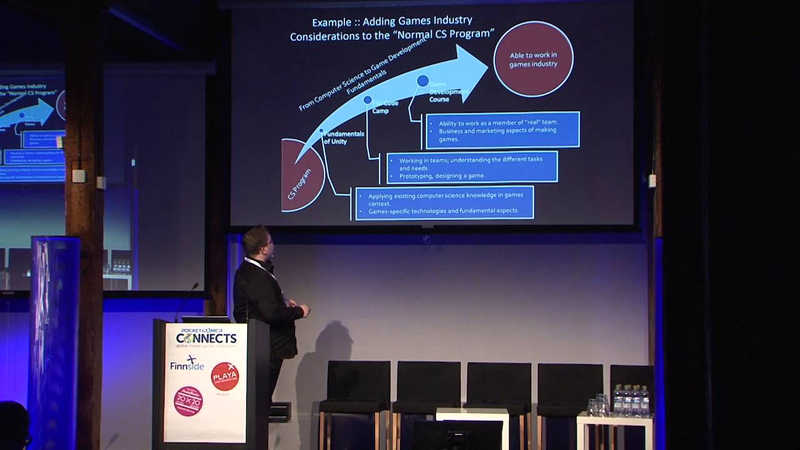
they would actually have an idea on what to do similarly based on our survey we knew for example that scrum is something that game companies tend to use when they are talking about the managed uh development processes so we decided to add more scrum on our software engineering courses simply to give the people more ideas on how the industry is working or lower the learn burning curve of entering the uh game industry so on this uh idea I draw a road map this is something that's basically done on a Sho string budget it's an addition to normal or traditional computer science program it can also work on top of any information systems program so this is something that you can expect to function on any University or
original University which has something to do with computer science so if you are trying to uh get your local University involved in your game cluster you can say that this actually is something you can do so basically three courses on the first one we teach the fundamentals of well Unity this time but it can be any framework which is considered useful so that people understand the game specific Technologies and fundamental aspects of doing games I know that the well the games industry and software industry aren't that far from each other but still we know that there's certain aspects in games which are completely different from making mobile applications or other sorts of software like artificial intelligence um real time multiplayer uh on several different uh uh platforms or with between several different users or
uh 3D mathematics and 3D Graphics these are things that are also done in Mobile well application development but it's much much more common in games okay so if we covered the basics on this here then we put people to work together there's a very ex excellent uh event in Finland The Finnish game Jam which is also jointly arranged with the global game Jam so we can use this to make people form groups understand the different tasks uh do game design by prototyping and finally offer an self- assisted course on game development on this course we are all actually also applying our business school and uh uh faculty of industrial engineering so not only do we expect our students to create a well something
let's say uh not released release version of their game but and also expect them to draft up uh business plan and marketing plan and sort of have everything else but the paperwork done if they would be founding a company so this sort of and this takes one year this three courses are designed so that you can take everything within one year so if you decided that okay now I want to go to the games industry then you just go through this Pipeline and the other stuff like Java or C++ or memory management of software engineering stuff testing stuff quality assurance is taught you in the basic program which is here so it doesn't make you game industry professional by any means but it makes an engineer uh crudely said it makes a Nokia engineer into something that can
live in the games industry quite nicely okay so uh couple of things I just want to mention since I've spent some time on my uh first half of my presentation is also that well uh we are sort of a uh human wave tactics of univer uh of University I mean with this approach that we if we find a new and interesting thing to try out as a university we can always uh send out people doing their bachelor's thesis or Master's thesis on these topics so why not uh arrange it so that these people can actually do their Master's thesis and bachelor's thesis as internships in companies it solves the startup company's problem of having no people or having no developers and having just full Pro
Force of development work our University solved the problem of having places to put our master's thesis students and finally the thesis student has some place relevant in the industry to do their work so everyone wins in this scenario also like I said earlier uh if there's if it's possible to apply the interested people people uh in games development from companies from anywhere as uh teaching assistants or guest lecturers we can try to help these startup companies to get money to participate for example in some uh well trade uh conferences for example games development game developer conferences or games connections or any other places like here I know that the train ticket from LA to here is well is not that much but combine the train ticket and hotel
room for two nights it's a it's a cost that sometimes as impossible as it sounds is beyond what uh student group or complete uh seed startup company can afford or can afford easily also uh provide contacts so that these uh seed companies or startup seeds get into talks with investors and funders and people uh for example uh with people from Kor as soon as possible so that they find the contacts needed to secure funding it's not that difficult I mean for myself it's a forwarding email and possibly uh calling afterwards so our results I said earlier that I'm not going to use this entire presentation congratulating myself on
conducting This research work but uh well our idea of doing something that's actually relevant uh somewhat paid off so we were working with a budget of 200,000 for three years so keep in mind that of course this wasn't the only money we also had more funding from the game cluster but this is the this was the focused money for our University and on my perspective with that sort of money we were helping to create five new local game companies and 50 new jobs in the region which haven't persist which are going to persist even after the uh project has ended so it may not be something that gives me the gives me or the region of La uh that uh much uh possibility to Market ourselves as the central Hub of the northern European
game uh scene but it's definitely better result than what could be expected from normal university involvement in research project and of course this is not only the this is obviously not the only thing we were doing I wasn't only doing this besides these uh industry uh cooperation and marketing work and teaching work we were also so conducting the normal research project our idea to approach this was the gameing industry from the Viewpoint of software engineering or more or less saying that asking the question what uh do we already know from software development and what can we use from software development knowledge to help support games industry so I drafted a wordcloud this is from all
our uh project Publications and reports and discussions and as you can see uh there's huge wealth of different topics cover covered of course the development and objectives are fine I guess we were doing something with games but also pointing out there's business there's testing there's budget work there's quality aspects uh there's industry aspects modeling work or artificial intelligence programming uh all the different sort of things which uh are covering the games industry from as many angles as possible so that we can actually uh help our local companies to evolve and also uh have a sort of a faintest idea on what to do with the uh well 100,000 ,000 uh mobile systems
developers who have recently found out that they might need some other work for example in the games industry so uh finally I'm going to put this here so this address here uh has all our Publications all our results all our uh any well basically anything worthwhile to show into to people it's already there it's publicly available go see it we will we are talking there about what we should be teaching to uh game developers in addition of what we already teach to software Engineers also some prototypes for games stuff like that really interesting version of pickup uh pickup 52 I made that myself unfortunately and that sort of stuff so my name was yusur will probably also be
after this presentation but thank you for listening and have a nice rest of the event thank you [Applause]
Summary
The integration of regional universities into local game industry clusters serves as a vital catalyst for startup growth, particularly in regions facing economic downturns. By shifting the traditional academic focus from purely theoretical research to practical, industry-aligned support, universities can effectively bridge the resource gap for early-stage game developers. Startups typically require financing, talent, professional contacts, specialized tools, and physical office space—resources that universities are uniquely positioned to provide through existing infrastructure and academic networks.
The methodology for this collaborative model involves leveraging university resources to lower the barrier to entry for new companies. By utilizing regional university budgets to fund "game business hatcheries," institutions can provide startups with essential office space, equipment, and access to industry-specific software licenses. Furthermore, universities can facilitate talent pipelines by integrating industry-relevant curricula—such as Unity development, 3D mathematics, and agile project management—into standard computer science programs. This approach also creates a symbiotic relationship where students gain practical experience through internships and thesis projects within these startups, while the companies benefit from a steady stream of skilled labor.
Evidence from a three-year, 200,000-euro project in the Lappeenranta region demonstrates the efficacy of this model. By focusing on direct industry support rather than traditional, slow-moving academic peer-review cycles, the initiative helped launch five new game companies and created 50 sustainable jobs. The project successfully combined academic research on software engineering and quality assurance with hands-on business mentorship, proving that regional universities can act as essential hubs for economic development. Ultimately, the thesis is that universities must actively adapt their resources to meet the immediate, practical needs of the game industry to foster long-term regional growth and innovation.

























Comments