Updated Mar 17, 2026 by Video Games Europe
What can I help with?
AI-powered answers with citations from the library.
What can I help with?
AI-powered answers with citations from the library.
Legal · January 1, 2025
Published by Video Games Europe
A coalition of European and international industry associations representing technology, media, banking, hospitality, travel, e‑commerce and fintech firms has voiced collective concern over the proposed unconditional refund right for merchant‑initiated transactions (MITs) in the EU Payment Services Regulation. The central argument is that extending the eight‑week unconditional refund provision, originally designed for SEPA Direct Debits (SDDs), to all MITs would create an unbalanced regulatory framework that undermines legal certainty, increases fraud risk and jeopardises the sustainability of many business models across the European economy. The coalition points to existing consumer protections under PSD2, which already grant an unconditional eight‑week refund for SDDs and a conditional dispute right for MITs, as sufficient. It cites a 2024 consumer fraud survey indicating that 40 % of adults admitted to some form of online fraud in the past year, 45 % view exploiting policy loopholes as acceptable, and 26 % regularly use multiple accounts to obtain free digital content. Extending unconditional refunds to MITs would likely amplify these behaviours, exposing merchants to systematic refund claims for goods and services already consumed. Sector‑specific analysis highlights heightened vulnerability for digital content providers, hospitality operators and subscription‑based e‑commerce services, where unconditional refunds could erode revenue predictability, increase operational costs and strain smaller merchants. The coalition warns that such outcomes run counter to EU objectives of supporting SMEs and maintaining a trustworthy payments ecosystem. The position urges legislators to retain the refund right exclusively for SDDs, rely on the existing PSD2 dispute mechanisms, and await the forthcoming Digital Fairness Act before introducing additional consumer‑protection measures in payments law.
Joint Industry Statement — Broad industry coalition voices concerns over unbalanced refund right in the EU Payments Services Regulation Our associations represent European and international companies from a wide range of sectors — including technology, culture, media, content providers, banking, hospitality, travel, e-commerce and fintech. In the context of the Trilogue negotiations on the EU Payment Services Regulation (PSR), we wish to express collective concern about the proposed introduction of an unconditional refund right for merchant-initiated transactions (MITs) under Article 62(1). The European Parliament has recognised the inherent risks of this measure and excluded MITs from the scope of the refund right in its text, while maintaining it for SEPA Direct Debits (SDDs). We urge the co-legislators to uphold the Parliament’s approach, ensuring that the PSR protects consumers without undermining trust, legal certainty, and sustainable business models across the European economy. Under PSD2, consumers already benefit from two distinct protections: an unconditional eight-week refund right for SDDs and the ability to dispute MIT payments, under certain conditions, within the same timeframe (Article 76). Extending an unconditional refund right originally designed for SDDs to all MITs overlooks crucial differences between these transaction types and existing consumer law safeguards. It would also remove the ability of merchants to challenge disputes, creating an inherently unbalanced regulatory framework.
ng an unconditional refund right originally designed for SDDs to all MITs overlooks crucial differences between these transaction types and existing consumer law safeguards. It would also remove the ability of merchants to challenge disputes, creating an inherently unbalanced regulatory framework. MITs and SDDs are fundamentally different payment methods that merit distinct treatment. Extended refund rights for SDDs are appropriate because they are post-order guarantees, customers have limited control over debiting from their account (albeit with their prior authorisation) and a need to prevent misuse. MITs, however, already feature robust safeguards through strong customer authentication and existing dispute rights under PSD2. Applying identical refund rules to MITs and SDDs would have far-reaching consequences — incentivising abuse and exposing merchants to systematic refund claims for goods, content and services that have already been consumed. It would also substantially increase operational costs across the entire payment processing chain. An economy-wide fallout MITs have a much wider variety of use cases than SDDs — from streaming and press subscriptions to hospitality services and e-commerce — and their use by merchants of all sizes is on the rise. Smaller merchants would be particularly exposed to the cumulative effect of repeated refunds and chargebacks, which could create significant operational and financial burdens and ultimately run counter to the EU’s wider objective of supporting SMEs.
ir use by merchants of all sizes is on the rise. Smaller merchants would be particularly exposed to the cumulative effect of repeated refunds and chargebacks, which could create significant operational and financial burdens and ultimately run counter to the EU’s wider objective of supporting SMEs. Recent research underscores the scale of potential misuse. According to Ravelin’s 2024 Customer Fraud Survey,<sup>1</sup> 40% of adult consumers admitted to some form of online fraud in the past year, with 36% considering it in the future. Nearly half (45%) consider it acceptable to exploit policy loopholes, often because it was perceived as easy. The same study found 1Ravelin, Friendly fraud trends: Brazen consumer attitudesrevealed in Ravelin’s Consumer Fraud Survey, 11 April 2024, https://www.ravelin.com/blog/friendly-fraud-trends-survey-report.
that 26% of adults regularly use multiple accounts to take advantage of promotions or to access digital content for free. Introducing an unconditional refund right for all MITs in the EU would unintentionally amplify this behaviour, exposing a wide range of sectors to higher fraud risk and eroding trust in legitimate refund mechanisms. For example, digital content providers are likely to face situations where people sign up for a service, consume large amounts of copyright-protected content, and then request a full refund weeks later — with no ability for merchants to contest the claim. Providers would still be required to pay royalties to rightsholders for content consumed during that 8-week period. Similarly, in the hospitality sector, businesses would have less protection against “no-shows.” Hotels often depend on prepayments, deposits, or post-stay MITs (for damages or extras). If guests can unconditionally request refunds, it would undermine revenue predictability and fair cost recovery. E-commerce subscription services allow automatic recurring deliveries of everyday items like food and household supplies. These services often include loyalty benefits and savings programs. As this is managed as an MIT, with an 8-week unconditional refund right customers would be able to use the benefits associated to the program and receive goods eg. weekly without merchants being able to contest a possible refund claim.
services often include loyalty benefits and savings programs. As this is managed as an MIT, with an 8-week unconditional refund right customers would be able to use the benefits associated to the program and receive goods eg. weekly without merchants being able to contest a possible refund claim. These are just some examples of the risks associated with this measure, but the impact is likely to be economy-wide. This is why the EU’s refund framework must remain proportionate, balanced, and aligned with existing safeguards — protecting consumers while protecting business sustainability and Europe’s payments ecosystem. Strong safeguards are already in place We believe that existing safeguards already provide robust recourse. Consumers have a conditional refund right under PSD2 for unauthorised or disputed MITs and can engage with merchants directly for legitimate complaints or service issues. Under existing card payment schemes, consumers benefit from robust dispute and refund mechanisms, including chargebacks, which allow them to reclaim funds for unauthorised or faulty transactions through their payment service provider. Refund rights are also governed under EU consumer law, with the Consumer Rights Directive (Article 11) already providing a targeted framework to enhance transparency and user control in subscription-based transactions.
for unauthorised or faulty transactions through their payment service provider. Refund rights are also governed under EU consumer law, with the Consumer Rights Directive (Article 11) already providing a targeted framework to enhance transparency and user control in subscription-based transactions. We see no clear evidence to support the extension of an unconditional refund right to MITs. Moreover, consumer protection and digital contract rules will be subject to a comprehensive review under the forthcoming Digital Fairness Act, making intervention through payments legislation both premature and potentially duplicative or contradictory. Introducing an unconditional mechanism on top of existing protections rebalances risk entirely onto merchants, encouraging misuse rather than trust. To ensure a balanced and fraud-resistant payments ecosystem, an unconditional refund right should remain limited to SDDs, as under PSD2. We urge the co-legislators to adopt the European Parliament’s position and remove MITs from the scope of Article 62(1) and Recital 109. We remain committed to constructive dialogue on this important issue going forward.
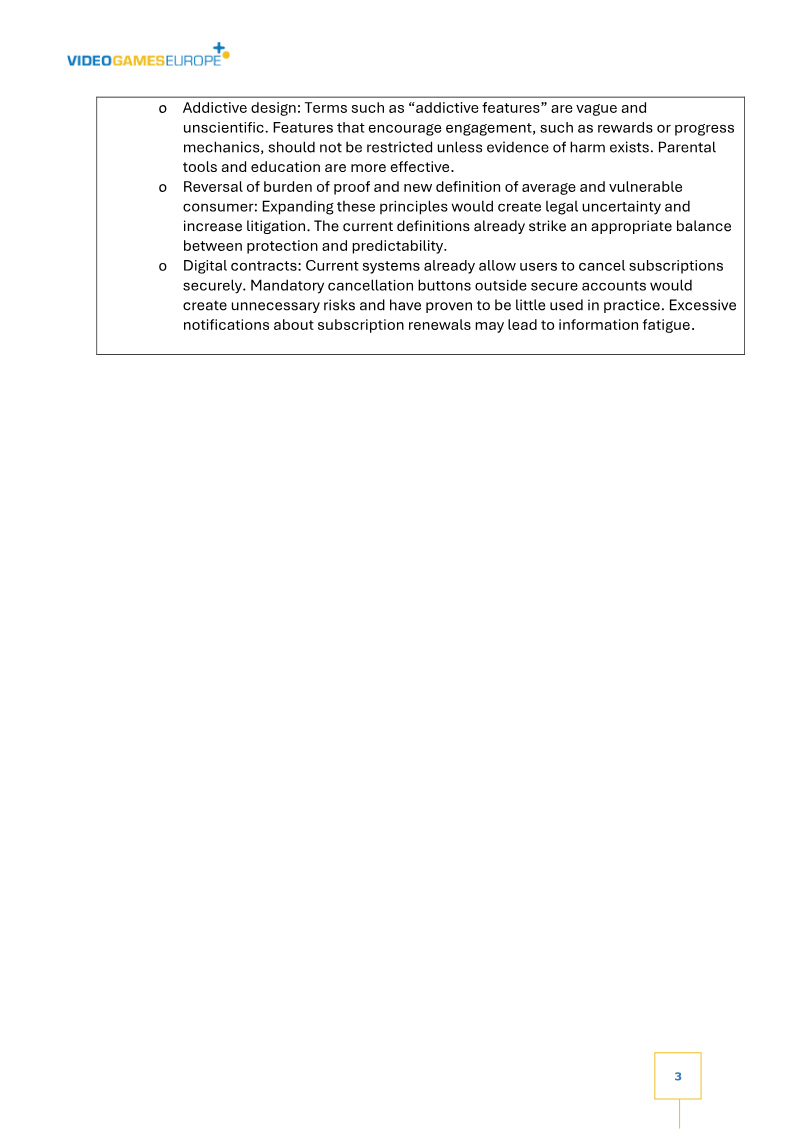
The analysis contends that the existing EU consumer‑protection framework is already adequate for ensuring digital fairness in the video‑game sector and should be fully deployed before any new legislation is considered. It calls for a coordinated, holistic approach that aligns the 2021 Guidance on digital services and the enforcement powers granted by the Omnibus Directive, and urges the European Commission to publish clear, ex‑ante guidelines on fair commercial practices. The industry’s self‑regulatory PEGI system, which enjoys roughly three‑quarters consumer awareness and provides age‑appropriate ratings, is presented as a cornerstone of this coordinated framework. Evidence is offered that the current acquis effectively bans manipulative tactics such as bait‑and‑switch and false testimonials, with notable success in the gaming market. Coordinated actions by national consumer protection authorities on in‑app purchases during 2013‑14 and the Italian competition authority’s 2020 commitments on loot‑box transparency illustrate the system’s capacity to curb unfair practices. The analysis warns that forthcoming rules could duplicate or undermine these established mechanisms. A specific argument is made regarding in‑game currencies, which are characterised as non‑convertible digital content lacking real‑world monetary value. Accordingly, they should be exempt from “monetary equivalence” regulations, provided that transparency is achieved by displaying the real‑currency price at the point of purchase and clearly informing players of the transaction details. The overall recommendation is to rely on the existing EU consumer‑protection instruments, reinforced by industry self‑regulation, to safeguard digital fairness across the European video‑game market.
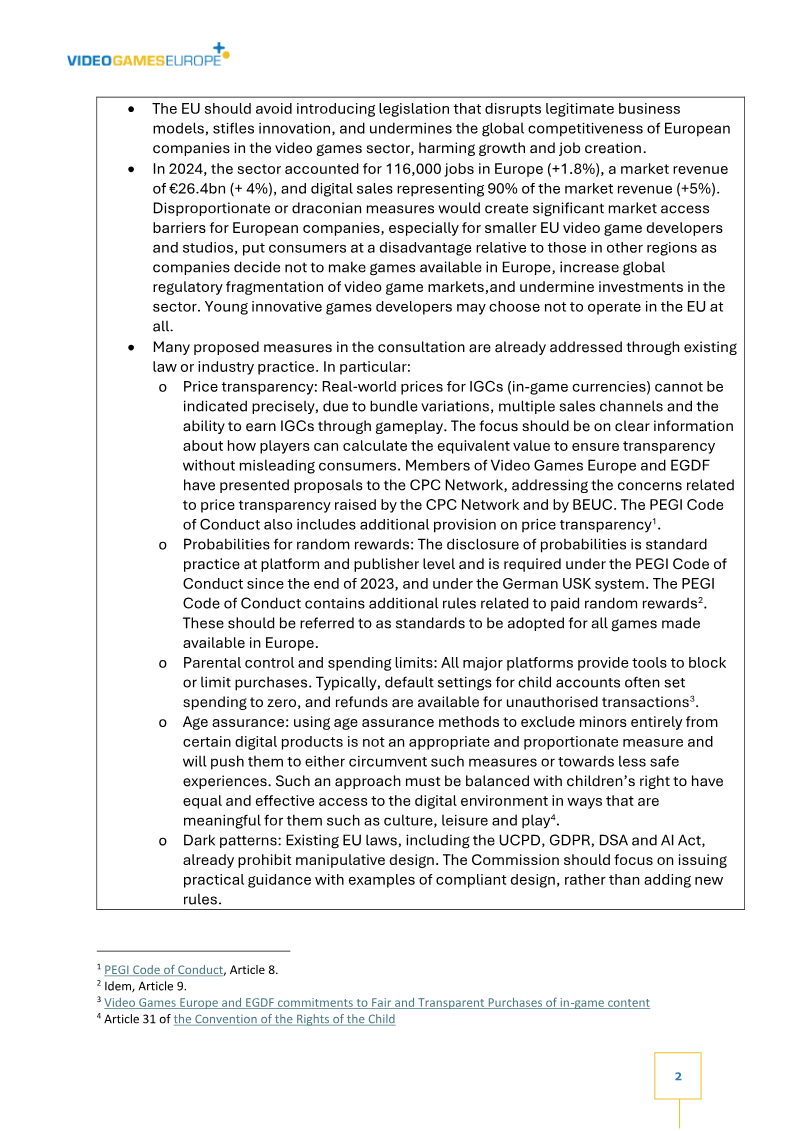
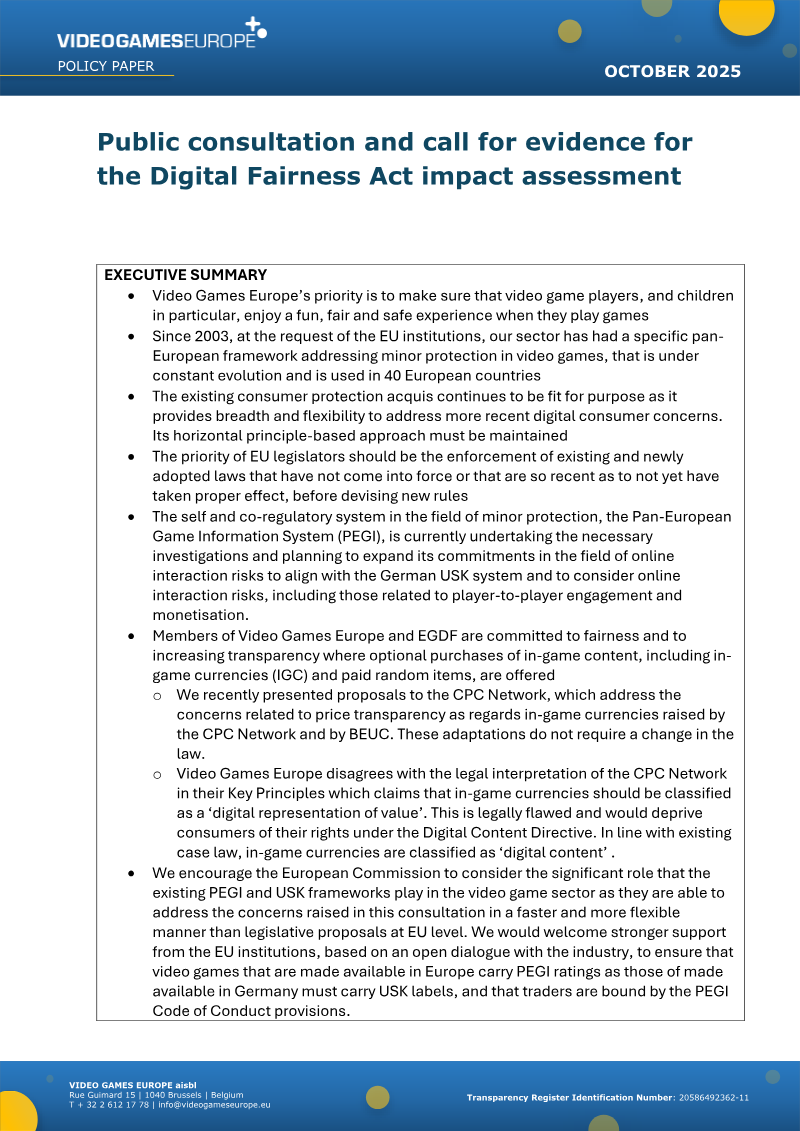
The response to the public consultation on the Digital Fairness Act argues that the European Union’s existing consumer‑protection framework, together with the continent‑wide PEGI rating system and Germany’s USK scheme, already delivers the breadth, flexibility and enforcement capacity required to safeguard minors and ensure transparency for in‑game currencies and loot‑box‑type rewards. By emphasizing self‑ and co‑regulatory measures—clear real‑world cost calculations for virtual currencies, mandatory disclosure of reward probabilities, 48‑hour refunds for unused purchases and robust, default‑zero‑spend parental‑control settings—the industry contends that new, draconian legislation would jeopardise a sector that generated €26.4 billion in 2024. Empirical evidence underpins the argument that current safeguards are effective: only about 18 % of children are permitted to buy in‑game items, 95 % of purchases are supervised, 79 % of parents recognise PEGI labels, and 80 % are familiar with USK age ratings. Survey data also show that parental‑control tools now allow consent to data processing, limit communication and content sharing, and are audited by self‑regulatory bodies such as USK. Multilingual awareness campaigns have been deployed across 16 EU countries, partnering with family and media‑literacy organisations to promote joint play and responsible spending. The industry further maintains that the EU’s Consumer Rights Directive, Digital Content Directive, Data‑Protection Regulation, AI Act and Digital Services Act already cover “dark‑pattern” and vulnerability‑targeting practices. It calls for concrete, industry‑co‑created guidance rather than expanded definitions that could dilute legal certainty and impose disproportionate compliance costs, especially for subscription‑cancellation mechanisms. Reclassifying in‑game currencies as “digital representations of value” would strip existing protections and generate an impractical proliferation of contracts. Overall, the position presented seeks to preserve the balance between consumer information, the right of withdrawal and market innovation, urging legislators to enforce and refine current rules while supporting the video‑games sector’s self‑regulatory governance structures that span the EU and address both economic and child‑protection concerns.
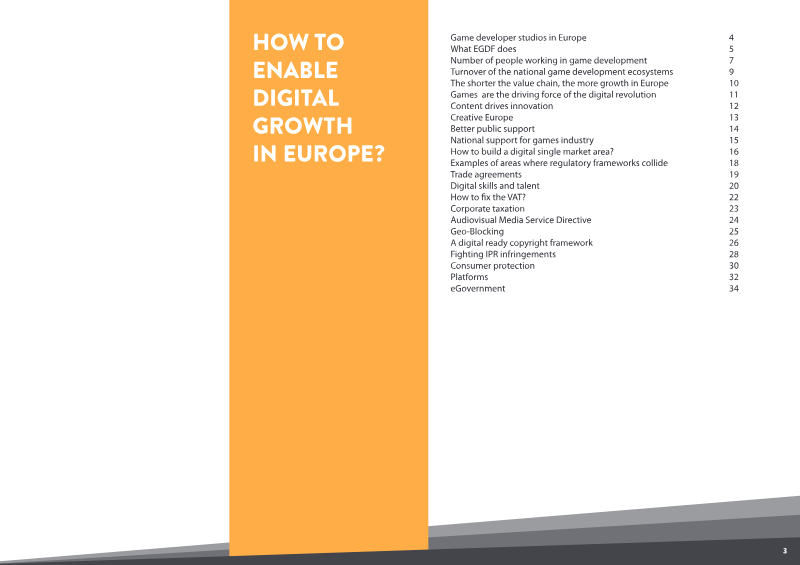
HOW TO Game developer studios in Europe 4 What EGDF does 5 ENABLE Number of people working in game development 7 Turnover of the national game development ecosystems 9 DIGITAL The shorter the value chain, the more growth in Europe 10 Games are the driving force of the digital revolution 11 Content drives innovation 12 GROWTH Creative E...
Video Games Europe endorses the European Commission’s draft Directive on common rules promoting the repair of goods, framing the initiative as essential to the EU’s green transition and to more sustainable consumption of electronic products. The organization argues that the gaming sector, which generated €23.3 billion in revenue in 2020, employs around 90 000 people and reaches roughly 250 million European players—over half of whom use consoles—has already established effective repair and refurbishment practices that should inform the legislation. The core recommendation is that a replacement with a refurbished console be treated as equivalent to a repair, reflecting the voluntary agreement among major console makers (Sony, Microsoft, Nintendo) that provides authorised repair centres, a stock of refurbished units, and a typical repair turnaround of less than 14 working days. This approach is presented as both cost‑effective for consumers—repairs or refurbished replacements cost well below a new unit—and beneficial for the circular economy. The paper opposes the parliamentary proposal for mandatory loaned replacements during repairs, citing logistical complexity, fraud risk, and additional environmental burdens from extra shipping. It also welcomes the Commission’s decision to avoid fixed maximum repair times, preferring the “reasonable period of time” standard from Directive (EU) 2019/771, and supports retaining the current two‑year legal guarantee, noting that extending it would yield only 0.3 % CO₂ savings and negligible waste reduction over 15 years while imposing higher costs on firms. A market‑based pricing regime for repairs is advocated, arguing that price controls would channel demand to manufacturers and marginalise independent repairers. The organization cautions against expanding the scope to include batteries or imposing direct producer liability, recommending that such matters be addressed within the existing Batteries Regulation and consumer‑protection framework to avoid legal uncertainty. Overall, the submission seeks to align the right‑to‑repair rules with proven industry practices, ensuring environmental objectives are met without compromising consumer convenience or market competition.