1 free read left. Create a free account for unlimited reading + AI research.
Create free accountWhitepaper European Conference on Games Based Learning (ECGBL)
1 free read left. Create a free account for unlimited reading + AI research.
Create free accountWhitepaperEuropean Conference on Games Based Learning (ECGBL)
The authors say prior work on AI-assisted game development has focused overwhelmingly on entertainment and production workflows.
This paper investigates how generative AI tools, specifically OpenAI's GPT-3 for text generation and DALL-E for image creation, can be integrated into the design of educational games using the Unity engine. Prior work on AI-assisted game development has focused overwhelmingly on entertainment titles and production workflows, leaving the educational domain comparatively underexplored. The authors frame their inquiry around two research questions: the extent to which reinforcement-based AI can assist the educational game design process, and what role human content creators play when such tools generate material. The study's stated conclusion is that these integrations enrich the user experience and have potential to improve learning outcomes, though the evidence presented is qualitative and preliminary.
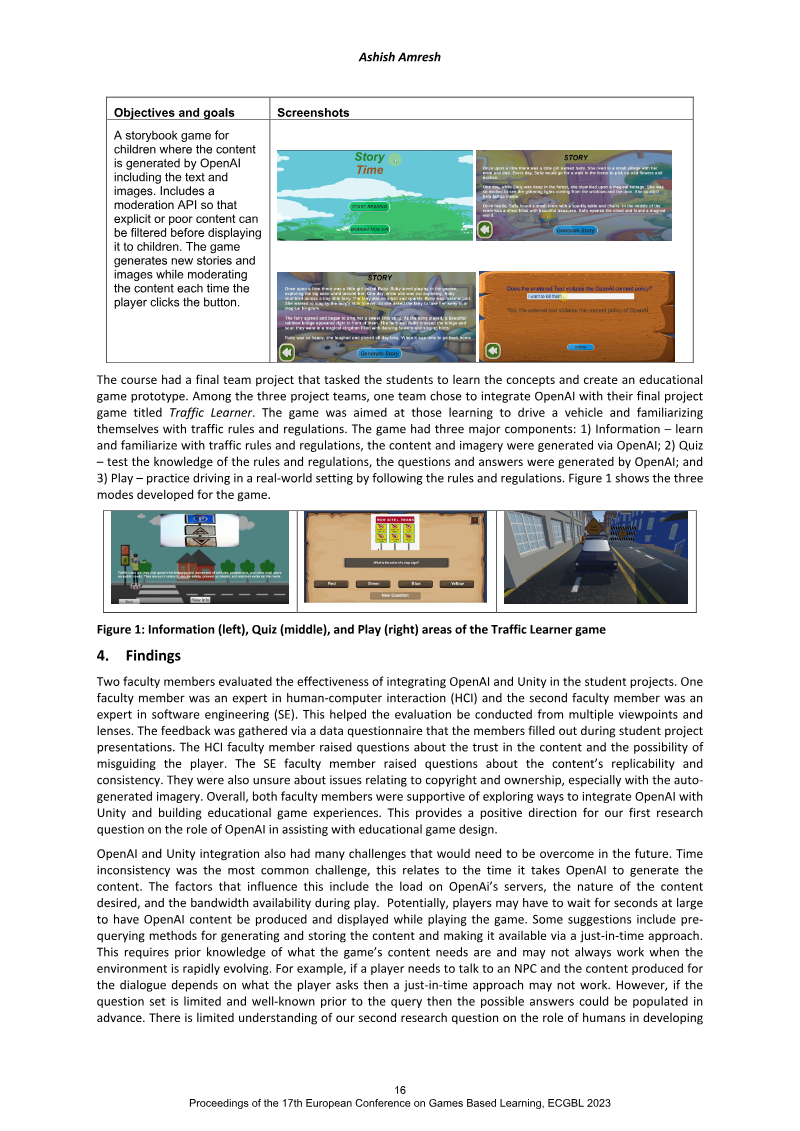
The empirical basis consists of ten computer science graduate students in a game-based learning course, who were given an OpenAI-Unity asset and three weeks to build educational components. Projects included a chemistry game in which AI-generated compounds and images support bonding-equation tasks, a Jeopardy-style quiz generator spanning history, science, and social studies, a moderated children's storybook, and a final team project called Traffic Learner covering driving rules through information, quiz, and driving-practice modes. Two faculty members, one in human-computer interaction and one in software engineering, evaluated the work through questionnaires completed during presentations. Their concerns centered on trust in generated content, the risk of misleading players, replicability and consistency, and copyright and ownership of AI-generated imagery, though both supported continued exploration.
The authors identify time inconsistency as the most common technical challenge, since response latency depends on server load, content complexity, and bandwidth, which can cause visible delays during play. Suggested mitigations include prequerying and caching content or using just-in-time generation when interactions are predictable. The authors acknowledge that their second research question remains only partially answered, noting that human-AI collaboration is necessary in some contexts while full automation may become feasible as the technology matures. The paper proposes extending the content-agnostic game engineering framework with AI-generated content and stealth assessment in a cyclical adaptive loop, while noting limits around quality control, accuracy, and ambiguity.
Each row is a game or company this document names, each column a document, oldest first. A mark means that document names it. Select a row to see those documents.



European Conference on Games Based Learning (ECGBL) · 2026



European Conference on Games Based Learning (ECGBL) · 2026



European Conference on Games Based Learning (ECGBL) · 2026



European Conference on Games Based Learning (ECGBL) · 2026



European Conference on Games Based Learning (ECGBL) · 2026



European Conference on Games Based Learning (ECGBL) · 2026



European Conference on Games Based Learning (ECGBL) · 2026



European Conference on Games Based Learning (ECGBL) · 2026



European Conference on Games Based Learning (ECGBL) · 2026



European Conference on Games Based Learning (ECGBL) · 2026



European Conference on Games Based Learning (ECGBL) · 2026



European Conference on Games Based Learning (ECGBL) · 2026
European Conference on Games Based Learning (ECGBL) · 2026
European Conference on Games Based Learning (ECGBL) · 2026
European Conference on Games Based Learning (ECGBL) · 2026