1 free read left. Create a free account for unlimited reading + AI research.
Create free accountWhitepaper European Conference on Games Based Learning (ECGBL)
1 free read left. Create a free account for unlimited reading + AI research.
Create free accountWhitepaperEuropean Conference on Games Based Learning (ECGBL)
Earlier studies reported gains in social skills and communication but had not examined quality of life or been tested in France.
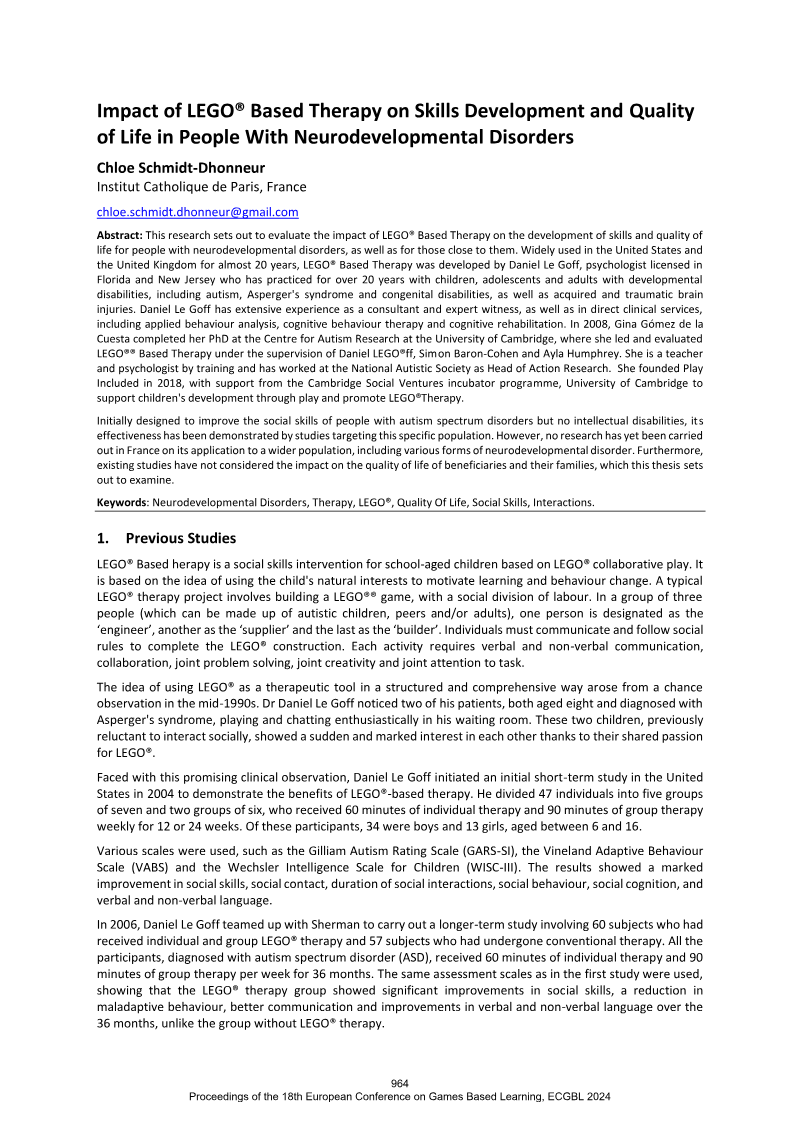
This thesis evaluates whether LEGO® Based Therapy, a structured social-skills intervention that uses collaborative LEGO® construction, can benefit people with neurodevelopmental disorders beyond autism, and whether it improves quality of life for beneficiaries and their families. Prior research, largely from the United States and United Kingdom and centred on autistic children, had reported gains in social skills and communication but had not examined quality of life or been tested in France. The author developed a 15-hour training module and a bespoke evaluation grid covering pre-construction, construction, language and vocabulary, and social skills, then trained 317 learners who delivered the therapy to 76 practitioners' service users between February 2022 and June 2024.
After excluding incomplete records, the analysis drew on 108 participants aged roughly 5 to 88, with diagnoses spanning ADHD, autism, dys disorders, epilepsy, dementia, Down's syndrome, schizophrenia and others. Individual and group formats were compared by age group. Individual sessions appeared more effective for children aged 5 to 7 in language and vocabulary and for young adults aged 18 to 25, while group sessions seemed more beneficial for most other age groups. Progress varied by diagnosis, with participants who had ADHD, often alongside other conditions, showing notable gains in several domains, and participants with schizophrenia showing the least change, likely because their baseline scores were already high, suggesting the grid may not suit that level of functioning.
Quality of life was measured with the PedsQL scale, completed by children and parents before and after sessions, in a subsample of 67 subjects. Children reported improvements in emotional well-being and social relationships in most cases, with over 70 to 80 percent noting gains in these areas, and more moderate changes in physical and academic functioning. Parents perceived benefits mainly in emotional and academic domains, a divergence the author attributes to differing vantage points. Group sessions were associated with somewhat stronger perceived improvements than individual sessions.
The study has notable limitations that the author acknowledges. Its sample was small and uneven across age and diagnostic groups, no control group was used, the custom grid lacked clear scoring guidance for receptive versus expressive skills, and the PedsQL scale was validated for child health populations rather than for this intervention. Conclusions about efficacy should therefore be read as preliminary, though the author argues the results support wider clinical adoption of L
Each row is a game or company this document names, each column a document, oldest first. A mark means that document names it. Select a row to see those documents.



European Conference on Games Based Learning (ECGBL) · 2026



European Conference on Games Based Learning (ECGBL) · 2026



European Conference on Games Based Learning (ECGBL) · 2026



European Conference on Games Based Learning (ECGBL) · 2026



European Conference on Games Based Learning (ECGBL) · 2026



European Conference on Games Based Learning (ECGBL) · 2026



European Conference on Games Based Learning (ECGBL) · 2026
University of Toronto · 2026



European Conference on Games Based Learning (ECGBL) · 2026



European Conference on Games Based Learning (ECGBL) · 2026



European Conference on Games Based Learning (ECGBL) · 2026



European Conference on Games Based Learning (ECGBL) · 2026
European Conference on Games Based Learning (ECGBL) · 2023



European Conference on Games Based Learning (ECGBL) · 2026
European Conference on Games Based Learning (ECGBL) · 2026