
Market (Overall)·Updated Apr 8, 2026 by Newzoo
What can I help with?
AI-powered answers with citations from the library.
What can I help with?
AI-powered answers with citations from the library.
Report · January 1, 2025
Published by Newzoo
The Global Games Market Report 2025 projects a steady expansion of the worldwide player base to 3.6 billion, with payers rising to 1.6 billion and total revenue reaching $188.8 billion, a 3.4 % increase year‑over‑year. Mobile dominates growth and revenue, contributing $103 billion (55 % of the market) and expanding 4.5 % YoY, while PC and console follow at 3.1 % and 2.5 %. The report notes that average spend per payer is expected to decline slightly through 2028 as the market matures, underscoring the importance of retention, innovative monetization and post‑launch content to sustain growth in an increasingly saturated ecosystem. Geographically, the Asia‑Pacific region leads with a 4.2 % YoY increase, and North America remains strong for console sales (5.4 %). Key growth drivers include the launch of Nintendo Switch 2, continued success of live‑service titles on PC, and a shift toward direct‑to‑consumer monetization in mobile. Discoverability challenges and content fragmentation are identified as notable hurdles across all platforms. Single‑player AAA titles released in the February–May window outperform those launched August–November by an average of 34 %, largely due to crowded holiday windows and cannibalization. Early Access titles that transition to full release within 4–9 months generate the highest new‑player lift, while staggered cross‑platform releases capture only about 13 % of the total player base. Player attrition drops sharply in weeks 2–5 and stabilizes after week 12, indicating that longer main‑story content (20–40 hours) and simulation elements help retain players over the long term. The commercial life of single‑player titles is increasingly driven by post‑launch content, strategic discounting and community engagement rather than initial premium spend. DLC revenue shares evolve over a game’s lifecycle, with genres aligning to specific monetization models and subscriptions gaining influence on long‑term engagement. Post‑launch content is identified as the key determinant of discoverability, retention and profitability across a game’s back catalogue. Methodologically, the report employs a top‑down, data‑driven model that blends proprietary engagement metrics (Game Performance Monitor, Steam data), public economic indicators and partner insights to forecast platform‑specific player, payer and revenue figures through 2028. The approach excludes taxes, hardware and gambling from revenue calculations and provides detailed platform‑by‑platform forecasts (PC, console, mobile, cloud, VR) alongside analytical tools for market segmentation, genre trends and post‑launch monetization strategies.
Contents 00 Foreword 03 01 The global games market 09 Players and payers 11 Revenues 15 Genre revenues 20 02 Special focus topics 27 #1 Play it again: Revisiting the past for modern success 29 #2 Modernizing release windows: Data-driven launch insights 31 #3 The $80 dilemma: A new price ceiling or too soon? 41 #4 The long game: How post-launch content fuels engagement 43 #5 Unboxing Roblox: User trends, genre insights, and strategic fit 45 03 The games market per region and country 47 04 Methodology and terminology 54 05 Work with Newzoo 64
A new chapter This year’s free edition of the Global Games Market Report marks a personal milestone, my first edition as Newzoo’s Director of Market Intelligence. Over the past few months, I’ve had the privilege of working alongside our team of seasoned experts, whose deep market knowledge and dedication have shaped every page of this report. Together, we’ve refined our approach to make this report more relevant, insightful, and valuable. Our focus has been on quality over quantity. We’ve aimed for clarity, impactful storytelling, and a strong balance between narrative, data, and visuals. Rather than covering too many things at a surface level, we’ve chosen five main topics to explore in greater depth. This approach delivers richer, more strategic perspectives that capture both the current state of the market and its forward-looking trends. As always, the report is built on strong data and designed for an engaged, professional audience; readers looking for answers to the questions that will guide their decisions in a fast-changing industry. This year’s Global Games Market Report marks the start of a new chapter, one with sharper focus and deeper insights. We’re excited for you to read this year’s free edition and, as ever, we welcome your feedback. Excelsior! Emmanuel Rosier Director of Market Intelligence
Foreword We are excited to welcome you to this year’s free The paid version of the report includes five edition of the Global Games Market Report, detailed special focus topics. Over the coming Newzoo’s premier publication and guide to our months, we will share extracts of three of these platform’s Games Market Reports & Forecasts topics. The five topics we analyzed are: tool. This report is designed to help you navigate a ✓ Remakes and remasters: Reviving classic IPs market where growth is harder won, but where has become a proven strategy for extending opportunities abound for those who act. Whether franchise lifecycles, generating reliable you’re seeking to benchmark performance, spot revenue, tapping into nostalgia, and emerging trends, or plan your next move, we hope strengthening brand value. you find the clarity, depth, and strategic angle you need. ✓ Release timing and launch strategies: The Finally, I want to thank the Newzoo team for their timing of a game’s release, early access period, dedication and expertise in making this report and platform exclusivity are crucial in come alive. maximizing player engagement and sales. ✓ Game pricing and value perception: Pricing, genre, and content length are key factors in Key themes this year: how players perceive value. As development
od, dedication and expertise in making this report and platform exclusivity are crucial in come alive. maximizing player engagement and sales. ✓ Game pricing and value perception: Pricing, genre, and content length are key factors in Key themes this year: how players perceive value. As development ✓ Moderate audience growth: The global player costs rise, publishers must carefully balance base will reach 3.6 billion in 2025 (+4.4% YoY), accessibility, profitability, and player but the share of the online population playing expectations. games is plateauing. Payer growth (+4.9%) ✓ Post-launch content and long-tail continues to outpace revenue growth, leading monetization: DLC, expansions, and ongoing to a slight decline in average spend per payer. updates are essential for sustaining ✓ Low to moderate all-round growth: Still, 2025 will bring some growth, with all platforms expected to see between 2% and 6% YoY growth in players and/or revenues. The market remains resilient and full of opportunity for those who adapt. engagement and revenue and helping to extend the commercial life of new games and remasters. ✓ Roblox, UGC, and the platform ecosystem: The growth of Roblox and user-generated content is reshaping how players engage and ✓ Platform dynamics: PC and console are, or will, how IP is built, signaling a shift toward more see renewed momentum, with PC player creator-driven, platform-centric models in the growth outpacing mobile and console. Cross- industry. platform releases, new hardware cycles, and the anticipation of titles likeGrand Theft Auto VI are reshaping the competitive landscape. Michiel Buijsman
d more see renewed momentum, with PC player creator-driven, platform-centric models in the growth outpacing mobile and console. Cross- industry. platform releases, new hardware cycles, and the anticipation of titles likeGrand Theft Auto VI are reshaping the competitive landscape. Michiel Buijsman Principal Market Analyst [email protected]
Contributors Michiel Buijsman Emmanuel Rosier Principal Market Analyst Director of Market Intelligence Tianyi Gu Mehmet Şahin Manager Market Analysis Jr. Game Analyst Tomofumi Kuzuhara Michal Kulijewicz Sr. Data Analyst Jr. Game Analyst Michael Wagner Horatiu Mitu Sr.Market Analyst Director of Marketing Brett Hunt Danjing Zhou Market Analyst Sr. Digital Marketing Manager Tiago Reis Inez Anema Market Analyst Jr. Designer
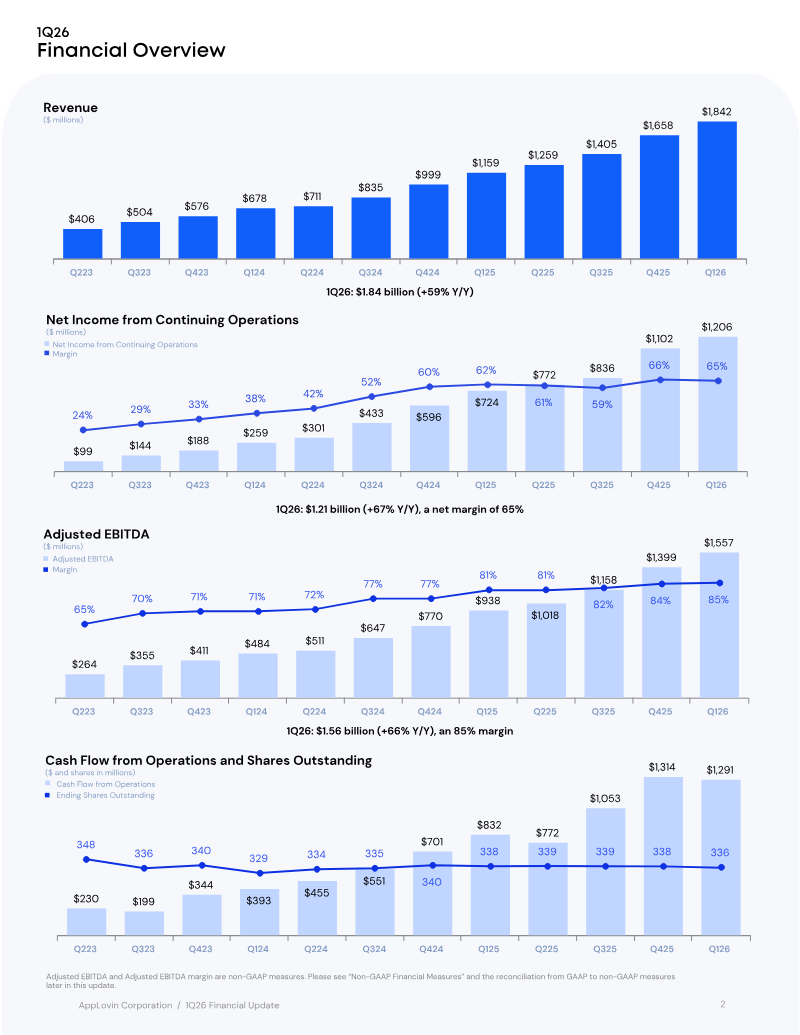
AppLovin’s Q1 2026 financial update reports a revenue of $1.842 billion, up 59% year‑over‑year, and net income from continuing operations of $1.206 billion, a 66% increase to a net margin of 65%. Adjusted EBITDA reached $1.557 billion, an 85% margin, reflecting a 66% rise from the prior year. Cash flow from operations matched Adjusted EBITDA at $1.556 billion, underscoring strong operating liquidity. Shares outstanding averaged 1.053 million, with diluted earnings per share of $3.56. The company’s balance sheet shows cash and equivalents at $2.759 billion, up from $2.487 billion, and total assets of $7.708 billion versus $7.260 billion a year earlier. Long‑term debt remained stable at $3.514 billion, while equity rose to $2.363 billion from $2.135 billion. Operating expenses grew modestly, with research and development increasing to $94 million from $56 million, while sales and marketing rose slightly to $60.8 million. Methodologically, the update presents both GAAP and non‑GAAP measures; Adjusted EBITDA is defined by excluding items such as stock‑based compensation, restructuring costs, and goodwill impairment. The reconciliation table shows cumulative Adjusted EBITDA margins climbing from 65% in Q1 2025 to 85% in Q1 2026, driven by revenue growth and controlled cost expansion. The update covers the United States market for Q1 2026, with data drawn from audited financial statements and internal reconciliations.
The 2026 State of Gaming analysis demonstrates a shifting landscape in which mobile gaming remains the largest driver of downloads—approximately 50 billion in 2025—but its growth rate is slowing. Revenue, however, continues to climb as monetization models mature and lifetime value deepens, especially within hybrid‑casual titles that now generate the most incremental income. In contrast, PC and console platforms experience record revenue growth, with Steam’s premium segment up 32 % and blockbuster releases such as Battlefield 6 capturing significant market share from incumbents. Shooter downloads on these platforms have plateaued, suggesting new titles are primarily cannibalizing existing audiences rather than expanding the category. Genre‑specific dynamics reveal that strategy games are the only mobile genre to grow in downloads, driven by 4X titles from Eastern developers. Action and shooter games dominate PC/console gains, while hyper‑casual remains the largest download engine but shows a notable lift in time spent, particularly in Tier 2 markets. Casual titles face declining day‑7 retention, indicating a stickiness challenge that could erode long‑term player value. Live‑ops and acquisition strategies have evolved toward retention‑focused events, multi‑tier season passes, and expedition‑style rewards. These mechanisms now represent the most reliable revenue drivers across competitive genres such as RPG, action, and simulation. Advertising spend remains concentrated on social channels—YouTube, Facebook/Instagram—and high‑attention formats like video, playable, and rewarded ads. Battlefield 6’s pre‑launch spend surpassed Call of Duty titles, leveraging Facebook, Reddit, and desktop display, while its post‑launch strategy pivoted to YouTube with cinematic, celebrity‑hook creatives. Geographically, the U.S. market shows a skew toward lifestyle and puzzle categories despite lower IAP shares, whereas casino titles exhibit higher spend‑to‑revenue efficiency. Overall, the industry is moving from acquisition toward deeper monetization per user, with indie shooters and simulation titles gaining traction amid intense competition in the shooter segment.
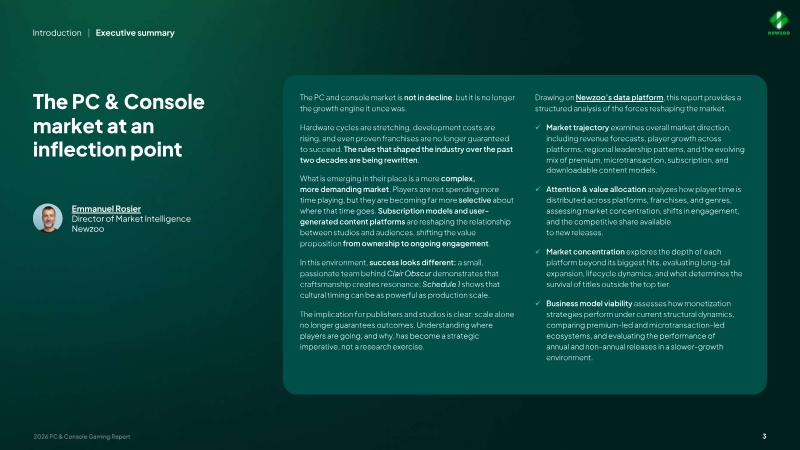
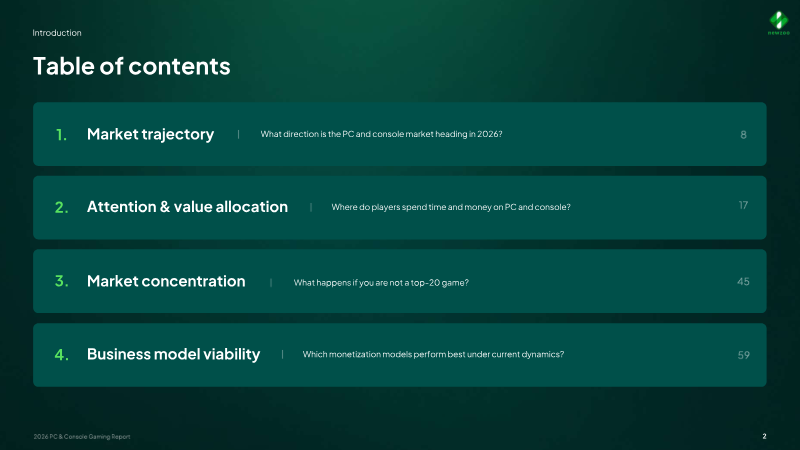
1. Market trajectory What direction is the PC and console market heading in 2026? 8 What direction is the PC and console market heading in 2026? 2. Attention & value allocation Where do players spend time and money on PC and console? 17 3. Market concentration What happens if you are not a top-20 game? 45 4.
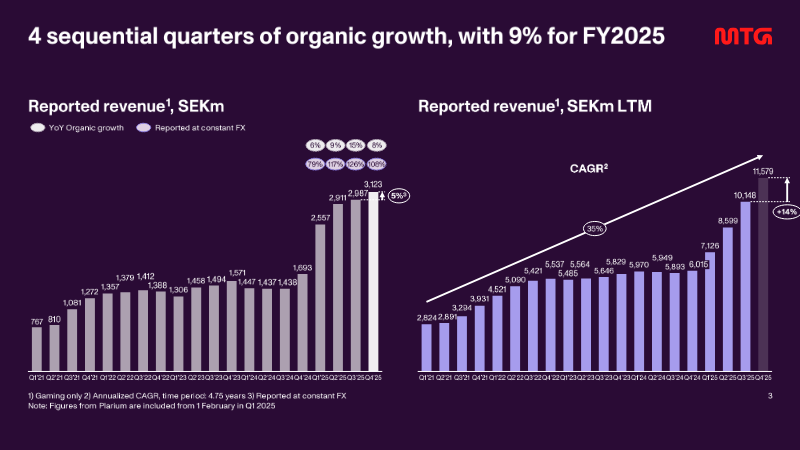
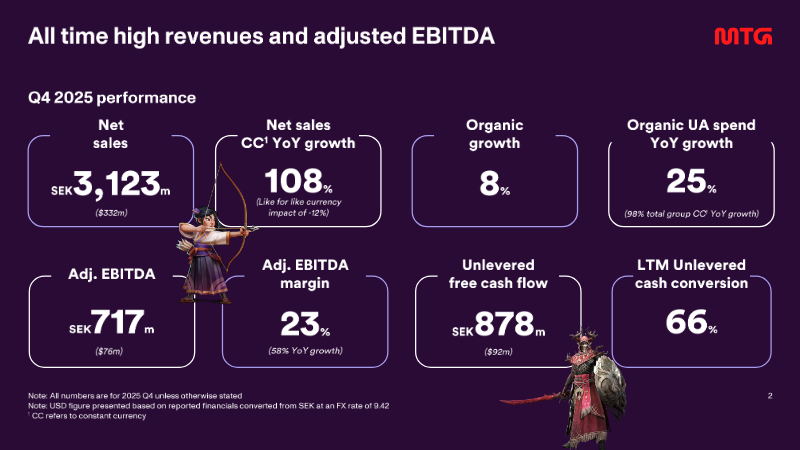
The interim filing presents the fourth‑quarter 2025 financial results for a midcore‑casual gaming group, emphasizing a record‑setting revenue run and the successful execution of a transformation agenda that includes the integration of the Plarium acquisition and the rollout of a new district structure in early 2026. Revenue reached SEK 3,123 million, reflecting 108 % organic growth year‑on‑year and a 25 % increase on a constant‑currency basis, while adjusted EBITDA rose to SEK 717 million, delivering a 23 % margin that matches the full‑year figure. Unlevered free cash flow amounted to SEK 878 million, with a cash‑conversion rate of 66 % and a leverage ratio of five times EBITDA, underscoring robust liquidity and disciplined capital management. User‑acquisition spending accelerated, representing 38 % of quarterly revenue—up from 37 % in the prior quarter—and grew 76 % on a reported basis, driven by heightened investment in original studios, new casual titles, and the racing franchise. The direct‑to‑consumer channel expanded by 600 basis points to 32 % of total revenue, reflecting a strategic shift toward higher‑margin in‑app purchases. Across the fiscal year, the company posted a 9 % organic revenue increase, with word‑games, racing, and RAID franchises delivering the strongest quarter‑end performance. Operating cash flow for the quarter stood at SEK 840 million, while adjusted net income was SEK 1,390 million, translating to an adjusted EPS of SEK 11.33. The financial outcomes exceed guidance and position the firm to meet its medium‑term outlook, with a pre‑IPO study for PlaySimple concluded and the midcore transformation progressing as planned.