Related Documents
Report
State of the Game Industry 2018
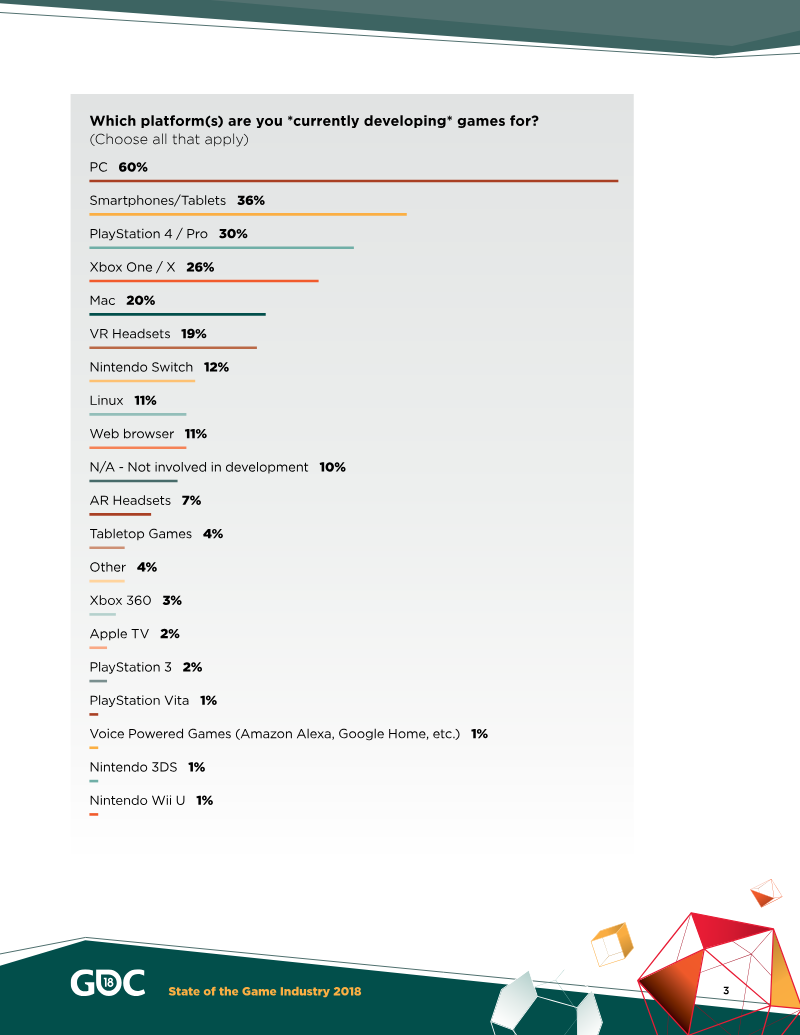
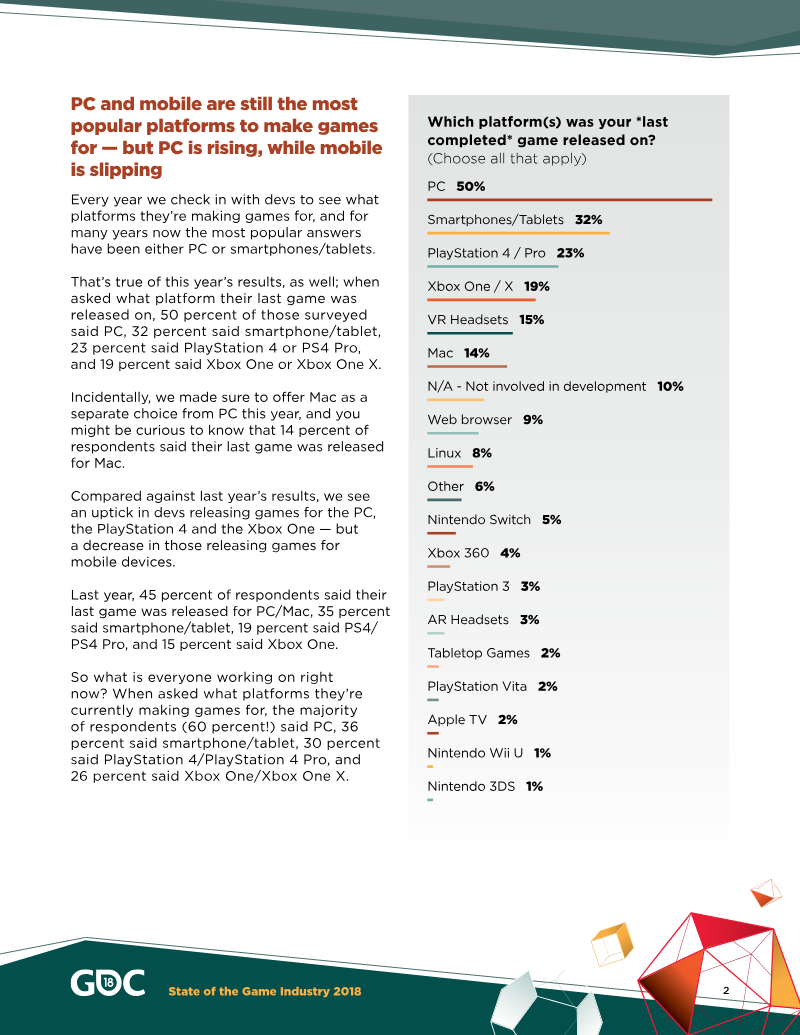
The 2018 State of the Game Industry report provides a comprehensive snapshot of the global game development landscape leading into GDC 2018. Based on a survey of nearly 4,000 game developers, the findings highlight a significant shift in platform preference, the maturation of the virtual reality market, and evolving monetization strategies. The survey sample primarily represents North America (63%) and Europe (22%), with a workforce largely composed of developers with three to ten years of experience. A primary thesis of the findings is the resurgence of PC and console development at the expense of mobile platforms. While PC remains the dominant platform—with 60% of developers currently creating titles for it—interest in smartphones and tablets has slipped to 36%. The Nintendo Switch emerged as a major industry force; developer interest in the console (36%) surpassed both Xbox One and mobile. Furthermore, 28% of developers who launched on the Switch reported sales that exceeded their average on other platforms, and 73% expressed confidence that the Switch would outsell the Wii U. The report indicates a cooling of enthusiasm for Virtual Reality (VR). For the first time in three years, faith in the long-term sustainability of the VR/AR business declined, with 29% of respondents expressing skepticism. While the HTC Vive remains the most popular headset for development, many creators believe VR will not reach the household penetration levels of traditional consoles until after 2030, if ever. Instead, 42% of developers anticipate that mobile-based immersive reality will be the dominant technology within five years. Regarding business operations, the industry remains heavily reliant on self-funding, with 83% of developers using company or personal funds. Despite the public controversy surrounding "loot boxes," approximately 11% of developers plan to include paid item crates in their next projects. Marketing remains a largely internal effort, as less than a quarter of developers work with external publishers. Social media was identified as the most effective tool for game discovery, while eSports reached a record high in perceived long-term sustainability at 91%.
Game Developers ConferenceMar 2018
Report
State of the Game Industry 2021
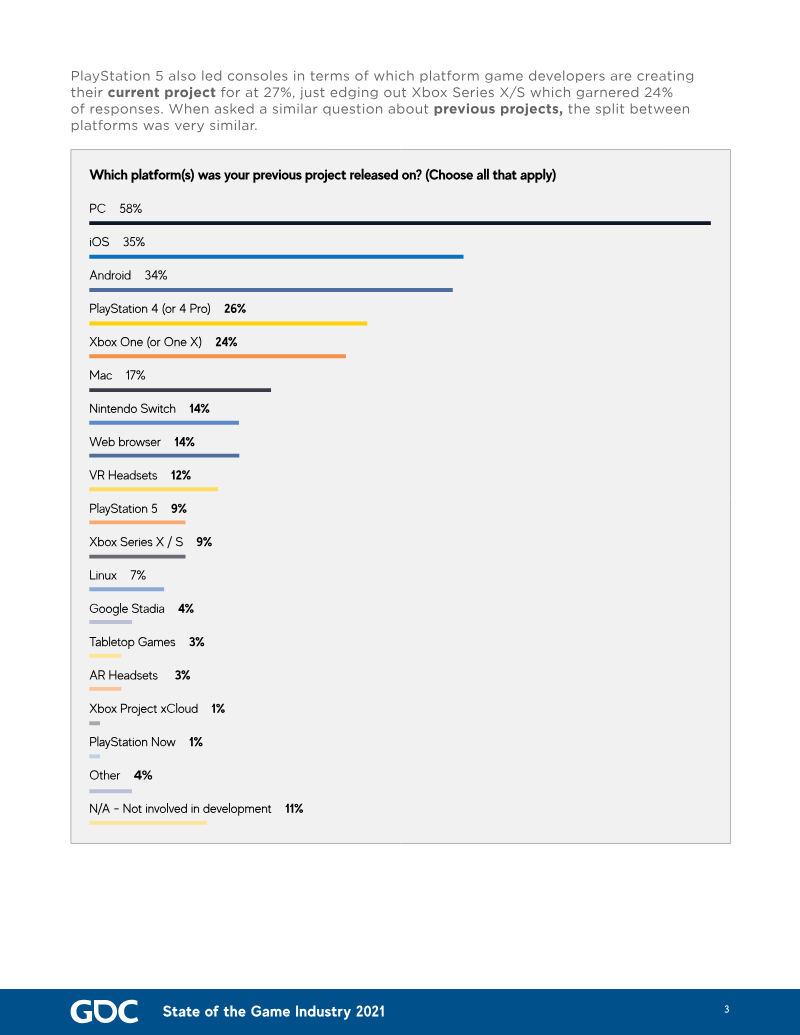
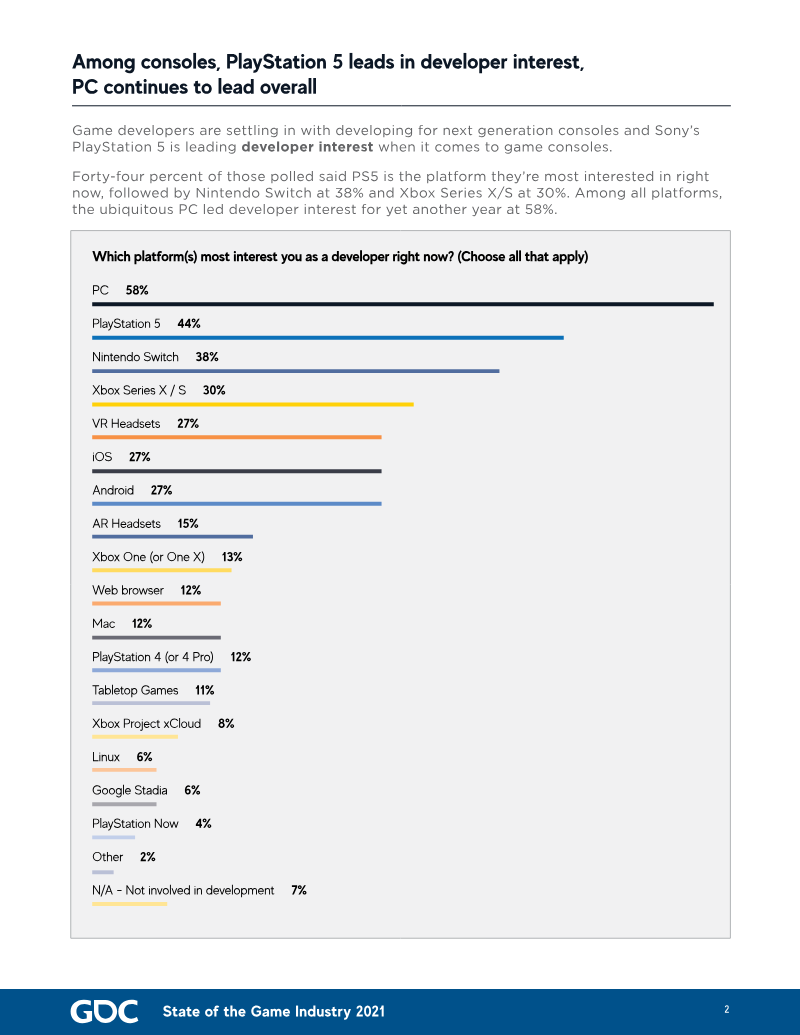
The global game industry entered 2021 characterized by a shift toward next-generation hardware and a complex transition to remote work environments. While the PC remains the foundational platform for development and revenue, the PlayStation 5 has established itself as the primary console of interest, capturing 44% of developer attention. Conversely, interest in immersive technologies has cooled, with VR and AR engagement dropping to 38% as the market consolidates around the Oculus Quest. Despite these platform shifts, a significant tension persists regarding digital storefront economics; only 3% of developers believe the traditional 30% revenue cut is justified, signaling a growing demand for more equitable distribution models. The operational landscape has been profoundly shaped by the COVID-19 pandemic, leading to a notable increase in project delays, which rose from 33% to 44% year-over-year. However, the shift to remote work has proven surprisingly effective, with 66% of professionals reporting stable or increased productivity. This transition has not eliminated long-standing labor issues, as 30% of the workforce still reports "crunch" weeks exceeding 60 hours. Consequently, support for unionization remains high at 51%, driven by a desire for better work-life balance and fair compensation within a workforce where 57% of developers have a decade or less of experience. Industry growth remains steady, evidenced by 47% of studios expanding their staff, yet demographic and social challenges persist. Although 60% of studios have initiated diversity and inclusion programs, the workforce remains 73% male, and only 31% of developers have implemented specific accessibility measures in their projects. As developers prioritize digital storefront promotion and word-of-mouth for discoverability, the industry continues to balance rapid technological adoption with the need for systemic improvements in labor practices and representation.
Game Developers ConferenceJan 2021
Report
State of the Game Industry 2017
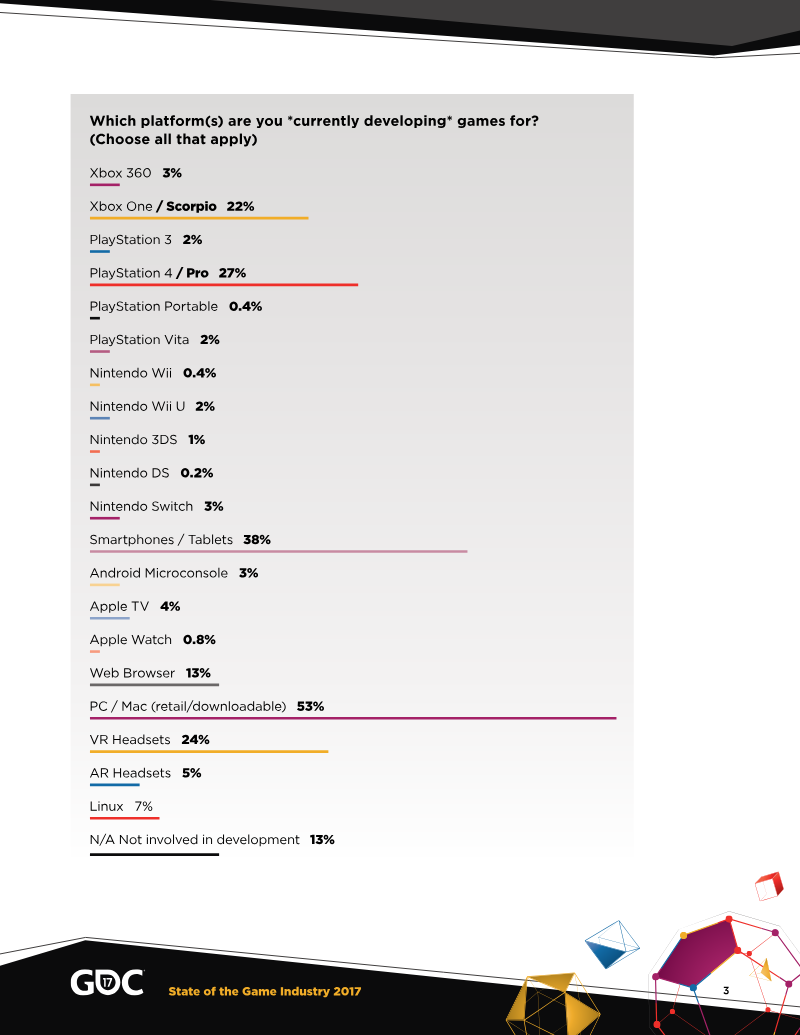
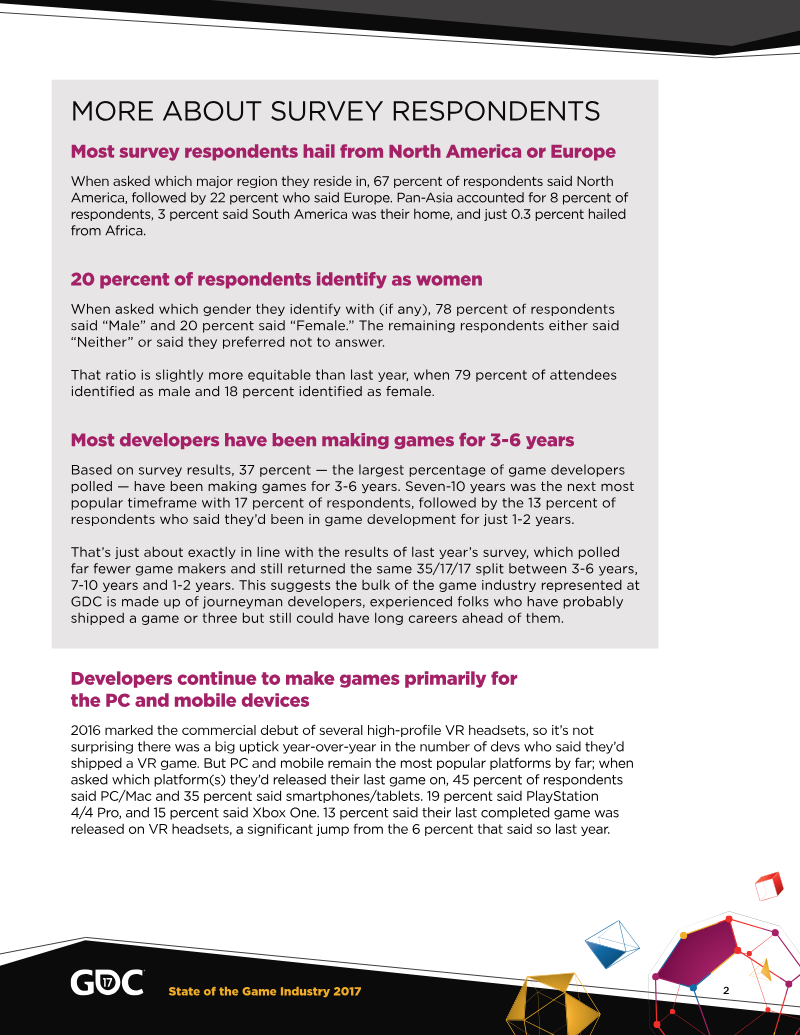
The 2017 State of the Game Industry report provides a comprehensive snapshot of the global development landscape leading into the 31st Game Developers Conference. Based on a survey of over 4,500 professional game developers, the data primarily reflects the perspectives of "journeyman" creators in North America (67%) and Europe (22%), with the largest segment of respondents (37%) possessing three to six years of industry experience. The findings highlight a significant shift in the immersive technology sector, where the HTC Vive emerged as the leading platform for VR/AR development, surpassing the Oculus Rift in both current usage and future interest. While 61% of developers are not yet involved in VR, those who are have increasingly moved toward the Vive, which 40% of respondents expect to support for their next projects. Despite concerns regarding hardware costs and motion sickness—which affects 83% of developers to some degree—75% of the industry views VR and AR as a sustainable long-term business, with a plurality predicting that augmented reality will be the dominant immersive tech within twenty years. In the broader platform market, PC (53%) and mobile (38%) remain the primary targets for development. Notably, Android (54%) surpassed iOS (51%) in developer interest for the first time in the survey's history. Regarding consoles, developers expressed cautious optimism for the Nintendo Switch, with 50% predicting it will outsell the Wii U. However, the industry remains divided on mid-cycle hardware refreshes like the PS4 Pro and Project Scorpio; while only 5% view them negatively, 41% remain undecided about their impact on the traditional "fixed-spec" benefits of console development. Financially, the industry continues to lean toward independence, with 55% of projects funded by internal company resources and 54% of developers operating without a traditional publisher. Confidence in crowdfunding saw a slight decline, with 46% of respondents expressing no interest in the model. Conversely, confidence in eSports reached an all-time high, with 90% of developers affirming its long-term sustainability as it moves toward mainstream social acceptance.
Game Developers ConferenceJan 2017
Report
State of the Game Industry 2023
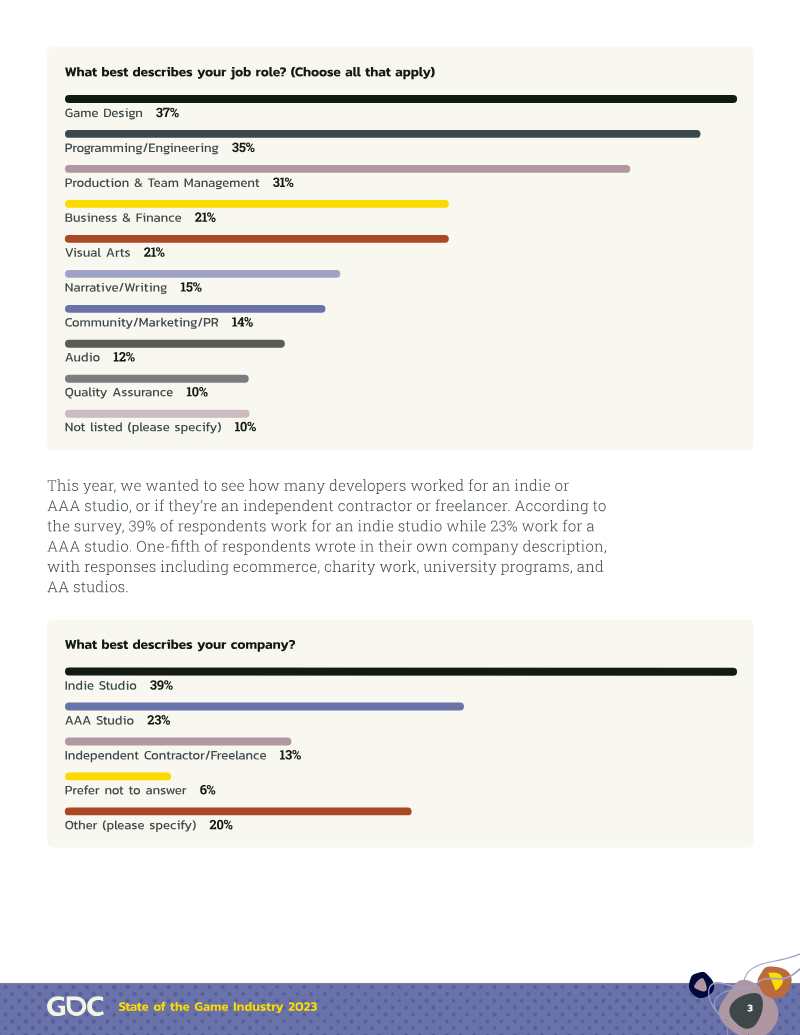
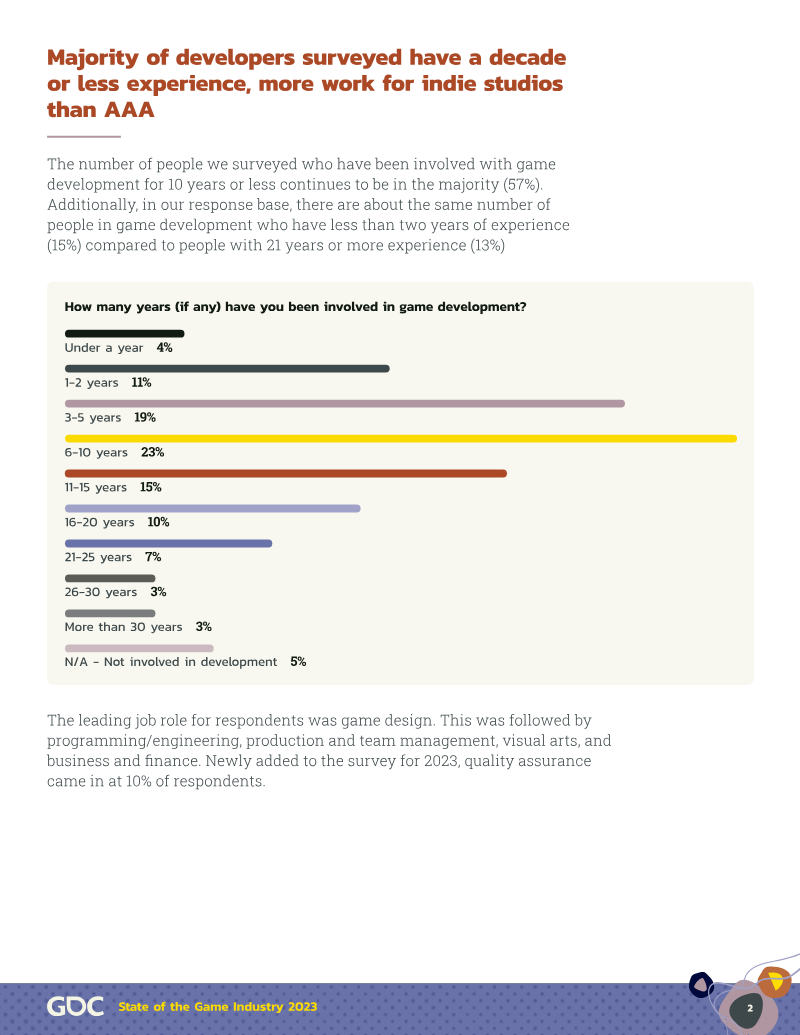
The global game development landscape in 2023 is characterized by a return to established platforms and a growing skepticism toward speculative technologies. PC remains the primary focus for the majority of developers, while the PlayStation 5 has emerged as the preferred console for both current projects and future interest. Conversely, enthusiasm for blockchain and the metaverse has waned significantly, with a vast majority of studios reporting no interest in the former and nearly half of the workforce doubting the long-term viability of the latter. This shift coincides with a workforce demographic that is increasingly concentrated in smaller indie studios and composed of professionals with a decade or less of experience. Operational priorities are shifting toward social responsibility and internal structural reform. Diversity, equity, and inclusion initiatives, alongside sustainability and accessibility measures, have become standard considerations for more than half of the industry. However, significant labor tensions persist, evidenced by a majority of developers supporting unionization and widespread concern regarding the impact of large-scale studio acquisitions on the market. While hybrid work models have become the norm, the industry continues to struggle with self-imposed pressure to work extended hours and a reliance on traditional discovery methods, such as word-of-mouth and storefront promotions, over emerging social media platforms. The industry also faces critical challenges regarding workplace safety and demographic representation. Player harassment remains a pervasive issue, affecting 40% of the workforce and disproportionately impacting community managers and marginalized groups. While most companies have issued statements addressing these incidents, developers are calling for more robust enforcement policies and mental health resources. Demographically, the industry remains largely white and male, though a significant 20% of respondents identify as LGBTQ+. These findings suggest an industry in a state of transition, balancing technological pragmatism with a heightened focus on cultural and structural accountability.
Game Developers ConferenceJan 2023