1 free read left. Create a free account for unlimited reading + AI research.
Create free accountWhitepaper International Journal of Serious Games
1 free read left. Create a free account for unlimited reading + AI research.
Create free accountWhitepaperInternational Journal of Serious Games
The industry uses affordable consumer technology and natural user interfaces to make rehabilitation more accessible for stroke survivors.
Key finding. Low-cost consumer hardware and natural user interfaces are successfully utilized to improve accessibility in gamified rehabilitation.
Gamified in-home rehabilitation systems for stroke survivors represent a critical intersection of low-cost consumer technology and clinical motor recovery. By analyzing 28 studies conducted between 2009 and 2017, the industry demonstrates a clear preference for affordable, accessible hardware, such as natural user interfaces, to facilitate upper-limb exercise. While these systems universally employ point-based rewards and meaningful play to bolster patient adherence, a significant implementation gap persists. Although the potential for sophisticated, data-driven recovery is high, the majority of current solutions remain tethered to therapist supervision and lack the robust, real-world testing necessary to validate their efficacy outside of controlled clinical environments.
The current technological landscape is characterized by a reliance on basic engagement mechanics at the expense of advanced, adaptive features. While foundational elements like intuitive gameplay are standard, critical tools—including automated difficulty adjustment, range-of-motion tracking, and safety-focused alert systems—are present in less than a quarter of existing designs. Furthermore, advanced capabilities such as real-time data analytics, social interaction, and age-appropriate customization remain severely underutilized. This disparity suggests that while the industry has successfully lowered the barrier to entry for home-based therapy, it has yet to fully leverage the potential for intelligent, autonomous systems that can monitor patient progress and safety without constant clinical oversight.
Future development must transition toward hybrid models that integrate therapist expertise with automated, real-time kinematic data analysis. Prioritizing the implementation of engagement detection, intelligent safety alerts, and multi-modal recovery—addressing cognitive, upper-limb, and lower-limb rehabilitation simultaneously—is essential. By shifting focus from simple gamification to sophisticated, user-driven, and data-informed platforms, the industry can bridge the gap between experimental prototypes and reliable, long-term clinical tools that effectively support stroke survivors in their home environments.
International Journal of Serious Games · 2023
International Journal of Serious Games · 2022
International Journal of Serious Games · 2020
International Journal of Serious Games · 2020
International Journal of Serious Games · 2020
International Journal of Serious Games · 2020
International Journal of Serious Games · 2020
International Journal of Serious Games · 2020
International Journal of Serious Games · 2020
International Journal of Serious Games · 2020
International Journal of Serious Games · 2020
Air Force Institute of Technology · 2020



European Conference on Games Based Learning (ECGBL) · 2026
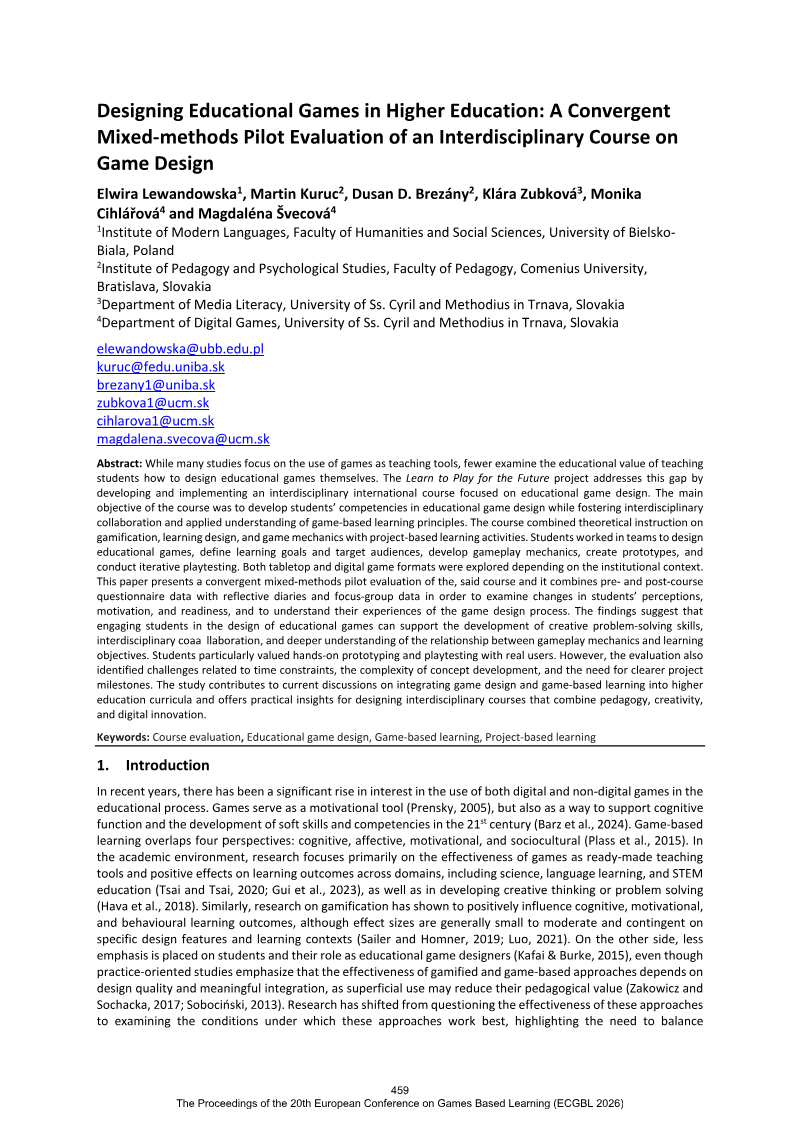
European Conference on Games Based Learning (ECGBL) · 2026
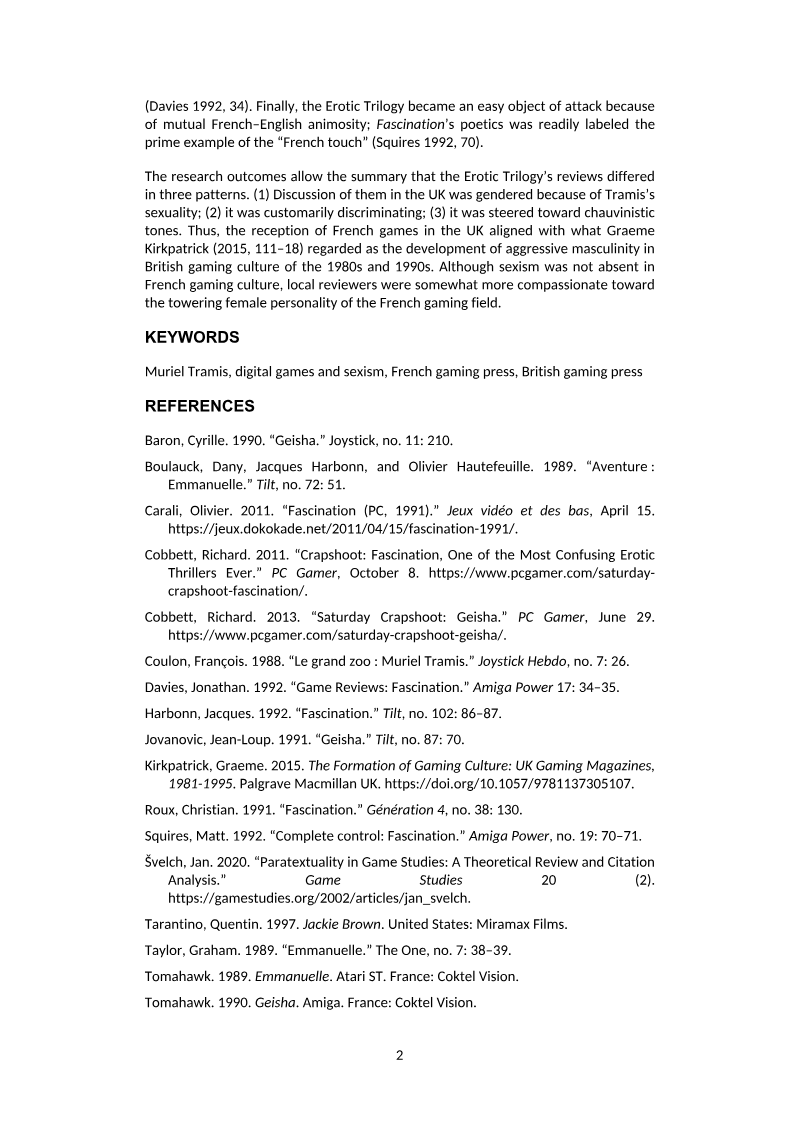


DiGRA · 2026