1 free read left. Create a free account for unlimited reading + AI research.
Create free account
Games You Might Not Have Tried: Horror - Find New Games for Halloween - Extra Credits
Key insights
7 takeaways- 01Strong, distinct visual identities—such as the 1920s animation style in Bendy and the Ink Machine or the claymation aesthetic of Little Nightmares—are primary drivers of effective horror atmosphere.
- 02Games can effectively utilize specific historical and cultural settings to ground horror, such as Detention’s use of 1960s Taiwan to build its narrative foundation.
- 03Titles like Hellblade: Senua’s Sacrifice demonstrate that gaming can provide sensitive, immersive portrayals of neuroatypical experiences to enhance narrative depth.
- 04Experimental design choices, such as the top-down perspective in Darkwood, can create intense feelings of claustrophobia and player disempowerment.
- 05The horror genre thrives on innovative mechanics and atmosphere over technical polish, as evidenced by titles like Prey, which uses a mimic mechanic to force constant environmental distrust.
- 06Social deduction and cult management mechanics, as seen in The Shrouded Isle, offer unique ways to engage players in horror-themed gameplay beyond traditional survival tropes.
- 07Surreal imagery, even in non-horror media like the children’s game Nightmare Ned, can create lasting, unsettling impressions that function as unintentional horror.
Ask AI about this video
Transcript
Welcome all. Samhain comes, and so we don our awesome costumes and present to you a series of creepy, ghoulish, terrifying, and/or Lovecraftian games that you might not have tried. They may not be polished, they may not be masterworks, but we can promise you that they all have something interesting about them. So, in the spirit of the season, here are some horrors to delight. Let's begin. Prey We already did a whole episode about how great this game is, but if you haven't tried the game yet and this makes it look a little bit interesting, go play it through and then go back to that episode. The episode is very spoiler-heavy, but it might give you a new way to look at the game. Prey is Aliens meets Deus Ex in space, which is really all I have to say, I think. And
yeah, I can nitpick some things like the combat being a little frustrating on higher difficulties, the objective markers occasionally misleading you, or the weightless sections feeling a tad sluggish, but there is so much else to like that I have no reservations about recommending it. It's got a rock-solid narrative, a wide variety of ways to solve any given problem, a neat progression system, a freely explorable world that you gain more and more access to as you progress, kind of like a good Metroidvania, and like we said in that Prey episode, it has an ending that leaves you with something to ponder. But what makes this sci-fi game worthy of a horror list, you might ask. And I'm glad you did because it's the enemies, or rather one particular enemy, which ratchets up the tension by causing you to completely mistrust your environment, the mimics. These enemies can take the shape of any ordinary object, so you'll find yourself becoming suspicious of any oddly placed coffee cup or cardboard box, and then just when you've let your guard down, wham, that office chair
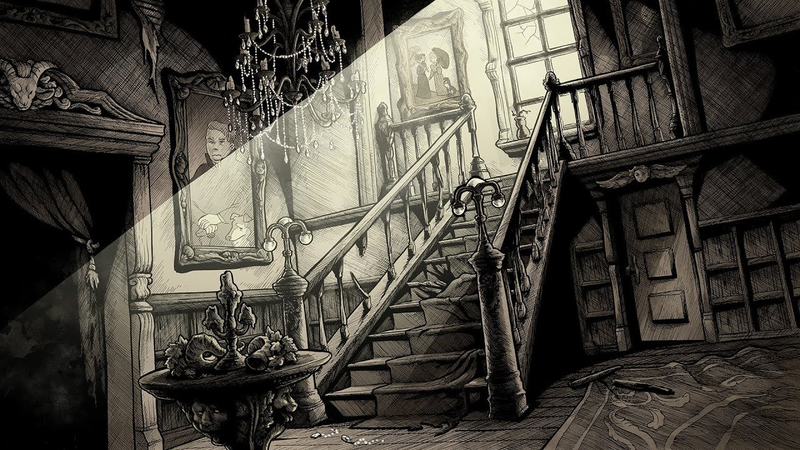
turns into a slavering monstrosity and it eats your face. Go play Prey. Bendy and the Ink Machine. Who knew that those goofy old 1920s cartoons could be made so terrifying? In this game, you play an animator haunted and hunted by one of his creations. The game itself is a fairly standard mix of puzzles and jump scares, but the atmosphere really sets this one apart. I mean, imagine walking through Rapture, only this time Rapture is an old-school cartoon studio, and the splicers are evil Felix the Cat. Please tell me some of you still know who Felix the Cat is. I'm going to be really sad if none of you remember who Forget it. They've only released three out of the intended five chapters of Bendy and the Ink Machine so far, but don't let that stop you. It's
Halloween, man. These games are in season. Detention. The most interesting thing about Detention is definitely its unique setting. It uses the terror of martial law in 1960s Taiwan as the impetus for its horror, delving into Taiwanese myths and history. There were a few times that I wished the translation was a little bit stronger, and the simplistic nature of its adventure game play sometimes keeps it from being quite as effective as it could be, but it still serves as an excellent example of how much this genre benefits from reaching past our traditional go-to monsters and settings.
Hellblade: Senua's Sacrifice This game is a major contender for most metal game title of the year. But, in addition to that, this is the game that I always hoped Ninja Theory would make. They have taken all of their strengths with character and performance and turned them toward a project much smaller in scope and more intimate in subject matter. A Pict warrior exploring a nightmarish underworld manifested of her own psychosis. Sure, it's got a handful of frustrating moments and little to no explanation of how its own mechanics work, but this is the type of narrative we always knew Ninja Theory could do, and they do it well. I can't think of another semi-major game release
with a truly neuroatypical protagonist. Other games may pay some lip service to that idea or simply tell you that their character has a non-standard mental state, but Hellblade does not mess around. It runs with this. They don't beat you over the head with it, but Senua's mental state is absolutely essential to her character, to the world they build and the story they tell. It's not perfect, but Ninja Theory clearly put a lot of thought and effort into representing this stuff in the experience, and it is great. So, go check it out. Also, check out their dev diaries. Ninja Theory documented the development of this game as they went on YouTube, and it is a great watch if you're interested in seeing what AAA development on a low budget looks like.
Darkwood Rogue-like survival horror with crafting and a weird creepy narrative? Why, yes, please. Darkwood is basically Don't Starve if Don't Starve had more story and was way more disturbed. It's a post-apocalyptic tale about debased humanity somewhere in Eastern Europe filled with disturbing fungus, twisted wolf men, and all the horrors of the dark. What makes this particularly interesting is that it's all delivered in a top-down format, a rare perspective for horror, but actually quite effective. And while you play, you will inevitably feel some frustration at the design choices made to disempower you, like limiting your vision to your actual field of view in a top-down game, or adding a delay to your melee weapon attacks. But as you start to adjust to these limitations, you may start to realize that it's those very design decisions that make the world seem so threatening and help you to sink into
this stifling terrifying forest of Darkwood. Observer Some games are worth playing for the atmosphere alone. Observer is one of those games. Observer brings to life a version of Krakow that's half Blade Runner and half William Gibson. It's mind-bending cyberpunk horror writ in neon and chrome. Here's the premise. You are a detective in the near future and you are investigating a murder. You
aren't sure, but the victim might be your own son. This game's gimmick is that you can hack directly into the minds of your suspect and every time you do, it's a fantasmagoria of surrealistic horror. Games are an amazing medium for disjointed dream-like horror because you can wander through that horror rather than simply having the experience told or showed to you. And Observer is very, very good at delivering that kind of horror. The Shrouded Isle. Have you ever played that old kids board game Guess Who? Have you ever wished that you could play Guess Who, but instead with a group of deranged cultists in a small village just before the old ones rise?
Really? Wow. Well, I got news for you, weirdo. Somebody made a game just for you. You should probably play this. Now, I was a little disappointed that the game basically devolves into managing resource bars as you go, but I love the way this game takes a stab at trying to suss out things about people rather than simply solving logic puzzles. I want to see more games try this cuz it could be great. Little Nightmares. Imagine Inside, except this time filled with claymation horrors. That is how this game feels. The controls are a bit awkward, especially on a mouse and a keyboard, and the puzzle design could use some
refining, but those moments where you are hiding from some grotesque monstrosity as it hunts for you, or better still, where you're cowering and hoping to not be seen while that monstrosity just goes about its ordinary routine nearby, those moments are fantastic. Admittedly, some of the game's frustrations do dissipate the terror in places and make you all too aware that you are playing a game, but when it works, it transports you to a horrific Tim Burton-esque world that I would love to see more of. And finally, Nightmare Ned. This is the most horrifying game of all time. Now, it's intended to be a children's
game to teach kids not to be afraid of the dark, but oh my god, it has these rats that sing as they fall into a meat grinder. It has you playing through a mouth full of your own rotting teeth. It has your character strapped to a spinner in order to determine what organs they'll have removed or added by a psychopathic doctor. This game is truly the stuff of nightmares. So, hide under your covers and imagine you are 8 years old again, and you are given this game to help you face your fears, and then emerge hours later grasping at sanity, hanging on to the waking world by the barest thread, wondering what sorts of minds would ever unleash such horror upon the world. It was Disney. Disney made this. Now available from Disney Interactive. Happy Halloween, though. See you next week.
Summary
This analysis highlights a curated selection of horror-themed video games, focusing on titles that offer unique narrative experiences, innovative mechanics, or distinct atmospheres despite occasional lack of polish. The primary objective is to introduce players to underappreciated or ambitious games that deviate from traditional genre tropes, providing a diverse range of experiences suitable for the Halloween season.
The selection spans various sub-genres and design philosophies. Prey is highlighted for its tension-inducing mimic mechanic, which forces players to constantly distrust their environment. Hellblade: Senua’s Sacrifice is noted for its sensitive and immersive portrayal of psychosis, marking a significant step forward in representing neuroatypical protagonists in gaming. Other titles, such as Detention, are praised for utilizing specific historical and cultural contexts—in this case, 1960s Taiwan—to ground their horror, while Darkwood is recognized for its effective use of a top-down perspective to create a claustrophobic, disempowering survival experience.
The analysis also covers titles that prioritize atmosphere and experimental design. Observer is lauded for its surreal, cyberpunk-inspired dreamscapes, and The Shrouded Isle is noted for its unique approach to social deduction and cult management. Little Nightmares and Bendy and the Ink Machine are identified for their strong visual identities, drawing inspiration from claymation and 1920s animation, respectively. Finally, the retrospective inclusion of the children’s game Nightmare Ned serves as a cautionary example of unintentional horror, illustrating how surreal imagery can create lasting, unsettling impressions. Collectively, these games demonstrate the breadth of the horror genre, proving that mechanical perfection is secondary to the ability to transport players into compelling, unsettling, and thought-provoking worlds.














Comments