1 free read left. Create a free account for unlimited reading + AI research.
Create free accountWhitepaper European Conference on Games Based Learning (ECGBL)
1 free read left. Create a free account for unlimited reading + AI research.
Create free accountWhitepaperEuropean Conference on Games Based Learning (ECGBL)
Students in three rural west-coast Canadian elementary classes, grades 5 through 7, played, sketched and built games.
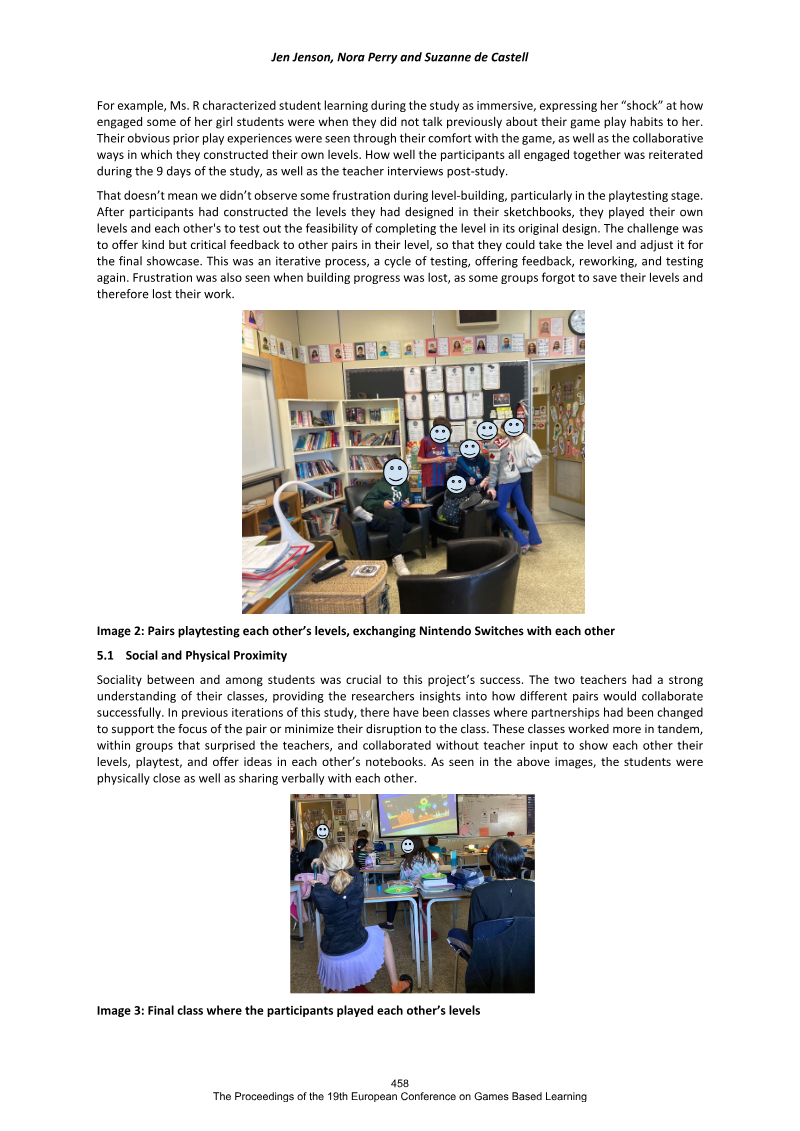
This study by Jennifer Jenson, based at the University of British Columbia, examines how playing and designing digital games can support design thinking among school-aged students in a small, rural community on Canada's west coast. Over nine days in April 2025, 53 students in three elementary classes (grades 5 through 7) first played the fast-paced WarioWare: Get It Together! in pairs on Nintendo Switch Lite consoles, then sketched characters, rules, and game screens in individual design sketchbooks, and finally built levels in Super Mario Maker 2. Of the 56 students who participated in level design, 34 levels were completed, and 22 of those were playable, with 5 judged exceptionally complex. Data sources included classroom video, interviews, fieldnotes, and a student questionnaire on technology access.
The findings suggest that play-centered, low-barrier game design fostered engagement, collaboration, and iterative design practices such as testing and revision. Observers recorded high affect, laughter, and peer cooperation, and teachers remarked that pairs and students who normally struggled to focus or integrate were more on task and participatory. The study also documents shifts in classroom social dynamics: students who were typically marginalized, including a boy who was an avid Nintendo player and a shy student who usually read quietly, became sources of expertise and were drawn into the center of classroom activity.
The research also complicates assumptions about the digital divide. Access to home computers was very limited, with desktops or laptops reported by only a handful of students, while game consoles and smartphones were common. Nearly all participants already had basic game literacy, and the rural context was marked by strong outdoor and physical play traditions. The author frames these as deep inequities relative to urban peers, especially in light of rapid AI adoption in education.
The study is explicitly limited by its short duration, small scale, and qualitative design, without pre- and post-testing to measure learning gains. The author positions it as a short-term intervention that extends research on connected gaming and game-based learning into under-represented rural settings.
Each row is a game or company this document names, each column a document, oldest first. A mark means that document names it. Select a row to see those documents.



European Conference on Games Based Learning (ECGBL) · 2026



European Conference on Games Based Learning (ECGBL) · 2026



European Conference on Games Based Learning (ECGBL) · 2026



European Conference on Games Based Learning (ECGBL) · 2026



European Conference on Games Based Learning (ECGBL) · 2026



European Conference on Games Based Learning (ECGBL) · 2026



European Conference on Games Based Learning (ECGBL) · 2026



European Conference on Games Based Learning (ECGBL) · 2026



European Conference on Games Based Learning (ECGBL) · 2026



European Conference on Games Based Learning (ECGBL) · 2026



European Conference on Games Based Learning (ECGBL) · 2026



European Conference on Games Based Learning (ECGBL) · 2026
European Conference on Games Based Learning (ECGBL) · 2026