1 free read left. Create a free account for unlimited reading + AI research.
Create free account
Five Silver Bullets for New Teams
Key insights
6 takeaways- 01Validate market appetite before full-scale production by using low-budget ad campaigns and functional mockups to ensure development resources are directed toward concepts with proven commercial potential.
- 02Design marketing assets capable of capturing user attention within a two-second window to effectively compete in a saturated gaming landscape.
- 03Integrate marketing as a foundational pillar of game design from the start to align technical development, user acquisition, and creative strategy, rather than treating it as a post-production task.
- 04Treat the transition from advertisement to store page and core gameplay as a single, cohesive experience, using analytics to replace intuition with empirical evidence.
- 05Adopt an agile release cycle to deploy minimum viable products early, which generates cash flow, refines development processes, and provides actionable player feedback.
- 06Identify clear thematic hooks and unique value propositions by analyzing competitor ad libraries and engaging with player communities on platforms like Discord to understand audience behavior.
Ask AI about this video
Transcript
okay don't forget this week as well folks that it's careers week um pocket gamer connects digital eight and you can find out the latest and greatest of who's hiring and who is looking for somebody just like you um as always you can do that information in our discord channel you can also use the meat to match to meet with people if you don't have um time or an opportunity to do bits and pieces that you need to do because life's very very busy so please use the tools that um the folks at pocketgamer provide for you through steel media and with all of our sponsors i think it's really important that this is a place for us to connect be happy be one big family you know the games development industry is vast and so if we can come together in these little places like now with the best of
finland then we stand a really great chance and opportunity to be able to get more done and on that subject five silver bullets for new teams with the amazing arnie lina kangas from super plus games how are you doing today arnie it's really nice to see you thank you thank you i'm doing very well it's nice to see you as well and those are some really fabulous glasses i must say six out of five not even five out of five but six seven what a recommendation okay i'm gonna come back in 20 minutes with some questions for you people if you've got questions for the amazing arnie he looks amazing today by the way i just want to say that put it in the q a box down below have a chat in there as well give us some feedback let us know how you feel and we'll come back in 20 minutes arnie thanks very much indeed all right thank you so hello everybody uh as said uh my name is arne lindergongas i am ceo at super plus games and we're mostly known for our hills of
steel franchise a 70 million player player tank action game franchise and today i am bringing you five silver bullets for new teams i first just want to say thank you to unity and pocket gamer for having me talk here and arranging all of this conferencing thingy and udr audience game folks let's get on with it and see if i can make good on my sufficiently bold claims here a little bit about this talk uh this is mostly aimed at like smaller teams who are making their first game uh maybe maybe you're pitching through some investors maybe you're trying to going around and trying to convince people that you're somebody who can actually uh establish a business and make some games and keep improving them uh time of their time um this is based on things that uh i wish i would have known uh when i was starting
out at first and these are also things that people have asked me before uh over the years in conferences and you know igda meetings and stuff like that so trying to base it in actual need i've taken into consideration the limitations of small teams you really don't have a lot of money you basically have no time you have only a few people and each one of those people have multiple hats to wear so they're kind of context switching all the time so it's kind of draining on mental energy as well for everybody but without further ado let's get on to the first bullet uh marketing is something that i want to focus on a lot today uh i think marketing is something that's easily neglected when you first start making a game and you kind of leave it at the last minute but it is really woven into everything it is it is a central part of your game design who you are making the game for uh who you're gonna market it to what are the
unique selling points of your game and how you're gonna actually present those uh unique selling points uh in the marketing assets uh what are your tech limitations really dictate how what you're going to do with marketing are you going to show your ad to everybody who owns an android phone or maybe only everybody who has over 2 gigabytes of ram for example and as much as it sucks uh the landscape today is that you will not get discovered without marketing so you really have to be thinking about this all the time and you really have to put in the money and resources uh to do this thing a cool game is never enough but with clever marketing you can probably make your money back even with a bad game marketing is that effective uh and while you're at it uh i think don't just think about marketing but run an actual campaign on your game mockups so
when you're actually designing a game maybe doing some core game mockups with ui and stuff like that maybe polish them a little bit more and run an actual image campaign ad you know make up a marketing slogan for it and put it up uh redirect it to a website make probably a mailing list and make people join your beta and you can actually then when you released your game you can send the link to these people and actually get some installs out of it so the money is not wasted that way either and i think uh here one of the things is that the assets don't actually need to be that good looking especially when you're testing out stuff attention grabbing is much more important in this phase you just need to really test out uh if your game idea is getting any clicks if everybody is actually interested if they're stopping when they see your ad and actually clicking through you can focus on the quality later you can raise that bar later when you actually know that the game is worth
making if you've never actually done a marketing campaign for a game before i would suggest that you just log into unity ads and just start a campaign uh it's not that hard you can probably get in like half an hour uh really working campaign for your game and of the budget one of the things you usually hear is that you don't have money for marketing but i think like with 50 euros you can already do a lot so even if your cpi was like 50 cents you would get 100 installs per day and that would be 700 per week and that's already like close to a thousand players which i think is a good good sort of threshold after which you will know know a bit about where your game is actually at monetization-wise or retention-wise and even if if you use cheaper cpi countries that cpi will go down it will be probably like something like 10 cents or something uh it's
and you'll get more installs uh later on when you've actually spent some spend some time and spend some money on the platform you can expand to other platforms later so at google ads at facebook et cetera and in the in the pipeline as well and uh one thing here is that you should really reach out to these platforms because they really want to like help you once you start spending more money in these platforms uh just reach out to them because they really want to give you the best practices on like creatives uh how you should structure your campaigns what sort of bits you should have be having on your campaigns and stuff like that so everybody wins when you scale up just keep that in mind bullet 2 is actually marketing creatives so like i said i'm going to ramble upon ramble on about marketing a lot one thing that for me was pretty hard to wrap my head around was marketing creatives when i first started
and the way i like to think of them myself is like maybe you have a one second visual pitch for your game you just have that one second uh to grab the attention of the user and after that you have probably like two seconds to keep them interested after that they probably will just uh doze out and not even care if you think about like what it is to scroll facebook and what it actually requires for you to stop by in an ad you should do that uh it's really hard to do even if you you're watching a rewarded ad in a in a game uh you usually just put the put the phone on the table and wait for the ad to go go away so grabbing the user attention is really really important here and try to find creative ways to actually grab that user for yourself uh this might be a controversial point for some uh but like i said
marketing kind of overwhelms everything it's uh it's a part of everything in the game i think marketing can and should affect game design uh when games are not just the build they're basically everything that the build is related to they're the way you actually deliver the build to people they're the ad they're the store page uh they're your servers your qa your customer support everything here is related and every part of this web should be supporting each other part so just let if if you feel like you can't do marketing creatives with your game that are catchy enough then maybe affect the game design itself and make something that is marketable i think that's a really really valid strategy and uh some words on market research uh you should really look at your competitors creatives uh and you really
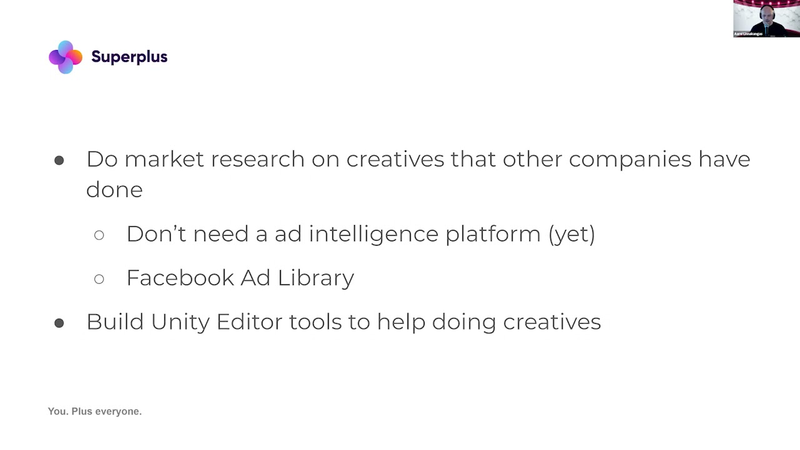
don't need a very expensive platform for this at first you can just go to facebook ad library i think that's one of the better or better ones to use uh if you just want to check like what your competitive competitors are running um you can go there check your competitors ad what are they running in united states or japan or russia or whatever and kind of get more ideas on how your attention grabbing creatives could be done just use it use it heavily and as a side note i wanted to include that when you're building uh your tools for your games in unity editor uh i think if you have some tools for example for jumping ahead in progression for the player or something like that think about ways to actually include those tools to help marketing creatives uh doing the marketing creative so maybe maybe somebody who's uh recording the gameplay wants to jump to another point of progression maybe they
want to slow the time down so you get a really cool slo-mo explosion stuff uh creatives um stuff like that get get really creative and and think about how you're gonna do those uh creatives in the very beginning uh don't leave it to the last minute you will thank yourself bullet three uh user funnel design this is also one of the things that was kind of a revelatory thing for me back in the day when i started thinking about user funnels more uh expansively like i said that the games are not just uh built but the everything else that the build touches uh and it really starts from the ad to the store page uh then to the app into the tutorial world one level two whatever then uh all the way up to the purchases or whatever behavior you're actually measuring here and it is really i think it is really useful to think
that the everybody you're showing the ad to are basically almost your users already or they are your users they're just dropping off before they actually get to the store page so try to optimize for that and here this is kind of a harder point to get across but the core game is not something your usual user stumbles upon you should really design the whole journey like what do you actually want the player to do uh in the beginning what what do you want them to get away from the ad the store page what do you want them to do in the tutorial really think about the ux and menu the core game is not something uh you put it put up a menu and then the player just do stumbles upon your card game and starts playing there really use the player motivation create motivation for the player and keep that motivation in mind
to actually guide the player consistently towards where they need to be and then use data to validate your qualitative decisions based on this and not not just put up a menu and then maybe instrument it with uh data events and then discover from the data oh something's wrong in the menus uh i don't know what you should really do with the thinking beforehand uh and then uh if you want to measure this if you've never done it i would just if you're using unity just use unity analytics uh you can use something else later if you if you need to like uh fill in uh you need more features or something and i think your best friends would be funnel analyzer and segments in there i won't go into details on how they work i think they are pretty straightforward and simple once you get the hang of them and once you know what you actually want to measure but i
think the tools are not the main point here the main point here is actually knowing what to measure and starting to understand your game and it goes a long way if you're actually if you've actually designed all of the funnel steps like really carefully to begin with then you can start to learn uh which events lead to desirable purchases what your game is actually consisting of and what your users are actually doing in there and then you can start using that data in your marketing campaigns and not just targeting installs after that which leads to more money bullet four this is sort of a shorter one [Music] but i wanted to include it because i've seen so many times uh this being neglected as well so read the story guidelines guidelines uh read the god darn manual as they say uh so app store review guidelines and android quality guidelines these dictate a lot of different things
they touch a lot of the things that you have in your build button animations uh stuff like that how you handle in-depth purchases is your back button actually functioning as it should be uh if you don't do this it can lead to submission rejections or you might be rejected for featuring or if you're doing something particularly nasty you might even get actually removed from the app store and that's that's not uh but you probably have to you probably have to go out of your way to do something nasty to actually get to that point to be honest uh but uh don't uh don't do it like so that uh when when you've had to when you're actually supposed to submit the builds you're still uh implementing back button functionality i've heard from people that that's not fun then actually for the uh bullet number five
last bullet today and it is released early and released often so if i started now with a new team a new company um i would probably do this i would create game sketches for let's say three to four game sketches for hyper casual games i would run a marketing campaign pit those all of those game concepts together and pick the winner and create an mvp soft launch for that in like couple of weeks then uh run marketing on that game look at the data do a couple of liveops updates and then try to sort of optimize the game further from that and sort of keep running running this loop for a few games at least and what this enables you to do is after if you're for example pitching to investors then you have multiple small
games to show you show them that you've actually gone through the whole process from the beginning to the end uh you will have lots of data hopefully data that shows that you can actually fix issues uh with the game i don't think it's a deal breaker uh especially in the uh c phase if you if your metrics aren't that good yet uh obviously don't go in with like day one retention of ten percent that's probably not going to be good for anybody uh but still it doesn't have to be perfect only if you have the realistic vision on how to fix those metrics uh which you can probably show off when when you have data on these multiple games that you already done with your team so keep that in mind uh what it also enables you is to go through the whole process of releasing the game with your whole team there are blind spots uh in every team
there are limits and those get revealed uh really rapidly things will go wrong sometimes they go horribly wrong and it is better for things to go horribly wrong when you have developed your game for two weeks uh then two months or two years for that matter and your cooperation gets really honed in and you get a lot of experience on knowing what actually goes into the process of releasing a game to a market place and that is something that you really need to have experience in to sort of get the your business flowing uh last and the most probably the most important thing here is you'll get a bit cash flowing in so this teaches you how the business is actually how the business actually flows overall so you can start to look at your burn rate and the income
that you're having and start to really see what you need to do and what kind of resources you need when when if you're trying to make your business profitable and uh make it stable make it sustainable uh you learn to optimize this i'll be on a small scale after that if you become really good at it it's only mathematics and that was all that i had to say from these bullets i think uh i i really hope that uh some of these points were were useful to somebody uh thought provoking at least in some some sense uh and it remains to be seen if these bullets were truly silver or or golden i think the main point the main bullet that i want to give out is that even if you have just a small team uh all of the aspects that the game are have to be done anyway but and even if it's hard and even if you are limited in resources you can
actually do them you can go and learn of course another another way of looking at it is that uh you have to do it in order to survive in order to have a business that will live in the future as well and i think that's the only uh silver bullet that counts that's basically all i had thank you that was amazing thank you um it was amazing because i think all those bullets are actually golden not silver i think these are words to live by and we've had a few of that today um in in the developer toolkit especially that we have to really put the user in the driving seat i think it's very difficult for people to do that sometimes so it's very refreshing to see that you have really thought this through and come up with a sort of five point even though they're pretty expansive checklist of what you kind of should do certainly from my perspective working in
the games industry and you can see that i'm worth core game the core game is like really important to me but it means that i want to work more with marketing and sales to make sure that there is a constant not echo chamber but feedback loop of like consistency throughout when i'm creating games and you have illustrated that perfectly in your presentation so thank you arnie and we've got some q a and there's a lot for you as well so let's get cracking can you think of any examples where the marketing for a game has been potentially ruined at the beginning of the game and have any of them managed to bounce back or come back from the brink marketing has been ruined um i don't see necessarily and i'm talking about the uh mobile space you can ruin your marketing by basically spending all your money and not looking at the data but i don't think like you can essentially ruin your marketing if you're just careful and kind of step by step increase use the
creatives that actually work and just put your money on those uh do more targeting talk with the platforms uh get get their tips and insights on what you should actually do i don't think you can actually like really ruin your marketing unless you do something like nasty don't talk do you think uh again i i think i think not uh you will see if your marketing creatives actually work or not uh there have been like cases where of course we all know like the games that uh sort of push the limits of marketing so maybe maybe they have uh marketing creatives that don't exactly match the game that you're going to download and i think that can ruin a game uh but i don't know in the long run if if you just stop doing that if you stop doing the things that aren't working i don't think
you can really ruin a game with marketing interesting do you feel like you can spoon feed players too much sometimes though um the the person asking the question says when i think of some huge games like dota it's only been this past year that they've released a player guide in-game so do you think we give the players too much sometimes i've seen it quite a lot well i don't know um it's hard to say uh if it works for the games i don't necessarily see that it's uh yeah it's i don't think spoon feeding is is actually of course you shouldn't spoon feed but i so many times when i play games especially like aaa pc games that are kind of uh what i what i've played all my life but especially now that i see like i really can't like focus on what what should i actually do it's really hard to sometimes learn uh learn the
learn the ropes of the game so to say uh because the ui design uh i think has generally in the past in games been kind of the thing that nobody wants to do and you give it to the intern and it's not it's not that important the core game is what matters the graphics are what matters but that's that's really not the case i think uh usability is so important and that will that will bring like so many more players to your game uh i don't think you can over communicate that much i mean probably you can but i don't i don't have a lot of examples of like spoon feeding how do you deal with negative reviews and how do they form negative reviews well uh how do we deal with them yeah uh well we basically there are multiple perspectives on
dealing with uh negative reviews one is of course the psychological you have to like understand that uh they might not be personal everybody in the internet uh uses an immediate say some really nasty stuff uh that's uh that's a real issue it can sometimes hurt a lot when somebody says some really nasty things about you and your game that's one way that's one thing that has to be dealt with then you just have to remember the people who actually love and send you like uh send you like their fan art like we've received like people have made a snow snow tanks uh and stuff like that which are like amazing uh amazing to receive something like that from the fans but then from the product side it's actually it's actually a bit more of a large work we usually try to like uh find out what the user is actually saying uh what's actually driving them nuts about the game what is the actual issue there or are they are they just trolling
basically great customer support and great answering and asking trying to ask the right question from them is i'm not the expert on that issue so i i can't really say any any tips on how to do that well we have professionals taking care of that in our company uh i don't know how to do that that's magic to me but um then then the um one side is that if if there actually is a is an issue in the game you of course have to deal with that you have to take a look at if there's a bug or if something is actually uh a bit too hard or something um i was going to say that's usually the direction of travel that people are going in when they start making negative reviews it's because there's something that's happening in the game that we're not aware of as the developers so we need to get in there quick and sort of figure it out how do you at superplus best understand your audience there's plenty of data around and you know you can get data wranglers to work
stuff out like that but you seem like the kind of guy that is a bit more hands-on and not just sort of fed data so how do you best understand your audience and what tips could you give our audience in figuring that out well i would say [Music] one is of course that you keep in you always have an idea who your players are from the very beginning so when you design the game like i said uh sort of having the idea who your actual audience is then one part is just the customer support and reviews taking a really close look at those and what the community actually is actually thinking in terms of that a really big part of it is just uh gathering data and looking at the data on where your users are coming from and uh how are they playing and what game modes are they playing and how much are they playing and how much are they paying and stuff like that
then of course doing scouring in the internet we have a lot of youtube videos that people do that's been a really really great way for us to actually see what the community is like and what they actually enjoy what they laugh at and there's a lot of like fan fan videos about our game in youtube going on uh searching for those constantly uh is one way we also have luckily a very active discord uh with a lot of members uh that's of course a really good way to understand the core audience and what the what are the sort of the players that actually like hear our game care about our games and uh stay there for the longest time i've been playing games for about well a million years and i myself feel sometimes that we have come such a long way with community discord for now is the icing on the cake but where do you see
the kind of community maintenance in games sort of coming together in the future we're obviously talking tomorrow especially about the metaverse and uh that's a place that's awash with community uh effectively and if you go on to massively multiplayer platforms and stuff there is a lot of community that needs to be wrangled there and if you've got discord running and twitter and you've got this and this and this where is the where's that sweet spot uh that's a probably uh not a million dollar question but probably a billion dollar question uh to be honest uh and i can't really answer it but yeah we're just raised us in the stepping stones of this whole uh social uh thing and i think the thing about like social any type of like social phenomenon is that you really cannot uh predict where it's going uh the internet has birthed so many uh
interesting things that i would have not thought are actually possible to exist but there they are in the good old internet um but yeah i think we will have just this is just a stepping stone for any sort of source of gaming and we will just go deeper and deeper into that rabbit hole are the same the final question i've got is about the heavily saturated marketplace again which it keeps up popping up today how do you stand out after we've gone through all of your silver bullets how can we and it's still not working what what do you think we can do do we just pick up the phone and say arnie come get us come save us uh don't do that i'm busy enough already but i can let you guys but you should and this is also another at least million dollar question but you should do really careful like market research on what's what's actually out there and if you can actually execute
on the idea so if you're gonna make a match to a game does it make sense for you to make a mastery game do you have some sort of an audience overlap for example with uh with another something maybe a theme or something that's not never been done before in mastery game and then finding that the way to sell that to the audience uh that's probably the key but that's yeah that's the simple formula but that's really hard to actually execute in the in practice well look you absolutely rock and we've had an amazing time with you today if people want to get in touch with you they can do so um via the information that you gave on your slides or maybe pop over to our discord for a few minutes and say hey that would be amazing i know that there'll be many more questions there's been a lot of love for you and you've given some really good positivity in this session so thank you very much indeed yes always thanks everybody thank you very much indeed it was great to see you thank you great to see you too i hope to see you
all uh in person perhaps someday so we can do this on an actual stage oh that'd be amazing january that's what it'll be finger hearts see you then all right see you then i'll be in discord for at least half an hour now after this so you can ask me questions there thank you
Summary
New development teams must integrate marketing as a foundational pillar of game design rather than treating it as a post-production afterthought. By aligning technical development, user acquisition, and creative strategy from the outset, studios can significantly mitigate the risks associated with market entry. The core thesis posits that early validation through low-budget ad campaigns and functional mockups allows teams to test market appetite before committing to full-scale production, ensuring that development resources are directed toward concepts with proven commercial potential.
Success in the current saturated gaming landscape requires a rigorous, data-driven approach to the entire user funnel. Developers should prioritize the creation of assets capable of capturing attention within two seconds, supported by internal tools that facilitate rapid iteration. By treating the transition from initial advertisement to store page and core gameplay as a single, cohesive experience, teams can utilize analytics to replace intuition with empirical evidence. This strategy is bolstered by the adoption of an agile release cycle, where minimum viable products are deployed early to generate cash flow, refine development processes, and gather actionable player feedback.
Navigating this competitive environment necessitates a disciplined focus on market research and audience segmentation. Developers must identify clear thematic hooks and unique value propositions that distinguish their titles from established competitors. By leveraging resources such as competitor ad libraries and maintaining active engagement through community channels like Discord, studios can better understand audience behavior and adapt to shifting social trends. Ultimately, the ability to synthesize technical execution with a deep understanding of user psychology and platform-specific requirements remains the primary driver of long-term viability for emerging game development teams.
























Comments