1 free read left. Create a free account for unlimited reading + AI research.
Create free account
F2P Design Tips for 2021, Collections FTW (3 of 4) Ft. Jeff Witt
Key insights
6 takeaways- 01Collections offer significant monetization potential by distributing pieces through gacha systems, sale packs, or event rewards.
- 02The psychological satisfaction of a collection system is enhanced by rewarding players with multiple items for a single action, utilizing a mix of common and rare items to increase perceived value.
- 03Collections function as a versatile, low-risk engagement tool that provides short-term, achievable milestones to break the monotony of core gameplay loops across genres like RPGs, strategy, and casual games.
- 04Successful completion of a collection should offer tangible rewards, such as power-based bonuses for RPGs and strategy titles, or economic incentives like currency and consumables for casual games.
- 05To maximize effectiveness, developers must tie the acquisition of collection pieces to specific, thematic in-game actions, which helps educate players on progression while providing secondary goals.
- 06Designers should integrate collection systems early in the development cycle rather than as post-launch additions to ensure they effectively bolster player retention and provide consistent objectives.
Ask AI about this video
Transcript
hi everyone and thanks jeff for joining me today we're going to be going over your third key design tip for 2021 and this week we're going to be talking about collections so jeff how should people be thinking about collections how are they used in games today collections is like a sort of wild card feature that could really go in any so any genre of game and you've seen them in many genres you've obviously seen them in um you know like the farm build style games you've seen them in rpgs you've seen them in casino games it really is something that could fit in almost every genre and um the great thing about collections is um they're they're they could be great for engagement it gives players something a short-term goal that they could focus on while they're playing the core game but also could be used for modernization you could sell
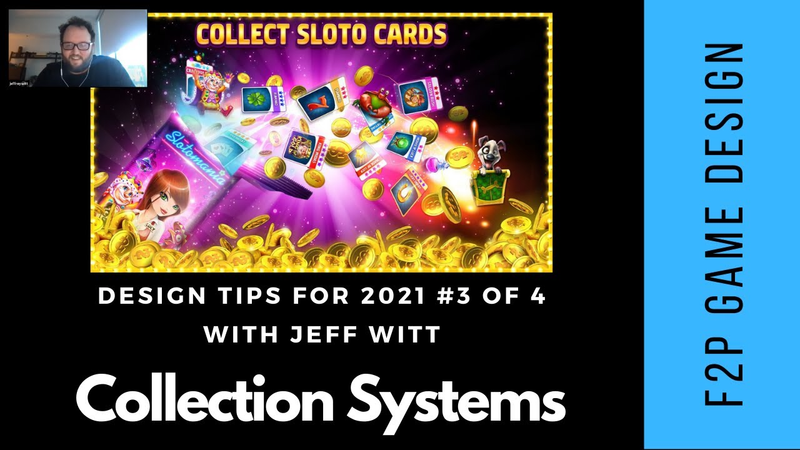
collection pieces in gotchas in sales sale packs as event rewards it's easily expandable you could launch with you know 10 collections and add new collections over time it really is um a low risk low sort of cost feature to add in that won't really conflict with anything else you have in your game so um you know it's probably the feature that i recommend the most um just because i know it's gonna fit in with what the main design is for the game right and jeff we've seen collections in a lot of different genres as you mentioned i mean obviously in rpg collections are used a lot especially with gotcha systems but in addition even like social casino we're seeing like you know the slaughter card system and sladomania and how do you think about or i would say first why do you think collections are so
popular and what is it about collections that allows them to be integrated in so many different kinds of genres part of it is you know when you're giving rewards more is generally better i mean we know from um games you know if you get four five things instead of one thing when you do an action it just psychologically feels better right and that's what collections allows you to do because some pieces of a collection are given out are much more common than others you may by the time you complete a collection you may have you know 200 of one of the collection pieces but only one of the rarest pieces so collections allows developers to just give out a lot more stuff for actions and and social casino you bring up is a good example of that you know when when you're just you know winning coins or waiting for that mini game like uh getting these uh items that
are not coins you know breaks up the monotony of just you know focusing on coins that you're winning and it allows you to think about um other stuff to do besides just playing the core game and it's similar to uh it's similar uh with other genres um you know in in a farm game uh you know knowing you know going through the monotony of harvesting on your crops it's the same action but then having that surprise moment where you also get a collection piece again it breaks up the monotony and it creates more feel-good moments um the challenge for collections is what do you get when you complete the collection and obviously um rpgs and strategies are going to have an advantage there because they could always give you know bonuses that help but even casual games like any game where you that has even like a basic economy economic reward permanent economic rewards for completing collections are always going to be popular
the even cons like consumables or just more currencies can work depending on the economy of your game so um that is just something to think about if you're thinking about implementing collections into your game and jeff would you recommend any specific collection design any particular ones that if if i'm a designer or if i'm a product manager looking at my game and i'm trying to think about how would i integrate collections into my game what are some references or examples that you can think of and then when you see those examples and think about your own game how would you think about integrating something like that to be relevant for the specific game that you're looking at um i would first think about how are you going to distribute collection um collection items um you know if it's a you know for example a strategy game and you wanted to
have collections be farmable from this one action type say like um uh you know game of war used to have like a treasure uh digging sort of feature on the map where a treasure spot would appear and you go send an army and dig up what's there and you get you know um some rewards so like if you imagine doing that with collection say a collection you thematically made artifacts like and you had to complete um artifact by collecting all its pieces tying that to a feature like excavating on the map or something like that could work pretty well in a forex game it gives your armies something that is not pvp oriented to do but yet could create opportunities for more pvp if other armies try to boot you off that excavation spot uh rpgs it's you know um having special certain um gameplay modes associated with the collections um
could be a way to drive players to engage with those uh gameplay modes or you could have special events um with uh with more casual games like farm games having the collection be associated with the action that's rewarding it's like if you know say your carrots have its own collection the collection pieces could be you know something that has to do with carrots like a carrot you know clothing with carrots on her or um yeah something like that um it'll make sense to the player and it gives the player a little information about how they get collection pieces if they could tie the action to the pieces that they get otherwise that that's kind of another challenge for games is informing players where do they find these collection pieces um so i would definitely advise trying to tie the collection pieces to specific actions so that you educate
your players on how to try and complete the collections all right cool any other words of wisdom last minute tips for the audience here or should we should we close this out and wait for tip four coming up um just that you know a lot of games feel like collections can come down the road and after they launch and get their kpis to where they want to be but i would i'm a believer in doing them sooner rather than later okay not just for like because of the monetization implications but more so for engagement you know having these sort of shorter to sort of middle time goals to work towards can really help a game if you feel like your game does not give players enough short-term goals to work on so just keep that in mind when deciding when to implement collections into your game all right cool
all right thanks jeff there we have it jeff's design tip number three of four of game design tips and concepts that you should be thinking about for 2021 thanks a lot for your time jeff great talking with you as always okay [Applause] [Music] bye [Music] bye
Summary
Collections represent a highly versatile and effective design feature for free-to-play games, capable of integration across diverse genres ranging from RPGs and strategy titles to social casino and farming games. The primary purpose of implementing collections is to enhance player engagement by providing short-term, achievable goals that break the monotony of core gameplay loops. By rewarding players with multiple items for a single action—where some items are common and others are rare—developers can create a more satisfying psychological experience and increase the perceived value of player efforts.
From a design perspective, collections serve as a low-risk, easily expandable system that does not conflict with existing game mechanics. They offer significant monetization potential, as collection pieces can be distributed through gacha systems, sale packs, or event rewards. To maximize effectiveness, developers should tie the acquisition of collection pieces to specific, thematic in-game actions. This approach not only educates players on how to progress toward completion but also provides non-combat objectives in strategy games or secondary goals in casual titles.
The ultimate success of a collection system depends on the rewards provided upon completion. While RPGs and strategy games can leverage power-based bonuses, even casual games can benefit by offering permanent economic rewards, currencies, or consumables. Rather than treating collections as a post-launch addition, designers are encouraged to implement them early in the development cycle to bolster engagement and provide players with necessary short-term milestones. By aligning collection themes with core gameplay actions, developers can create a cohesive experience that encourages consistent participation and long-term retention.