1 free read left. Create a free account for unlimited reading + AI research.
Create free accountWhitepaper European Conference on Games Based Learning (ECGBL)
1 free read left. Create a free account for unlimited reading + AI research.
Create free accountWhitepaperEuropean Conference on Games Based Learning (ECGBL)
A systematic review of Scopus and Web of Science searches, conducted in February 2023, examined game-based learning in entrepreneurship education.
This systematic review examines how game-based learning, including serious games, gamified courses, and simulations, is applied to entrepreneurship education in higher education. Drawing on searches of Scopus and Web of Science conducted in February 2023, the authors screened 88 documents and selected 28 for full review, with publication dates reaching back to 2009. The scope spans a range of game formats and academic contexts, with studies drawn from multiple countries, including German student samples.
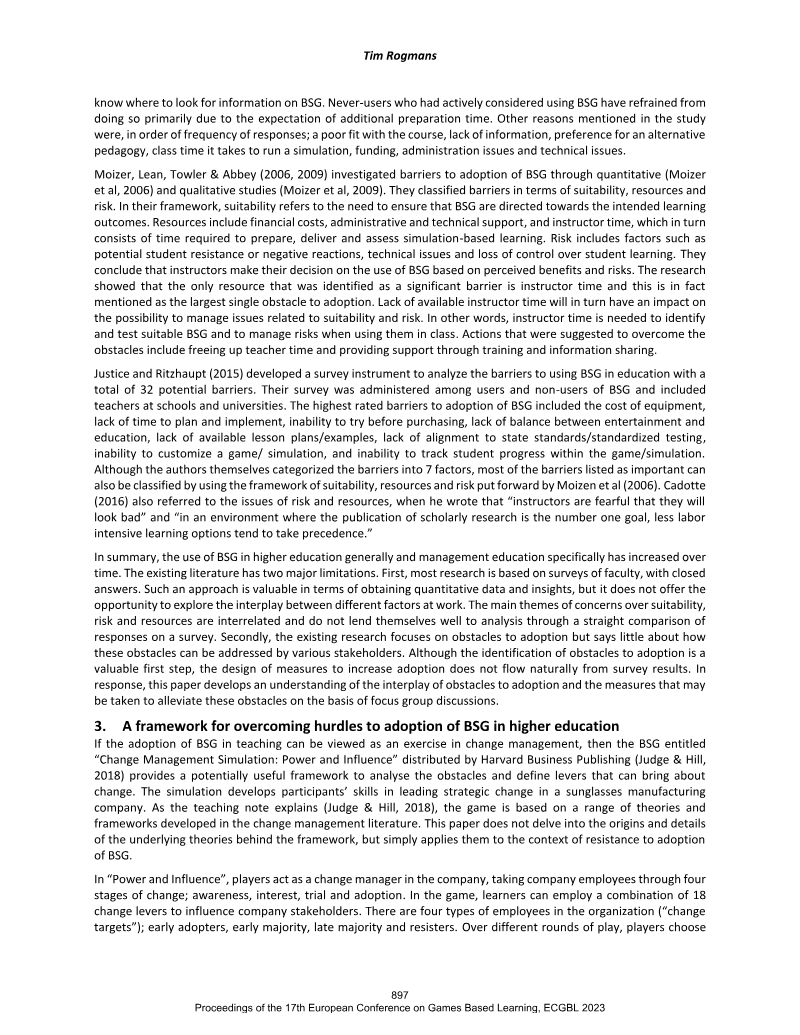
The reviewed evidence generally points to positive effects. Studies report gains in entrepreneurial knowledge, self-efficacy, attitudes, and intentions, as well as improvements in innovation skills, engagement, and business-planning outcomes. Notable investigations include a Facebook-based game evaluated with 2,706 participants, the Global Board Game Project, and simulation tools such as Dynama (N=713) and Risk&RACE (N=120). Sample sizes vary considerably, and outcomes are shaped by learner motivation, personality traits, prior gaming experience, teamwork dynamics, and academic background.
The review also identifies important limitations. Development costs can be substantial, and some students may feel less comfortable with digital games or prefer traditional instruction. A recurring methodological weakness is the absence of control groups in many studies, which constrains claims about causal effects. The authors therefore conclude that, while the evidence is encouraging, firmer conclusions require further research. Priority areas include gender differences, collaborative learning mechanisms, and the durability of learning effects over time, along with designs that incorporate student concerns into game development.



European Conference on Games Based Learning (ECGBL) · 2026



European Conference on Games Based Learning (ECGBL) · 2026



European Conference on Games Based Learning (ECGBL) · 2026



European Conference on Games Based Learning (ECGBL) · 2026



European Conference on Games Based Learning (ECGBL) · 2026



European Conference on Games Based Learning (ECGBL) · 2026



European Conference on Games Based Learning (ECGBL) · 2026



European Conference on Games Based Learning (ECGBL) · 2026



European Conference on Games Based Learning (ECGBL) · 2026



European Conference on Games Based Learning (ECGBL) · 2026



European Conference on Games Based Learning (ECGBL) · 2026



European Conference on Games Based Learning (ECGBL) · 2026
DiGRA · 2026