Key insights
4 slides
The solution
FSMs and eye-tracking create a robust hands-free interface.
Integrating Finite State Machines with eye-tracking technology provides a strong framework for hands-free interaction in 2D platform games.
New Method. FSMs combined with eye-tracking offer a robust framework for hands-free gaming.
1 / 4
- 01The integration of Finite State Machines (FSMs) with eye-tracking technology successfully mitigates the 'Midas Touch' problem, preventing unintended inputs during 2D platform gameplay.See it on page 11
- 02Google’s MediaPipe framework provides the necessary precision for gesture recognition, enabling reliable translation of ocular movements into responsive game mechanics.See it on page 4
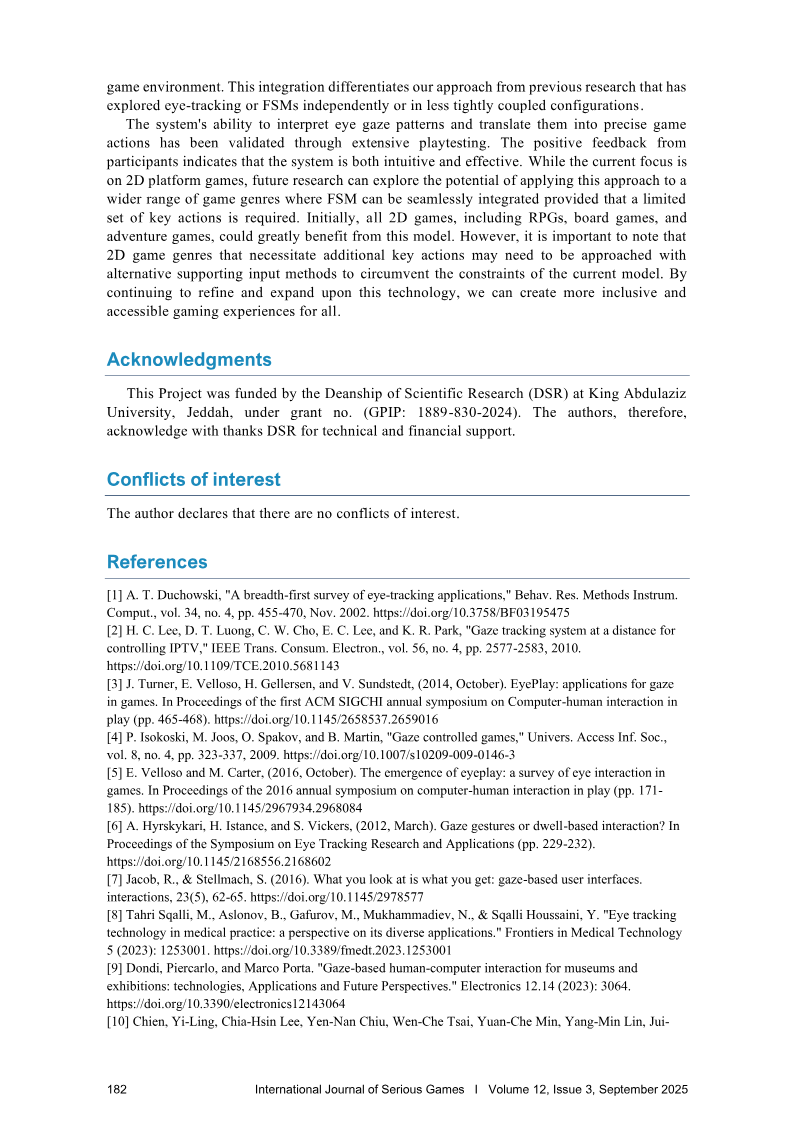
- 03Empirical testing with 34 participants confirmed that the gaze-controller system is both intuitive and maintains a balance between ease of use and mechanical challenge.See it on page 11
- 04Statistical analysis of user feedback indicates high satisfaction levels, validating FSM-based logic as an effective method for managing complex state transitions in real-time environments.See it on page 11
- 05The system demonstrates technical feasibility for mainstream genres by successfully integrating computer vision tools with game engines like Godot.See it on page 12
- 06This research establishes a scalable model for accessible, hands-free gaming interfaces that provide high-performance experiences without compromising gameplay depth.See it on page 1
Ask AI about this report
Summary
The integration of eye-tracking technology with Finite State Machines (FSMs) provides a robust framework for hands-free interaction in 2D platform gaming. By mapping specific ocular gestures to game mechanics, this system effectively resolves the Midas Touch problem, where unintended gaze movements trigger accidental inputs. The architecture utilizes Google’s MediaPipe for precise gesture recognition, ensuring that user intent is accurately translated into responsive gameplay actions. This approach represents a significant advancement in multimodal interface design, offering a viable alternative to traditional controller-based inputs.
Empirical validation of this system involved a study of 34 participants, whose feedback confirms that the gaze-controller is both intuitive and accessible. Statistical analysis of the playtesting data indicates high levels of user satisfaction, with subjects reporting that the interface maintains an appropriate balance between ease of control and mechanical challenge. These findings suggest that the implementation of FSM-based logic is highly effective at managing complex state transitions in real-time gaming environments, thereby enhancing the overall user experience for players seeking alternative input methods.
This research establishes a foundational model for future developments in accessible gaming technology. By leveraging established software engines such as Godot alongside advanced computer vision tools, the system demonstrates that sophisticated gaze-based control is technically feasible for mainstream game genres. The success of this implementation highlights the potential for broader applications of eye-tracking interfaces, suggesting that such systems can provide inclusive, high-performance gaming experiences without sacrificing the depth or responsiveness expected by modern players.