1 free read left. Create a free account for unlimited reading + AI research.
Create free account
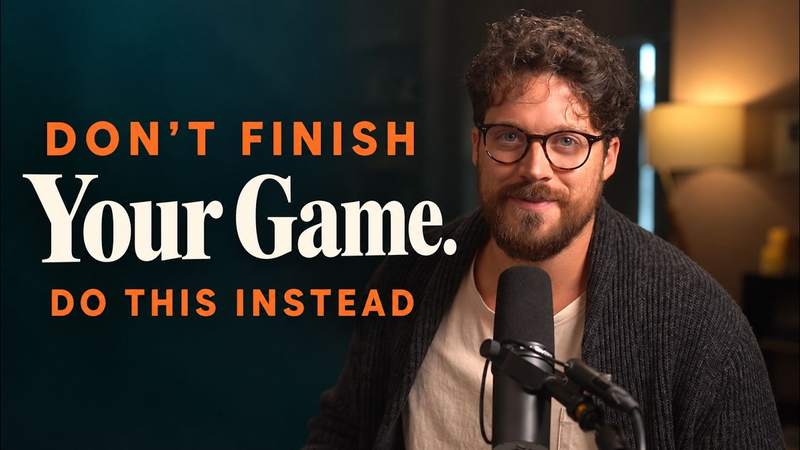
Don't Finish Your Game. Do This Instead.
Key insights
7 takeaways- 01The speaker suggests developers without a released game apply an early-access mindset to their 1.0 release, continuing to build community afterward, since brand and audience care matter more than any single launch.
- 02The speaker argues indie developers should treat a 1.0 launch as the start of a continuously updated platform rather than the finish line, nurturing an existing audience instead of competing with the flood of new releases expected in 2027.
- 03The example is Twisted Tower, which the speaker says has roughly 230,000 wish lists along with strong sales and reviews.
- 04Post-launch work includes bug fixes and optimizations, autosave and manual save/load systems, character controller physics fixes, added languages, participation in bundles including ones with Blumhouse and Mouse PI, and a new game mode driven by player feedback.
- 05The method is to read reviews, identify common complaints, and prioritize fixes with a very small team, with AI tools suggested to help triage the feedback efficiently.
- 06The speaker calls this reciprocity and contrasts it with the monetization-heavy live-service model of AAA studios, favoring free content and improvements that reward existing players and convert hesitant wish list holders.
- 07The thesis is based on personal experience and industry conversations rather than formal research, and is presented as a strategic perspective rather than established fact.
Ask AI about this video
Transcript
So, I think the days of freaking out about making sure your game is absolutely perfect on launch are kind of ending. And it has to do with AI and it has to do with just I think that the changing ecosystem for for indie games. I am going to spitball some things in this video and they're not based on any fact. They're just based on my gut feeling and just people I've been talking to in the industry. Um I I I know what you're feeling about your game. Um because I've felt I've felt that way about my own games in the past. So I've re released three commercial releases. Um and they're all setting it very positive. I'm very proud of of their launches. I think I very much prioritize their launch. It needs to be bug free, needs to be
tested thoroughly. I need to make the game as polished as possible. I need to market the crap out of the game before launch. That's my how my approach has always been and to a degree will continue to be my approach. But I would put so much pressure on myself about launching 1.0 know and I am feeling like I am feeling like instead of worrying so much about a single launch, I'm starting to feel my gut feeling is that instead there's a bunch of launches for a game and there's a bunch of launches after your game. Yes, launch is important. Yes, you should. I mean, kind of going back on what I just said, you should treat 1.0 with a high degree of severity and seriousness, and you should try and make it as perfect as possible. Um, but I'm starting to see games a
little differently. Um, I'm starting to see them as platforms. I'm starting to see them as intellectual property IPs that grow and scale and get updated and the community continues to be built and concerns are addressed and things are added. And the reason why I think this is valuable especially and relevant especially in the AI the AI generation of indie gamedev which we are in currently. If you look if you took a look at NextFest, you know that we're in the age of AI and some would say AI slop. Um I'm sure there's plenty of that. I haven't taken a look at NextFest. Um I've kind of been head down doing updates for Twisted Tower, but in the age of AI, this is particularly valuable. Treating your game like a a platform. Um, I think the key to the the
world of AI and and AI gamedev and hundreds of thousands of games that I think are going to be released in 2027. The key is building an audience around your brand and building an audience around your intellectual property, building an audience around your skew, if I want to sound professional. And and here's how that's related specifically to Twisted Tower. So today we launched a bunch of languages um for Twisted Tower. French, Portuguese, Brazilian Portuguese, simplified Chinese, Russian, obviously we have English. Um who are the other ones? German, there's there's a bunch. Um, and by the way, if you want to click the link below to to get a pretty freaking big discount for Twisted Tower uh, for Scream Screamfest um, with Steam, feel free to click the link below. And I know most of you have probably already played Twisted Tower, so thank you so much for doing that. Feel free to leave a review as well.
That helps a lot uh, during this sale event. Please. Yeah. So, the link is below if you want to check it out, leave a review or whatever. Um, that's a little CTA there, but um, we're we're doing that with Twisted Tower right now. We're we're adding more content to Twisted Tower localization, right? Obviously, most people launched that with 1.0, but if you don't, like we didn't, and I didn't have the time or the budget to do that. Um, do that. Add updates to your game. We're working on a huge update. We've read the reviews. Um, we're looking at all, and I say we, me and me and James and Felipe, we're reading reviews and we're like, "Hey, we need to do this. We need to fix this. We need to patch that. We need to add this game mode. We need to add this level." So, I'm continuing to tweak and adjust and change and update Twisted Tower based on the reviews. I'm not I'm not too proud or nervous to read reviews and go, "Hey, you know what? Maybe we
need to tweak that and fix that, change that." Um whereas the way I used to think about games, I don't know why I did this, but the way I used to think about games is I was think I would think I'm done. Game is done. 1.0. See you later. Moving on to the next thing. If your game has proven itself and has proven to be profitable, what you should do, and I credit to to James and also Felipe, my team members on on their mindset on this. If your game has proven to be enjoyed, people like it, and it's selling, why not nurture that current audience and that current skew and scale it? So, here's here's specifically why this is val or how how we're going to do this for Twisted Tower. We're working right now on filling in the gaps that were glaring with the game. So, instead of getting our feelings hurt about any gaps that the game had, and believe me, there's plenty, instead of going, you
know what, I'm fine with the gunplay as it is. I'm not going to do anything. I'm not going to change it. I'm fine with the world building as it is. I'm not going to change it. I'm moving on. That that is a temptation for a lot of game devs, and believe me, it's a it's a temptation for me. Instead of doing that, we go, okay, what are what are the common complaints? And you can use Claude to to help you with this or or chat. You can say, "What are some common complaints with Twisted Tower and and how can we address those in an economical way, uh, an efficient way?" Because look, we're I'm a tiny team. Um, tiny team and, um, we're doing what we can to to address any concerns. um with the time we have available, you look at those and you go, "Okay, I've got this five these five things that are just common complaints, what can we do to make to to listen to those reviews and put updates into the
game?" This is valuable in the age of AI because what you're doing, this is this is so crucial. I look at Twisted Tower and I go, "Oh, I've got 250,000 wish lists or I think 230 right now or something. I've got 230,000 wish lists. Why would I try and compete in the sea of new games that are coming out to restart and start building up my wish list when instead what I can do is nurture the current players, have them coming back for more, but also engage with those current wish lists and give those wish lists what they're waiting for. They're waiting for something, right? They haven't converted yet. So, they're waiting for something. And so, I can't tell you what we're working on. Um, but I can tell you what we've currently made and released the bunch of patches for uh bugs and and
optimizations and uh we added an autosave system, autosave and manual save system, a loading system where you can load saves. It's crazy we launched without that, but we now have that, which was a common complaint. Uh, character controller physics issues. Um, bugs, localization, like I said, um, bundles. We've been participating in a lot of bundles. We participated with Blumbhouse for Crystal the theater of vitals. We participated with the Choo Choo Charles bundle. It was like a mascot bundle. And today, big announcement today. Um, we're now partnering with Mouse PI. Um, so now we're in a mouse PI bundle. And so we're bundling it, right? That's cool. localization, bugs, features, [snorts] but we have been so hard at work, and I'm gonna give ton of credit to Felipe and James for this. So hard at work at creating a new game mode that satisfies players who felt like Twisted Tower didn't have something, lacked a
small little thing. And I can't tell you what it is, but we are doing our damnedest. Is that a bad word? [laughter] We're doing our damnedest [gasps] to release an update hopefully in the next couple months that just tells these people, "Hey, we love you. We hear you. Here's what we've got for you. We got a new update for you that you're going to love, right?" And this is based on feedback. So, look, if you've got a skew or you've got a game or you're going to launch your game, [sighs and gasps] in the age of AI, when we've just got a a a title wave of games coming in, could it be that it would be wise for you to focus your attention on your current skew and release updates, especially if you have wish lists, right? If you have a lot of wish lists, why would you start over? Why would you start completely fresh? Now, admittedly, I am in pre-production
with my next game, but there's no reason not to nurture the current game and the current skew. Now, not this isn't for everybody. Like, if your game tanked and nobody likes it and you don't have wish lists, it's time to move on. [snorts] But if your game did well, I'm looking at Twitch to Tower. I'm like, great sales, tons of reviews, um, very positive scores, right? I'm like, let's nurture that base. Let's let's blow um the bellows onto the flame and get it going again. Right. And I I think that I think this is the way forward for a lot of indies now. AAA does this. They turn their games into platforms, but they do it in a very manipulative, sneaky way. A lot of a lot of AAA studios do this where it's like every update is just skins. uh [laughter] loot drops, all this stuff, you know, it's like instead of trying to milk the
audience, and I'm not saying I won't ever do add-ons to to support the team, but um it's some something called reciprocity. Reciprocity is a marketing term where you give give give free free free update update update update, new level, new game mode, right? Uh language support, all this stuff. you keep giving and giving and giving and the goal is to nurture your current base but encourage those those outlying wish lists to convert. I think this is a smart smart move moving forward uh for 2027. Now, if you don't have a game released, here's the final thing I'll say. If you don't have the a game released, keep that in mind. Think, yeah, I'm not doing early access, right? But could it be that I can treat 1.0 kind of like that? And here here's what I mean. Don't don't don't take that the wrong way. Here's what I mean. With early access, you release a game, right? And then you just
nurture that base until 1.0. But I'm curious if in 2027 it would be smart to even after 1.0 continue to nurture that base for that skew. Guys, this is brand building. This is audience building. audience and brand. Audience and brand. By the way, brand is just voice. It's your voice. It's your personality coming through a identity. Nurturing that base, listening to that base, knowing, hey, knowing what they're asking for, hearing them genuinely, and addressing concerns and growing growing your products. 2027, man. You don't instead of competing with all the games coming out, compete with yourself. [laughter] compete with your current skew, your wish lists you have and try and nurture them and comfort them. Um, so that's all I wanted to share with you guys. Um,
feel free to check out the localization below. Feel free to check out the mouse pi bundle below. If you've already purchased Twisted Tower, thank you so much. Seriously, thank you so so much for supporting. And if you haven't left a review yet, feel free to leave a review. That would mean a lot. Um, honest review, whatever you thought, negative or positive, uh, leave a review. And um that's all I wanted to share with you. I've just been learning a lot, guys. I've been learning a lot about nurturing your product, nurturing your base, and and and showing care and love and updating your current base. Um there's no reason to build it again. Your current customer base, they are a priority and they should always be. I love you guys. Take it easy. Cheers.
Summary
The speaker argues that indie developers should stop treating a 1.0 launch as the finish line and instead treat their game as a platform: a continuously updated intellectual property that grows alongside a community. The core thesis is that, in an era of AI-assisted development and a flood of new releases expected in 2027, the most valuable move is to nurture an existing audience and its wish list rather than attempting to compete for attention with brand-new titles. The speaker is clear that these ideas are based on personal experience and conversations within the industry rather than on formal research, and presents them as a strategic perspective rather than established fact.
The concrete example is the developer's own game, Twisted Tower, which the speaker describes as having roughly 230,000 wish lists and strong sales and reviews. Since launch, the team has shipped bug fixes and optimizations, added autosave and manual save and load systems, addressed character controller physics issues, and added several languages. They have also participated in multiple bundles, including ones with Blumhouse and Mouse PI, and are developing a new game mode in response to player feedback. The method described is to read reviews, identify common complaints, and prioritize fixes with a very small team, with the speaker noting that AI tools can help triage that feedback efficiently.
The speaker frames this approach, which they call reciprocity, as a contrast to the monetization-heavy live-service model common among AAA studios, where updates often consist of cosmetics and loot. Instead, the emphasis is on free content and improvements that reward existing players and encourage hesitant wish list holders to convert. The speaker also suggests that developers without a released game could apply an early-access-style mindset to their 1.0 release, continuing to build the community afterward. The overarching conclusion is that brand and audience building, grounded in listening and consistent care, matter more than any single launch.













Comments