1 free read left. Create a free account for unlimited reading + AI research.
Create free accountWhitepaper DiGRA
1 free read left. Create a free account for unlimited reading + AI research.
Create free accountWhitepaperDiGRA
Distilling the key insights…
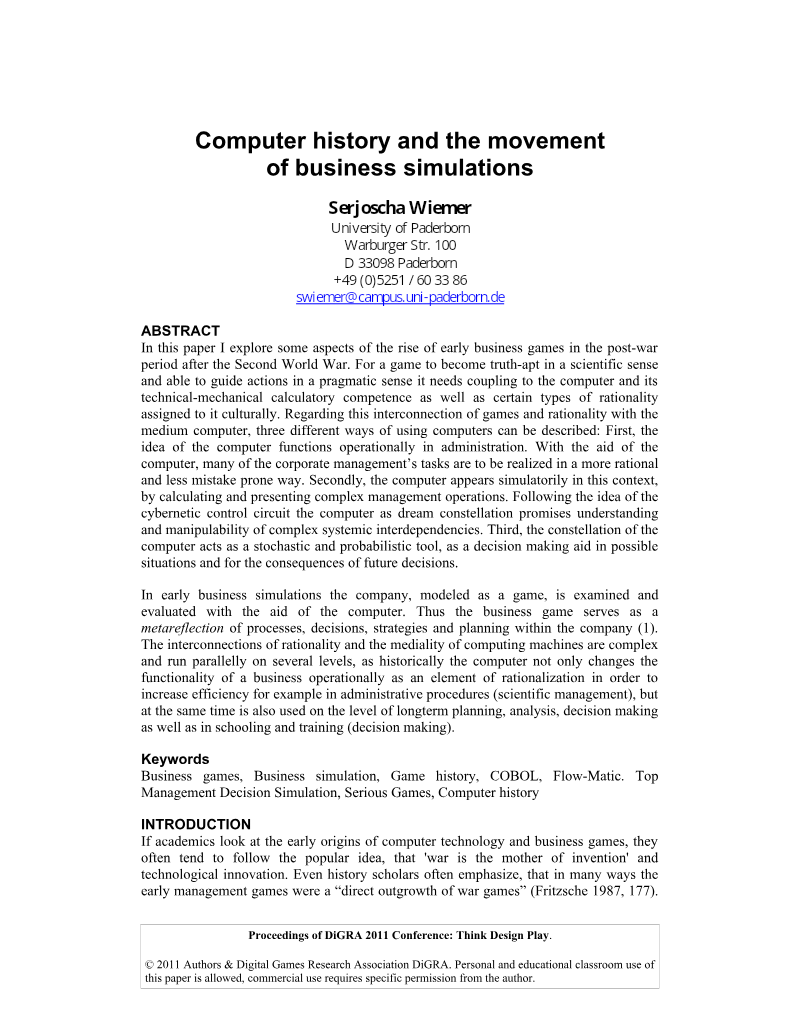
This paper examines the emergence of early business simulation games in the post-war period and argues that these games became credible and persuasive only through their coupling with the computer, which carried cultural associations of objectivity and rationality. The author identifies three ways computers were used in this context: operationally, to rationalize administrative work; simulatorily, to calculate and display complex managerial interdependencies in line with cybernetic control ideas; and stochastically, as an aid to decision-making under uncertainty. The central claim is that business games grew out of the civilian and commercial application of computing rather than being a straightforward extension of military war games, challenging a widely repeated historiographical assumption.
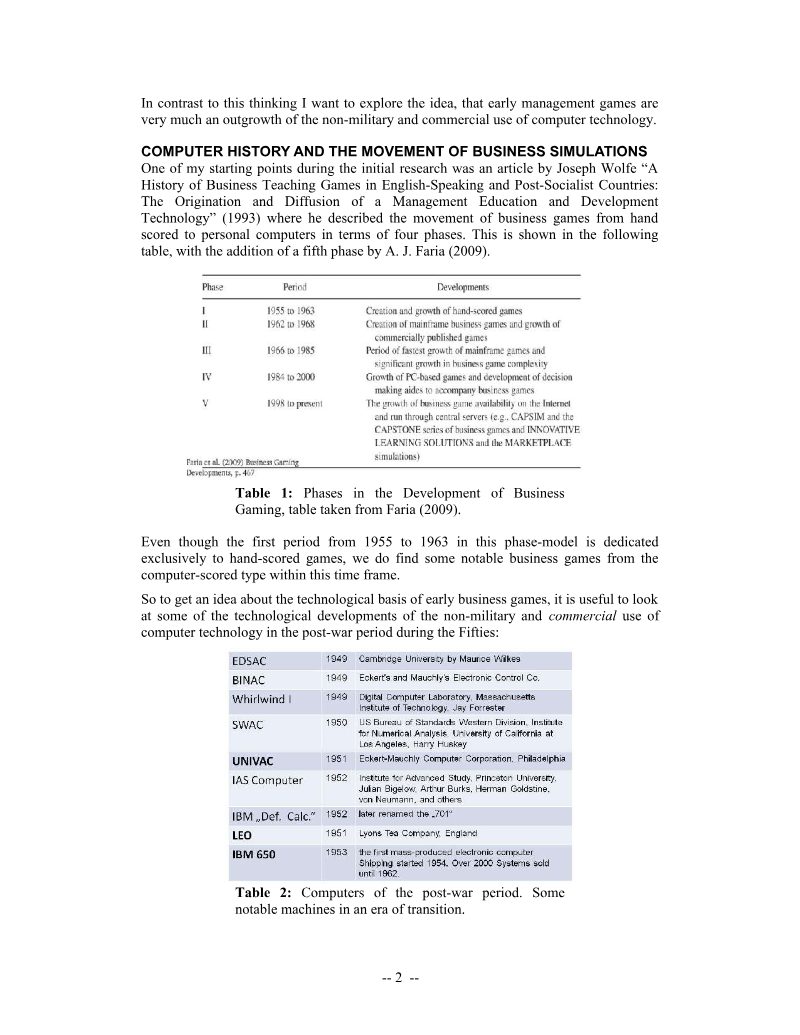
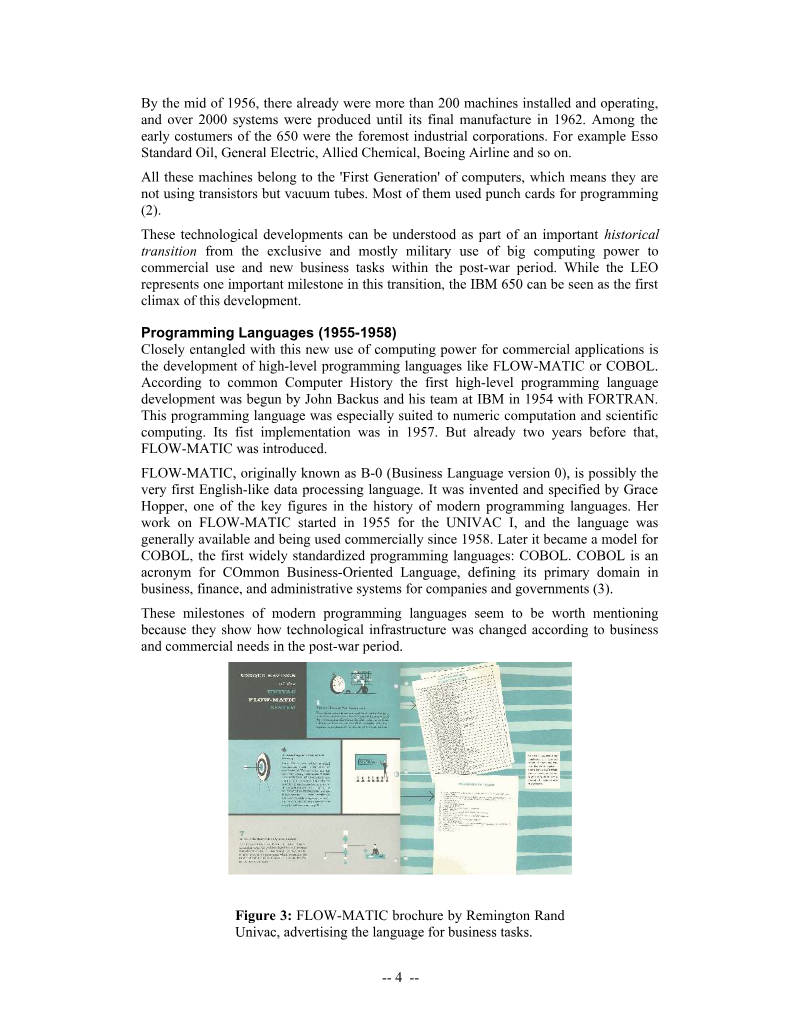
The historical groundwork traces key post-war machines, including EDSAC, UNIVAC, LEO, and the IBM 650, which was mass-produced from 1954 and sold in over 2,000 units by 1962. It also covers the development of business-oriented programming languages, notably FLOW-MATIC, invented by Grace Hopper, and COBOL, which was shaped by the efforts of the Codasyl committee formed in 1959. These developments are presented as evidence that computing infrastructure was reshaped around commercial needs during the 1950s. The paper also adopts a phase model of business gaming from Wolfe (1993) and Faria et al. (2009), spanning hand-scored games through internet-delivered simulations.
The core case study concerns the American Management Association's Top Management Decision Simulation, first run around 1956 on an IBM 650 and restricted to executives attending AMA programs. The author notes that contemporary researchers Cohen and Rhenman estimated the underlying calculations could have been done on desk calculators in roughly 45 minutes, prompting the question of why a costly machine was used at all. The answer offered is that the computer contributed drama, an impression of objectivity, and a sense of realism, with its opacity to players being a precondition of its credibility. The paper concludes that the computer's role in early business games cannot be reduced to number crunching, and it suggests that reconstructing and replaying early games could clarify the balance between role-play, discussion, and computer-based simulation.



DiGRA · 2016



DiGRA · 2016



DiGRA · 2016



DiGRA · 2016



DiGRA · 2016



DiGRA · 2016

DiGRA · 2015



DiGRA · 2015



DiGRA · 2015



DiGRA · 2015
DiGRA · 2015
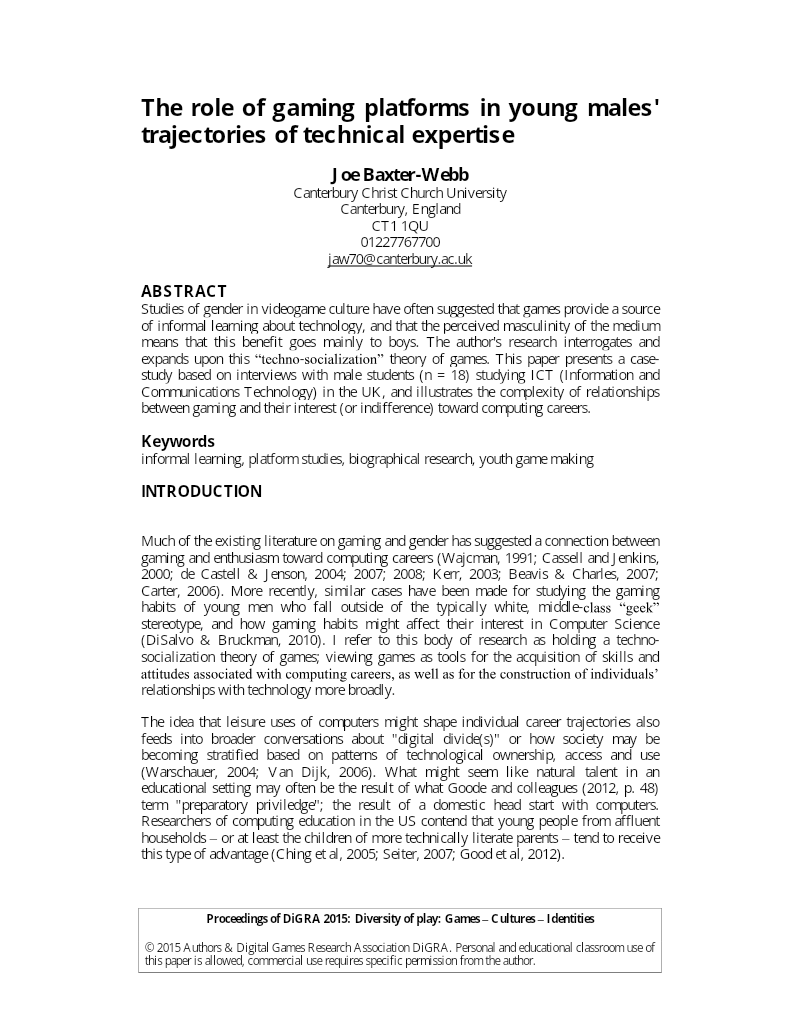
DiGRA · 2015
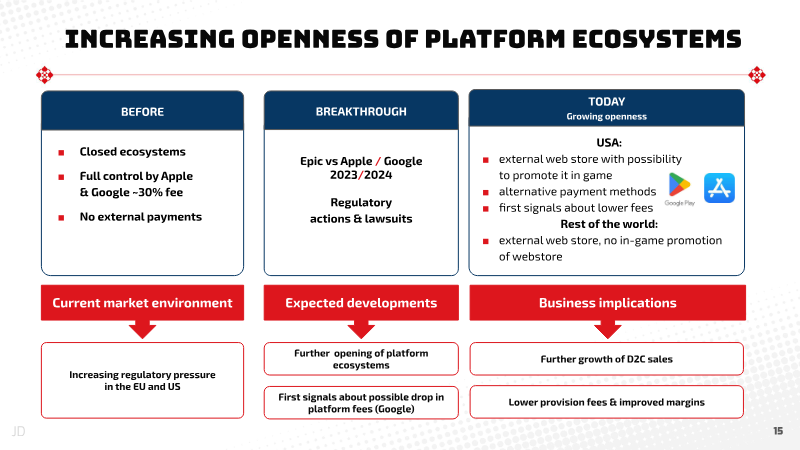
Ten Square Games · 2026













Comments