1 free read left. Create a free account for unlimited reading + AI research.
Create free account
Company culture at NaturalMotion
Key insights
6 takeaways- 01To maintain transparency and momentum, the studio implemented a rigorous cadence of progress updates, holding leadership accountable to staff every six weeks.
- 02NaturalMotion improved internal health survey scores by nearly 20 points over a two-year period by transitioning from fragmented team dynamics to a unified studio culture.
- 03The cultural transformation initiative began by identifying core studio strengths, such as high-fidelity graphics, and using direct employee feedback to shape the vision for change.
- 04The company successfully increased its Glassdoor rating from 4.0 to 5.0, resulting in recognition as a top workplace in the UK.
- 05Following the initial turnaround, the studio has entered a second phase of development focused on long-term goals, including a player charter and enhanced diversity and inclusion initiatives.
- 06Leadership utilized a structured six-step change management process that prioritized accountability by assigning specific owners to address identified obstacles in communication, collaboration, and environment.
Ask AI about this video
Transcript
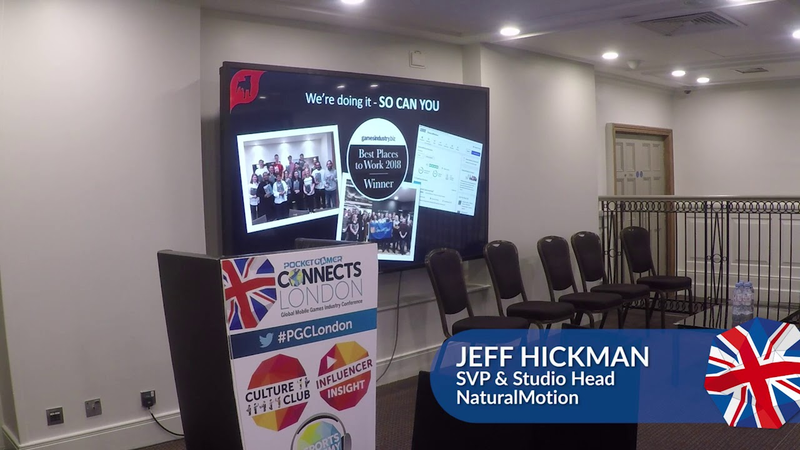
[Music] well if you guys have seen this Clara's giant but I'm gonna walk around a little bit hello and welcome to PG C in London my name is Jeff Hickman and I am here to talk to you about cultural change at natural motion games if you don't know who I am I've been in the industry working with high-performing teams for about 20 years I started out at mythic entertainment launching with the launch team of Dark Age of Camelot I was also responsible for Warhammer Online age of reckoning I was down in Austin Texas with Bioware for the launch and successful transition of free-to-play of Star Wars with Republic I got to the privilege of working on
games like The Simpsons tapped-out and NBA live mobile I've been around for a little while currently I'm with natural motion games and I get the privilege of working on some really special products CSR racing one of titans and if you guys have been paying any attention to the news in the last six months we signed with Disney and Lucas to build a couple of new Star Wars mobile games it's pretty awesome and like Sabrina said it's a pretty wonderful place to work just in the games industry overall so what are we talking about today let's talk about culture Sabrina set me up really well I want to define culture in my own way just to make sure that we're level set on what I'm talking about today here's how I look at culture the ideas customs social behavior of a particular people or society and I think the most important thing to understand about culture is it isn't innate it's learned again Sabrina set me up really
well you can shape culture you can change culture you can grow culture from nothing if that's what you want to do and there's a lot of things there's a lot of things that people are going to tell you about culture today they're gonna define it for you just like I just did they're gonna talk about how you grow it we're gonna talk about how you shape it there's all sorts of different cultures throughout the world I've worked with a lot of them you guys have all worked with a lot of them but today I don't want to talk about growing new culture what I want to talk about is what happens when you have a good culture and you want to make it great or you have a culture that's good but is going the wrong direction and some not so good I want to tell you the story over the last two years of my life almost two years about cultural change in the success of natural motion games so when I joined natural motion I joined
for probably one big reason I fell in love I fell in love with the games and I fell in love with the people truthfully CSR racing has the most sophisticated high performing team that I have ever worked with in my life and I've worked in a lot of places I spent six years Bioware that was a great team the CSR amazing the things that Julian widows and his team do in that game and in the team is unbelievable as a matter of fact Julian's gonna be speaking about his culture at GDC this year I encourage you all to go it's an amazing talk so when I was introduced to the CSR team I was amazed it is such a great team yet at the same time there was I had some questions some confusion as I looked at some of the other ways of measuring how the teams were doing within natural motion outside of CSR
racing I started to see some concerns some things that were concerning so if you look at Glassdoor for example two years ago natural motions Glassdoor rating was not very good and it was going down even though we had these high-performing teams if you looked at our team engagement surveys and what the people within the business were saying about the direction we were heading even though we were so successful some negative things were coming up if you looked at our retention of employees who was being hard if you look at our if you looked at our ability to hire new people who was problematic it's like what's going on if things are going so well then why are people saying they're not going so well and so we sat down as a leadership team and we decided to make a change and what I want to walk you through is the six steps that we took to change from good
to great to stop some of the confusing decline and change to the greatness that I believe we are coming towards today this stuff isn't it's not hard sorry it's not complex it is hard it's really hard but if with a couple of ground rules I think anybody can do the things that we've done so first of all just recognize this can be really hard to do second of all don't make it any harder on yourself then you absolutely have to it's going to be hard enough to make the changes that you need to make so let me use the examples as best as I can if what we've gone through in the last year and a half to two years in natural motion the first thing that we did at natural motion when we decided I think something's wrong we need to improve somehow we sat down and we talked about
our vision for the future simon Sinek said that greatness starts with your vision for what you want to be and that's what we did we went out to our studio to literally every single person in our studio we talked to them one-on-one through surveys we took him out to lunch we had beer at the pub we did anything that we could do to gather information from our teams and then we sat down in a room as a senior leadership team and we talked about what we wanted our vision to be and I'm not talking about a wordsmith for word vision business vision you'll find if you already haven't that video game teams kind of look at that a little cynically we just wrote plain English authentic words on the board eight sentences we talked about how we wanted to behave in the business how we people to see us as leaders authentic communicative transparent we talked about what we wanted people to think
about our games we talked about all these things we said look it's those eight sentences that we want to be two years from now four years from now six years from now and then we identified what was currently working it's pretty straight forward what are the things that we're already doing that match the vision for who we want to be keep those things I'll give you an example natural motion has always been known for Wow spectacular triple a console on mobile type graphics it's a strength of ours when people pick up our games they go I expect that and it will always be a strength of ours a foundation for us to build on and so that was one of those things that we literally wrote on a sticky note and put up next to that sentence on the board and then we did that for as many other things as we could think of and we said okay foundationally those are the good things we want to keep but what about the obstacles what about the not-so-good things what are the things that are
driving the sentiment in glass door or in our internal ratings or you know causing people to leave the studio what are those obstacles and so we sat it was probably four hours with about ten of us and we just all wrote our thoughts on sticky notes and we stuck them on a wall and there had to be 250 it was mind-boggling and terrifying all at once it's like wow how do you drink an ocean run soup at a time very carefully and that's what you need to think about as you pull your obstacles up onto the board and whatever way you're going to do it how do you put them together in a way that you can actually overcome so we sat down and we took those obstacles we took our vision we took the things that were working for us and we put them together in a plan we literally group three truth white board categories for all of these obstacles it was things like communication collaboration environment
benefits players how do we treat our players how do we partner with our players what are the things that we do to appreciate them and make them truly make them partners we group them all together and then we sat and we went okay now how do we actually attack each one of the obstacles that's sitting on the board how do we put a plan together that we can use to overcome each one of these and some of them are quite small like easily approachable others were gigantic and to this day we're still working on them and taking sips out of the ocean on some of them what we did is we assigned a responsible owner to each one of the categories it's critically important I know that there's this desire to be inclusive assigning a responsible owner does not mean that you don't communicate it doesn't mean you don't you're not inclusive it doesn't mean you don't get ideas from other people all it means is there's a person you can go to and say hey you're responsible for this you need to figure
out how to move the things forward the plan forward in some cases you need to put the plan together and so we basically sat in the room literally and said okay who wants to take environment and when the senior leader said I'll take it and I said okay who wants to take benefits I'll take it we signed each one of those to one of those people they then went out and they figured out how we were going to move those things forward in some cases they put together small councils in some cases they engage the entire studio in some cases they just figured out the way the way forward in every case we took small sips and then we checked in regularly this is key hold yourselves accountable and let others hold you accountable for the work that you're trying to do so in natural motion we called these things studio initiatives and every three to four
weeks we would get together as a senior leadership team and every person who was an owner would stand up and go okay let's talk about environment today for the last three weeks here's what I've been working on and here's what I'm gonna work on in the next three weeks and sometimes there wasn't a lot of movement so this is one of the things that makes it hard you all have another job to do it's making games and running your business isn't marketing and QA and everything that we do you still have to do this if you want to be great and then we would check in with the studio literally stand up in front of the studio every six weeks and go okay it's a studio initiatives update guys and the sugar go okay and they'd settle in and then each one of us would get up and go okay here's the things that we said we were gonna work on over the last six weeks here's what we did work on great not so great no matter what we hold ourselves accountable and then we talked about what we were gonna work on for the next six weeks okay here's the thing we're gonna do next here's what we want to include you guys and here's how we're
gonna put another counselor together or here's how we're gonna use tiny plants to get information about whether you think we're moving it forward and we rinsed and repeated and refined what we were doing constantly does it work is the action that we're taking actually moving us forward really look at in the eye don't be afraid of it it's the only way that you're going to get the change that you want in the cultures that you have I am really proud of my team at natural motion they've done a thing that was really hard to do last December we basically declared victory on let's call it phase one of our studio initiatives program phase one if you look at the results that we have you can measure them in a lot of different ways if you look at Glassdoor for example or London reviews and what they are today by the way but I'm assuming they're still around 4.0 for London I think they're
like 5.0 for Brighton if you look at the award that we won last year for the greatest places to work in the UK from game industry up days we never would have won that two years ago if you look at how we're engaged with our community if you look at our team health surveys and the fact that they've raised almost 20 points positively if you look at our ability to hire and keep our people everything points to success or at least the beginnings of success in changing our culture but it's not done so now we've moved into phase 2 and phase 2 we did exactly the same thing it doesn't have to be any more complex than the six things I laid out we sat down as a leadership team we decided hey how far we move towards our vision are we there yet no okay what are the obstacles that are in our way what are the good things that we're doing that's our plan moving forward let's categorize them and so for us this year it's things like continued
our efforts and player we've got this beautiful player Charter now how we partner with our players how we value them what our commitments are to our players now how do we continue to instill that in our game teams how do we really own it it's things like collaboration within our game teams and across natural motion in Zynga and probably most importantly for us is diversity and inclusion if you look at DNI it's a thing that I think the industry should I think we all know this is your struggles with a little bit and it's so important bringing in diverse thoughts to your teams representing diverse thinking for the for the team but also for the players so that your games can be the best that they can be is critically important that as a matter of fact Fung Phillips our chief legal officer from zingin natural motion is here today she is leading the DNI efforts within Zynga and beyond actually
so if you guys have any questions phone raise your hand again Fung is here to talk about this not just in this room but with anybody who wants to talk to please seek her out it's an important part of our future and it can be important part of yours also if we can do it you can do it let's wrap up so my ideas for culture ideas customs and social behavior particular people our society it's pretty stale like okay it's how you guys behave with each other it's the expectations of how you each behave it's in your power to define it's hard it's hard to do you can't to Sabrina's plane earlier you can't just say it you have to do it you have to show it as leaders you have to show it in the team you have to lay out what you want to be be clear about what you want your destination to be talk openly about what that is and your people will follow you they will six steps that we used this is
just change management I used plain language there's lots of ways that you can talk about this there's four steps or six steps this is how we did it it works really well for us I hope it can work well for you all so that's all I have questions so you talked about how culture is something we have to teach each other so what do you do when you get new employees right now you have this great culture everyone understand it's it's almost that's something we have to talk about anymore so how do you on board new people into it yeah that's a great question here's the things that we do it's really hard by the way it's all of this stuff is really hard what we do number one I think your team's teach each other if there's a good culture and a person
comes into that culture they learn from the people around them we've also as Mark just begun as part of her face to we've begun a new onboarding process where I literally get in front of new employees every quarter and I give them the overview I talk about this stuff who we want to be I talk about our strategies our objectives our tactics our mission I walked them through who we are as a natural motion and zynga and then we talk about the values that we have and we try to express it as openly as we possibly can and then those people are a part of our we have them every two weeks our studio updates where we're talking about studio initiatives we clearly point out that's the vision of who we want to be and you know what our future looks like and we try to just bring them slowly into these this is our culture and this is our behaviors that make sense it's probably not perfect and we'll continue to improve on it but I
think it's it's those things another questions in the case of a strategic shift well for example we go from coral games to casual so do you have any advice on how to retain people and keep them motivated yeah I think we are I'm assuming we've all been through that I've been through it 50 times I think the key period is authenticity and transparency as a leadership team the place where I see people get in trouble is when they try to cover the difficulty of change like that in nice words and nice talk with their teams it comes across as fuss and even before that it's super important to build an authentic voice with your team's they need to be able to trust you and then you lean on that trust as you go in to change like that and you walk them through it and always recognize that everybody's going through a change curve
you as the leadership team they're probably way down the change curve by the time the team knows about stuff like that and so recognize they're gonna have to go through the change curve a so and you are there to Shepherd them as an authentic transparent leader don't keep things close to best tell them things they can take it [Music] you
Summary
NaturalMotion’s approach to cultural transformation centers on the premise that organizational culture is a learned behavior that can be actively shaped, refined, and scaled. The primary objective of the company’s recent initiative was to transition from a state of high-performing but fragmented team dynamics to a cohesive, unified studio culture. Despite the commercial success of titles like CSR Racing, the studio faced internal challenges, including declining employee engagement scores, poor Glassdoor ratings, and difficulties in recruitment and retention.
The methodology employed to address these issues followed a structured six-step change management process. Leadership began by establishing a clear, authentic vision through direct engagement with the entire studio, utilizing surveys and informal discussions to identify existing strengths—such as the studio’s reputation for high-fidelity graphics—and critical obstacles. These obstacles were categorized into themes like communication, collaboration, and environment, with specific owners assigned to each to ensure accountability. The studio implemented a rigorous cadence of progress updates, holding leadership accountable to the staff every six weeks and refining initiatives based on consistent feedback loops.
The results of this two-year effort include a significant improvement in internal health surveys, which rose by nearly 20 points, and a marked increase in external employer branding, evidenced by a 4.0 to 5.0 rating on Glassdoor and recognition as a top workplace in the UK. Following the success of this initial phase, the studio has transitioned into a second phase focused on long-term goals, including the implementation of a player charter, enhanced cross-team collaboration, and a dedicated focus on diversity and inclusion. The strategy emphasizes that while cultural change is inherently difficult, it is achievable through transparency, authentic leadership, and the consistent application of measurable, iterative processes.














Comments