1 free read left. Create a free account for unlimited reading + AI research.
Create free accountArticle Swiss Game Developers Association
1 free read left. Create a free account for unlimited reading + AI research.
Create free accountArticleSwiss Game Developers Association
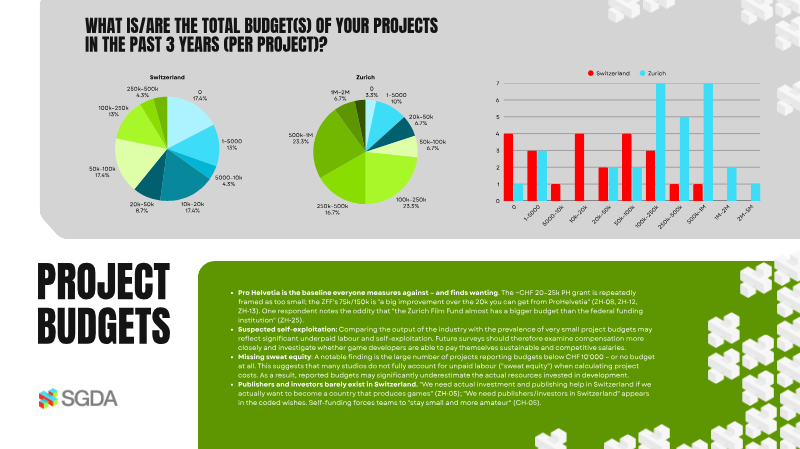
Roughly two-thirds of a typical Swiss game studio's budget comes from private capital and contract work. The president of the Swiss Game Developers Association attributes the small investor share to the absence of a distinct domestic entertainment industry and few investor success stories.
This document is an interview-based piece published by the Swiss Game Developers Association (SGDA) in July 2016, in which the association's president, Matthias Sala, makes the case that the Swiss game industry is well suited to the national economy but requires support from private investors and the government to grow. Sala argues that games can be produced locally at modest cost and sold worldwide digitally, making them scalable products. The central thesis is that Switzerland currently lacks the incentives and business conditions needed to compete in a fast-growing global market.
The piece presents several key points. Roughly two-thirds of a typical Swiss game studio's budget comes from private capital and contract work, with investor funding playing only a small role, which Sala attributes to the absence of a distinct domestic entertainment industry and few investor success stories. He identifies marketing as the main funding need, noting that more than 1,000 new games are released worldwide each day. As a comparison, the interview cites the Canadian province of Québec, which has used tax breaks and job-creation incentives to build a major game development hub that reportedly created about 10,000 jobs within a few years. Sala proposes that investments in Swiss game companies be taxed more favorably than offshore hedge fund investments as a possible incentive.
The analysis is anecdotal rather than quantitative: it draws on the association president's own views and comparisons rather than a formal survey, dataset, or sample. Its job projection is illustrative, suggesting that ten new games with 10 to 50 staff each could generate up to 500 jobs, and it acknowledges that a Québec-scale outcome is unlikely in Switzerland, where growth would depend mainly on startups. The piece also addresses the industry's public image, noting a shift from skepticism toward recognition of games as technology, art, and serious applications in medicine, science, and education.
PocketGamer.biz · 2026